How Much Deposit Should a Contractor Ask For? State Limits
How much deposit should a contractor ask for? Small jobs, materials-heavy jobs and big projects, with the state caps and quote wording to copy.
The MakeHay team · · 11 min read
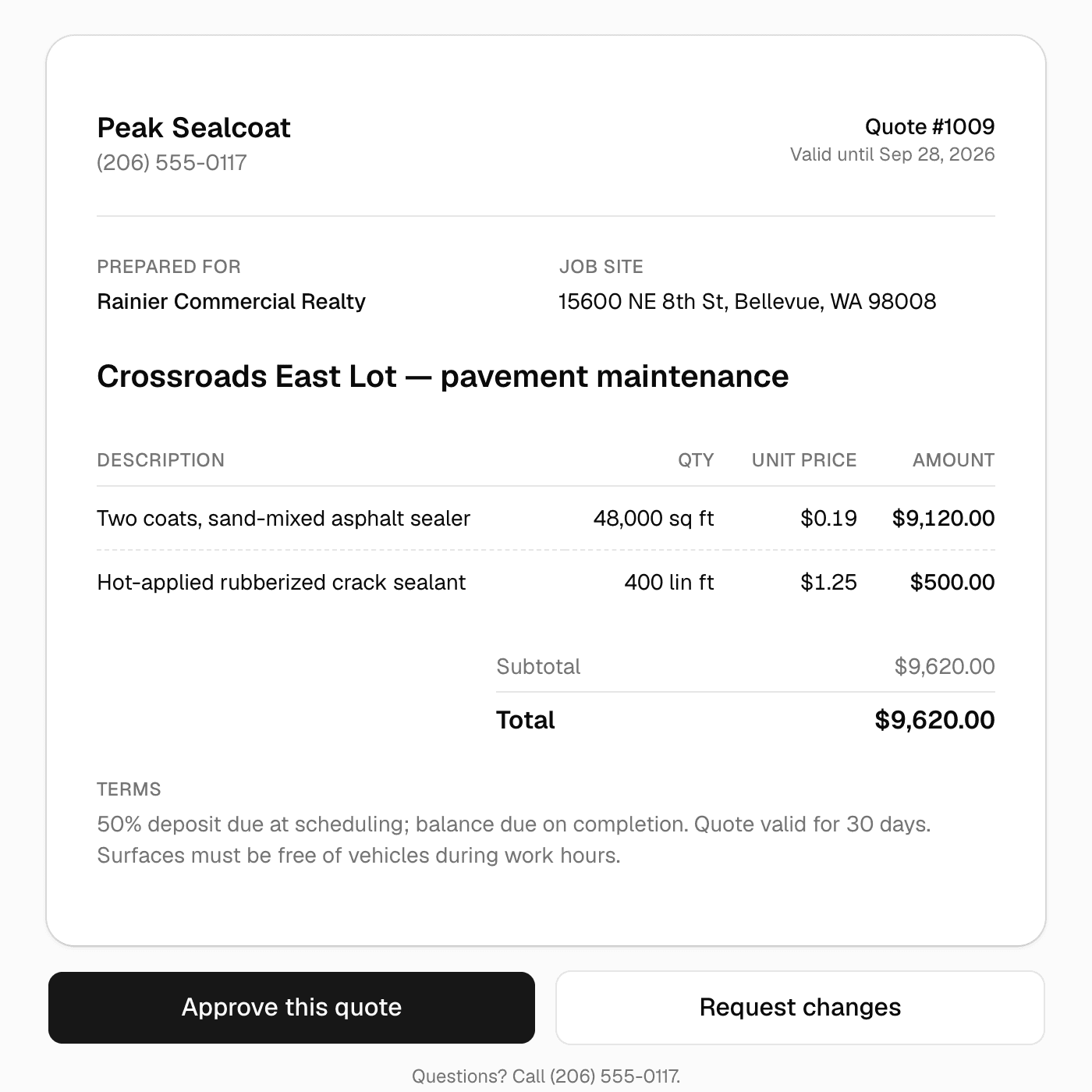
How much deposit should a contractor ask for? Nothing or a small flat amount for a one-visit service, the cost of the order when you buy materials first, and a modest deposit plus progress payments for a project that runs for weeks. Some states cap it by statute on residential work: California limits a home improvement down payment to the lesser of 10 percent or $1,000, and Maryland, Pennsylvania, Massachusetts and Maine limit it to one-third of the contract price on the contracts their laws cover.
What a deposit is for (and what it is not)
A deposit is the part of the price paid before work starts, and it covers what you commit before day one: a reserved date, special-order materials, a permit. It is not profit taken early. Maryland and Pennsylvania bar any payment before the home improvement contract is signed, and California's licensing board puts it this way: a contractor may require a down payment, but collecting for work not yet completed or materials not yet delivered is against the law.
How much deposit should a contractor ask for? By job type
Ask for the least that covers what you spend before day one. A North American Deck and Railing Association blog post on deposits (one builder's practice, not a survey) describes 10 percent at signing plus a 15 percent start-up payment on smaller and mid-size jobs, 5 percent or a flat figure at signing on larger projects, progress payments as the work runs, and warns that 50 percent will create reluctance with many customers.
One-visit services
For work done in one visit and billed the same day, skip the deposit or keep it to a small flat amount applied to the invoice. A pressure wash, a restripe or a per-push plow visit (see how long it takes to plow a parking lot) has little bought ahead, so a deposit mostly adds a second payment to chase.
Materials-heavy jobs
When you buy before you build, the deposit should cover materials ordered for this job that cannot go back on the shelf. Two capped states write that into the statute: Pennsylvania allows one-third plus the cost of special order materials named in the contract, and Massachusetts the greater of one-third or the cost of special-order or custom-made materials. Elsewhere, write it as a dollar amount so the customer sees what it buys.
Projects over several weeks
Keep the deposit modest and move the money to progress payments tied to finished stages. The deck builders' post describes a small deposit, weekly draws, and 10 percent or less as the final balance. California makes that law for home improvement contracts: progress payments may not exceed the value of work performed and materials delivered. A seasonal snow contract is billed by the month instead; see how to price a seasonal snow plowing contract.
Contractor deposit laws by state: five caps, with the statute
All five states checked cap the deposit on the contracts their statutes cover; the table links the current text.
| State | Cap on the deposit | Contracts it covers | Statute |
|---|---|---|---|
| California | Lesser of 10% of the contract price or $1,000 | Home improvement contracts | BPC 7159.5(a)(3) |
| Maryland | One-third of the contract price | Home improvement contracts | Bus. Reg. § 8‑617(b) |
| Pennsylvania | One-third, or one-third plus the cost of special order materials named in the contract | Home improvement contracts over $5,000 | HICPA § 517.9(a)(10) |
| Massachusetts | Greater of one-third or the actual cost of special order or custom made materials and equipment | Residential contracting agreements over $1,000 | M.G.L. c. 142A § 2(a)(6) |
| Maine | Initial down payment of at most one-third | Home construction contracts over $3,000 | 10 M.R.S. § 1487(5) |
A state missing from this table is one this post did not check, not one with no cap. Every section covers residential work, so a commercial lot or a municipal contract may fall outside it, and the thresholds differ ($1,000 in Massachusetts, $3,000 in Maine, $5,000 in Pennsylvania, where home improvement itself starts above $500).
The California contractor deposit limit also fixes the contract wording
California also dictates the sentence. The Contractors State License Board's November 2022 bulletin lists what a home improvement contract must carry under BPC 7159(d): the heading Down Payment, a space for the amount, and this statement in at least 12-point boldface: THE DOWN PAYMENT MAY NOT EXCEED $1,000 OR 10 PERCENT OF THE CONTRACT PRICE, WHICHEVER IS LESS. A violation of the down payment or progress payment limits in section 7159.5 is a misdemeanor.
Maryland home improvement deposit: still one-third after HB 1499
The cap is still one-third. Maryland's House Bill 1499 (2026 session) would have raised it to one-half from October 1, 2026, but the General Assembly's bill page shows a House hearing canceled on March 11, 2026 as its last action and no passage.
Good to know: This is general information, not legal advice. Statutes and rules change; read the current text and ask your state licensing board or a lawyer before you rely on it.
No row for your state: a reasonable contractor deposit percentage
Reasonable means the deposit matches what you spend before the first day on site, and the customer can see why.
- Size it to the commitment: a flat booking amount or nothing for same-day work, the materials cost for special-order product, a modest percent for multi-week projects.
- Stay under the capped states' numbers anyway: one-third is the ceiling in four of the five.
- Put it in writing with a due date and what it covers.
Deposit vs progress payment vs paid on completion: pick one per job
Pick one structure per job and say it on the quote.
- Paid on completion: one invoice when the work is done. The default for a single visit.
- Deposit plus balance: the deposit at approval, the rest on the final invoice, for a job finished in days.
- Deposit plus progress payments: a small deposit, then invoices for stages already performed and materials already delivered, the structure California requires for home improvement payment schedules.
In MakeHay, a job can be billed in stages: a deposit on the quote, progress invoices started from scratch for the stages between, and the final invoice started from the approved quote. Progress invoices are not deducted automatically, so lower the final invoice's lines by what they covered.
Worked example: A $3,200 job: the deposit in California, in the one-third states and where no cap was found
- Deposit = contract price × deposit rate. California at the cap: 0.10 × $3,200 = $320, below the $1,000 ceiling, so $320 is the most allowed.
- Balance due on completion in California: $3,200 minus $320 = $2,880.
- At the one-third cap in Maryland, Pennsylvania, Massachusetts and Maine: $3,200 ÷ 3 = $1,066.67, so $1,066 stays under the ceiling on a covered contract.
- Where no cap was found, with 25 percent chosen (the deck builders' post's figure for a smaller job that starts soon after signing): 0.25 × $3,200 = $800.
- Balance due on completion there: $3,200 minus $800 = $2,400.
Result: $320 down and $2,880 on completion in California; at most $1,066 down in the four one-third states; $800 down and $2,400 on completion where no cap was found, on the same $3,200 job.
How to ask for a deposit on a quote: two samples to copy
Write the deposit as its own line under the total, with the amount, when it is due and what it buys, then the balance that follows. Both samples use the worked example's job.
- Percent, for a multi-day job: Deposit: 25 percent ($800), due when you approve this quote, applied to your final invoice. Balance of $2,400 due on completion.
- Dollar amount, for a materials job: Deposit: $800, due at approval, covers the fence panels and posts ordered for your job. Balance of $2,400 due when the work is finished.
In California, use the statutory statement from the CSLB bulletin and keep the down payment within it. In Maryland and Pennsylvania, nothing can be collected before the contract is signed, so the due date is at signing.
Collecting the deposit before the job hits the calendar
Collect the deposit at approval, online, and keep the job off the calendar until the money is in. Approval and the deposit then happen in one step, so the deposit is never a separate payment to chase.
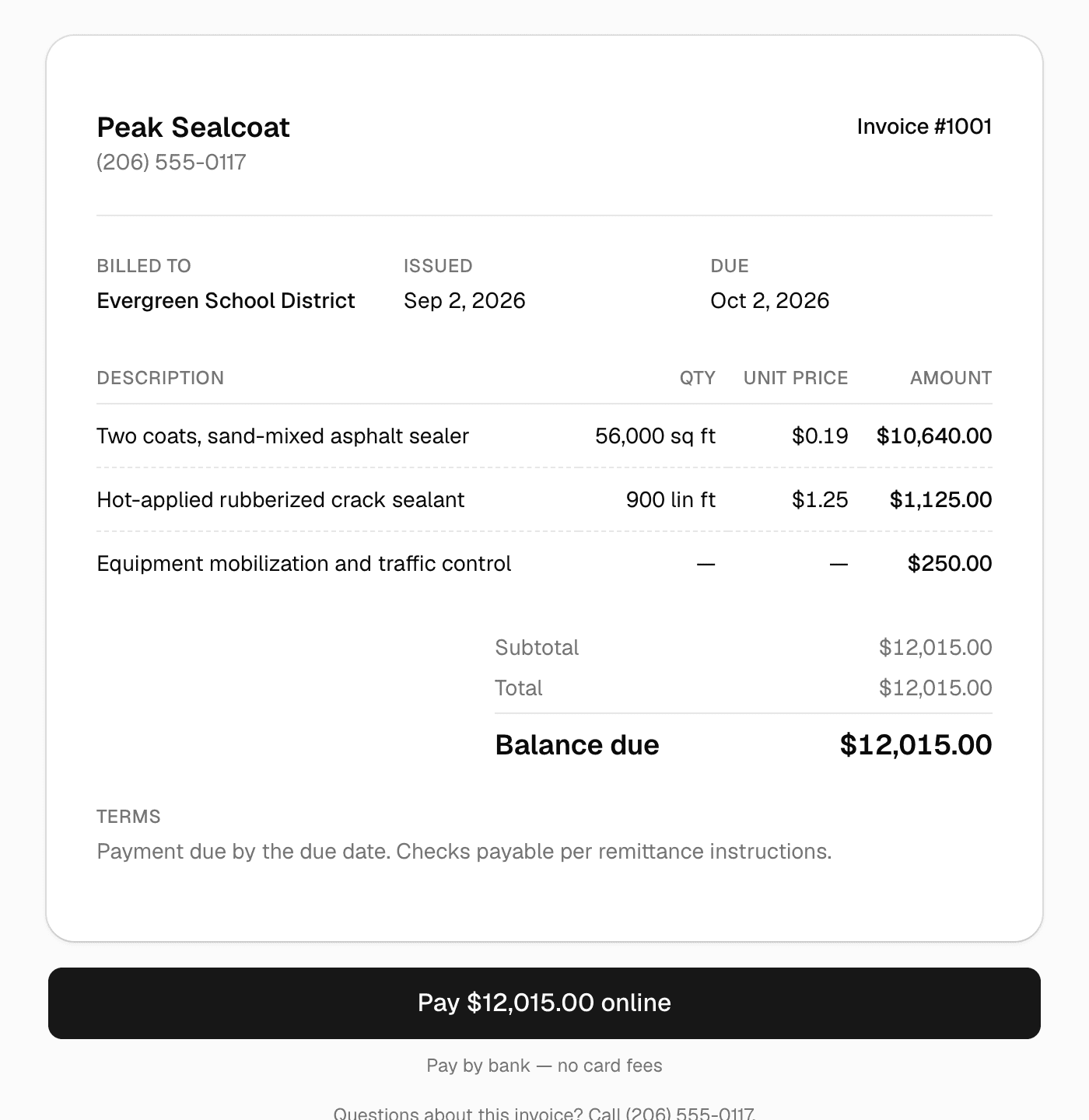
In MakeHay, a quote's Deposit is a percent of the total or a dollar amount. With Stripe connected (online payments are for US businesses), the button reads Approve & pay, and the quote is approved only once the deposit is paid by card. The deposit is saved as its own paid invoice and shows as Deposit received against the Balance due on the final invoice; Customer pays the fees in Settings › Payments covers deposits at approval. Approval records the customer's typed name, the date and IP address. A contract PDF can go out for e-signature from an emailed link, and the signed copy with its Certificate of Completion lands in the client portal.
Refunds, cancellations and the 3-day rule
Under the US Federal Trade Commission's Cooling-Off Rule, a sale at the customer's home for $25 or more (or $130 or more somewhere other than the customer's home) can be canceled until midnight of the third business day after the transaction. The seller must say so in the contract and hand over a cancellation form.
Two exclusions matter. A visit the buyer asked for to repair or maintain the buyer's personal property (an appliance or a mower, not a driveway, roof or lot) is outside the rule, though extra goods or services sold during that visit are not, and the rule's text gives no similar exclusion for work on the house or the land. A genuine immediate emergency is excluded only when the buyer made the contact and gives a separate, dated and signed statement in their own handwriting waiving the three-business-day right.
After a valid cancellation, the seller has 10 business days to refund all payments made under the contract, the deposit included. Outside the rule, your cancellation terms and state law decide, so say on the quote what the deposit covers and what part is refundable.
Good to know: This is general information, not legal advice. Statutes and rules change; read the current text and ask your state licensing board or a lawyer before you rely on it.
FAQ
Is it normal for a contractor to ask for 50 percent up front?
In the five states this post checked (California, Maryland, Pennsylvania, Massachusetts and Maine), 50 percent is over the cap on covered residential contracts: California allows the lesser of 10 percent or $1,000, the other four one-third. Outside those statutes, check your own state; the deck builders' post warns that 50 percent creates reluctance with many customers and describes 5 to 25 percent at signing instead.
What is the maximum deposit a contractor can ask for in California?
On a home improvement contract, $1,000 or 10 percent of the contract amount, whichever is less, under Business and Professions Code section 7159.5(a)(3). The contract must print that limit in boldface, progress payments may not exceed the value of work performed and materials delivered, and a violation of those payment limits is a misdemeanor.
Can a customer get a deposit back?
Sometimes by law, otherwise by your terms. A sale at the customer's home for $25 or more falls under the US FTC Cooling-Off Rule: the buyer can cancel until midnight of the third business day and every payment comes back within 10 business days. A visit the customer asked for to repair personal property is excluded; the rule gives no similar exclusion for work on the house or the land. Beyond that, your cancellation terms and state law decide.
Should a deposit be a percent or a dollar amount?
Percent for multi-week work, a dollar amount for small and materials jobs. A percent scales with the job and matches how four capped states write the limit. A dollar amount names what it buys, which is clearer on small jobs and materials jobs. California's cap uses both (the lesser of 10 percent or $1,000), so a California quote needs the arithmetic either way.
Sources
- California Business and Professions Code section 7159.5 (2025) · Subdivision (a)(3): if a downpayment will be charged, the downpayment shall not exceed one thousand dollars ($1,000) or 10 percent of the contract amount, whichever amount is less; the section applies to all home improvement contracts as defined in Section 7151.2. (accessed October 12, 2026)
- CSLB Reminds Contractors of Progress Payment Restrictions (industry bulletin, November 22, 2022) · The required contract statement in at least 12-point boldface: THE DOWN PAYMENT MAY NOT EXCEED $1,000 OR 10 PERCENT OF THE CONTRACT PRICE, WHICHEVER IS LESS; subsequent payments must not exceed the value of materials and work performed; a schedule of progress payments must describe each phase; a violation of section 7159.5 and its down payment and progress payment restrictions is punishable as a misdemeanor. (accessed October 12, 2026)
- Maryland Business Regulation § 8‑617 (statute text) · (a) A person may not demand or receive any payment for a home improvement before the home improvement contract is signed. (b) A person may not receive a deposit of more than one-third of the home improvement contract price before or at the time of execution of the home improvement contract. (accessed October 12, 2026)
- House Bill 1499, Business Regulation, Home Improvement Contracts, Deposits (2026 Regular Session) · Synopsis: increasing from one-third to one-half the maximum portion of a home improvement contract price that a person may receive as a deposit before or at the time of execution; proposed effective date October 1, 2026; status history ends with a House hearing canceled on March 11, 2026, with no passage shown. (accessed October 12, 2026)
- Home Improvement Consumer Protection Act, 73 P.S. § 517.1 et seq. (Pennsylvania Office of Attorney General) · Section 517.9(a)(10): for a home improvement contract in which the total price is more than $5,000, a person may not receive a deposit in excess of one-third of the home improvement contract price, or one-third plus the cost of special order materials that will be ordered, as designated in the written contract; section 517.9(a)(9) bars any payment before the contract is signed; the home improvement definition in section 517.2 covers work with a total cash price of more than $500. (accessed October 12, 2026)
- M.G.L. c. 142A, Section 2: Residential contracting agreements; requirements · Applies to every agreement to perform residential contracting services in an amount in excess of one thousand dollars; paragraph (a)(6) limits an advance deposit to the greater of one-third of the total contract price or the actual cost of any materials or equipment of a special order or custom made nature that must be ordered before work begins. (accessed October 12, 2026)
- 10 M.R.S. § 1487, Home construction contracts · Any home construction contract for more than $3,000 in materials or labor must be in writing; subsection 5: the method of payment, with the initial down payment being limited to no more than 1/3 of the total contract price. (accessed October 12, 2026)
- Cooling-off Period for Sales Made at Home or Other Locations (Federal Trade Commission) · The rule covers door-to-door sales valued at more than $25 and gives buyers the right to cancel the sales contract within three business days of the transaction. (accessed October 12, 2026)
- 16 CFR Part 429, Rule Concerning Cooling-Off Period for Sales Made at Homes or at Certain Other Locations (2024 edition, GovInfo) · Section 429.0(a): a purchase price of $25 or more if the sale is made at the buyer's residence or $130 or more at other locations; exclusions for a buyer-requested visit to repair or perform maintenance upon the buyer's personal property and for a bona fide immediate personal emergency with a separate dated and signed waiver in the buyer's handwriting; section 429.1(a): the buyer may cancel at any time prior to midnight of the third business day after the date of the transaction; section 429.1(g): within 10 business days after receipt of a notice of cancellation, refund all payments made under the contract or sale. (accessed October 12, 2026)
- How Much of a Deposit Should You Ask For? Cash Flow: Deposits & Progress Payments (NADRA blog, Bobby Parks, December 1, 2020) · One builder's practice, not a survey: on smaller to midsize jobs, 10% was collected as a contract deposit at contract signing and a second deposit of 15% as a start-up payment; with larger projects, 5% or a flat figure; 25% when a smaller job starts close to the contract date; at the end of the job, 10% or less as a balance; asking for large deposits such as 50% will create reluctance with many customers. (accessed October 12, 2026)