How Long Does It Take to Plow a Parking Lot? Per Acre Math
How long does it take to plow a parking lot? Blade width, speed by snow depth, turns and stacking turned into truck hours per acre and a per push price.
The MakeHay team · · 11 min read
How long does it take to plow a parking lot? With a pickup and a 98-inch blade, about 36 minutes for an open 1-acre lot in 2 inches of snow and about an hour in 6 inches, turns and stacking included; a 3-acre lot runs 70 minutes and 2 hours. No published rate says so; the number comes from blade width, speed by depth and the lot's shape.
How long does it take to plow a parking lot? It depends on the lot
Nobody publishes a plowing rate per acre, because the same acre takes a different time in 2 inches than in 8, and on an open lot than on one cut up by islands. BOSS Snowplow's productivity guide says commercial contractors typically target 1 to 2 acres per hour per truck on mixed lots; a target is not a quote.
Public bids show the spread: on a 2013 Missouri DOT tabulation for a state office lot, two bidders priced plowing plus melting agent applications for the 0.5 to 5 inch band at $2,200 and $600 per occasion. The bidder who knows the truck hours behind the number can defend it.
Step 1: Get the lot's square footage
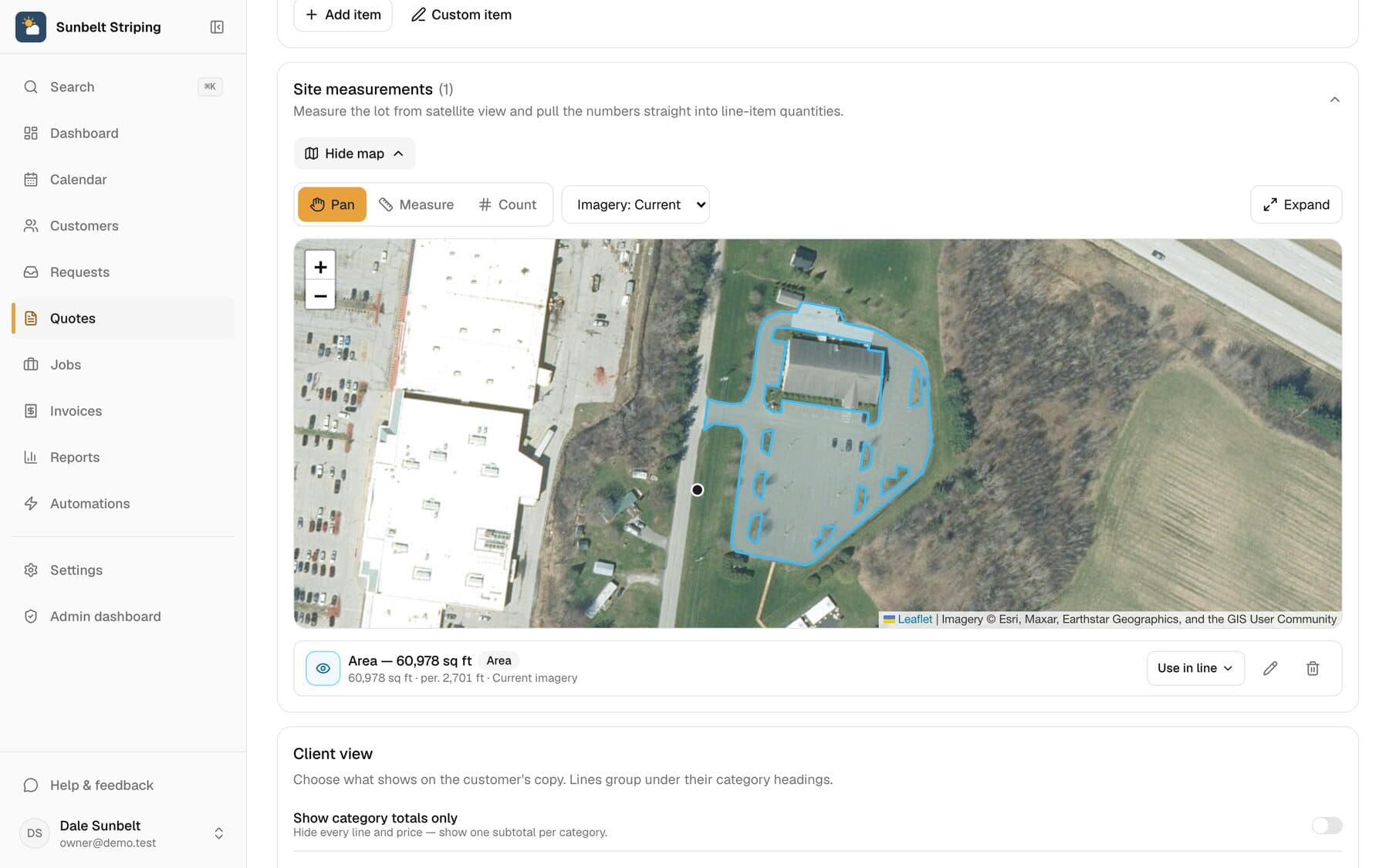
Divide the square feet of pavement you will actually push by 43,560 to get acres. Trace the paved area only, leave out islands and curbed beds, and note the long dimension: passes and turns depend on which way you plow.
The free satellite measurement tool returns a lot's square footage from a traced outline, no account needed, and Cut out removes islands; in MakeHay the saved measurement fills a Per square foot line through Use in line (measuring help).
Step 2: Effective blade width at an angle
A blade loses width as soon as it is angled. BOSS Snowplow's guide puts a 98-inch V-plow (its DXT series, measured with the wings straight) at around 85 inches of effective width at a 30-degree angle, 7 ft per pass after rounding down; a straight blade or an expandable plow has its own figure. Then take off your own overlap: 6 inches of overlap on every pass leaves 6.5 ft, and that is the width that goes into Step 4 (the worked example keeps the round 7 ft).
Step 3: Speed by snow depth and lot clutter
Speed moves the answer most, and it drops with depth. Open lots with long runs sit at the top of a BOSS Snowplow band; lots with islands, light poles and curbs sit at the bottom.
| Snow depth | Plowing speed |
|---|---|
| 1 to 2 inches | 10 to 14 mph |
| 2 to 4 inches | 8 to 12 mph |
| 4 to 6 inches | 5 to 10 mph |
| 6 to 10 inches | 3 to 7 mph |
| Over 10 inches | 1 to 5 mph |
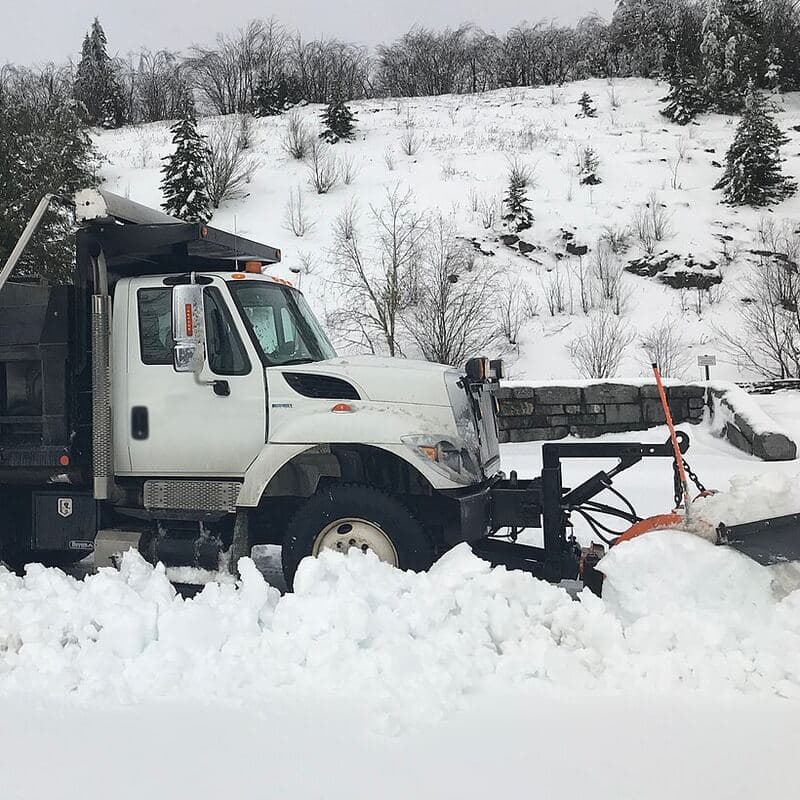
Plan for the depth the weather record gives. NOAA's 1991 to 2020 normals list, per station, the average days a year with 1 inch or more of snow and with 3 inches or more (codes GE010TI and GE030TI): 11.4 and 3.9 days at Chicago O'Hare, and 1.4 days with 5 inches or more (GE050TI), so most snow days there stay under 3 inches, and a 2-inch trigger puts most pushes under 5 inches, in the 2 to 4 inch band at 8 to 12 mph or the 4 to 6 inch band at 5 to 10 mph (see the seasonal contract post).
In MakeHay, every scheduled visit carries the National Weather Service forecast for the lot's own coordinates, and the snow plowing setup suggests a rule named "Plow night", or "Snow event" for snow removal: max rain 50 percent and max temp 34°F (US addresses only; see the weather help article).
Step 4: Plow time per acre with passes, turns, stacking and a buffer
Plowing time is acres divided by real acres per hour, plus the turns, the piles and a buffer the formula does not see.
Snow plow productivity acres per hour, from the field capacity formula
The field capacity formula is acres per hour equals width in feet times speed in mph times field efficiency, divided by 8.25, and Iowa State's Ag Decision Maker derives 8.25 from 43,560 sq ft per acre and 5,280 ft per mile. BOSS Snowplow says to start at 60 to 80 percent efficiency until your own records say otherwise; 7 ft at 10 mph gives about 8.5 acres per hour before efficiency and roughly 6 after it.
Then add what the formula leaves out. BOSS counts 15 to 30 seconds per turn, 5 to 15 minutes per lot for stacking piles at the perimeter, and a 20 to 25 percent buffer. Passes are the lot's short side divided by the effective width, rounded up; turns are one fewer.
Worked example: Truck minutes for a 1-acre and a 3-acre lot at 2 inches and at 6 inches
- At 2 inches: acres per hour = width × speed × efficiency ÷ 8.25 = 7 ft × 10 mph × 0.7 ÷ 8.25 = 5.94, so 60 ÷ 5.94 = 10.1 minutes per acre.
- At 6 inches, 5 mph: 7 × 5 × 0.7 ÷ 8.25 = 2.97, or 20.2 minutes per acre.
- 1-acre lot, 220 ft by 198 ft, plowed the long way: 198 ÷ 7 = 28.3, so 29 passes and 28 turns × 30 seconds = 14 minutes.
- 3-acre lot, 440 ft by 297 ft: 297 ÷ 7 = 42.4, so 43 passes and 42 turns × 30 seconds = 21 minutes.
- Stacking 5 minutes at 2 inches, 15 at 6; buffer 25 percent.
- 1 acre, 2 inches: (10.1 + 14 + 5) × 1.25 = 36.4 minutes.
- 1 acre, 6 inches: (20.2 + 14 + 15) × 1.25 = 61.5 minutes.
- 3 acres, 2 inches: (3 × 10.1 + 21 + 5) × 1.25 = 70.4 minutes.
- 3 acres, 6 inches: (3 × 20.2 + 21 + 15) × 1.25 = 120.8 minutes.
Result: For the 1-acre lot, 36 minutes at 2 inches and 62 at 6 (the same per acre); for the 3-acre lot, 70 minutes at 2 inches (23 per acre) and 121 at 6 (40 per acre).
On the 1-acre lot at 2 inches the 28 turns (14 minutes) take longer than the straight runs (10 minutes), so a small cut-up lot can cost more per acre than a 3-acre open one; and 6 inches takes about 70 percent longer than 2, so price per push in depth bands.
Step 5: From truck hours to a per push price
A per push price is truck hours times a loaded hourly rate plus margin, with salt on its own line. O*NET's wages page for landscaping and groundskeeping workers, from 2025 Bureau of Labor Statistics data, gives a US median of $18.82 per hour ($14.98 at the 10th percentile, $27.28 at the 90th). The US Energy Information Administration prices on-highway diesel weekly: $6.199 per gallon for the week of October 5, 2026. The salt post prices the salt line.
Worked example: Per push price for the 1-acre lot at 2 inches
- 36 minutes on the lot plus 15 minutes driving (your own log) = 51 minutes = 0.85 hours.
- Driver at the BLS median: 0.85 × $18.82 = $16.00.
- Fuel at 1.5 gallons per hour (your own log) and $6.199 per gallon: 0.85 × 1.5 × $6.199 = $7.90.
- Truck, blade and insurance at $30 per hour (your own number): 0.85 × $30 = $25.50.
- Cost: $16.00 + $7.90 + $25.50 = $49.40.
- Price at a 35 percent margin: $49.40 ÷ 0.65 = $76.00.
- Rate check: $76 ÷ 0.85 hours = $89.41 per truck hour.
Result: $76 per push, $76 per acre, for the 1-acre lot in 2 inches; the same arithmetic gives $114 at 6 inches, and $127 and $203 for the 3-acre lot.
| Lot and depth | Minutes | Truck hours | Cost | Per push | Per acre |
|---|---|---|---|---|---|
| 1 acre, 2 inches | 36 | 0.85 | $49.40 | $76 | $76 |
| 1 acre, 6 inches | 62 | 1.28 | $74.39 | $114 | $114 |
| 3 acres, 2 inches | 70 | 1.42 | $82.52 | $127 | $42 |
| 3 acres, 6 inches | 121 | 2.27 | $131.93 | $203 | $68 |
Loaders, pushers and haul-off: when hourly beats per push
Per push pricing assumes the snow fits on the lot. When the piles have nowhere to go, or the depth sits in the bottom band at 1 to 5 mph, a loader takes over and the price goes hourly. A pusher box on a skid steer or loader clears a wider swath than a truck blade and bills by the hour the same way. The same 2013 Missouri DOT tabulation shows the shape: a loader with operator at $150 and $100 per hour, a loader and dump truck at $240 and $200 per hour, and a dump fee of $80 and $50 per load. Those are one US state's bids from 2013: use the structure, not the prices.
Sanity check against market ranges and your own logs
Consumer cost guides for homeowners quote driveways, not lots: Bob Vila's snow removal cost guide, updated January 2024, puts a plow visit at $30 to $50 for a driveway, with no per-acre figure for a lot. The 2013 Missouri DOT bids ran $600 and $2,200 per occasion for plowing plus melting agents in the 0.5 to 5 inch band and $100 and $150 per hour for an extra plowing trip, so the example's $89 per truck hour sits below both bidders: its truck and margin figures are lean, not generous.
Your own logs beat any table: for every push this winter, write down the lot, the depth, the minutes from first pass to last pile and the drive time; after a dozen storms you have an efficiency factor and a stacking time per lot.
Putting it on the quote
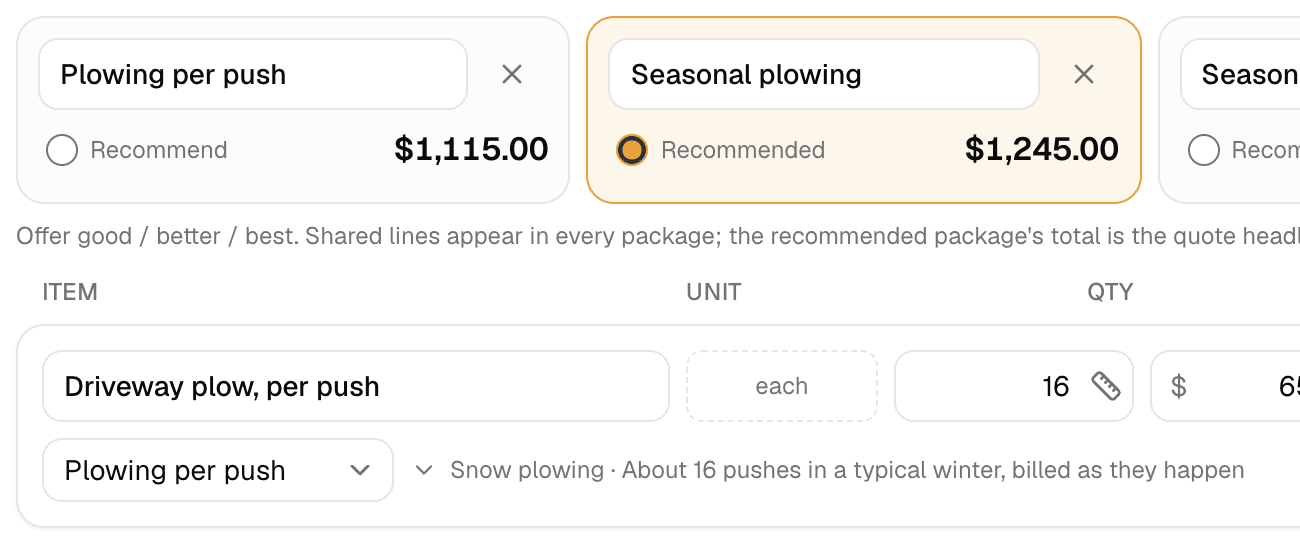
In MakeHay, the snow plowing starter list under Settings › Services carries "Commercial lot, per push" and "Driveway plow, per push" as Each items, "Sidewalk and walkway" as Per linear foot and "Pre-season stake and mark" as a Flat price. A request form with the "Job site address" question lets a property manager submit the lot, and a repeating job with Bill after each visit makes one invoice per push, each visit marked Done or Skip (repeating service help); the snow plowing software page shows the quote these lines make.
FAQ
How many acres can one truck plow per hour?
On paper a 7 ft blade at 10 mph clears about 8.5 acres an hour, about 6 at 70 percent efficiency, before any turns. With turns, stacking and obstacles in, BOSS Snowplow's guide puts the usual target at 1 to 2 acres per hour per truck on mixed lots, and the worked example lands at about 1 to 2.6.
How do you bid commercial snow removal per acre?
Measure the pavement, convert it to truck hours for each depth band, and price each band per push from a loaded hourly rate plus margin, with salt and sidewalks as their own lines; the 2013 Missouri DOT bids used 0.5 to 5 inches, 5 to 8, and 9 and up. For a seasonal fee, multiply by the NOAA snow day normals and cap it (seasonal contract post).
How much do you charge per acre for snow plowing?
There is no going per-acre rate, because the price per acre depends on the lot's size and shape and on the depth. The worked example gives $76 per acre for a 1-acre lot and $42 for a 3-acre lot in 2 inches of snow, then $114 and $68 in 6 inches. Quote the lot per push, in depth bands.
What about sidewalks?
Price sidewalks as a separate line per linear foot; a shovel runs on a different clock than the truck. The 2013 Missouri DOT tabulation priced sidewalks, walkways and steps per occasion in the same three depth bands, at $460, $1,200 and $1,800 from one bidder and $375, $750 and $1,125 from the other.
Sources
- How to Calculate Snowplow Productivity Per Hour in 7 Steps (BOSS Snowplow) · "For example, BOSS V-plows like the DXT series have a 98-inch blade width when straight." "At a 30-degree angle, the effective plowing width drops to around 85 inches." "Parking lots with islands, light poles, and curbs require slower speeds than open roads or lots." Depth table: 1 to 2 inches at 10 to 14 mph, 2 to 4 inches at 8 to 12 mph, 4 to 6 inches at 5 to 10 mph, 6 to 10 inches at 3 to 7 mph, over 10 inches at 1 to 5 mph. "A 7-foot effective width at 10 mph yields a theoretical rate of about 8.5 acres per hour." "With a 0.7 efficiency factor, your realistic productivity drops to approximately 6 acres per hour." Start with an efficiency factor between 60 and 80 percent; turns add 15 to 30 seconds each; pushing snow to the perimeter and building piles takes 5 to 15 minutes per lot; include a 20 to 25 percent buffer for transitions. Commercial contractors typically target 1 to 2 acres per hour per truck for mixed complexity lots. Published July 29, 2026, updated September 29, 2026. (accessed October 12, 2026)
- Farm Machinery Selection (Iowa State University Extension and Outreach, Ag Decision Maker) · "Field capacity usually is measured in acres accomplished per hour, and is affected by three variables: width, speed and field efficiency." "Width refers to the effective working width of the implement, excluding overlapping, and is measured in feet." "The factor 8.25 is a conversion factor calculated by 43,560 sq. feet per acre / 5,280 feet per mile." The formula itself is shown as an image: acres per hour = width in feet × speed in mph × field efficiency ÷ 8.25. Page updated January 2017. (accessed October 12, 2026)
- Tabulation of Responses for Snow and Ice Removal for Office Locations, tabulation 169 (Missouri Department of Transportation, St. Louis District) · Posted November 21, 2013. Traffic Management Center lot, snow plowing and melting agents per occasion, two bidders: half an inch to 5 inches $2,200.00 and $600.00; 5 to 8 inches $4,400.00 and $1,200.00; 9 inches and up $6,500.00 and $1,800.00. "E. Hourly rate for special trips for plowing $150.00/hr $100.00/hr." "F.1. Loader only w operator $150.00/ hr $100.00/hr." "F.2. Loader & dump truck w operators $240.00/ hr $200.00/hr." "F.3. Dump Fee cost per dump load with operators and disposal fees $80.00/ load $50.00/load." Sidewalks, walkways and steps per occasion in the same bands: $460.00, $1,200.00, $1,800.00 and $375.00, $750.00, $1,125.00. Prices from 2013, read October 12, 2026. (accessed October 12, 2026)
- Landscaping and Groundskeeping Workers, local and national wages (O*NET OnLine, Bureau of Labor Statistics 2025 wage data) · United States row, "Hourly Median (50%)": $18.82, and "Annual Median (50%)": $39,150. "10% of workers earn $14.98 or less per hour." "10% of workers earn $27.28 or more per hour." Source line on the page: Bureau of Labor Statistics, 2025 wage data. Read October 12, 2026. (accessed October 12, 2026)
- Readme: By-Variable and By-Station Normals Files, 1991 to 2020 (NOAA NCEI) · "AVGNDS = average number of days meeting criteria given." "The additional information fields for precipitation elements take the form GEnnnuu in which nnn is a value and uu are the units." "Possible values for units are HI (hundredths of an inch), TI (tenths of an inch)." ANN-SNOW-AVGNDS-GE010TI, ANN-SNOW-AVGNDS-GE030TI and ANN-SNOW-AVGNDS-GE050TI are listed in the annual snow file, so they are the average days a year with 1.0 inch or more, 3.0 inches or more and 5.0 inches or more of snowfall. (accessed October 12, 2026)
- US Climate Normals 1991 to 2020, annual and seasonal by-station file for Chicago O'Hare International Airport, USW00094846 (NOAA NCEI) · ANN-SNOW-NORMAL 38.4 inches; ANN-SNOW-AVGNDS-GE001TI 27.8 days; ANN-SNOW-AVGNDS-GE010TI 11.4 days; ANN-SNOW-AVGNDS-GE030TI 3.9 days; ANN-SNOW-AVGNDS-GE050TI 1.4 days; each with completeness flag S over 28 years (25 years for the snow total). Read October 12, 2026. (accessed October 12, 2026)
- Gasoline and Diesel Fuel Update (US Energy Information Administration) · US average retail prices for the week of October 5, 2026: regular gasoline $4.354 per gallon, on-highway diesel $6.199 per gallon. Read October 12, 2026. (accessed October 12, 2026)
- How Much Does Snow Removal Cost? A Budgeting Breakdown (Bob Vila) · A consumer cost guide written for homeowners, last updated January 3, 2024. "Homeowners can expect to pay between $30 and $50 per visit or push by a plow." "It costs around $30 to $95 per visit to plow snow." "The average cost to plow a driveway 60 feet long and two cars wide is between $30 and $50." No commercial or per-acre figure on the page. Read October 12, 2026. (accessed October 12, 2026)