Snow Plow Trigger Depth: 1 Inch vs 2 Inch, Priced and Worded
Snow plow trigger depth explained: what a 1 inch and a 2 inch trigger each cost over a winter from NOAA snow day counts, plus contract wording to copy.
The MakeHay team · · 11 min read
A snow plow trigger depth is the accumulation that starts plowing, and it decides how many visits a winter holds. NOAA's station normals count the days at 1 inch and at 2 inches, so a 1-inch trigger's extra visits can be priced before anyone signs: at Chicago O'Hare, 11.4 days a year reach 1 inch and 6.6 reach 2 inches. Ice is a separate rule, and the contract says where depth is measured and by whom.
What a snow plow trigger depth is, and what it is not (ice)
A trigger is the snow depth at which you roll, and nothing else. SIMA's article Triggered defines it as "a specific measurement of snow accumulation" reached before service starts, and the seasonal contract post turns NOAA day counts into pushes on it. A trigger is not an ice rule: SIMA's clause to avoid is salt only after 1 inch has accumulated, because "a dusting of snow combined with freezing rain" is slick with the trigger unmet, so salting runs on icy surfaces or a freezing forecast instead.
How many inches of snow before plowing: triggers by surface
Pick the trigger per surface, not per property: the walk a tenant takes at opening needs a lower trigger than the back lot. Belvidere, Illinois' snow plowing policy is tiered: under 1 inch it salts only, from 1 to 2 inches it plows once the storm ends, above 2 inches it plows the driving lanes and re-plows every additional 3 inches. Minneapolis' sidewalk rules give a business 4 daytime hours after the snow stops to clear the full width to bare pavement, and a house 24 hours.
| Surface | Trigger | What the documents require |
|---|---|---|
| Lots and drive lanes | 1 or 2 inches, priced from the normals below | Belvidere plows driving lanes above 2 inches and re-plows every 3 inches; its own lots are cleared before 7:00 a.m. when possible |
| Sidewalks | 2 inches on a 24-hour clock, or any snow on a 4-hour clock | Milan: 24 hours after 2 inches, and 24 hours after ice forms. Minneapolis: full width to bare pavement in 4 daytime hours (business). New York City: a 4 ft path within 4 hours of a daytime end to snow |
| Entrances and accessible routes | The walk trigger or lower | Minneapolis corner lots clear curb cuts and crosswalks to the gutter; Belvidere clears its lot stairs before 7:00 a.m. |
| 24-hour sites | Zero tolerance, no depth | The contractor acts on the weather and time of day, and inspects between storms for refreeze if the client expects it |
Counting the extra visits a 1-inch trigger adds
The extra visits are the days between 1 and 2 inches, and NOAA counts them: NCEI's 1991 to 2020 normals carry, per station, the average days a year with snowfall at 1, 2 and 3 inches or more, the readme's GE010TI, GE020TI and GE030TI fields (TI is tenths of an inch).
| Snowfall threshold | Days a year | Field |
|---|---|---|
| 1 inch or more | 11.4 | ANN-SNOW-AVGNDS-GE010TI |
| 2 inches or more | 6.6 | ANN-SNOW-AVGNDS-GE020TI |
| 3 inches or more | 3.9 | ANN-SNOW-AVGNDS-GE030TI |
So a 1-inch trigger at O'Hare rolls on 11.4 days a year and a 2-inch trigger on 6.6: 4.8 more plow days, the ones with 1 to 1.9 inches on the ground. The seasonal post shows where to pull your own station's CSV.
2 inch trigger snow removal versus 1 inch: pricing the difference
The per-push price does not change with the trigger; the count does. The per-acre post costs a 1-acre lot in 2 inches at $49.40 and prices it at $76 per push (its assumptions, not a market rate); the seasonal post adds a reserve of 3 pushes at cost before the cap.
Worked example: A 1-acre lot at a 1-inch and a 2-inch trigger over an O'Hare winter
- Expected pushes = days at the trigger or more + days at 3 inches or more: 11.4 + 3.9 = 15.3 at 1 inch, so 15.
- At 2 inches: 6.6 + 3.9 = 10.5, rounded up to 11, since half a push is a push.
- Per push at either trigger: $76, the per-acre post's price for the lot in 2 inches.
- Seasonal base at 1 inch: 15 × $76 = $1,140.
- Seasonal base at 2 inches: 11 × $76 = $836.
- Reserve for either trigger: 3 pushes at the $49.40 cost = $148.
- Seasonal price at 1 inch: $1,140 + $148 = $1,288, capped at 18 pushes.
- Seasonal price at 2 inches: $836 + $148 = $984, capped at 14 pushes.
- Difference: $1,288 less $984 = $304 a season for 4 more expected pushes.
Result: $76 per push at either trigger; $1,288 a season at a 1-inch trigger against $984 at a 2-inch trigger for the 1-acre lot, a $304 gap for 4 extra pushes.
Offer both: a customer who sees $1,288 beside $984 picks with the budget in view, or takes 1 inch on the walks and 2 inches on the lot.
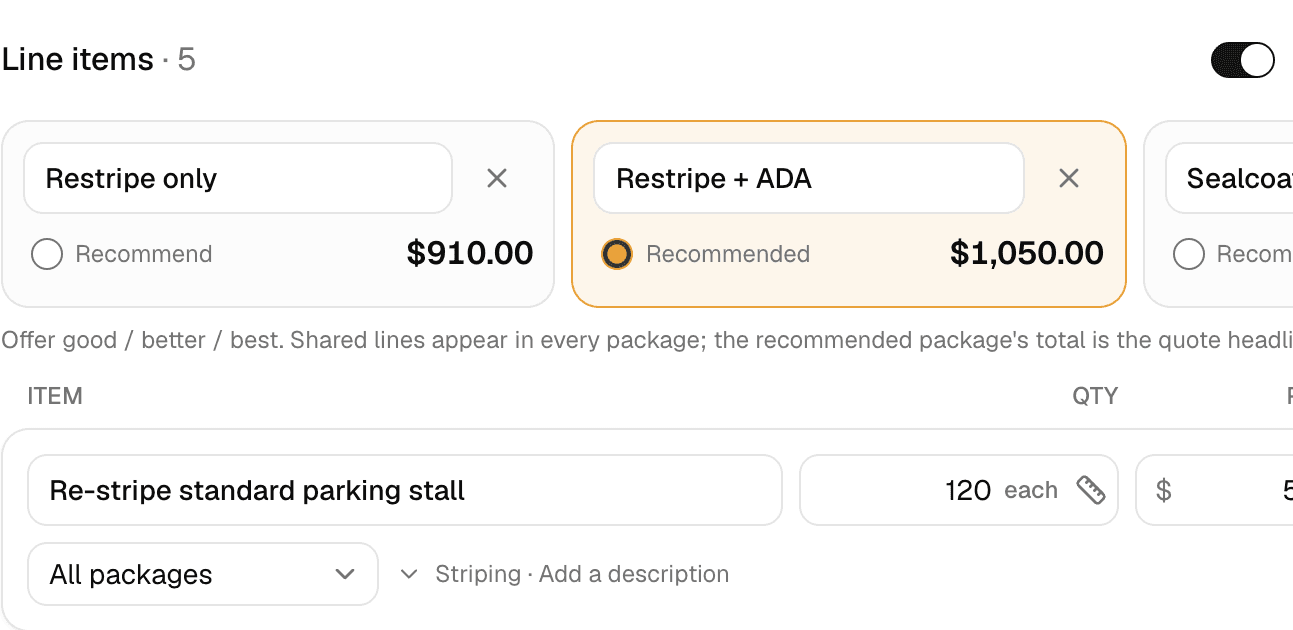
In MakeHay, a quote carries up to three packages (Good / Better / Best), so a 1-inch and a 2-inch service level sit side by side and the customer picks one as they approve (packages help). The snow plowing starter list has "Driveway plow, per push", "Commercial lot, per push" and "Salt application" as Each, "Sidewalk and walkway" as Per linear foot and "Pre-season stake and mark" as Flat price; snow removal adds "Pre-treatment" as Each.
Zero tolerance snow contract: what the words buy
Zero tolerance is a service level, not a depth. Phil Harwood's scope of work column in Landscape Management puts it plainly: in a zero-tolerance contract "the contractor has the discretion to do whatever is needed" based on the weather and time of day, and a trigger depth in the same contract "implies the scope of work is something less than zero tolerance", so pick one model per surface. Write down whether the client expects inspections between storms for refreezing and whether your authority to act is unrestricted, since a restriction moves liability.
Price it as pre-treatment plus patrol visits: a brine pass before the snow at the rates in the salt post, a return at each shift change or opening while the event runs, and the refreeze checks between storms, so the line is a per-event price with an hourly rate behind it for long storms.
Snow removal trigger ice: freezing rain and refreeze below the trigger
Ice below the trigger belongs to the salt clause, which runs on conditions. On Minnesota's MPCA winter parking lot factsheet, six of the eight freezing rain rows in the de-icing table read "Apply chemical" with no plowing, and the two that pair freezing rain with snow read "Plow & apply chemical": the plow goes first where there is snow to move, chemical after it. A refreeze after the plow leaves is a salt call, not a push.
Anti-icing is the other half. The factsheet says anti-icing "prevents the bond from forming between pavement and ice" and "must be applied prior to snow fall", at 0.3 to 0.8 gallons of salt brine per 1,000 sq ft before light or moderate snow and 0.3 to 0.6 before frost or black ice. SIMA says the same from the contract side: salt on icy surfaces or a freezing forecast, whatever the depth.
In MakeHay, a repeating "ice check" job with Bill after each visit invoices each salt-only call, and each visit is marked Done or Skip with Weather as a reason (mark a visit done or skipped).
Who decides the trigger was reached: the measurement clause
The contract decides, by naming where depth is read and by whom. Kenton, Ohio's code section 425.13 declares an emergency snow condition at 4 inches on the streets "as determined by measurement by the Safety-Service Director or as determined by the local U.S. Weather Station". Osseo, Minnesota's snow emergency policy has an on-duty Public Services employee or police officer measure 2 or more inches at the Public Works facility parking lot, street address printed.
Kenton's weather station option ties the number to the National Weather Service station whose normals priced the contract: NWS Chicago's snow climatology takes its Chicago normals from O'Hare. Name the station, and add a ruler reading at a named flat spot on site, as Osseo does, for storms that miss the airport.
In MakeHay, every scheduled visit carries the National Weather Service forecast for the job site's own coordinates (US addresses only), and the suggested "Snow event" rule is max rain 50 percent and max temp 34°F, "Salt only" max temp 32°F (plan around the weather). A forecast is not a depth measurement.
Contract wording to copy
Seven clauses cover the arguments, built on the city rules above, Harwood's two questions and O'Hare's season dates.
- Trigger per surface: "Plowing of the parking lot begins when accumulation reaches 2 inches. Sidewalks, entrances and accessible routes are cleared at 1 inch, the entire width, to bare pavement."
- Measurement point: "Accumulation is the snowfall reported by the National Weather Service for [station name], or the contractor's ruler reading at [location on site], whichever is higher."
- Response time: "Plowing begins within [hours] of the trigger being reached. Sidewalks and entrances are cleared within 4 hours of the end of daytime snowfall, the lot within [hours]."
- Salting on conditions: "De-icer is applied when surfaces are icy or the National Weather Service forecasts freezing conditions, after snow is cleared, with no depth threshold. Pre-treatment goes down before forecast snow at the Schedule A rate."
- Season dates: "The season runs December 1 through March 31." At O'Hare the normal first 1-inch snowfall is December 7 and the last March 20.
- Drifting and re-plow: "Drifting over a cleared surface is a new event once it reaches the trigger after [hours] without new snow. A return inside that interval is a follow-up visit at the follow-up rate, outside the seasonal cap."
- Who calls: "The contractor determines that the trigger has been reached at the measurement point above, inspects for refreeze between storms at the Schedule A rate, and notifies [name] before and after each visit."
The seasonal contract post covers the state statutes that void hold-harmless clauses in plow contracts.
Good to know: This is general information, not legal advice. Statutes and rules change; read the current text and ask your state licensing board or a lawyer before you rely on it.
FAQ
What is a 2 inch trigger?
Plowing starts once 2 inches of snow have accumulated at the contract's measurement point; below it nothing is owed except what the salt clause says. Belvidere plows driving lanes above 2 inches, and Osseo declares a snow emergency at 2 inches measured at a city lot. At O'Hare, 2 inches is reached on 6.6 days a year against 11.4 at 1 inch.
Is a 1 inch trigger worth the extra visits?
For a customer whose walks and entrances carry foot traffic at opening, yes: the extra pushes are the light ones, and at O'Hare they add about 4 expected pushes, $304 a season on the example lot. For a back lot that opens mid-morning, a 2-inch lot trigger with a 1-inch walk trigger buys the same safety for less.
What about drifting after the plow leaves?
Give it a clause of its own. Belvidere re-plows driving lanes for every additional 3 inches until the storm ends, a depth rule for a return; drifting is a return without new snowfall. Name the interval after which a drift that reaches the trigger is a new event, and bill a return inside it as a follow-up visit outside the seasonal cap.
Does a trigger apply to salting?
No. A trigger starts plowing; salting runs on conditions. SIMA names salt only after 1 inch as the clause to avoid, because freezing rain on a dusting is slick below any trigger, and the MPCA factsheet's freezing rain rows call for chemical with no plowing. Write salting on icy surfaces or a freezing forecast, after the surface is cleared.
Sources
- Triggered: Why accumulation thresholds should be removed from snow management contracts (SIMA Snow and Ice Resource Center) · "A trigger depth is typically defined as a specific measurement of snow accumulation" that must be reached before services are initiated. "For example, a contract may specify salt application only after one inch of snow has accumulated." "If there is a dusting of snow combined with freezing rain, the surface can become dangerously slick." "Instead of relying on trigger depths, contracts should specify that salt will be applied when surfaces are icy" or when forecasts predict freezing conditions. By David Gallagher; names no measurement point and no triggers by surface. (accessed October 13, 2026)
- Readme: By-Variable and By-Station Normals Files, 1991 to 2020 (NOAA NCEI) · "AVGNDS = average number of days meeting criteria given." Precipitation fields take the form "GEnnnuu in which nnn is a value and uu are the units", with TI meaning tenths of an inch. "ANN-SNOW-AVGNDS-GE001TI is the annual average number of days with snowfall greater than or equal 0.1 inch." The annual snow file lists GE001TI through GE200TI, so GE010TI, GE020TI and GE030TI are the days a year with 1.0, 2.0 and 3.0 inches or more. (accessed October 13, 2026)
- US Climate Normals 1991 to 2020, annual and seasonal by-station file for Chicago O'Hare International Airport, USW00094846 (NOAA NCEI) · Station "CHICAGO OHARE INTL AP, IL US". ANN-SNOW-NORMAL 38.4 inches (flag S, 25 years); ANN-SNOW-AVGNDS-GE010TI 11.4 days; GE020TI 6.6 days; GE030TI 3.9 days; each day count with completeness flag S over 28 years. Read October 13, 2026. (accessed October 13, 2026)
- Chicago Snow Climatology (NWS Chicago) · For Chicago O'Hare on 1991 to 2020 normals: first snowfall of 1 inch or more "December 7", last "March 20". Much of the page is for "two official climate sites, Chicago and Rockford". The yearly count of 1-inch days appears only as a chart image, so the count in the post comes from the NCEI station file. (accessed October 13, 2026)
- Winter Parking Lot and Sidewalk Maintenance Factsheet (Minnesota Pollution Control Agency stormwater manual) · "Anti-icing chemicals must be applied prior to snow fall." "Anti-icing prevents the bond from forming between pavement and ice." Anti-icing table, salt brine in gallons per 1,000 sq ft: 0.3 to 0.6 prior to frost or black ice, 0.3 to 0.8 prior to light or moderate snow; "Consider the following table to be a starting point only." De-icing table: eight pavement temperature rows carry freezing rain; six read "Apply chemical" and two (20 to 25°F rising and 15 to 20°F falling, each "Snow or Frz. Rain") read "Plow & apply chemical". (accessed October 13, 2026)
- Sidewalk Snow Clearing Rules (City of Minneapolis) · Minneapolis Ordinance 445.20. Homes and duplexes: "You must clear sidewalks within 24 hours after it stops snowing." All other properties: "within 4 daytime hours (8 a.m. to 5 p.m.) after it stops snowing." "Shovel the entire width of the city sidewalk" down to bare pavement; corner properties clear curb cutouts and crosswalks to the street gutter. (accessed October 13, 2026)
- Snow Plowing Policy (City of Belvidere, Illinois) · Under 1 inch: "Salting Only", once roads become slick. 1 to 2 inches: salting stops after 1 inch; plowing begins when the storm ends if conditions warrant. Over 2 inches: only the driving lanes are plowed, re-plowed for each additional 3 inches until the storm ends; municipal lots, lot stairs, streetscape parking, adjoining sidewalks and bridges are cleared of measurable snow before 7:00 AM when possible; after the storm all streets, alleys and parking lots are plowed curb to curb. (accessed October 13, 2026)
- 901.07 Removal of Ice and Snow, Codified Ordinances of Milan, Ohio (American Legal Publishing) · The owner or occupant "shall, within twenty-four hours after a snowfall of two inches or more, cause the snow to be removed from the sidewalk", and when the sidewalk is encumbered with ice "shall, within twenty-four hours after its formation, cause the sidewalks to be made safe by removing the ice or sprinkling the sidewalk with salt or some other suitable substance." (accessed October 13, 2026)
- Snow and Ice Removal Laws (New York City Department of Sanitation) · Deadlines for building owners and occupants: snowfall ends between 7:00 AM and 4:59 PM, "Clear within 4 hours"; between 5:00 PM and 8:59 PM, within 14 hours; between 9:00 PM and 6:59 AM, by 11:00 AM. The cleared path must be "at least four feet wide". (accessed October 13, 2026)
- 425.13 Snow Emergencies, Code of Ordinances (City of Kenton, Ohio, on American Legal Publishing) · "An emergency snow condition shall exist at such time as a uniform accumulation of four inches of snow has accumulated upon the streets of the City as determined by measurement by the Safety-Service Director or as determined by the local U.S. Weather Station." Ordinance passed February 12, 1979; the Director posts signs giving "the depth of snowfall necessary to cause an emergency snow condition to exist." (accessed October 13, 2026)
- Snow Emergency Notification Process (City of Osseo, Minnesota) · "The City of Osseo will declare a snow emergency when designated City staff measures two or more inches of accumulated snow at the Osseo Public Works Parking Lot" (Section 71.06 of the city code). "A City of Osseo Public Services employee, who is currently on-duty or an on-duty Osseo Police Officer, will measure any current snow fall at the Osseo Public Works Facility parking lot" at 800 Broadway Street East, and reports 2 or more inches to the Public Services Director or Police Chief, who declares. (accessed October 13, 2026)
- Snow Strategy: Review your scope of work in snow contracts (Landscape Management) · By Phil Harwood, August 23, 2022, updated November 3, 2023. A trigger depth "implies the scope of work is something less than zero tolerance." "In a zero-tolerance contract, the contractor has the discretion to do whatever is needed" based on the weather and time of day; "the inclusion of a trigger depth is inconsistent and confusing." Whether "the client has an expectation for you to inspect the property between storms for refreezing" belongs in the scope and pricing. "Does the contractor have unrestricted decision-making authority? If not, what restrictions apply, and how is liability redistributed?" (accessed October 13, 2026)