How Much Salt to Put on a Parking Lot (and What to Charge)
How much salt to put on a parking lot: pounds per 1,000 sq ft by pavement temperature from state tables, then bags, tons and a per application price.
The MakeHay team · · 11 min read
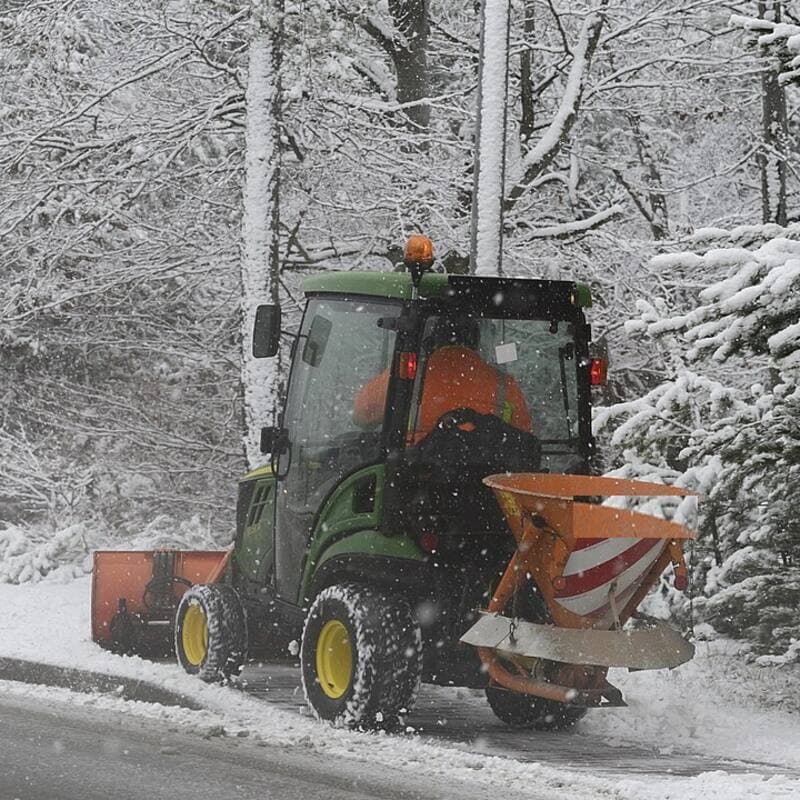
How much salt to put on a parking lot comes from a state rate table, not a guess. Minnesota's MPCA factsheet puts dry rock salt at 0.75 to 3 lb per 1,000 sq ft and New Hampshire's UNH T2 Table 19 at 4.5 to 10 lb, by pavement temperature, trend and precipitation. Measure the lot, pick the row, convert to bags or tons, cost the salt at a dated price, add the trip, and the per-application line follows.
How much salt to put on a parking lot: a rate, not a guess
Pounds are what you buy, what the spreader drops and what a property manager can check, so the price starts there. MN LTAP's property manager guide caps salt on entrances and small areas at 4 lb per 1,000 sq ft, adjusted between 1 and 4 lb by what is left after clearing, and sends parking lots to a rate chart worked "incrementally downward" toward the MPCA guidelines; the MPCA factsheet is that chart, and it warns that too high a rate "may result in slippery conditions or tracking."
Step 1: Measure the lot (satellite is fine for salt)
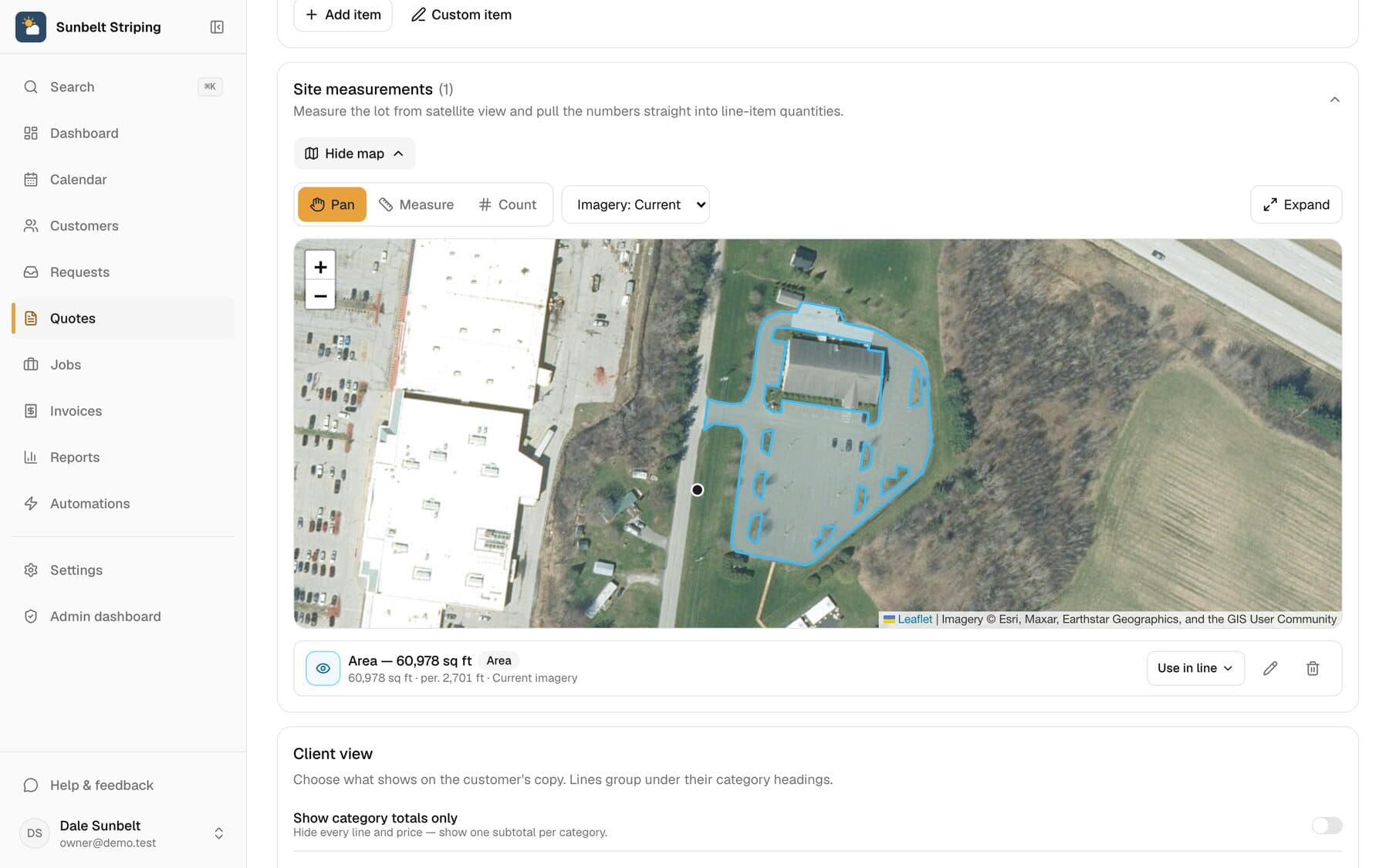
Trace the paved area from satellite imagery and use the square footage as it comes; a few percent either way moves the pounds, not the price. The MPCA factsheet's own method is "parking lot area (or drive lane distance) = Length x Width", and a traced outline beats pacing it off.
The free satellite measurement tool returns the lot's square footage from a traced outline, and Cut out removes islands and curbed beds.
Step 2: Pounds per 1,000 sq ft by pavement temperature
Read pavement temperature, not air temperature, then take the row for the trend and the precipitation; both sources also carry lower numbers for salt pre-wetted with brine.
| Pavement temperature and trend | Weather | MPCA dry salt | UNH Table 19 dry salt |
|---|---|---|---|
| Above 30°F, rising | Snow (plow, treat intersections only) | 0.75 | 4.5 |
| 30°F, falling | Snow | 1.5 | 6.5 |
| 30°F, falling | Freezing rain | 1.75 | 7 |
| 20 to 25°F, falling | Snow | 2.75 | 9.5 |
| 20 to 25°F, falling | Freezing rain | 3 | 10 |
| 0 to 15°F | Snow | Not recommended; pretreated blends 3 | Not recommended; pretreated blends 10 |
Why the two tables disagree by about four times
UNH's footnote says its rates "are based on road application guidelines" from Minnesota's 2005 field handbook and tells you to adjust current rates "incrementally downward toward these guidelines": a ceiling to work down from. The MPCA table was written for lots, is offered "as a starting point" to modify over time, and is the chart MN LTAP tells property managers to work their current rates down toward. Bid on the rate you actually spread.
Step 3: From pounds to bags and tons
The MPCA factsheet's own formula is "application rate x parking lot area / 1000 ft2". Bags are pounds divided by the bag weight and tons are pounds divided by 2,000; Morton's Safe-T-Salt comes in 25 lb and 50 lb bags, and the arithmetic uses the 50 lb bag.
Worked example: A 40,000 sq ft lot at two temperature rows
- Area in thousands: 40,000 ÷ 1,000 = 40; pounds = (area ÷ 1,000) × rate.
- Row 1, 30°F falling with snow, MPCA 1.5 lb per 1,000 sq ft: 40 × 1.5 = 60 lb.
- Row 2, 20 to 25°F falling with snow, MPCA 2.75 lb per 1,000 sq ft: 40 × 2.75 = 110 lb.
- Bags, row 2: 110 lb ÷ 50 lb per bag = 2.2, so load 3 bags.
- Tons, row 2: 110 lb ÷ 2,000 = 0.055 tons.
- Row 2 on UNH Table 19, 9.5 lb per 1,000 sq ft: 40 × 9.5 = 380 lb, 7.6 bags (load 8), 0.19 tons.
Result: 110 lb (3 bags, 0.055 tons) on the MPCA row or 380 lb (8 bags, 0.19 tons) on the UNH row, at 2.75 and 9.5 lb per 1,000 sq ft, for the 40,000 sq ft lot.
Step 4: Rock salt price per ton from 2025 public bids
Bulk rock salt was bid at $63.27 to $71.19 per ton delivered in a 2025 Ohio county bid tabulation, treated salt at $84.27 to $88.38, and the 2025 Ohio DOT contract came in at $63.99. Those are municipal and county quantities, a village's 3,500 tons and a county's 18,000; a pallet or truckload buyer gets a different number, so use your supplier's quote and write its date on the estimate. The date matters: Mayfield Village's Ohio DOT contract price went from $48.98 to $63.99 per ton in one year.
| Buyer | Season | Material | Price per ton |
|---|---|---|---|
| Mayfield Village, OH (Ohio DOT contract) | 2025 to 2026 | Bulk road salt, Cargill | $63.99 (was $48.98 the year before) |
| Lake County, OH road department | 2025 | Untreated bulk, delivered | $63.27 Morton, $70.94 Compass Materials, $71.19 Cargill |
| Lake County, OH road department | 2025 | Treated, delivered | $84.27 Morton, $88.38 Cargill |
Step 5: Labor, spreader calibration and the crystal spacing check
The trip costs more than the salt. At the UNH row, 0.19 tons at the Ohio contract price is $12.16 of material, and an hour of a worker at the 2025 BLS median for landscaping and groundskeeping workers ($18.82 per hour on O*NET) is $18.82. The truck, spreader, insurance and a season on call are the rest. The $100 per hour trip rate in Step 6 is the low public bid for a plow trip on a 2013 Missouri DOT tabulation; it has to cover that wage, the truck and the spreader.
Calibrate before the first storm. The MPCA factsheet lists "amount of material your truck or sander delivers at each setting and speed" as information a rate table needs. Pick a gate setting and a ground speed, run a measured 1,000 sq ft strip or catch the drop on a tarp, weigh it, and write the lb per 1,000 sq ft next to that setting.
Then check by eye: MN LTAP says that at the right rate "granular salt crystals should be spaced about 2 to 3 inches apart", about 1 lb per 250 sq ft on entrances and small areas and never more than 4 lb per 1,000 sq ft there.
Step 6: How to price salting services and cap the season
Price each application as salt at cost plus a markup, plus the trip at your hourly rate, then multiply by an expected count for the seasonal cap. For scale, a 2013 Missouri DOT tabulation for state office lots shows bids of $100 to $150 per hour for a plow trip and $250 to $820 per treatment of a parking area.
Worked example: Per-application price for the 40,000 sq ft lot
- Salt at the Ohio contract price: 0.19 tons × $63.99 per ton = $12.16.
- Material with a 30 percent markup for handling (your own number): $12.16 × 1.3 = $15.81.
- Trip and spreading, 1 hour at $100 per hour (the low hourly bid on the 2013 MoDOT tabulation; use your own): $100.
- Per-application price: $15.81 + $100 = $115.81, call it $116.
- Rate check: $116 ÷ 40 = $2.90 per 1,000 sq ft.
- Seasonal cap: $116 × the station's average days a year with 1 inch or more of snow (NCEI GE010TI); at Chicago O'Hare that normal is 11.4 days, so $116 × 11.4 = $1,322, before salt-only calls.
Result: $2.90 per 1,000 sq ft, $116 per application for the 40,000 sq ft lot, and a $1,322 seasonal cap at O'Hare's 11.4 snow days.
Salt is about a tenth of that price at the UNH rate and under 4 percent at the MPCA row (110 lb is 0.055 tons, $3.52), which is the case for pricing per application, not per bag: the customer is buying a truck, a driver and a promise to show up.
For the cap, pull the station's GE010TI normal (average days a year with 1 inch or more of snowfall, NCEI 1991 to 2020 normals) the way the seasonal plowing contract post shows, add the salt-only calls that come with freezing rain and refreeze, and write the count and the cap into the contract.
In MakeHay, a weather rule can carry a max temperature (the suggested "Salt only" rule in setup is max temp 32°F) and the forecast is read for each job site from the National Weather Service for US addresses; see plan around the weather.
Pre-treating with brine: when it cuts the rate
Brine before the storm cuts the rate because, as the MPCA factsheet says, "anti-icing prevents the bond from forming between pavement and ice". Its anti-icing table runs 0.3 to 0.6 gallons of salt brine per 1,000 sq ft before frost or black ice and 0.3 to 0.8 before light or moderate snow, and pre-wetted salt spreads lower than dry: 1.25 against 1.5 lb per 1,000 sq ft at 30°F falling with snow on MPCA, 5.75 against 6.5 on UNH.
The catch is timing: "anti-icing chemicals must be applied prior to snow fall", so a brine pass is its own trip on its own trigger and its own line, not a replacement for the post-storm application.
Putting the salt line on the quote and the contract
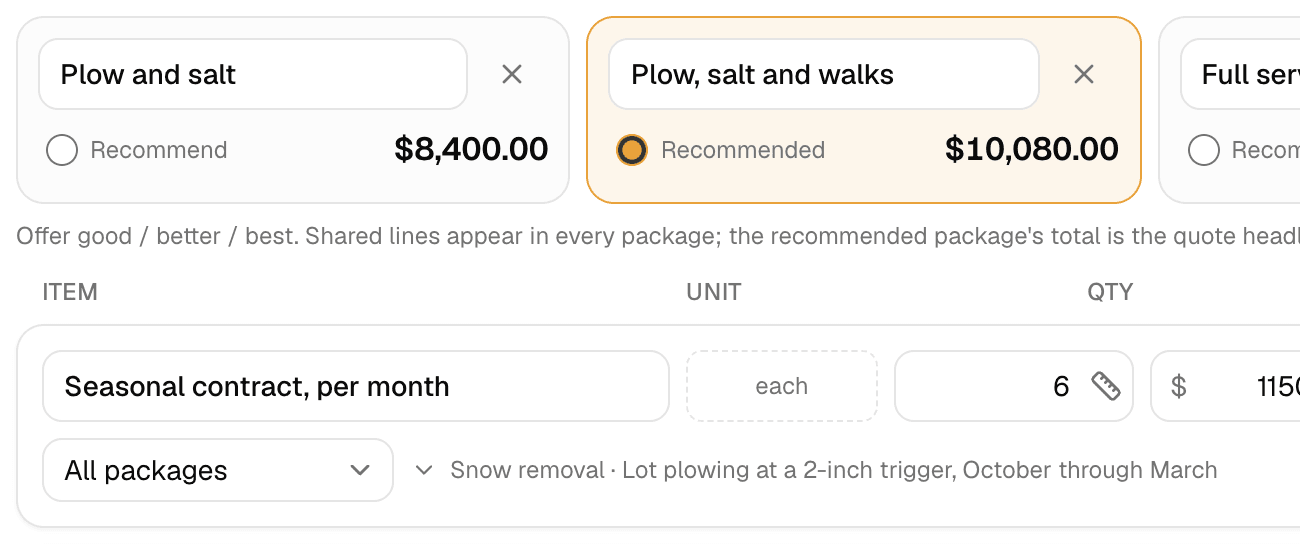
Salt goes on the quote as its own per-application line with the rate row, the trigger and the cap beside it; sidewalks get a separate line, hand work at a different rate; plowing sits next to both, per push. The snow removal page shows the shape. The contract spells out:
- The rate and its source, for example 2.75 lb per 1,000 sq ft from the MPCA row for 20 to 25°F, falling, with snow.
- The trigger: who calls an application, at what pavement temperature and precipitation.
- The per-application price, the seasonal cap and the application count behind it.
In MakeHay, the snow removal starter list has "Salt or de-icer application" and "Pre-treatment" as Each items and "Sidewalk clearing" as Per linear foot; the Each item is the per-application line. To let the measured area drive the line, add a service with the Per square foot unit under Settings › Services; the saved measurement fills its quantity. See set up your services and prices.
Visits on a repeating job are marked Done or Skip, and Bill after each visit invoices each application; see mark a visit done or skipped.
FAQ
Should salt be charged separately from plowing?
Yes. Plowing is priced by the push and salt by the application, and a storm can need one without the other: on six of the eight MPCA freezing-rain rows the action is "Apply chemical" with no plowing (the 20 to 25°F rising and 15 to 20°F falling rows pair freezing rain with snow and plow too), and snow above 30°F on rising pavement is "Plow, treat intersections only".
How much salt for a driveway?
MN LTAP's rule for small areas is about 1 lb of salt per 250 sq ft after clearing, never more than 4 lb per 1,000 sq ft. A 20 by 30 ft driveway is 600 sq ft, so about 2.4 lb; MN LTAP says a 12-oz coffee cup holds about 1 lb, so about two and a half cups, with the crystals 2 to 3 inches apart.
Does rock salt work below 15°F?
Not well. The MPCA factsheet says sodium chloride does not work on cold days below 15°F, and both tables mark dry salt not recommended from 0 to 15°F and send you to salt pretreated with other blends (3 lb per 1,000 sq ft on MPCA, 10 lb on UNH). Morton's product page puts Safe-T-Salt at melting down to 5°F.
How much does salting a parking lot cost?
About $116 per application for a 40,000 sq ft lot, or $2.90 per 1,000 sq ft, with salt at the 2025 Ohio contract price of $63.99 per ton and a $100 per hour trip rate from a 2013 Missouri DOT tabulation, which also shows bids of $250 to $820 per treatment of state office lots.
Sources
- Winter Parking Lot and Sidewalk Maintenance Factsheet (Minnesota Stormwater Manual, MPCA) · Deicing table in lbs per 1,000 sq ft, dry salt (NaCl) column: 0.75 above 30°F rising with snow, 1.5 at 30°F falling with snow, 1.75 at 30°F falling with freezing rain, 2.25 at 25 to 30°F falling with freezing rain, 2.75 at 20 to 25°F falling with snow, 3.0 at 20 to 25°F falling with freezing rain and at 15 to 20°F falling, not recommended at 0 to 15°F (blends 3.0); pre-wetted with brine column 1.25 at 30°F falling with snow. "Sodium chloride (NaCl; road salt) does not work on cold days, less than 15oF." Anti-icing table, salt brine in gallons per 1,000 sq ft: 0.3 to 0.6 prior to frost or black ice, 0.3 to 0.8 prior to light or moderate snow. "Anti-icing prevents the bond from forming between pavement and ice." "Anti-icing chemicals must be applied prior to snow fall." "Consider the following table to be a starting point only." "Too high an application rate may result in slippery conditions or tracking." "Parking lot area (or drive lane distance) = Length x Width." Key information needed: "Amount of material your truck or sander delivers at each setting and speed." Row above 30°F rising with snow: "Plow, treat intersections only"; six of the eight freezing rain rows: "Apply chemical" (the 20 to 25°F rising and 15 to 20°F falling rows, "Snow or Frz. Rain", are "Plow & apply chemical"); the 0 to 15°F row: "Plow, treat with blends, sand hazardous areas". Deicing section: "Develop your own application rates using the guidelines as a starting point and modify them incrementally over time to fit your needs." "To determine the amount of material needed, take the application rate x parking lot area / 1000 ft2." (accessed October 12, 2026)
- NH Road Salt Application Rates for Deicing Parking Lots (Pounds per 1000 sq.ft.), Table 19 (UNH Technology Transfer Center) · Page 2, application rate in lbs per 1,000 sq ft, dry salt column: 4.5 above 30°F rising with snow, 6.5 at 30°F falling with snow, 7 at 30°F falling with freezing rain, 8.25 at 25 to 30°F falling with freezing rain, 9.5 at 20 to 25°F falling with snow, 10 at 20 to 25°F falling with freezing rain and at 15 to 20°F falling, not recommended at 0 to 15°F (blends 10); pre-wetted with brine 5.75 at 30°F falling with snow. Footnote: "These rates are based on road application guidelines" (the Minnesota Snow and Ice Control Field Handbook, 2005) and "Develop your own application rates by adjusting your current rates incrementally downward toward these guidelines." Above 30°F rising with snow is "Plow, treat intersections only"; the blends column is headed "Salt Prewet/ Pretreated with other blends"; "Where temperature categories overlap, select the rate most applicable to your situation." (accessed October 12, 2026)
- Application Rates: How Much Salt? (Winter Salt Guide for Property Managers, Minnesota LTAP) · "For small areas, apply about 1 pound of salt per 250 square feet after clearing the snow and patches of snow or ice remain." "This is equivalent to about a 12-oz coffee cup (about 1 lb.) of salt scattered upon 10 sidewalk squares or a small 20 foot long by 12-foot-wide driveway." "Use no more than 4 pounds of salt per 1,000 square feet." "Adjust rate between 1 to 4 pounds depending on the amount of snow or ice remaining on the surface after clearing." (both under the heading Treating entrances and small areas; the Treating parking lots and sidewalks section gives no lb per 1,000 sq ft figure and refers to application rate charts and the MPCA guidelines). "At these rates, granular salt crystals should be spaced about 2 to 3 inches apart." Under Treating parking lots and sidewalks: "Application rate charts should be used to determine how much material to use, especially for larger areas." "Develop your own application rate chart by adjusting your current rates incrementally downward toward the following MPCA guidelines or other accepted rates." (accessed October 12, 2026)
- Morton Safe-T-Salt (Morton Salt product page) · "Available in 25 lb. bag and 50 lb. bag." "Melts down to 5°F." No price on the page; bag weight only, October 12, 2026. (accessed October 12, 2026)
- Memorandum: Winter Road Salt, ODOT (Mayfield Village, Ohio, August 1, 2025) · "The price per ton this year is $63.99 a change from $48.98 last year." The memo says the ODOT 2025 to 2026 winter road salt bids were awarded, the village buys through Cargill, and it ordered 3,500 tons. Price per ton of bulk road salt, $63.99, dated August 1, 2025, read October 12, 2026. (accessed October 12, 2026)
- Bid Tabulation, Lake County Road Department Salt 2025 (Lake County, Ohio, LCE project 2025 006) · Untreated bulk rock salt, delivered to the Painesville yard (15,000 tons) and the Lost Nation yard (3,000 tons), unit price per ton: Morton Salt $63.27, Compass Materials $70.94, Cargill $71.19. Treated rock salt, delivered, per ton: Morton Salt $84.27, Cargill $88.38 (Compass no bid). 2025 bid; the PDF's file date is May 15, 2025; opened and read October 12, 2026. (accessed October 12, 2026)
- Tabulation of Responses for Snow and Ice Removal for Office Locations, St. Louis District (Missouri Department of Transportation, posted November 21, 2013) · "E. Hourly rate for special trips for plowing $150.00/hr $100.00/hr" (two bidders). "C. Ice or frozen precipitation pretreatment / after treatment of melting agents parking areas $640.00 $250.00" for the Traffic Management Center lot and "$820.00 $300.00" for the District Office lot (item C carries no unit of its own; items A, B and D on the same schedule are per occasion). "F.2. Loader & dump truck w operators $240.00/hr $200.00/hr." Prices from 2013, read October 12, 2026. (accessed October 12, 2026)
- Readme: By-Variable, By-Station Normals Files (NOAA NCEI, US Climate Normals 1991 to 2020) · "Possible values for units are HI (hundredths of an inch), TI (tenths of an inch)." "Example: ANN-SNOW-AVGNDS-GE001TI is the annual average number of days with snowfall greater than or equal 0.1 inch." By the same pattern, ANN-SNOW-AVGNDS-GE010TI is the annual average number of days with snowfall of 1.0 inch or more; the readme lists that code in its file listings without a separate definition line. (accessed October 12, 2026)
- US Climate Normals 1991 to 2020, annual and seasonal by-station files (NOAA NCEI) · Per-station CSVs read October 12, 2026. Chicago O'Hare (USW00094846): 11.4 days with 1 inch or more of snowfall (ANN-SNOW-AVGNDS-GE010TI), flag S, 28 years. (accessed October 12, 2026)
- Landscaping and Groundskeeping Workers, local wages (O*NET OnLine, Bureau of Labor Statistics 2025 wage data) · United States row, "Hourly Median (50%)": "$18.82". "Workers on average earn $18.82 per hour." Source line: "Bureau of Labor Statistics [2025 wage data]." Read October 12, 2026. (accessed October 12, 2026)