Can a Contractor Charge a Credit Card Fee? Rules by State
Can a contractor charge a credit card fee? The card network cap, the states that ban or limit surcharges with each statute, and a $2,000 invoice four ways.
The MakeHay team · · 10 min read
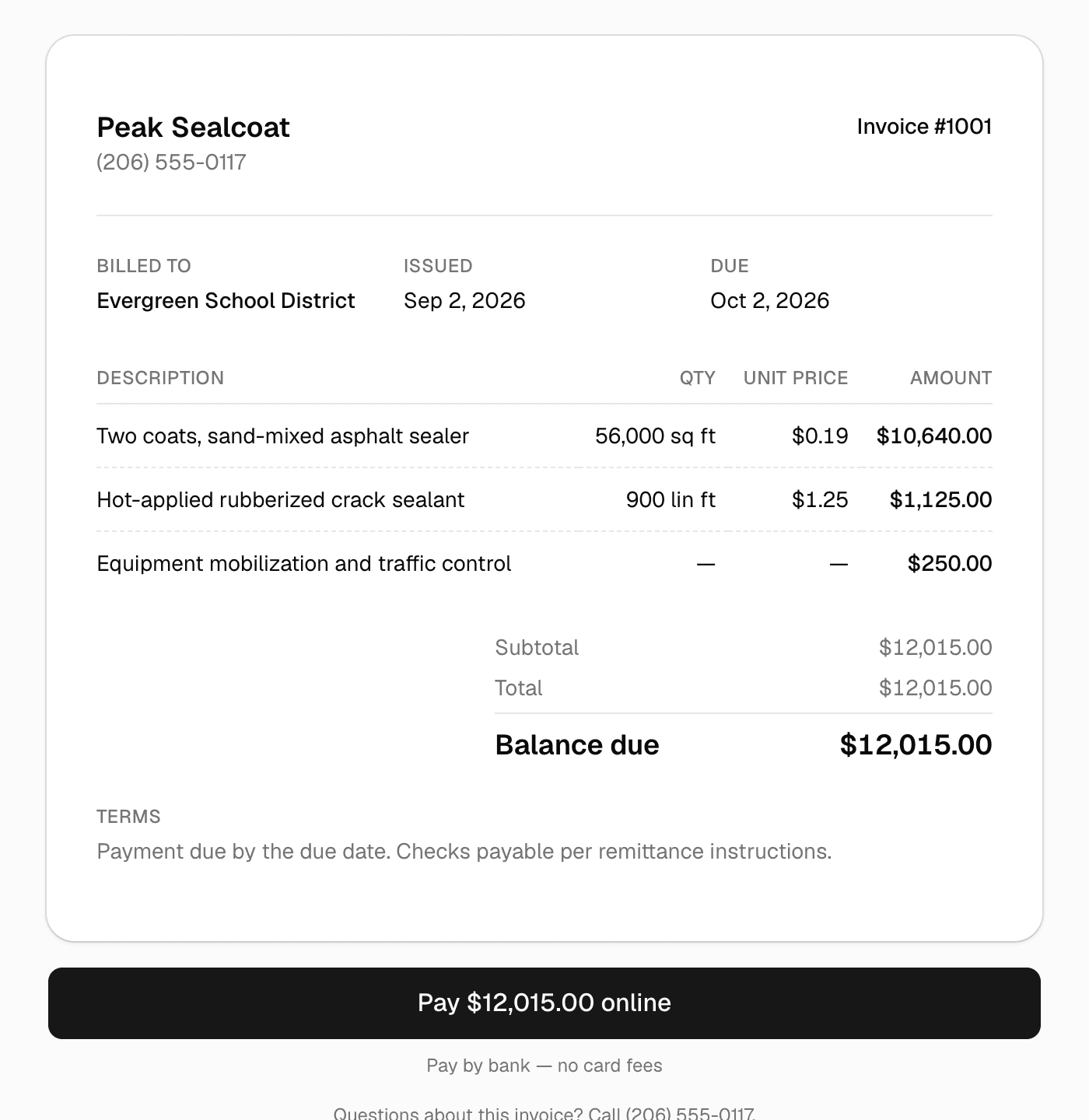
Can a contractor charge a credit card fee? In most states yes, on credit cards only, within the card networks' rules and your state's statute; in Connecticut, Massachusetts and Maine, no. Four choices cover every state: absorb the cost, surcharge where it is allowed, offer a cash discount, or steer customers to a bank transfer. Below: the network rules, six statutes with their text linked, and a $2,000 invoice four ways.
Can a contractor charge a credit card fee? Four ways to handle it
Yes in most states, and only one of the four ways to handle the cost needs a statute check.
- Absorb it. Price the job with the processing cost inside the number. Legal everywhere, nothing to post.
- Surcharge. Add the cost at checkout on credit cards only, within the network cap and your state's rule: banned in three states below, capped or conditioned in three more.
- Cash discount. Post one regular price and take something off for cash, check or bank payment. US federal law keeps card issuers from forbidding it; the three ban states allow it.
- Steer to bank payment. Offer a bank transfer beside the card button. Nothing is added to the invoice, so there is no fee to defend.
Surcharge vs convenience fee vs cash discount: the words matter
A surcharge raises the price for the card payer; a cash discount lowers it for everyone who avoids the card. US federal law, 15 U.S.C. § 1666f, says a card issuer may not prohibit a seller from offering a discount to induce payment by cash, check, or similar means, and that such a discount is not a finance charge if it is offered to all prospective buyers and disclosed clearly and conspicuously.
Maine's 9-A M.R.S. § 8‑509 defines a surcharge as any means of increasing the regular price to a cardholder that is not imposed on a customer paying by cash, check or similar means, and adds that a discount or reduction from the regular price is not a surcharge. Connecticut's is wider: any additional charge or fee that increases the total amount of a transaction for the privilege of using a particular method of payment. Calling the line a convenience fee changes nothing under either test.
The Visa surcharge cap and the debit rule
Both networks add conditions on top of state law, and neither lets you surcharge above your own cost. Visa's small-business page on rates, fees and rules says merchants must notify their acquirer 30 days before they begin surcharging, and defines the merchant discount as what a merchant pays its financial institution, typically a percentage per transaction. Visa's cap and its card rules sit in the surcharging FAQ and the considerations sheet, both downloads on that page; this post quotes only the page itself, so take Visa's number from those documents before you set one.
Mastercard's merchant surcharge rules page says surcharging Mastercard-branded credit cards has been permitted since January 27, 2013, and never on Debit Mastercard or Mastercard prepaid cards. A merchant notifies Mastercard and its acquirer no less than 30 days ahead and picks a brand-level or a product-level surcharge; a brand-level one is capped at the lesser of the merchant's average effective merchant discount rate or the Maximum Surcharge Cap, listed as 4 percent. The dollar amount goes on the receipt; nothing in the rules excuses a merchant from state or federal law.
Credit card surcharge laws by state
Three of the six statutes opened ban a credit card surcharge; three allow it with a cap or a notice rule.
| State | Rule on a credit card surcharge | Penalty or scope | Statute |
|---|---|---|---|
| Connecticut | Ban on any transaction; a cash, check or debit discount is allowed with notice | Unfair trade practice; added civil penalty up to $500 per violation | Gen. Stat. § 42‑133ff |
| Massachusetts | Ban on a cardholder who elects to use a credit card | No penalty in the section; a disclosed cash discount is not a finance charge | G.L. c. 140D § 28A |
| Maine | Ban on a credit card or debit card; a discount from the regular price is not a surcharge | Sellers in a sales transaction; governmental entities excepted | 9-A M.R.S. § 8‑509 |
| Colorado | Allowed up to 2% of the total cost or the merchant discount fee, with notice on the premises or before online checkout; not on cash, check, debit or gift cards | A violator is liable as a creditor under the Uniform Consumer Credit Code | SB21‑091, signed July 7, 2021 |
| New York | Allowed, not above what the card company charges the business; the total price inclusive of surcharge is posted | Civil penalty up to $500 per violation | GBL § 518 |
| Minnesota | Allowed up to 5% of the purchase price, with oral and posted notice in person and a notice at online checkout | Civil penalty up to $500 and a refund to each buyer | Minn. Stat. 325G.051 |
A state absent from this table is one this post did not check, not one that allows a surcharge. Connecticut's section was last amended effective June 6, 2024, New York's revision shown is dated February 16, 2024, and Minnesota's section was amended in 2023.
Good to know: This is general information, not legal advice. Statutes and rules change; read the current text and ask your state licensing board or a lawyer before you rely on it.
Can you charge a fee on debit cards?
No under the Mastercard rule, no in Connecticut, Maine and Colorado by statute, so treat debit as off limits everywhere. Mastercard bars the fee on Debit Mastercard and prepaid cards; Connecticut bans a surcharge for the privilege of using any method of payment; Maine bans one on a cardholder who uses a credit card or debit card; Colorado's act keeps it off debit card payments. A flat fee printed on an invoice does not know how the customer will pay, and the statutes that allow a surcharge tie it to the customer who elects to use a credit card.
Disclosure: the quote, the invoice and the payment page
Every statute that allows a surcharge says where the customer must see it.
- On the quote: the price, the ways to pay, and the fee or discount before approval. Minnesota wants the notice during the sale, Colorado before online checkout, New York the total price inclusive of surcharge.
- On the invoice and the receipt: the surcharge as its own line. Mastercard requires the dollar amount on the receipt; New York's final price may not exceed the posted price.
- In person: Minnesota wants the customer told orally and by a posted sign, Colorado wants notice on the premises; Connecticut asks for a cash discount to be posted on the premises, shown online before checkout and said aloud in a phone sale.
Worked example: A $2,000 invoice four ways
- Assumption: your cost of acceptance is 3 percent (a figure chosen for the arithmetic, not any processor's rate; take yours from your statement). Processing cost = payment × rate = 0.03 × $2,000 = $60.
- Absorbed: the customer pays $2,000 and you keep $2,000 minus $60 = $1,940.
- Surcharge at your cost, credit cards only, where allowed: the customer pays $2,000 + $60 = $2,060. The processor takes 3 percent of $2,060, which is $61.80, so you keep $1,998.20. Colorado's 2 percent route caps the line at 0.02 × $2,000 = $40; its merchant discount fee route allows the $60.
- Cash discount of 3 percent: a check or bank payer gets $2,000 minus $60 = $1,940; a card payer pays $2,000 with $60 of cost on your side, so both leave about $1,940.
- Paid by bank: the customer pays $2,000, no surcharge question arises, and you keep $2,000 minus your own bank-transfer cost.
Result: On a $2,000 invoice at an assumed 3 percent cost: $1,940 kept when absorbed, $2,060 paid and about $1,998 kept with a surcharge at cost, $1,940 either way with a cash discount, and $2,000 paid by bank less your bank-transfer cost.
The simplest option in most states: offer bank payment
A bank transfer button beside the card button sidesteps the question: nothing is added, nothing is posted, and the choice is the customer's.
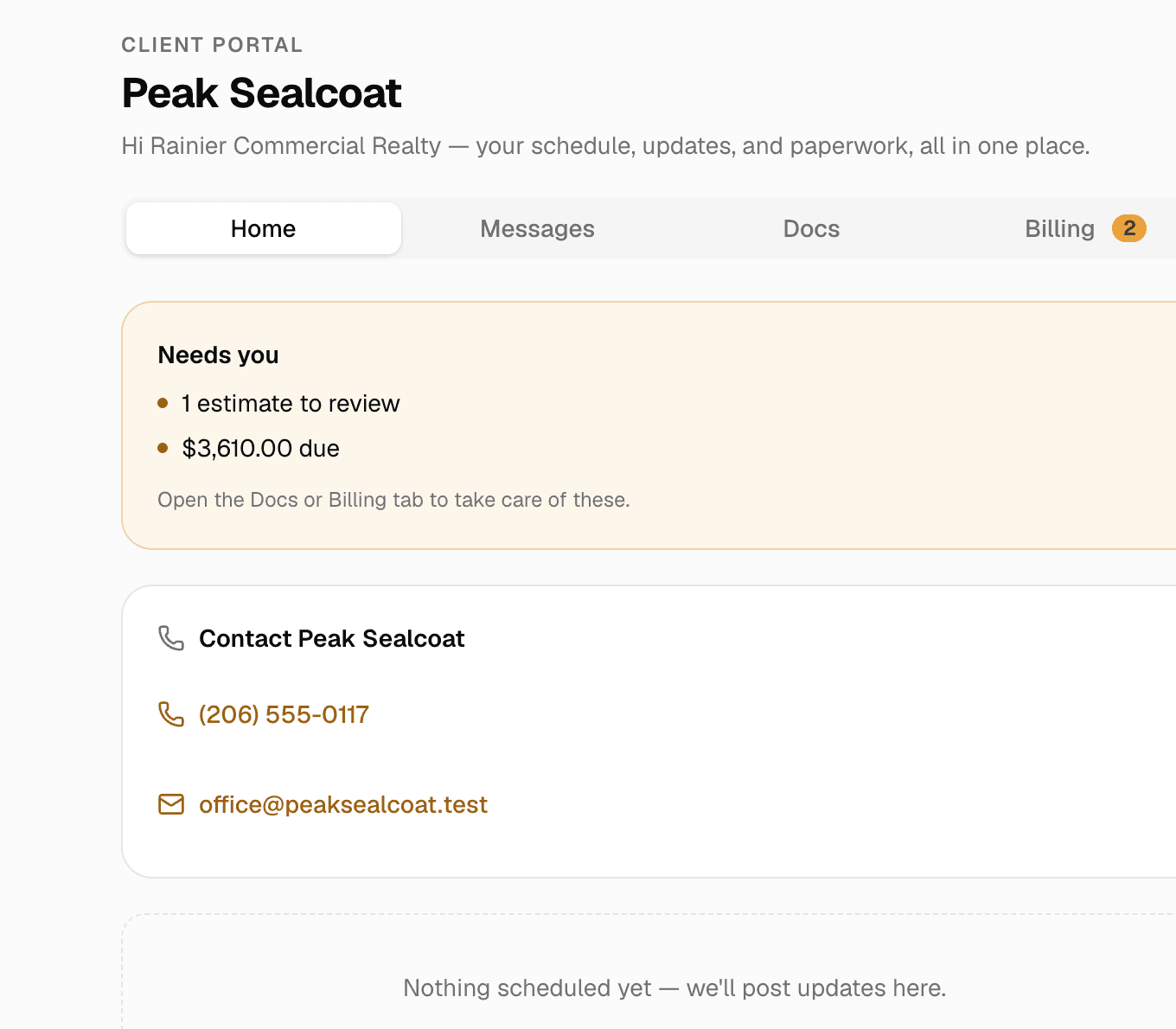
In MakeHay, customers pay invoices online by card or ACH bank transfer through Stripe's secure checkout (how your customer pays online). A bank payment shows Processing and typically takes 4 business days. Checks and cash are recorded with Record payment and carry no fee (record a payment); more on MakeHay invoicing and the pricing page. Online payments are for US businesses; Canadian businesses record checks and cash.
Customer pays the processing fee: the MakeHay switch and its limits
In MakeHay, the account owner turns on Customer pays the fees under Settings › Payments. From then on the amount the customer pays online is raised so you still receive the full invoice amount; on the customer's copy the extra shows as one Taxes and fees line. It covers online invoice payments, deposits paid when a customer approves a quote, and autopay charges; checks and cash you record yourself are unaffected. Turned off, the fees come from your payout again (Have your customer pay the online payment fees).
What it does not do: the switch does not check state law, and it does not know the card type in advance, so the same line reaches a customer who pays by debit card or bank transfer. Whether it is lawful where you work is your decision; in Connecticut, Massachusetts and Maine the statute bans the surcharge, leaving a cash discount or bank payment.
FAQ
Is it legal to charge a credit card fee in my state?
It depends on the state. Of the six statutes this post opened, Connecticut bans a surcharge on any transaction, Massachusetts on a credit card, and Maine on a credit or debit card. Colorado allows up to 2 percent or the merchant discount fee with notice, New York up to what the card company charges you, and Minnesota up to 5 percent with notice.
What is the maximum credit card surcharge?
The lowest of the caps that apply to you. Mastercard caps a brand-level surcharge at the lesser of your average effective merchant discount rate or 4 percent. Colorado allows 2 percent or the merchant discount fee, New York what the card company charges the business, and Minnesota 5 percent of the purchase price. Where a state is silent, the network rule still binds you.
Can you charge a fee on a deposit?
Only where you could charge it on the whole invoice. The six statutes speak of a sales transaction and a customer who elects to use a credit card, and none carves out a deposit, so a deposit paid by card falls under the same ban or cap as the balance.
Does the fee count as income?
Ask your accountant; this post opened no tax guidance. What the statutes do say is that the surcharge is part of the price the customer pays: New York requires the posted total price to include it, and Minnesota orders a seller who breaks the rules to refund it to each buyer.
Sources
- Credit Card Processing Fees & Interchange Rates (Visa, small business support) · Under Merchant credit surcharging, Before you start: Merchants must notify their acquirer 30 days before they begin surcharging. Merchants do not pay interchange reimbursement fees; merchants negotiate and pay a merchant discount to their financial institution that is typically calculated as a percentage per transaction. The page offers the surcharging FAQ, the surcharge considerations sheet and sample signage as downloads. (accessed October 13, 2026)
- What merchant surcharge rules mean to you (Mastercard) · The rule change permitting such surcharging went into effect on January 27, 2013. These fees are not allowed on Debit Mastercard or Mastercard prepaid cards. Advance notice to both Mastercard and the merchant's acquirer of the merchant's intention to impose a surcharge no less than thirty days before the merchant implements a surcharge. Merchants are permitted to apply either a brand-level surcharge or a product-level surcharge to Mastercard credit cards. A merchant may only surcharge a Mastercard cardholder at the lesser of the merchant's average effective merchant discount rate that the merchant pays its acquirer for Mastercard credit acceptance or the Maximum Surcharge Cap; The Maximum Surcharge Cap, 4%. Clear disclosure at the point of interaction which shall include the amount of the surcharge and the dollar amount of the surcharge on the transaction receipt. Nothing in the Mastercard rules affects any obligation of a merchant to comply with applicable state or federal laws. (accessed October 13, 2026)
- 15 U.S. Code § 1666f, Inducements to cardholders by sellers (Cornell LII) · (a) The card issuer may not, by contract or otherwise, prohibit any such seller from offering a discount to a cardholder to induce the cardholder to pay by cash, check, or similar means rather than use a credit card. (b) Any discount from the regular price offered by the seller for the purpose of inducing payment by cash, checks, or other means not involving the use of an open-end credit plan or a credit card shall not constitute a finance charge as determined under section 1605 of this title if such discount is offered to all prospective buyers and its availability is disclosed clearly and conspicuously. (accessed October 13, 2026)
- Connecticut General Statutes, Chapter 739, Sec. 42‑133ff, Surcharge based on method of payment prohibited · (a)(6) Surcharge means any additional charge or fee that increases the total amount of a transaction for the privilege of using a particular method of payment. (b) No person may impose a surcharge on any transaction. (c)(1) Nothing in this section shall prohibit any person from offering a discount on any transaction to induce payment by cash, check, debit card or similar means rather than by charge card or credit card. No person may offer any such discount unless such person posts a notice disclosing such discount, on the premises in person, on the Internet web site or digital payment application before completing any online transaction, and verbally before completing any oral transaction. (f) A violation is an unfair or deceptive trade practice; the Commissioner of Consumer Protection may impose an additional civil penalty not to exceed five hundred dollars per violation. Last amended by P.A. 24‑142, effective June 6, 2024. (accessed October 13, 2026)
- Massachusetts General Laws, Chapter 140D, Section 28A: Cardholder discounts; surcharges; finance charge · (a)(2) No seller in any sales transaction may impose a surcharge on a cardholder who elects to use a credit card in lieu of payment by cash, check or similar means. (b) Any discount from the regular price offered by the seller for the purpose of inducing payment by cash, check or other means not involving the use of an open-end-credit plan or a credit card shall not constitute a finance charge under section four if such discount is offered to all prospective buyers and its availability is disclosed clearly and conspicuously. (accessed October 13, 2026)
- Maine Revised Statutes, Title 9-A, § 8‑509, Credit card and debit card surcharge prohibition · 1. A seller in a sales transaction may not impose a surcharge on a cardholder who elects to use a credit card or debit card in lieu of payment by cash, check or similar means. For purposes of this section, surcharge means any means of increasing the regular price to a cardholder that is not imposed on a customer paying by cash, check or similar means. A discount or reduction from the regular price is not a surcharge. 2. Notwithstanding subsection 1, a governmental entity may impose a surcharge for payments made with a credit card or debit card for taxes, fines, charges and fees if it is disclosed clearly before payment and does not exceed the processing cost the entity incurs or its payment processor assesses. History: PL 2011, c. 427, Pt. A, §15; amended PL 2021, c. 150, §2. (accessed October 13, 2026)
- SB21‑091 Credit Transaction Charge Limitations (Colorado General Assembly bill page, summary as enacted) · The act repeals the prohibition and limits the maximum surcharge amount per transaction to 2% of the total cost to the buyer or lessee for the sales or lease transaction or the merchant discount fee, which is defined as the actual fee that a seller or lessor (merchant) pays its processor or service provider to process the transaction. A merchant is required to display notice regarding the surcharge on the merchant's premises or, for online purchases, before an online customer's completion of the sales or lease transaction. The act clarifies that a merchant is prohibited from applying the surcharge to cash or check payments, debit card payments, or payments made by redemption of a gift card. If a merchant imposes a surcharge in violation of the act, the merchant is subject to liability as a creditor under the Uniform Consumer Credit Code. Status: Became Law; Signed Act dated 07/07/2021. The page notes that the summary applies to the bill as enacted. (accessed October 13, 2026)
- New York General Business Law § 518, Credit card surcharge notice requirement (NY Senate Open Legislation, revision of February 16, 2024) · 1. Any seller in any sales transaction imposing a surcharge on a customer who elects to use a credit card in lieu of payment by cash, check, or similar means shall clearly and conspicuously post the total price for using a credit card in such transaction, inclusive of surcharge, provided however, any such surcharge may not exceed the amount of the surcharge charged to the business by the credit card company for such credit card use. The final sales price of any such sales transaction, inclusive of such surcharge, shall not amount to a price greater than the posted price. Nothing in this subdivision shall be deemed to prohibit merchants from offering a two-tier pricing system. 2. Any seller who violates the provisions of this section shall be liable for a civil penalty not to exceed five hundred dollars for each such violation. (accessed October 13, 2026)
- Minnesota Statutes 325G.051, Surcharges on credit cards (Office of the Revisor of Statutes) · Subdivision 1(a): A seller or lessor of goods or services doing business in Minnesota may impose a surcharge on transactions in Minnesota with a customer who elects to use a credit or charge card in lieu of payment by cash, check, or similar means, provided: (1) if processed in person, the seller informs the customer of the surcharge both orally at the time of sale and by a sign conspicuously posted on the premises; (2) if processed through a website or mobile device, by conspicuously posting a surcharge notice during the sale, at the point of sale, on the customer order summary, or on the checkout page; (3) if processed over the telephone, orally; and (4) the surcharge does not exceed five percent of the purchase price. (c) The term does not include a discount offered to a customer who pays by cash, check, or similar means if the discount is offered to all prospective customers and its availability is clearly and conspicuously disclosed. Subd. 2: A seller who violates this section is subject to a civil penalty of not more than $500 and shall refund the surcharge to each buyer. History: 1987 c 172 s 1; 2023 c 57 art 4 s 19. (accessed October 13, 2026)