Mobile Detailing Maintenance Plan Pricing, Visit by Visit
Mobile detailing maintenance plan pricing from your cost per visit: labor, water and drive time, the discount against a full detail, three ways to bill.
The MakeHay team · · 10 min read
Mobile detailing maintenance plan pricing starts with what one maintenance visit costs you: loaded labor for the minutes on the vehicle, the drive, water, chemical and a slice of insurance. Divide by one minus your margin, check the price against your full detail by the minutes each takes, then bill it one of three ways: an invoice after each visit, an autopay charge after each visit, or a prepaid pack of visits.
What a maintenance visit is, and what it is not
A maintenance visit keeps a detailed vehicle looking detailed: hand wash and dry, wheels and tires, door jambs, interior vacuum, a wipe of the dash and door panels, and glass. It is not a clay bar, paint correction, a sealant or coating, carpet extraction, or pet hair and odor work; those belong to the full detail.
Write that list down before you price anything, because the plan's margin lives in the minutes. A visit that drifts into clay every third month is a full detail at a maintenance price.
Cost per visit: labor, water, chemical and the drive
Cost per visit is labor for the minutes on the vehicle plus the drive, the water and chemical the visit uses, and its share of insurance. Time a few visits per vehicle class with a stopwatch; the minutes below are the example's own inputs.
Labor from the BLS 2025 median, loaded
The BLS 2025 median wage for cleaners of vehicles and equipment is $17.23 an hour in the O*NET wage table built from US Bureau of Labor Statistics data. Load it with the employer's share of Social Security and Medicare, 6.2 percent plus 1.45 percent in IRS Topic 751: $17.23 × 1.0765 = $18.55 an hour. Add your state unemployment tax and paid time off; workers' comp goes in the insurance line.
The van costs money whether or not you track it. The IRS business standard mileage rate is 76 cents a mile for July 1 to December 31, 2026 (IRS standard mileage rates), a tax figure, but a defensible stand-in until you have a year of receipts to divide by miles.
Mobile detailing water cost per vehicle
Your meter decides; the published figures bound it. The US EPA's WaterSense at Work guide puts conveyor washing without reclamation at 65.8 gallons per vehicle for friction washing and 85.3 frictionless, and self-service washing at 15.0 gallons on average (EPA WaterSense at Work, page 180). Maryland's environment department puts a 10-minute home hose wash at 100 gallons, or 30 with an automatic shut-off nozzle (MDE).
So 30 to 40 gallons with a shut-off nozzle is a fair planning figure. Price it at your own utility's rate per gallon; the example below uses a cent a gallon as its own input, which keeps water well under a dollar a vehicle.
Insurance per visit
Insureon's cost page for auto detailers and car washes, read October 13, 2026, gives medians from its own applicants: general liability $54 a month, commercial auto $46, workers' compensation $131, and a business owner's policy $89 (Insureon). Count a BOP or general liability, not both, and divide the month's premiums by the vehicle visits in a month.
How much to charge for mobile detailing against the full detail
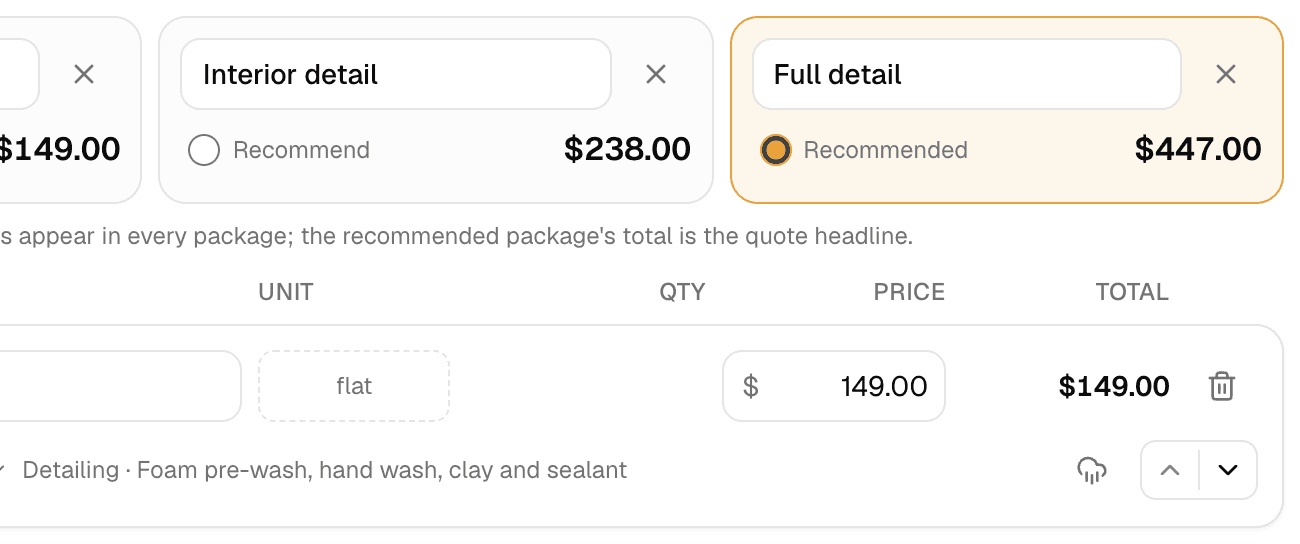
Charge the maintenance visit as a fraction of the full detail, set by minutes. If a sedan full detail takes 240 minutes and a maintenance visit 45, the visit is 45 ÷ 240 = 0.19 of the work, so a price near a fifth of the full detail is defensible. Price from cost first, then confirm the result sits under that ceiling; if it does not, the full detail is underpriced. The demo quote on the mobile detailing page shows two tiers on one quote, a flat $149 line for a wash, clay and sealant and a $447 Full detail package marked as the recommended one; those are demo numbers, not a market rate.
Vehicle size and service radius adjustments
Size changes the minutes and radius changes the drive, so adjust those inputs rather than the price. If the SUV takes 60 minutes against the sedan's 45 (your own stopwatch figures), its labor is a third higher and its price follows from the same formula. Price the drive as loaded labor plus the van's mileage, split across every vehicle at the stop: a two-vehicle household 5 miles out costs 10 miles and about 20 minutes, split in half, while a lone sedan 20 miles out carries 40 miles alone, about $30 of van at the IRS rate before labor.
Mobile detailing maintenance plan pricing: three ways to bill a plan
None of the three is a flat monthly charge that runs by itself; each bills a visit that happened or a pack the customer bought.
| Way to bill | What the customer sees | When money moves | If they skip a month |
|---|---|---|---|
| Invoice after each visit | One invoice per visit | When they pay it | No invoice |
| Autopay after each visit | A receipt from a saved card or bank | When the visit is marked done | No charge |
| Prepaid pack of visits | One invoice up front, sessions counted down | Once, up front | The session waits until the use-by date |
In MakeHay, a repeating job (Set up repeat, weekly or monthly) adds visits 60 days ahead, each marked Done or Skip, and Bill after each visit makes one invoice per visit (set up recurring service).
In MakeHay, turn on Autopay in the repeat settings and send the Email set-up link; the customer saves a card or bank account on Stripe's page, and Done & charge $X charges the visit and emails a receipt (set up autopay). Needs Stripe connected (US businesses).
Prepaid detailing packages: selling a pack of visits
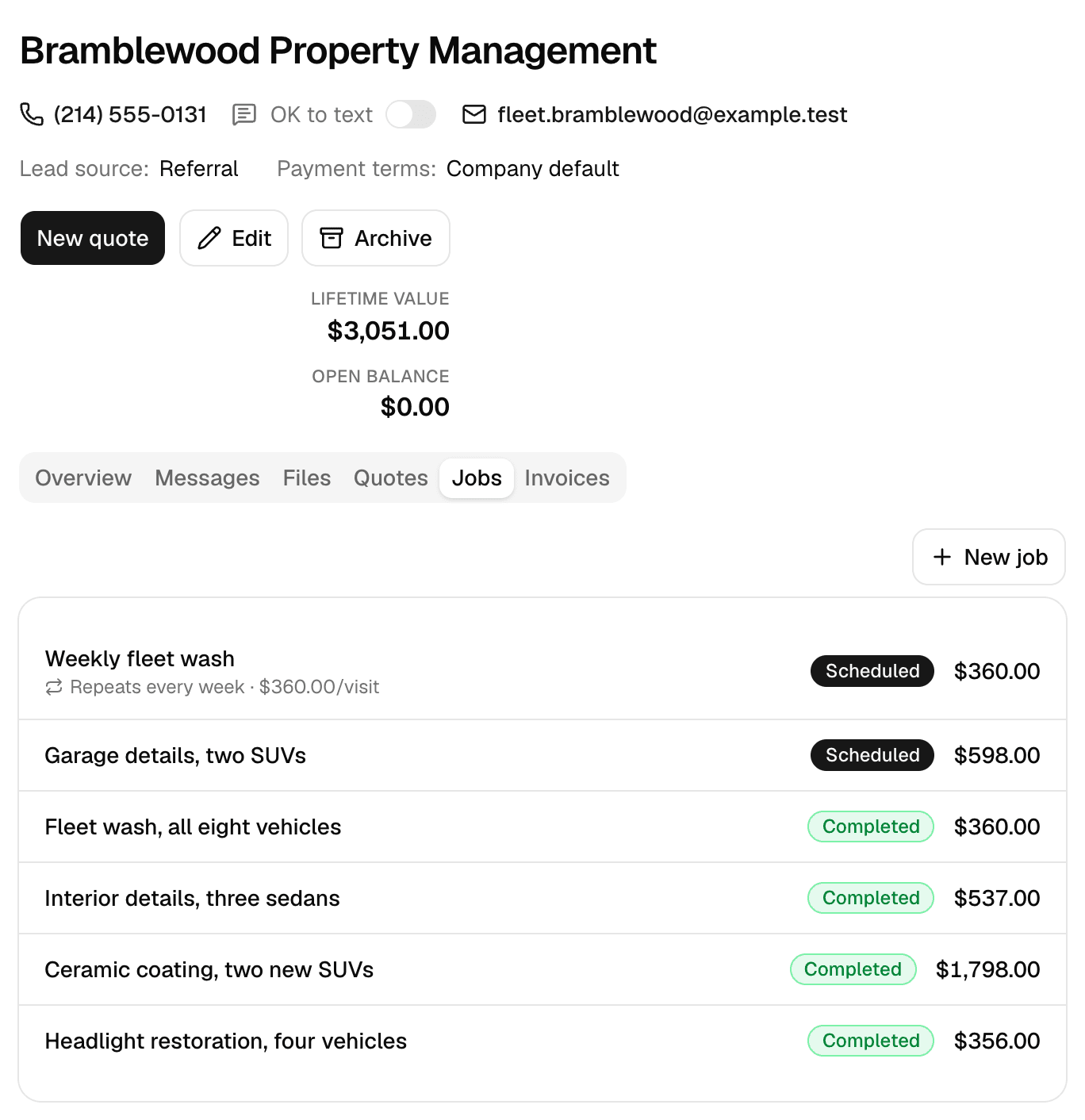
A prepaid pack is a service with a session count and a use-within window, sold once and used up visit by visit: one invoice, each visit marked done uses a session and is never billed again. The pack discount is yours to set; the example below takes a tenth off for paying a year ahead.
In MakeHay, the owner turns on Prepaid sessions under Settings › Advanced features; a pack is a service with Sessions in the pack, Use within (days) and Pack price, sold with Sell a pack from the customer's page, and sessions are added only when the invoice is paid in full (sell prepaid sessions).
Worked example: A sedan and an SUV, monthly maintenance for a year
- Loaded labor = wage × (1 + payroll share) = $17.23 × 1.0765 = $18.55 an hour.
- Sedan labor: 45 minutes (own input) ÷ 60 × $18.55 = $13.91.
- SUV labor: 60 minutes (own input) ÷ 60 × $18.55 = $18.55.
- Drive, 10 miles and 20 minutes round trip (own inputs): 20 ÷ 60 × $18.55 + 10 × $0.76 = $13.78, split two ways = $6.89 per vehicle.
- Water: 30 gallons sedan and 40 gallons SUV at $0.01 a gallon (own rate) = $0.30 and $0.40.
- Chemical (own input): $3 sedan, $4 SUV.
- Insurance per visit: ($54 + $46 + $131) ÷ 80 vehicle visits a month (own input) = $2.89.
- Sedan cost = $13.91 + $6.89 + $0.30 + $3 + $2.89 = $27; SUV cost = $18.55 + $6.89 + $0.40 + $4 + $2.89 = $33 (both rounded to the dollar).
- Price at a 50 percent margin = cost ÷ 0.5: $54 sedan, $66 SUV, $120 per stop.
- Year billed or autopaid after each visit: 12 × $120 = $1,440.
- Year as one 12-session pack per vehicle at 10 percent off (own input): (12 × $54 + 12 × $66) × 0.9 = $1,296.
- Year's cost: 12 × ($27 + $33) = $720; margin ($1,440 − $720) ÷ $1,440 = 50 percent per visit, ($1,296 − $720) ÷ $1,296 = 44 percent prepaid.
Result: $54 per sedan visit and $66 per SUV visit, $120 a stop; $1,440 for the year billed or autopaid after each visit, $1,296 as two prepaid packs, against $720 of cost.
Selling a plan in the driveway: the three terms and the 3-day rule
Sell the plan at the end of the first full detail, when the vehicle looks its best. Three terms go on every plan: the visit cadence (monthly, or every other week for a daily driver), what is excluded (clay, correction, extraction, pet hair and odor, coatings), and how it ends (a date, a visit count, or notice before the next visit).
A plan sold at the customer's home falls under the US Federal Trade Commission's Cooling-Off Rule, 16 CFR Part 429: a sale of $25 or more at the buyer's residence ($130 or more elsewhere) can be canceled until midnight of the third business day after the transaction. The seller must furnish a completed receipt or contract, hand over a Notice of Cancellation form in duplicate, tell the buyer orally of the right to cancel, and refund within 10 business days of receiving a cancellation (16 CFR 429.0 and 429.1); the deposit post covers the same rule for deposits.
Good to know: This is general information, not legal advice. Statutes and rules change; read the current text and ask your state licensing board or a lawyer before you rely on it.
Detailing packages pricing on one quote
Put the full detail and the maintenance visit on the same quote as two tiers, so the customer picks the heavy service now and sees the lighter one priced beside it: a flat price per vehicle class for maintenance, a package with its add-ons for the detail.
In MakeHay, the starter list prices "Full detail" as a Flat price line and "Fleet wash, per vehicle" as an Each line; a quote carries Good / Better / Best packages with one marked Recommend and a deposit paid by card at approval (offer packages).
FAQ
How much should a maintenance wash cost compared with a full detail?
Let the minutes decide. Divide the maintenance minutes by the full detail minutes and apply that fraction to the full detail price; a 45-minute visit against a 240-minute detail is about a fifth. Then price the visit from its own cost and margin and make sure it sits under that fraction.
Can you charge a customer's card automatically after each visit?
Yes, after each visit, not on a calendar. With autopay on a repeating job, the customer saves a card or bank account once, and marking a visit done charges that visit and emails a receipt. A month with no visit has no charge (set up autopay).
What happens if a customer skips a month?
Billed per visit or by autopay, a skipped visit is marked skipped with a reason and costs the customer nothing (mark a visit done or skipped). On a prepaid pack the session stays until its use-by date, so set a window long enough to absorb a vacation but short enough that the pack never becomes open-ended credit.
Sources
- National Wages: Cleaners of Vehicles and Equipment (O*NET OnLine, from BLS OEWS) · "Source: Bureau of Labor Statistics 2025 wage data" for the occupation, hourly: 10th percentile $13.17, 25th $14.62, median $17.23, 75th $19.73, 90th $22.89; the page reads "10% of workers earn $13.17 or less per hour." (accessed October 13, 2026)
- Topic no. 751, Social Security and Medicare withholding rates (Internal Revenue Service) · "The current tax rate for Social Security is 6.2% for the employer and 6.2% for the employee, or 12.4% total." "The current rate for Medicare is 1.45% for the employer and 1.45% for the employee." Wage base for earnings in 2026: $184,500. Page updated September 24, 2026. (accessed October 13, 2026)
- Standard mileage rates (Internal Revenue Service) · Business standard mileage rate: 76 cents per mile for July 1 to December 31, 2026; 72.5 cents per mile for January 1 to June 30, 2026; 70 cents per mile for 2025. (accessed October 13, 2026)
- WaterSense at Work, page 180, Vehicle Washing (US EPA, January 2017 web snapshot) · "Without reclamation, conveyor vehicle washing can use 65.8 gallons per vehicle (gpv) of fresh water during friction washing and 85.3 gpv of fresh water during frictionless washing. A reclamation system can reduce freshwater consumption to as low as 7.8 gpv during friction washing and 16.8 gpv during frictionless washing." In-bay: "from 60.0 gpv to as low as 8.0 gpv." Self-service: "the least amount of water, 15.0 gpv, on average." The page footnotes the figures to a study by Chris Brown (op. cit., p. 16). (accessed October 13, 2026)
- Water Conservation and Washing Vehicles (Maryland Department of the Environment) · "This means you use 100 gallons of water with only a 10-minute car wash." Its table of average water consumption in gallons per vehicle by car wash type lists a home wash with an automatic shut-off nozzle at 30 and without one at 100 (credited to WaterWiser, February 2003), self serve at 15 (International Car Wash Association and Mid-Atlantic Carwash Association), in-bay at 50 to 60 and conveyor at 66 to 85 (International Car Wash Association, Brown 2002). (accessed October 13, 2026)
- Auto Detailing & Car Wash Insurance Cost: Get Free Quotes (Insureon) · Read October 13, 2026. "Auto detailers and car wash businesses pay an average of $54 per month, or $646 annually, for general liability insurance"; a business owner's policy "$89 per month, or $1,073 per year"; workers' compensation "$131 per month, or $1,567 annually"; commercial auto "$46 per month, or $550 per year"; figures "sourced from the median cost of policies for car washes and auto detailers who apply for quotes with Insureon." (accessed October 13, 2026)
- 16 CFR Part 429, Rule Concerning Cooling-Off Period for Sales Made at Homes or at Certain Other Locations (2025 edition, GovInfo) · Section 429.0(a): a door-to-door sale has "a purchase price of $25 or more if the sale is made at the buyer's residence" or "$130 or more if the sale is made at locations other than the buyer's residence"; 429.1(a): "Fail to furnish the buyer with a fully completed receipt or copy of any contract pertaining to such sale"; 429.1(b): "a completed form in duplicate, captioned either 'NOTICE OF RIGHT TO CANCEL' or 'NOTICE OF CANCELLATION'", whose text reads "You may CANCEL this transaction, without any Penalty or Obligation, within THREE BUSINESS DAYS from the above date"; 429.1(e): inform each buyer orally of the right to cancel; 429.1(g): "Fail or refuse to honor any valid notice of cancellation by a buyer and within 10 business days after the receipt of such notice" refund all payments; the notice says payments "will be returned within TEN BUSINESS DAYS following receipt by the seller of your cancellation notice." (accessed October 13, 2026)
- Cooling-off Period for Sales Made at Home or Other Locations (Federal Trade Commission) · The rule provides that it is unfair and deceptive for sellers engaged in door-to-door sales valued at more than $25 to fail to provide consumers with disclosures regarding their right to cancel the sales contract within three business days of the transaction. (accessed October 13, 2026)