How Much to Charge for Sprinkler Blowout and When to Book
How much to charge for sprinkler blowout: a base plus per zone price from your minutes per zone, the compressor limits, and first freeze dates by town.
The MakeHay team · · 10 min read
Here is how much to charge for sprinkler blowout: a base fee for the drive and the hookup, plus a per-zone price built from the minutes a zone takes under the manufacturers' limits. Rain Bird's blow-out guide caps the air at 50 psi and any circuit at 2 minutes per cycle, two or more cycles per zone, so the minutes are known before you price them; the route runs between your town's first 32°F and first 28°F dates.
What a blowout costs you: minutes per zone and the drive
A blowout costs you minutes on site, which scale with the zone count, and the drive, which does not. Time three jobs and split the clock into a fixed part (park, hook up, shut the mainline, set the regulator) and a per-zone part (the air cycles and the switch); the base fee covers the first, the per-zone price the second.
The 2-minute rule and why zones take two cycles
Rain Bird's blow-out guide (October 20, 2025) says not to blow any circuit for more than 2 minutes at a time, since heat from the compressed air can damage pipes and components; switch zones, then repeat the cycle two or more times until only a fine mist leaves the heads. Two cycles are at most 4 minutes of air per zone, plus the switch; Rain Bird adds that running the air too long on gear drive rotors can melt the rotor head. K-Rain's page sets the limit at 1 minute at a time.
What size compressor to blow out sprinklers
K-Rain's page calls for a compressor delivering 20 to 25 cfm, air never above 50 psi and a pressure regulating valve; it warns that a small 2 hp shop compressor may not be adequate and that a high-pressure (120 psi), low-volume unit is the wrong tool. Rain Bird's blog goes bigger, a large compressor (50 to 70 gallons) holding 185 cfm or greater; one sentence there allows 75 to 85 psi for big lines, but its two step lists both set the regulating valve to 50 psi.
Colorado State University Extension's winterization page (reviewed August 2025) gives the sizing arithmetic: divide the zone's gallons per minute by 7.5 for the cfm needed, and hold the compressor at 40 to 80 psi, with 80 psi the maximum for rigid PVC and 50 psi for polyethylene (flexible black pipe). It also blows each zone out twice, in two short cycles. On poly all three pages agree at 50 psi.
A rented towable covers the biggest residential zone: Home Depot Rental listed a Doosan 185 cfm towable at $259 per day and $622 per week at its Williston, Vermont store on October 13, 2026 (the rate shows once a store is chosen). The regulator, not the machine, then sets the pressure.
How much to charge for sprinkler blowout: a base fee plus per zone
Charge a base fee for the drive and the fixed minutes, plus a per-zone price for the air cycles, each marked up as cost ÷ (1 minus your margin). The hourly cost is a wage plus the truck and compressor; for the wage floor, the BLS 2025 median for landscaping and groundskeeping workers is $18.82 per hour on O*NET (10th percentile $14.98, 90th $27.28).
| Zones | Minutes on site | With the drive | Cost | Price | Per zone |
|---|---|---|---|---|---|
| 4 | 50 | 90 | $66 | $109 | $27.25 |
| 8 | 70 | 110 | $80 | $134 | $16.75 |
| 12 | 90 | 130 | $95 | $158 | $13.17 |
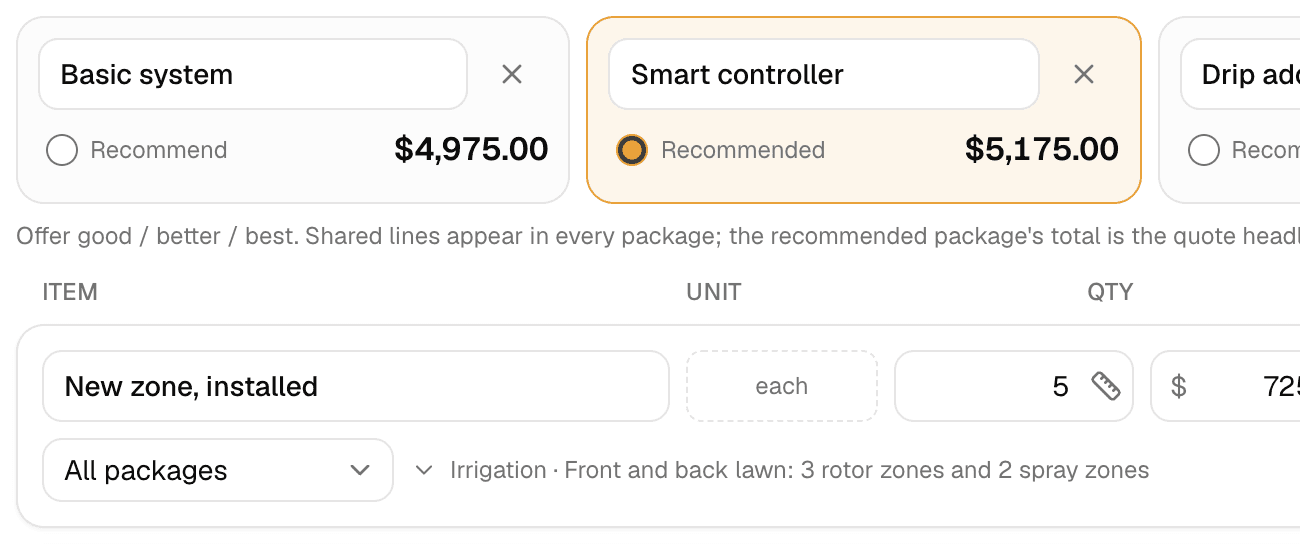
In MakeHay, a per-zone price is an Each line in the price book under Settings › Services (unit Each), so a quote carries the base fee as a Flat price line and the zones as a quantity (set up your services and prices).
Sprinkler blowout cost per zone in the consumer surveys
LawnLove's guide, a homeowner cost survey updated December 8, 2025, puts the national average at $60 to $145 and a blowout at $83.50 to $216.50, with three or more zones typically $26.50 per zone; its tiers run $50 to $75 for 1 to 2 zones up to $150 to $250 for 7 to 8.
Fixr's guide, a homeowner cost survey updated January 31, 2025, has a national average of $100 in a typical $75 to $150 range, $50 to $250 overall, and says specialists typically charge a flat rate for up to 6 zones and $8 per zone past that. The table's $109 and $134 sit inside both; if your margin needs more, raise the base fee first.
Worked example: An 8-zone residential blowout, 1 hour 10 minutes on site, 20 minutes of drive each way
- Minutes per zone: two cycles of at most 2 minutes (Rain Bird's limit) + 1 minute to switch = 5.
- On site: 30 fixed minutes + 8 zones × 5 = 70 minutes.
- Drive: 20 minutes each way = 40 minutes.
- Hourly cost = $18.82 BLS 2025 median wage + $25 truck and compressor (the example's own input) = $43.82.
- Base fee cost = (30 fixed + 40 drive) ÷ 60 × $43.82 = $51.12.
- Base fee = cost ÷ (1 minus a 40 percent margin) = $51.12 ÷ 0.6 = $85.
- Per-zone cost = 5 ÷ 60 × $43.82 = $3.65.
- Per-zone price = $3.65 ÷ 0.6 = $6.08.
- Job price = $85 + 8 × $6.08 = $133.64, so $134.
- Margin = $134 less a job cost of 110 ÷ 60 × $43.82 = $80.34, so $53.66, 40 percent.
- As a flat: $134 ÷ 8 zones = $16.75 per zone.
Result: $85 base plus $6.08 per zone, $134 for the 8-zone blowout ($16.75 per zone as a flat), with $53.66 of margin on $80.34 of cost.
When to winterize sprinklers: first 32°F and 28°F dates for your town
Winterize between the average first 32°F date, when calls start, and the average first 28°F date, the hard freeze that is the deadline. The US National Weather Service office for Kansas City publishes an average freeze table giving Kansas City a first fall freeze of October 28 and Princeton October 10; the NWS Blacksburg office's fall freeze page (a low at or below 32°F) gives Blacksburg October 10 and Roanoke October 22.
- Step 1: Open your NWS office's climate page (search weather.gov for your office and "first freeze") and read the average first fall freeze at 32°F for the nearest town.
- Step 2: Open NCEI's 1991 to 2020 normals search, find the nearest station and download its CSV (also in the by-station directory).
- Step 3: Read ANN-TMIN-PRBFST-T28FP50: in NCEI's readme the code is TnnFPmm, threshold and probability, so it is the date by which there is a 50 percent chance the first 28°F has come. Kansas City International reads October 24 for 32°F and November 1 for 28°F; Roanoke November 1 and November 12; Blacksburg October 19 and October 29.
In MakeHay, every scheduled visit carries the National Weather Service forecast for the job site's own coordinates about a week ahead, and a weather rule's Min temp °F during the service, set at 28, flags a visit whose forecast dips under it (US addresses only); see plan around the weather.
Filling the sprinkler blowout route from last year's list
Fill the route from last year's blowout customers first, this spring's startup customers second and the request form on your site third; the first two already know the price. Ask each for the zone count, which sets the price, and the backflow type.
In MakeHay, a request form (Settings › Request forms) takes the built-in "Job site address" question plus a Short answer question for the zone count and a Dropdown for backflow type, and Convert to customer + quote creates the customer, job site and draft quote in one click (take requests with a request form). Last year's blowouts set up as repeating jobs show under the Repeating filter on Jobs; visit reminders go the day before.
Backflow preventers, drip zones and the add-ons worth a line
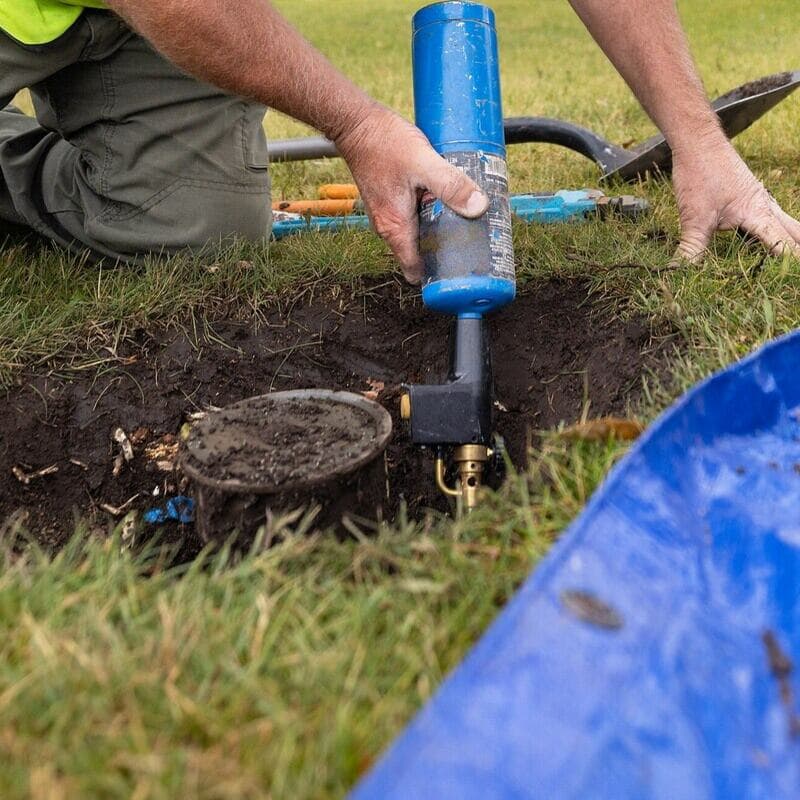
Colorado State's page says pressure vacuum breaker and reduced pressure backflow devices must never be blown out with compressed air and that their valves are left half open after the purge; Rain Bird's blog adds that the drained system gets its water source shut off and its valve boxes and backflow preventers insulated. So the backflow is a procedure, not an air cycle: price it into the base fee, and keep a backflow test, where a customer needs one, as its own line.
Drip zones have no heads to pop up, so the fine-mist check does not apply; time them separately and give them their own per-zone line if they run longer. A head or valve found broken is quoted before it is replaced, as an Each line.
Spring startup and fall blowout: the yearly pair on one job
Sell the fall blowout and the spring startup as one yearly pair, booked together, so the spring visit is on the calendar before anyone else quotes it. The spring visit reverses the fall one: water back on, the backflow valves closed from the half-open position Colorado State's page leaves them in, each zone run while the heads are checked. The other two-visit-a-year plan on this blog is gutter cleaning.
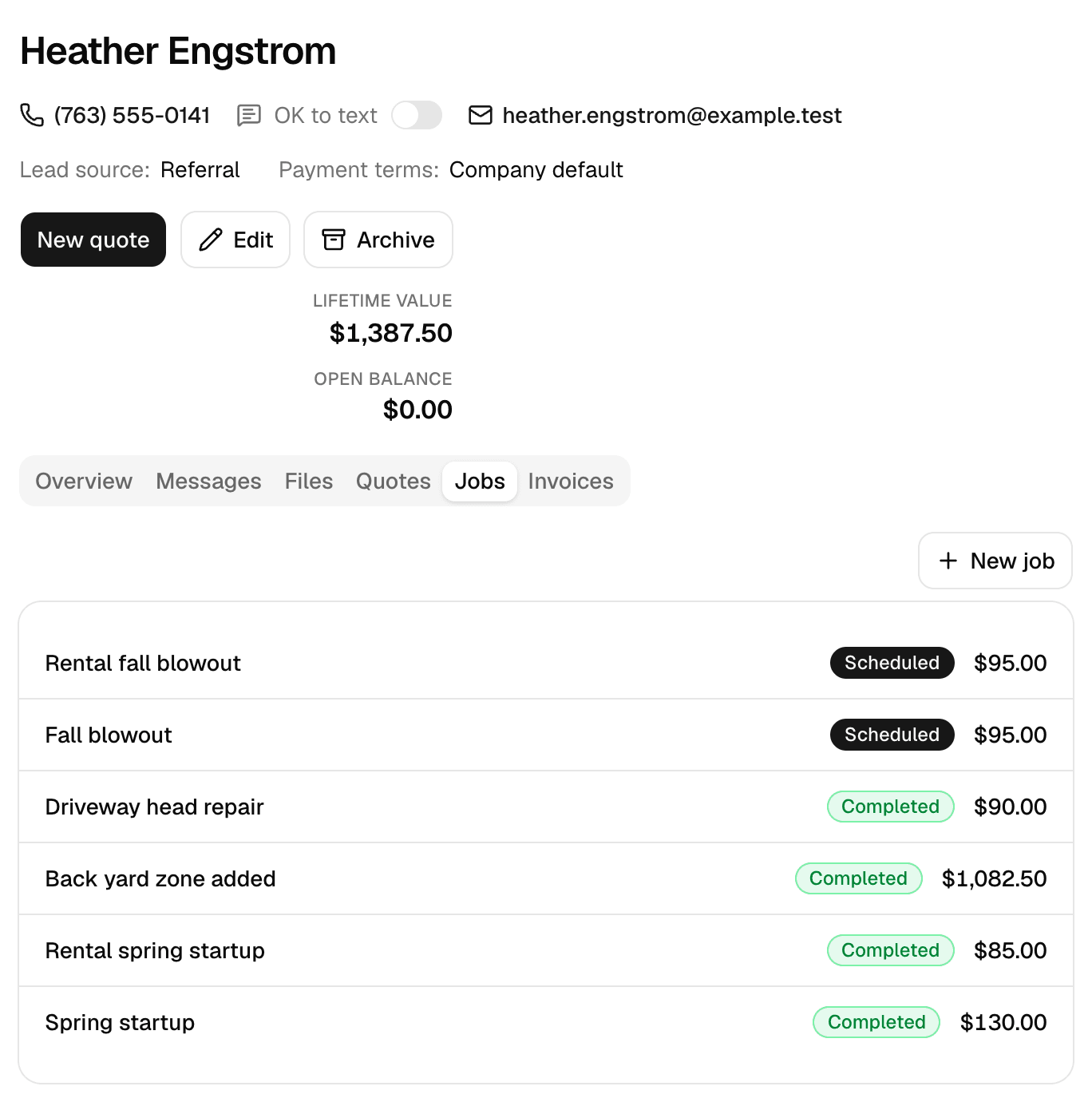
In MakeHay, the irrigation starter list carries "Spring startup" and "Fall blowout" as Flat price lines, "Rotor or spray head, replaced" and "Valve, replaced" as Each lines, and "Trenching" per linear foot. A repeating job (Set up repeat, every N weeks or months) adds visits 60 days ahead at the company's work hours; Bill after each visit makes one invoice per visit marked Done (set up recurring service), and autopay charges the saved card or bank account on Done & charge. There is no automatic yearly charge; the fall visit is billed when marked done.
FAQ
How much does a sprinkler blowout cost for one zone?
In the homeowner surveys, LawnLove (updated December 8, 2025) reports $26.50 per zone at three or more zones, and Fixr (updated January 31, 2025) a flat rate for up to 6 zones and $8 for each zone past that. Your own per-zone price comes from the minutes a zone takes, two cycles of at most 2 minutes plus the switch, at your hourly cost and margin, with the drive in the base fee.
Can you blow out sprinklers with a small compressor?
K-Rain's page says a small 2 hp shop compressor may not be adequate and calls for 20 to 25 cfm at no more than 50 psi through a pressure regulating valve; Rain Bird's blog wants 185 cfm or greater, still regulated to 50 psi. A compressor that cannot pop the heads up at 50 psi has too little volume; raising the pressure instead is what K-Rain warns against.
What if a freeze comes early?
Read the earliest dates, not the averages: the NWS Blacksburg page records a first freeze as early as September 5, 1982, and NCEI's T28FP10 element gives the date by which there is a 10 percent chance the first 28°F has come, October 19 at Kansas City International. Start at the 32°F average, keep open slots each week, and take above-ground backflow devices first.
Sources
- Fall is Blow-Out Season: Tips for Winterizing Your Sprinkler System (Rain Bird) · Posted October 20, 2025. The air pressure should not exceed 50 pounds per square inch (psi); recommends a large compressor (50 to 70 gallons) that can keep a continual flow of 185 cfm or greater; the same paragraph says the compressor should be regulated to provide 75 to 85 psi depending on the size of the lines, which contradicts the 50 psi rule, so the post quotes the rule and notes the sentence; both step lists set the pressure regulating valve on the compressor to 50 psi; open one valve before starting the air compressor; activate the circuit furthest from the air connection first; the airflow needed depends on the length of the pipes and the number of heads; do not blow any circuit for more than 2 minutes at a time, as heat from the compressed air can damage the pipes and other components; repeat the cycle two or more times until nothing more than a fine mist appears from the heads; leave one zone on while shutting off the compressor; running the air too long with gear drive rotors can heat the rotor wiper seal and melt the rotor head together; after draining, shut off the water source and insulate valve boxes and backflow preventers. (accessed October 13, 2026)
- Winterize and Blow Out Your Irrigation System (K-Rain) · Compressor must be capable of delivering 20 to 25 cubic feet per minute of air volume; air pressure must not exceed 50 pounds per square inch (psi); set the pressure-regulating valve on the compressor to 50 psi; a pressure-regulating valve must be used to avoid over pressurization; some small shop compressors (2 hp) may not be adequate; do not try to use an air compressor with high pressure (120 psi) and low volume; do not blow any circuit more than 1 minute at a time; repeat the cycle two or more times until nothing more than a fine mist appears from the heads. (accessed October 13, 2026)
- Home Sprinkler Systems: Preparing Your Sprinkler System for Winter (Colorado State University Extension) · Published October 2014, reviewed August 2025. Ideal pressures are in the range of 40 to 80 pounds per square inch (psi) for the air compressor, with 80 psi the maximum for rigid PVC pipe and 50 psi for polyethylene pipe (flexible black pipe); divide GPM by 7.5 to determine the cubic feet per minute (CFM) needed; each zone/station should be blown out twice; two short cycles per station beat one long cycle; pressure vacuum breaker (PVB) or reduced pressure (RP) backflow prevention devices must never be blown out with compressed air; after purging, leave all the valves on the backflow preventer half open. (accessed October 13, 2026)
- Average Last Spring/First Fall Freeze Dates (NWS Kansas City/Pleasant Hill, MO) · Table of average last spring and first fall freeze dates (32°F) by town with period of record: Kansas City (1888 to current) April 8 and October 28; Lexington (1892 to current) April 12 and October 21; Princeton (1893 to current) April 23 and October 10; Hamilton (1954 to present) April 26 and October 11. The 28°F hard-freeze dates on the page are maps, not text. (accessed October 13, 2026)
- Autumn Freeze Climate Information (NWS Blacksburg, VA) · A freeze is a low temperature at or below 32°F. Blacksburg (1952 to 2016): average first fall freeze October 10, earliest September 5, 1982, latest November 8, 2004. Roanoke (1912 to 2016): average October 22, earliest September 29, 1942, latest November 19, 2002. No 28°F data on the page. (accessed October 13, 2026)
- Readme: By-Variable and By-Station Normals Files, 1991 to 2020 (NOAA NCEI) · PRBFST is the date on which the first frost-freeze of the cold season will occur at the given probability and temperature threshold; the agricultural normals carry a temperature threshold and probability in the form TnnFPmm where nn is the temperature and mm is the probability (the example given is ANN-TMIN-PRBFST-T32FP10, a 10 percent probability of a temperature of 32 or less); the file lists ANN-TMIN-PRBFST-T28FP50 and ANN-TMIN-PRBFST-T32FP50. The readme's own wording of earliest versus latest is inconsistent, so the post says the date by which there is a given chance. (accessed October 13, 2026)
- Normals Annual/Seasonal 1991 to 2020, data search (NOAA NCEI) · NCEI's search page for the US Annual/Seasonal Climate Normals for 1991 to 2020 (it forwards to the dataset's page); the per-station CSVs the post reads are in the by-station directory listed next. (accessed October 13, 2026)
- US Climate Normals 1991 to 2020, annual and seasonal by-station files (NOAA NCEI) · Per-station CSVs read October 13, 2026. Kansas City International Airport (USW00003947): ANN-TMIN-PRBFST-T32FP50 10/24, T28FP50 11/01, T28FP10 10/19, 28 years. Roanoke Regional Airport (USW00013741): T32FP50 11/01, T28FP50 11/12, 30 years. Blacksburg NWSO (USC00440766): T32FP50 10/19, T28FP50 10/29, T28FP10 10/15, 26 years. (accessed October 13, 2026)
- National Wages: Landscaping and Groundskeeping Workers (O*NET OnLine, from BLS OEWS) · National hourly wages labeled Bureau of Labor Statistics 2025 wage data: 10th percentile $14.98, 25th $17.40, median $18.82, 75th $22.52, 90th $27.28. (accessed October 13, 2026)
- DOOSAN 185 CFM Towable Air Compressor Rental VSG (The Home Depot Rental) · Free-air delivery 185 cfm (air delivery 185 SCFM at 90 psi, maximum pressure 200 psi, 27 gallon tank). Rental pricing for Williston #4501 (Vermont) on October 13, 2026: $259 per 4 hours, $259 per day, $622 per week, $1,306 per 4 weeks, estimated and subject to change; the rate appears only after a store is selected. (accessed October 13, 2026)
- How Much Does it Cost to Winterize a Sprinkler System in 2025? (LawnLove) · Consumer cost survey updated December 8, 2025: the national average cost of sprinkler winterization is $60 to $145; a blowout typically costs $83.50 to $216.50; homeowners with three or more sprinkler zones typically pay $26.50 per zone; typical overall cost of winterization by zone count: 1 to 2 zones $50 to $75, 3 to 4 zones $80 to $100, 5 to 6 zones $100 to $130, 7 to 8 zones $150 to $250. (accessed October 13, 2026)
- Winterize Sprinkler System Cost (Fixr) · Consumer cost survey updated January 31, 2025: winterizing a sprinkler system costs between $75 and $150, with a national average of about $100; as low as $50 to inspect and manually drain a system with one or two zones and as high as $250 to inspect and blow out a system with seven to eight zones; most lawn care and irrigation specialists charge a flat rate between $50 and $150 good for draining up to 6 zones, and an additional $8 per zone beyond that. (accessed October 13, 2026)