How to Price Lawn Fertilization Per 1,000 Sq Ft (Bag Math)
How to price lawn fertilization per 1,000 sq ft: pounds of product from the bag's N percentage, cost per lawn, minutes per 1,000 sq ft, program pricing.
The MakeHay team · · 11 min read
How to price lawn fertilization comes down to the turf's square footage and four numbers per 1,000 sq ft: pounds of product (from the bag's nitrogen percentage), product cost (from a dated bag price), minutes (from your spreader) and a markup. Extension services already write the feeding rate in pounds of nitrogen per 1,000 sq ft, so the per-application price, the minimum and the program all come from the same unit.
How to price lawn fertilization: per 1,000 sq ft, not per visit
The per-visit price is the output: a per-1,000 sq ft rate times the turf area, with a minimum under it. Rutgers FS839 says lawn fertilizer recommendations are usually given in pounds of nitrogen per 1,000 square feet, and product, spreader time and the dealer's bag all scale with that same 1,000 sq ft. A flat price guessed from the street underpays the trip on a small yard and shorts the rate on a big one.
Step 1: Measure the turf, not the parcel
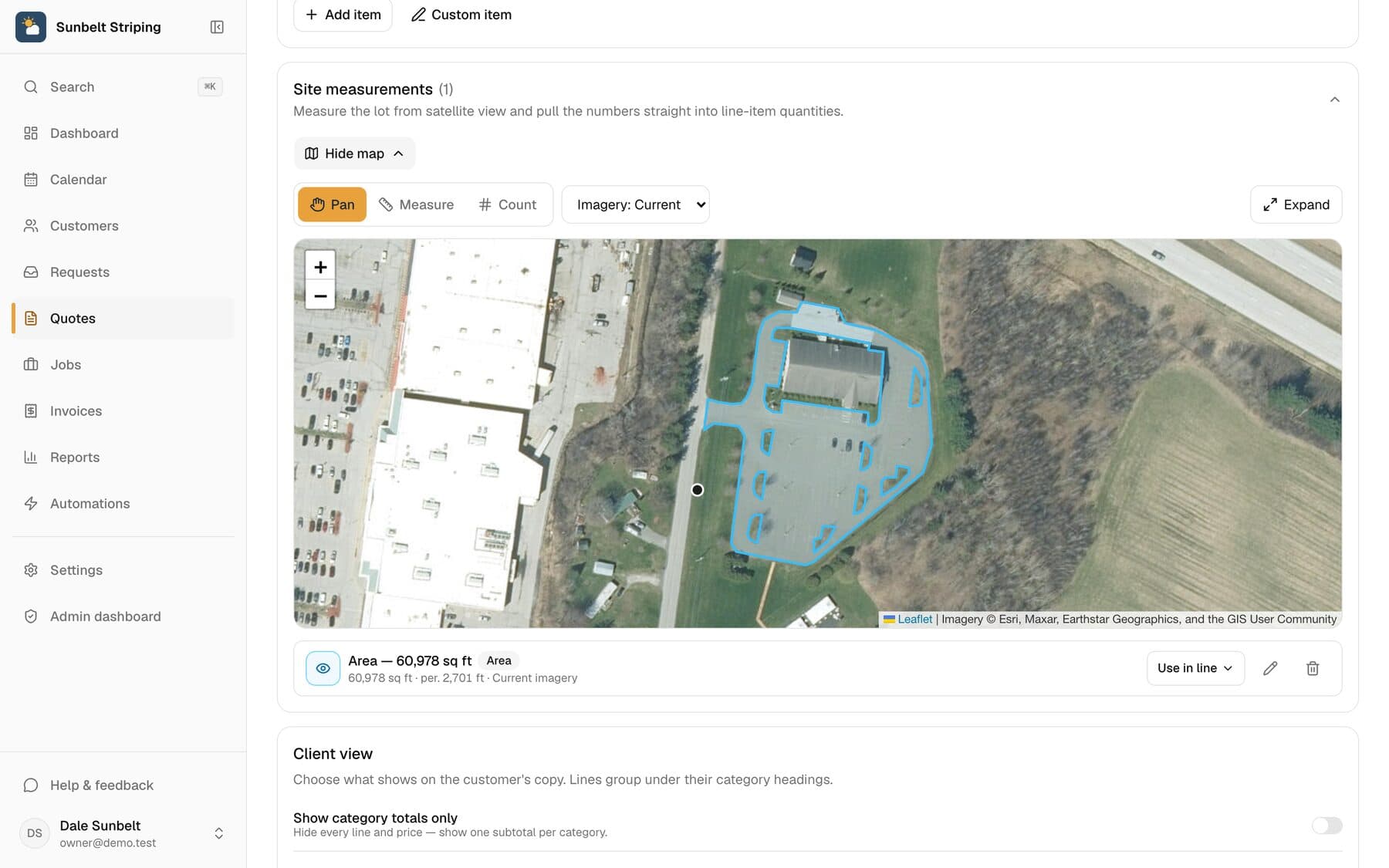
Trace the grass from satellite imagery and subtract everything that is not grass. Rutgers FS839 says to count only turf, not driveways, sidewalks or other non-turf areas; the same cut applies to beds, the house, a pool and a shed.
The free satellite measurement tool returns the square footage from a traced outline; Cut out removes beds and the house.
Step 2: How much fertilizer per 1000 sq ft: the bag's N percentage
Divide the nitrogen you want by the bag's nitrogen fraction. Penn State's turf fertilizer calculations page divides 1.0 lb of nitrogen per 1,000 sq ft by 0.26 to get 3.8 lb of 26‑5‑10. The first number on the bag is always the nitrogen percentage (Rutgers FS839), so for any grade, 100 divided by the N percentage is the pounds of product per 1,000 sq ft that carry 1 lb of nitrogen.
Why 1 lb? NC State Extension's lawn care page calls 1 lb of nitrogen per 1,000 sq ft a typical lawn feeding, and adds that many lawns do fine with 1 or 2 lb of nitrogen per 1,000 sq ft a year, which matters for the program below.
| Bag reads | Nitrogen | Product per 1,000 sq ft |
|---|---|---|
| 6‑2‑0 | 6% | 17 lb |
| 10‑10‑10 | 10% | 10 lb |
| 14‑3‑6 | 14% | 7 lb |
| 20‑5‑5 | 20% | 5 lb |
| 24‑6‑6 | 24% | 4.17 lb (NC State) |
| 26‑3‑4 | 26% | 4 lb, rounded |
| 26‑5‑10 | 26% | 3.8 lb (Penn State) |
| 35‑3‑5 | 35% | 3 lb |
Rutgers FS839 scales it to the lawn: multiply the per-1,000 figure by the lawn area divided by 1,000. Its example, 25,000 sq ft at 2 lb of nitrogen from a 25 percent bag, is 8 lb per 1,000 sq ft times 25, or 200 lb of product.
Step 3: How much does a bag of fertilizer cover, and what it costs
Bag coverage is the bag weight divided by the pounds per 1,000 sq ft. Penn State runs it for the 26‑5‑10 bag: 50 lb divided by 3.8 lb is 13.2, so a 50 lb bag covers 13,200 sq ft at 1.0 lb of nitrogen per 1,000 sq ft.
A label's coverage claim is the same arithmetic at the label's own rate, which is not always a full pound of nitrogen. Lawn Synergy's listing for a 50 lb bag of LESCO 24‑0‑11 showed $82.95 on October 13, 2026, covering 12,500 sq ft at its listed 4 lb per 1,000 sq ft; that rate is 0.96 lb of nitrogen (4 times 0.24). At a full 1 lb of nitrogen (4.17 lb) the same bag covers 12,000 sq ft. Price from the bag you buy, dated, because listings move.
Step 4: Minutes per 1,000 sq ft and the wage floor
Time the spreader, not the whole visit. Minutes per 1,000 sq ft is the minutes with the spreader running divided by the turf area in thousands. Spreader swath width times walking speed is a starting guess; a stopwatch on lawns you already know replaces it, the same minutes-per-unit method as pricing gutter cleaning per linear foot.
Then add the fixed minutes: drive time and loading. The wage floor is the BLS 2025 median for landscaping and groundskeeping workers, $18.82 per hour on O*NET, before payroll taxes, insurance, the truck and the spreader; the loaded rate you price with sits well above it.
Step 5: Lawn fertilization price per 1000 sq ft, with a minimum
The rate is product cost plus labor cost per thousand sq ft, marked up for overhead and profit. Under it sits a minimum per application, the fixed minutes (drive and loading) at your loaded rate, marked up, so a tiny lawn still pays for the trip.
Then check it against consumer cost guides. LawnLove's cost guide, a survey of prices homeowners paid, updated December 27, 2025, puts a professional application at $64 to $385 per visit including labor and $20 to $80 per 1,000 sq ft in its table. Fixr's cost guide, a consumer cost guide for homeowners updated January 31, 2025, puts a lawn at $200 to $500, average about $400 for roughly 10,900 sq ft, and the same $20 to $80 per 1,000 sq ft. Both are national prices paid, not your bag and your spreader: a sanity check, not the rate.
Worked example: A 6,800 sq ft lawn, one application, and a five-visit program
- Product per 1,000 sq ft from a 24 percent bag: pounds of product = pounds of nitrogen ÷ N fraction, so 1 lb ÷ 0.24 = 4.17 lb.
- Product for the lawn: 6.8 thousand sq ft × 4.17 lb = 28.4 lb.
- Cost per pound from the dealer listing: $82.95 ÷ 50 lb = $1.66 per lb.
- Product cost: 28.4 lb × $1.66 = $47.14, call it $47.
- Time (your own numbers): 20 minutes on site + 20 minutes of driving = 40 minutes.
- Labor at a loaded $45 per hour (your own number; the BLS 2025 median wage is $18.82 before payroll costs and the truck): 40 ÷ 60 × $45 = $30.
- Cost per application: $47 + $30 = $77.
- Price with a 75 percent markup for overhead and profit (your own number): $77 × 1.75 = $134.75, call it $135.
- Rate check: $135 ÷ 6.8 = $19.85 per 1,000 sq ft.
- Five-visit program, billed after each visit: 5 × $135 = $675.
Result: $19.85 per 1,000 sq ft, $135 per application for the 6,800 sq ft lawn, and $675 for the five-application program.
That sits a hair under the $20 per 1,000 sq ft floor of both consumer guides, which fits one dealer bag, a short visit and nothing but fertilizer. Weed control, a pre-emergent or lime add product and time, each as its own line.
Lawn treatment program pricing: four to six visits, billed after each
A program is the per-application price repeated on a calendar and billed as each visit is done. Price it as four to six visits a year, with the months set by your grass type, your extension service's schedule and your state's calendar (New Jersey bars nitrogen and phosphorus on turf before March 1, covered below). For irrigation customers the fall visit pairs with a sprinkler blowout.
Keep the season's nitrogen inside the budget. NC State's page says many lawns do fine with 1 or 2 lb of nitrogen per 1,000 sq ft a year; five visits at the full 1 lb each is 5 lb, so a five-visit program runs a lower rate per visit (2 lb ÷ 5 is 0.4 lb of nitrogen, or 1.7 lb of 24‑0‑11 per 1,000 sq ft) or makes some visits a weed control pass. Less product trims the product line, not the trip, which is why the minimum matters more on a program.
In MakeHay, a repeating job books the applications (monthly, Ends set to After a number of times); each visit is marked Done or Skip, and Bill after each visit makes one invoice per application; see set up recurring service. With autopay (US businesses), Done & charge charges the saved card or bank account; there is no automatic program charge. The suggested "Fertilizer and weed control" weather rule is max rain 30 percent, checked the day after at 30 percent, from the National Weather Service forecast (US addresses); see plan around the weather.
Prepaid sessions (Settings › Advanced features, off by default) sell a fixed number of applications up front, credited when the pack's invoice is paid in full; the detailing maintenance plan post covers packs.
The fertilizer applicator license your state may require
Your state may regulate who applies fertilizer to turf for pay. New Jersey does: a Rutgers Plant and Pest Advisory post from February 2013, Update on ProFACT, says all professionals need to be certified or trained to apply fertilizer to turf in New Jersey, and that nitrogen and phosphorus cannot be applied to turf there before March 1. It is a 2013 post; current training and exam details are on Rutgers' ProFACT site, profact.rutgers.edu. Elsewhere, ask your state's agriculture or environment department before the first paid application.
Good to know: This is general information, not legal advice. Statutes and rules change; read the current text and ask your state licensing board or a lawyer before you rely on it.
Putting applications on the quote
Each application is a per square foot line with the minimum in its description; each extra pass is its own line. In MakeHay, the lawn care starter list carries "Fertilizer or weed control application" as a Per square foot item and the saved measurement fills the quantity; the lawn care page demo quote prices mowing by lawn size at 6,800 sq ft.
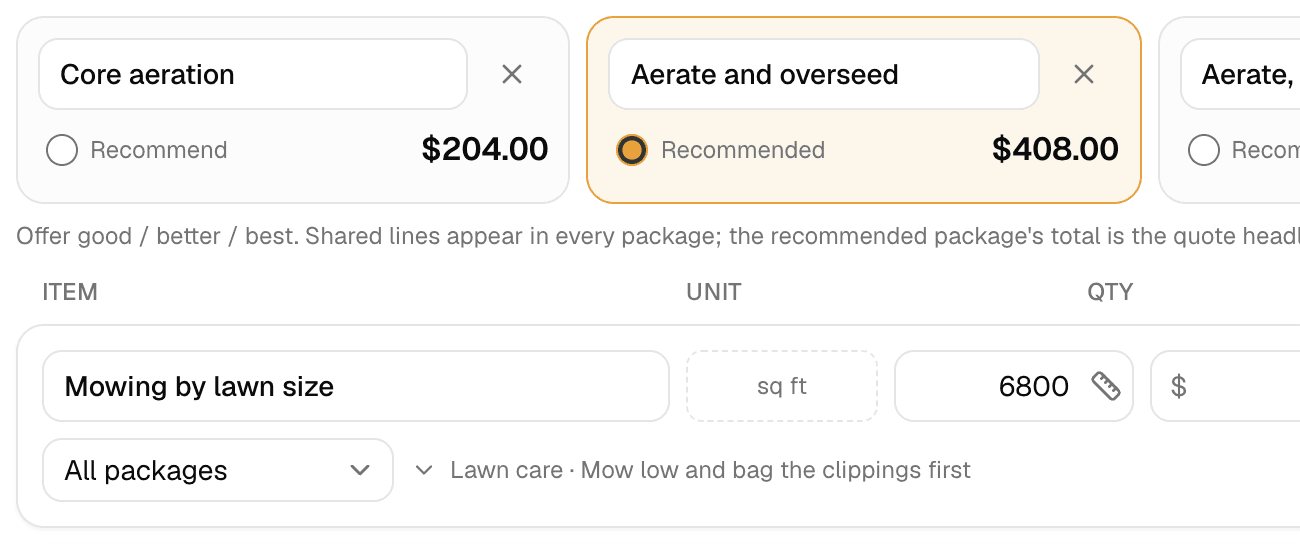
A per-1,000 rate becomes a per square foot price when you divide by 1,000: the $20 per 1,000 sq ft at the bottom of the LawnLove table is $0.02 per sq ft. The customer sees the square footage, the unit price and the minimum, which is the case for a bigger lawn costing more.
FAQ
How much should you charge per 1,000 square feet for fertilizer?
Build it from the bag and the clock: product per 1,000 sq ft (100 divided by the N percentage, in pounds) times cost per pound, plus your minutes per 1,000 sq ft at a loaded rate, marked up. The worked example lands at $19.85 per 1,000 sq ft and $135 per application; the LawnLove and Fixr consumer guides both table $20 to $80 per 1,000 sq ft.
How many applications does a lawn need a year?
Size it by nitrogen, not by visits. NC State Extension's lawn care page says many lawns will do fine with only 1 or 2 lb of nitrogen per 1,000 sq ft each year. A four to six visit program fits that when the nitrogen per visit is cut to match. Check your state's calendar; New Jersey bars nitrogen and phosphorus on turf before March 1.
Granular or liquid: which is easier to price?
Granular: the bag's N percentage, weight and price give product per 1,000 sq ft directly, and a rotary spreader is quick to time. Liquid is priced the same way from the label's rate per 1,000 sq ft and the jug's price, plus tank and hose time; the 1 lb of nitrogen convention is the same either way.
Do you need a soil test first?
It is the cheap way to avoid buying phosphorus and lime the lawn does not need. NC State's page says the soil test tells you how much phosphorus, potassium and lime you need, and that you may not need them at all. Rutgers and Penn State size the product from the nitrogen number alone, as the math above does.
Sources
- Calculations Used to Determine the Amount of Fertilizer Needed to Treat Turf (Penn State Extension) · Example 1: "divide the amount of nitrogen desired (1.0 lb nitrogen per 1000 sq ft) by the percentage of nitrogen in the bag (26%)"; "(1.0 lb nitrogen per 1000 sq ft) ÷ 0.26 = 3.8 lb of a 26‑5‑10 fertilizer" is needed to supply 1.0 lb nitrogen per 1000 sq ft. Example 3: "50 lb ÷ 3.8 lb = 13.2", "13.2 x 1000 sq ft = 13,200 sq ft", "Thus, a 50-lb bag of 26‑5‑10 covers 13,200 sq ft at a rate of 1.0 lb nitrogen per 1000 sq ft." Pounds of product per 1,000 sq ft and sq ft of coverage per 50 lb bag. (accessed October 13, 2026)
- FS839: How to Calculate the Amount of Fertilizer Needed for Your Lawn (Rutgers NJAES) · "Fertilizer recommendations for lawns are usually given in pounds of nitrogen to be applied per 1,000 square feet." "Nitrogen is always the first number in the three-number series listed on the fertilizer bag." Table 1 gives pounds of product per 1 lb of nitrogen by nitrogen percentage; 25 percent nitrogen needs 4 lb of product per 1 lb of nitrogen. Lawn area "should include lawn area only not areas covered by sidewalks, driveways, or other non-turf areas." Worked example: 2 lb of nitrogen per 1,000 sq ft with a 25 percent bag is 8 lb of product per 1,000 sq ft; a 25,000 sq ft lawn (5,000 sq ft front plus 20,000 sq ft back) needs 200 lb of fertilizer. (accessed October 13, 2026)
- Caring for Your Lawn and the Environment (NC State Extension) · "A typical lawn feeding is 1 pound of nitrogen per 1,000 square feet." Table 1, amount needed for 1 lb of nitrogen (rounded to the nearest pound): 6‑2‑0, 17 lb; 10‑10‑10, 10 lb; 14‑3‑6, 7 lb; 20‑5‑5, 5 lb; 26‑3‑4, 4 lb; 35‑3‑5, 3 lb. For a 24‑6‑6 bag: "1 ÷ 0.24 = 4.17. This is equal to a little more than 4 pounds of product." "Many lawns will do fine with only 1 or 2 pounds of nitrogen per 1,000 square feet each year." "Your soil test results will tell you how much phosphorus, potassium, and lime that you need." "Depending on the history of your soil, you may not even need to apply these nutrients!" (accessed October 13, 2026)
- Landscaping and Groundskeeping Workers, local wages (O*NET OnLine, Bureau of Labor Statistics 2025 wage data) · United States row, hourly median: "$18.82". "Workers on average earn $18.82 per hour." "Source: Bureau of Labor Statistics 2025 wage data." Read October 13, 2026. (accessed October 13, 2026)
- How Much Does Lawn Fertilization Cost in 2026? (LawnLove) · Consumer cost guide, updated December 27, 2025: "Professional lawn fertilization typically ranges from $64 to $385 per visit, including labor." "companies charge between $.02 and $.08 per square foot to fertilize a lawn." Table "Average cost per application": 1,000 sq ft, $20 to $80. The page says the guide draws data from a survey of fertilization prices across the U.S. Read October 13, 2026. (accessed October 13, 2026)
- Lawn Fertilization Cost | Lawn Treatment Prices (Fixr.com) · Consumer cost guide for homeowners, updated January 31, 2025: "The cost to fertilize a lawn ranges from $200 to $500, with a national average cost of $400" for a lawn "covering approximately 10,900 sq.ft."; $0.02 to $0.08 per sq ft, "most people spending about $0.04 per sq.ft."; table row 1,000 sq ft, $20 to $80. The page says it gathers figures from "a variety of pricing databases, licensed contractors, and industry experts." Read October 13, 2026. (accessed October 13, 2026)
- LESCO 24‑0‑11 Fertilizer (Lawn Synergy, online dealer) · Price $82.95 (shown beside a $89.99 regular price) for a 50 lb bag of LESCO 24‑0‑11; "50 lbs." "covers 12,500 sqft."; "Application Rate: 4 lbs per 1,000 sq ft"; free shipping on orders of $39 or more; online listing with no store shown, read October 13, 2026. (accessed October 13, 2026)
- Update on ProFACT (Rutgers Plant and Pest Advisory, February 20, 2013) · "Be advised that all professionals need to be certified or trained to apply fertilizer to turf in NJ." "Recall the that N & P fertilizer cannot be applied to turf (lawns, park, sports fields, etc.) in NJ before March 1st." Links to profact.rutgers.edu for training and exam details. A 2013 post, read October 13, 2026. (accessed October 13, 2026)