How to Price Tree Removal Per Inch of Trunk: Public Bid Data
How to price tree removal per inch of trunk diameter: measure DBH, read what cities pay per inch on public contracts, add crew hours, gear and the stump.
The MakeHay team · · 10 min read
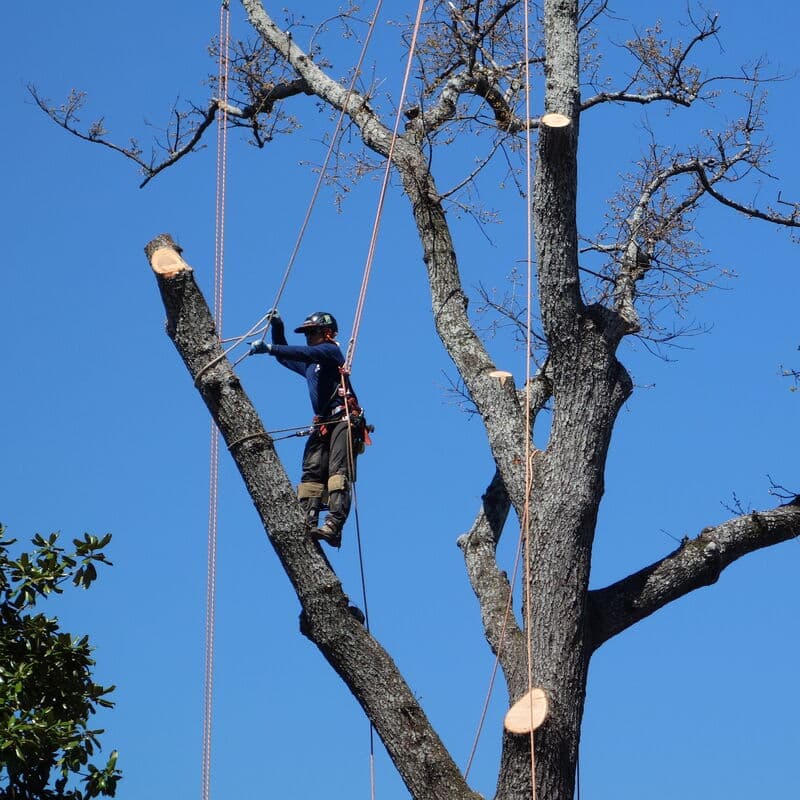
How to price tree removal starts with one measurement, the trunk diameter at 4.5 feet (DBH), and one choice: per inch, per size class, or from crew hours. Cities buy removals by the inch and by the size class under public contracts, so you can see what a removal is worth. This post reads two of them, then prices a 14-inch maple and a 30-inch oak both ways.
Why per-foot tree removal price lists online are made up
A per-foot price list names no buyer, no bid and no contract. Fixr's consumer cost guide (updated January 31, 2025) puts height or diameter charges at $2 to $5 per foot, which makes a 60-foot tree $120 to $300; no crew rolls a bucket truck for that. The two contracts below name the buyer, the rate and the inch it applies to.
How to measure DBH, height, drop zone and access
DBH is the trunk diameter at 4.5 feet above the ground. The City of Portland's measuring page says to read it with a diameter tape, or wrap a string and divide the circumference by 3.14. If the trunk splits below 4.5 feet, measure the smallest circumference below the lowest branch; a multi-stem tree counts the largest trunk in full plus half of each additional trunk. Then note the height, the drop zone and the truck and chipper access; those set the hours.
The free satellite tool at makehay.io/satellite-measurement-tool counts trees from above by tapping and measures the drop zone's area, but trunk diameter is a tape job. In MakeHay, a request form's built-in Job site address question and a Photo upload answer bring the trunk photo in before the visit; see Take requests with a request form.
How to price tree removal: per inch, per size class or crew hours
Quote with one method and check with another.
- Per inch: a rate per inch of DBH in two tiers (up to about 24 inches, and over), so a 14-inch tree at $50 per inch is $700.
- Per size class: one price for every tree in a band (up to 6 inches, 6 to 12, and so on), averaging the easy and the hard trees.
- Crew hours: people times hours times a wage, plus equipment, disposal, overhead and margin. The only method that sees the garage under the oak.
Tree removal cost per inch of diameter: what a city contract pays
The City of San Leandro, California pays West Coast Arborists, Inc. by the diameter inch under an agreement effective October 1, 2022, in the council's July 21, 2025 consent packet; cleanup and disposal are included in every line.
| Line | DBH | Rate |
|---|---|---|
| Tree only removal | 0 to 24 inches | $50 per inch |
| Tree only removal | Over 25 inches | $125 per inch |
| Tree and stump removal | 0 to 24 inches | $75 per inch |
| Tree and stump removal | Over 25 inches | $145 per inch |
| Stump grinding at grade | 15 inches and up | $35 per inch |
| 28-ton crane | Per hour | $169 per hour |
| Evening, weekend or holiday call-out | Per staff hour, 3-hour minimum | $139 per hour |
Read the jump between tiers, $50 to $125 per inch at the 25-inch line: a big tree is rigged down in pieces, not dropped.
Tree removal pricing per size class: an Oregon contract's bands
The City of Eugene, Oregon's hazardous tree removal contract with CTS, Inc. (a prevailing-wage price form in an August 17, 2010 amendment letter) pays per tree by diameter class, stump in its own column. The numbers are 16 years old; copy the structure.
| Class | DBH | Remove tree | Grind stump | Combined |
|---|---|---|---|---|
| A | Up to 6 inches | $124 | $27 | $151 |
| B | Over 6 to 12 inches | $249 | $45 | $294 |
| C | Over 12 to 18 inches | $373 | $63 | $436 |
| D | Over 18 to 24 inches | $496 | $90 | $586 |
| E | Over 24 to 30 inches | $745 | $108 | $853 |
| F | Over 30 to 36 inches | $869 | $117 | $986 |
| G | Over 36 to 42 inches | $993 | $152 | $1,145 |
Divide each band by its top inch and the rate barely moves: $124 for a 6-inch tree is about $21 per inch, $993 for a 42-inch tree about $24. The class price assumes the city hands you a row of them.
Why municipal prices understate a residential bid
A city rate is a volume rate, so a residential bid sits above it. The city supplies dozens of trees under one contract, street access for the truck and the chipper, no crane in the unit price (San Leandro's is a separate $169 an hour) and no lawn to restore. A homeowner buys one tree behind a house; price it higher and say why.
Fixr's consumer cost guide (updated January 31, 2025) runs from a $155 minimum for a small tree under 12 feet to $2,015 for a tree over 36 inches with the stump, above every band in the Eugene table.
Labor: crew size under Z133 and real hourly wages
Crew size follows the safety standard, not the quote. ANSI Z133 is the US safety standard for arboricultural operations; the International Society of Arboriculture announced the 2026 revision on June 4, 2026, and the standard itself is sold, not posted. Staff the job to it and count every person on site in the hours: the climber or bucket operator, the ground worker, and whoever a crane pick adds.
The wage has a public benchmark: the US Bureau of Labor Statistics 2025 median for tree trimmers and pruners is $24.50 an hour, the 10th percentile $18.24 and the 90th $38.61, read through O*NET. Burden and the truck sit in the example's overhead markup.
In MakeHay, the suggested tree service weather rule, "Climbs and crane picks", is max rain 30 percent, checked against the National Weather Service forecast for the job site's address (US addresses); see Plan around the weather.
Equipment lines: bucket, chipper, crane and haul-off
Each machine is an hourly line, and FEMA's 2025 Schedule of Equipment Rates is a public price for the machine alone (the operator runs through labor): brush chippers at $24.04 to $74.92 an hour by size, truck-mounted aerial lifts of 55 to 120 feet at $62.86 to $78.43 including the truck, truck-mounted cranes at $48.09 to $83.67.
A hired crane is a different number: San Leandro's contract carries a 28-ton crane at $169 an hour, so the crane company's quote is its own line. Haul-off is truck hours plus the dump fee, priced the way the plowing time guide prices a loader and a dump truck.
How much to charge for stump grinding per inch
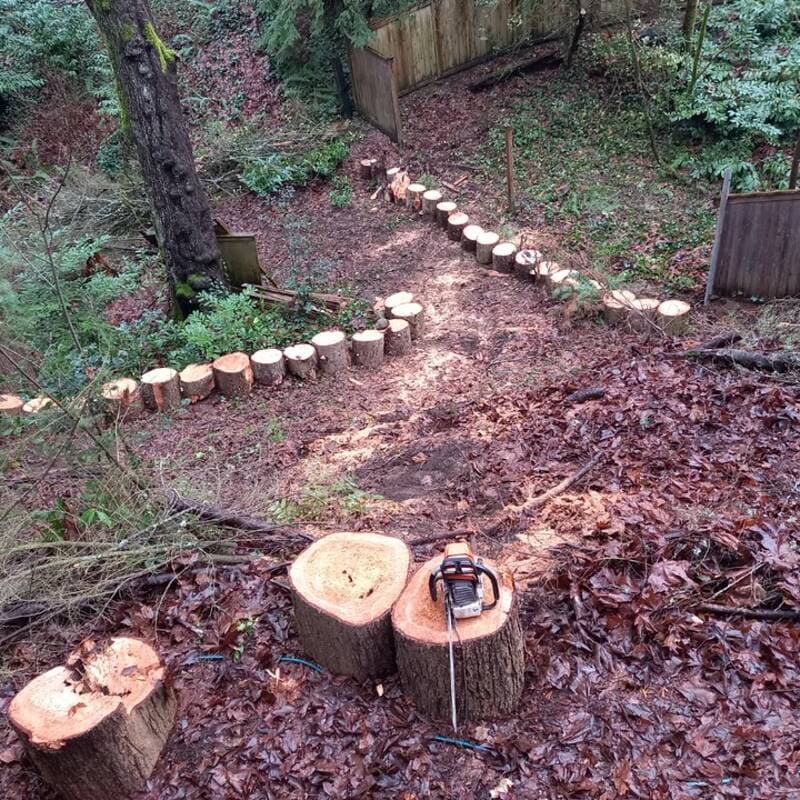
The stump is its own line, priced per inch of stump diameter at grade. San Leandro's contract pays $35 per inch for grinding; Eugene's 2010 classes grind a stump for $27 to $152 by band, about $3.25 to $4.50 per inch; and Falls City, Nebraska, which grinds stumps for residents, charged $3 per inch of stump width with a $30 minimum in 2023.
Write the stump as a separate item every time, because some customers want it left, and quote the fill and seed for the hole as a third line when they ask for it.
Worked example: A 14-inch maple with a clear drop and a 30-inch oak over a garage
- Maple, per inch: price = DBH × rate per inch = 14 inches × $50 (San Leandro's tree-only rate up to 24 inches) = $700.
- Maple, labor: 3 people × 3 hours × $24.50 per hour (the BLS 2025 median) = $221; hours are a placeholder for your timing.
- Maple, equipment at FEMA's 2025 rates: (chipper $29.70 + 55-foot bucket truck $62.86) × 3 hours = $278.
- Maple, direct cost = $221 + $278 = $499; haul-off is your own line on top.
- Overhead, with 25 percent as a placeholder for your accountant's figure: $499 × 1.25 = $624.
- Margin, with 20 percent as the placeholder: $624 ÷ 0.80 = $780.
- Maple check: $780 ÷ 14 inches = $55.71 per inch, just above the contract's $50.
- Oak, per inch: 30 inches × $125 (the over-25-inch rate) = $3,750.
- Oak, labor: 4 people × 8 hours × $24.50 per hour = $784.
- Oak, crane: 5 hours × $169 per hour (San Leandro's crane line; your crane quote replaces it) = $845.
- Oak, equipment: (chipper $29.70 + bucket truck $62.86) × 8 hours = $740.
- Oak, direct cost = $784 + $845 + $740 = $2,369.
- Oak, overhead and margin as one factor (1.25 ÷ 0.80 = 1.5625): $2,369 × 1.5625 = $3,702.
- Oak check: $3,702 ÷ 30 inches = $123.40 per inch, within $2 of the contract's $125.
Result: $55.71 per inch, $780 for the 14-inch maple; $123.40 per inch, $3,702 for the 30-inch oak with the crane; both before the stump line.
The methods part on access: per inch prices the oak on its trunk, crew hours price the crane. Quote from hours, then divide by the inches to check against the public tiers.
Tree service pricing guide on one quote: deposits, signatures and pay
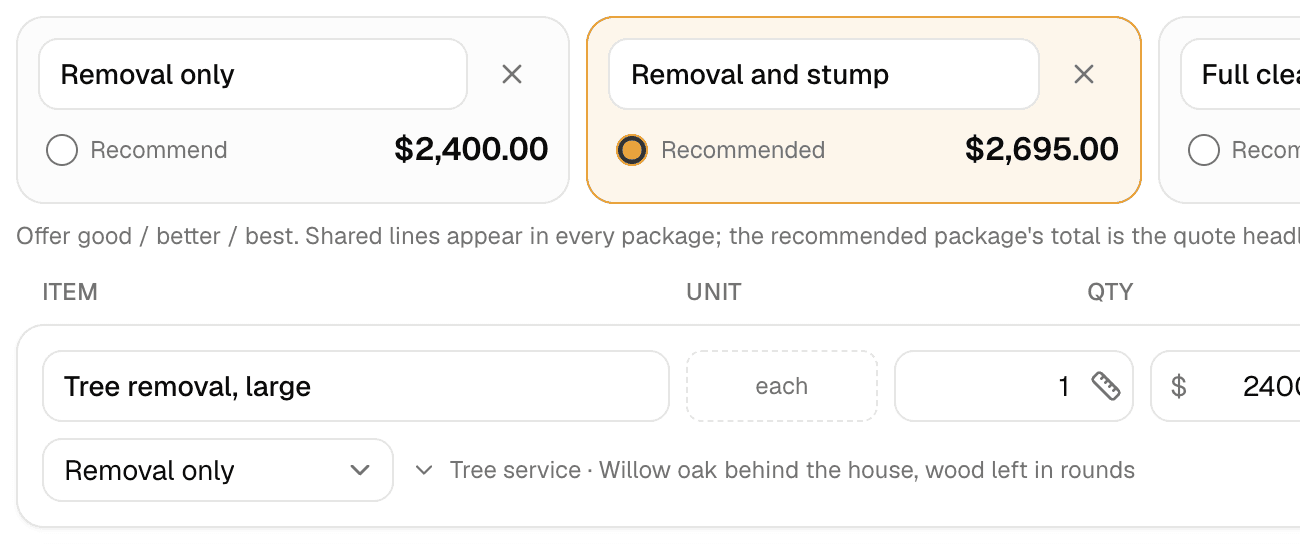
Put each item on the quote as its own line and offer the stump as a package the customer picks. In MakeHay, the tree service starter list under Settings › Services carries "Tree removal, by size class", "Stump grinding, by diameter" and "Crane, per hour" as Each lines and "Haul-away and chipping" and "Emergency storm call-out" as Flat price lines; the demo quote on the tree service page shows "Removal only" and "Removal and stump" side by side as Good / Better / Best packages.
A deposit as a percent or dollar amount is paid by card as the customer approves (how much to ask is in the deposit guide); a contract PDF can go out for an e-signature with a Certificate of Completion; and the invoice is paid online by card or ACH bank transfer into your own Stripe account (US businesses).
FAQ
Is tree removal priced per foot or per inch?
Per inch of trunk diameter at 4.5 feet, or per size class built on that inch. Public contracts use both: San Leandro pays $50 per inch up to 24 inches DBH and $125 over 25, and Eugene's 2010 contract paid one price per diameter class. Per-foot height figures come from consumer cost guides, not from buyers.
What does an emergency removal cost extra?
Price it by the hour with a minimum. San Leandro's agreement pays an evening, weekend or holiday call-out at $139 per staff hour with a 3-hour minimum; Fixr's consumer cost guide (updated January 31, 2025) says emergency work can run two to three times a standard removal.
Should the stump be a separate line?
Yes. Both contracts in this post keep it apart: San Leandro prices tree-only and tree-and-stump removal at different per-inch rates, with grinding alone at $35 per inch, and Eugene's classes carry a stump column of $27 to $152. A separate line lets the customer decline it and keeps the removal rate comparable.
Do I need a permit to remove a tree?
Often, and DBH is usually the trigger. Cities regulate street trees and trees above a size threshold, and some charge by the inch: Ann Arbor, Michigan's canopy loss fee for a city-owned street or park tree removed for a project is $252 per inch of DBH, less replacement caliper inches. Check the city's tree code first and put the permit on the quote as its own line.
Sources
- 5N Consent, City Council packet of July 21, 2025: Non-Professional Services Agreement between City of San Leandro and West Coast Arborists, Inc., Exhibit B Compensation Schedule (Laserfiche WebLink, plain text view) · Agreement effective October 1, 2022; "All applicable services include cleanup and disposal."; "Tree & Stump removal per dia. inch 0 to 24 inch dbh $75.00"; "Tree & Stump removal per dia. inch over 25 inch $145.00"; "Tree only removal per dia. inch 0 to 24 inch dbh $50.00"; "Tree only removal per dia. inch over 25 inch dbh $125.00"; "Stump grinding per dia. inch 15 to 48 inch dbh @ grade $35.00" and over 48 inch $35.00; "28-ton Crane $169.00" per hour; "Evening, Weekend, Holiday call-out $139.00" per staff hour, minimum 3.0 hours; piggybacked on the City of Burlingame contract; seen October 13, 2026. (accessed October 13, 2026)
- City of Eugene, Oregon, Hazardous Tree Removal contract with CTS, Inc., Amendment 3 letter of August 17, 2010 with the Price Form to Prevailing Wage (Laserfiche WebLink, plain text view) · "Unit price for tree removal by Diameter Class SUBJECT to prevailing wage rates", DBH at 4.5 feet, stump ground to a depth of 18 inches: Class A (up to 6 inches) $124.00 tree, $27.00 stump, $151.00 combined; Class B (over 6 to 12) $249.00, $45.00, $294.00; Class C (over 12 to 18) $373.00, $63.00, $436.00; Class D (over 18 to 24) $496.00, $90.00, $586.00; Class E (over 24 to 30) $745.00, $108.00, $853.00; Class F (over 30 to 36) $869.00, $117.00, $986.00; Class G (over 36 to 42) $993.00, $152.00, $1,145.00; Class H (over 42 inches) is not legible in the text view and is left out; standby rate $36.00 per hour; prices as of the 2010 document, seen October 13, 2026. (accessed October 13, 2026)
- How to Measure a Tree (City of Portland, Oregon) · "DBH refers to the tree diameter measured at 4.5 feet above the ground."; "Convert the circumference measurement to diameter by dividing the circumference by pi (3.14)."; multi-stemmed trees: "adding the total diameter of the largest trunk to one-half the diameter of each additional trunk", trunks connected above ground; angled trunks measured 4.5 feet along the center line; a trunk that splits below 4.5 feet is measured at the smallest circumference below the lowest branch; a branch or bump at 4.5 feet is measured slightly above or below. (accessed October 13, 2026)
- Tree Trimmers and Pruners: local wages (O*NET OnLine, Bureau of Labor Statistics 2025 wage data) · National hourly wages, "Source: Bureau of Labor Statistics 2025 wage data": median $24.50 per hour; "10% of workers earn $18.24 or less"; "10% of workers earn $38.61 or more"; annual median $50,960. (accessed October 13, 2026)
- ANSI Z133 (2026) Safety and Health Requirements standard is now available (International Society of Arboriculture newsroom, June 4, 2026) · Z133 "is a United States safety standard for use across the arboriculture industry"; the 2026 revision "for arborists and other workers engaged in arboricultural operations"; "is now available as of 27 May, 2026"; the page names no crew size, rescue, chipper or drop zone rule, so this post cites only that the standard exists and crews staff to it. (accessed October 13, 2026)
- Schedule of Equipment Rates (FEMA, applicable to disasters declared on or after July 1, 2025) · Hourly rates, equipment only: "Labor costs of the operator are not included in the rates and should be approved separately from equipment costs."; Chipper, Brush, Vermeer BC900XL $24.04, BC1000XL $29.70, BC1500 $54.11, BC1800XL $74.92; Aerial Lift, Truck Mounted, 55 ft $62.86, 80 ft $65.87, 100 ft $68.03, 120 ft $78.43, including truck; Crane, Truck Mounted, 19,000 lbs $48.09, 46,000 lbs $53.07, 60,000 lbs $83.67; Stump Grinder, Vermeer SC852 $55.28, SC1052 $56.33; Truck, Dump, 7 cubic yards $55.28 up to 18 cubic yards $147.99; seen October 13, 2026. (accessed October 13, 2026)
- Sanitation & Lawn Care in Falls City, NE (City of Falls City, Nebraska) · "For stumps located on private property, the City offers a stump grinding service."; "Measured the full-width of the stump at $3.00 per inch. ($30.00 minimum) for 2023"; "See most current annual fee resolution for current price."; seen October 13, 2026. (accessed October 13, 2026)
- Trees and Development (City of Ann Arbor, Michigan, Forestry) · "Any projects that propose the removal of a city-owned street or park tree will be required to pay a canopy loss fee."; "The current canopy loss fee rate is: $252/inch"; "The canopy loss fee is determined by subtracting the total caliper inches of replacement street trees from the total DBH", worked example (24 inches minus 6 inches) × $252 per inch = $4,536; seen October 13, 2026. (accessed October 13, 2026)
- Tree Removal Cost | Cost to Cut Down a Tree (Fixr.com, consumer cost guide) · Consumer cost guide, updated January 31, 2025 (the page says its figures come from pricing databases, contractors and industry experts, not from a buyer's contract): "The minimum cost for removal is $155 for a smaller tree under 12 feet."; "The maximum cost for removal is $2,015 for a very large tree, larger than 36 inches in diameter, including the stamp." (sic); "charges related to height or diameter run between $2 and $5 per foot on average"; stump grinding or removal "around $100 to $500 per stump"; emergency removal "could spend up to two or three times more"; its cost-factor percentages are opinion and are not reproduced. (accessed October 13, 2026)