How to Price Holiday Light Installation per Linear Foot
How to price holiday light installation: three models, roofline linear feet, C9 LED and wire cost per foot, labor by the hour, trees by height, removal.
The MakeHay team · · 11 min read
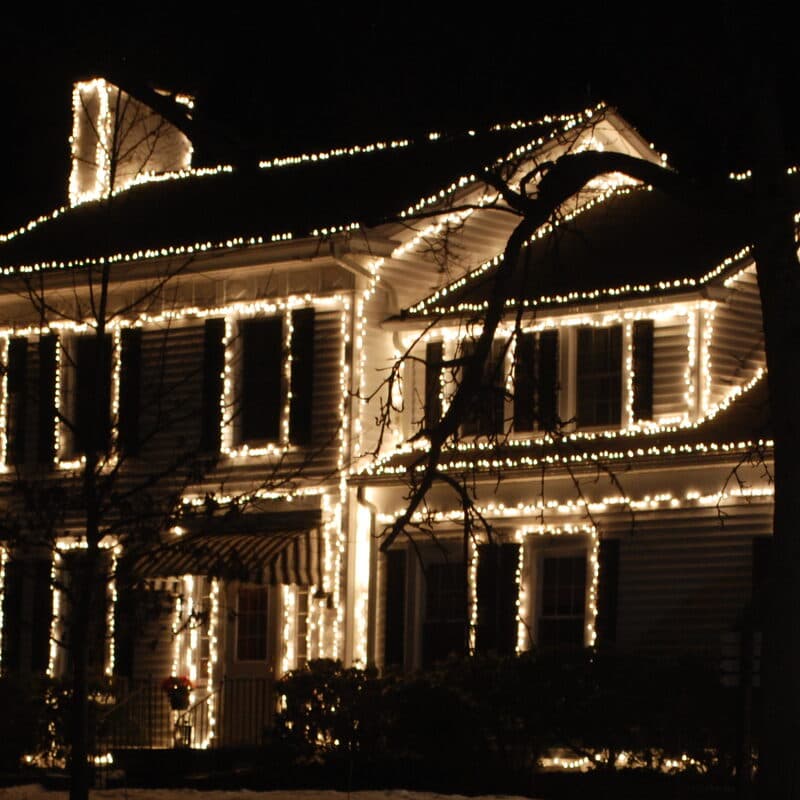
Here is how to price holiday light installation so the price per linear foot of roofline covers the lights, the labor, the ladder time and the January removal. Pick one of the three models, measure the roofline from satellite, price the parts from a supplier's page, put labor under it by the hour, and quote trees as their own lines.
Christmas light installation pricing starts with three models
The price depends on who owns the lights, so pick the model before the per foot number.
- Install only. The customer supplies the lights and pays for labor. The quote says every strand is tested on the ground and dead strands are set aside.
- Lease. You own commercial lights, install them, take them down and store them; the customer pays a season price, and the lights earn back their cost over several seasons.
- Sell and install. The customer buys the lights in year one at a markup and pays install and removal every year after.
For a market check, a homeowner survey from Fixr, updated January 31, 2025, puts roofline installation at $2 to $5 per linear foot for materials and labor, labor $1.50 to $3.50 of that, and $3.50 to $6 per foot on high or difficult roofs of about 16 feet or more. Those are homeowner numbers, not your cost; the rest of this guide builds the cost underneath them.
Measure the roofline in linear feet before you quote
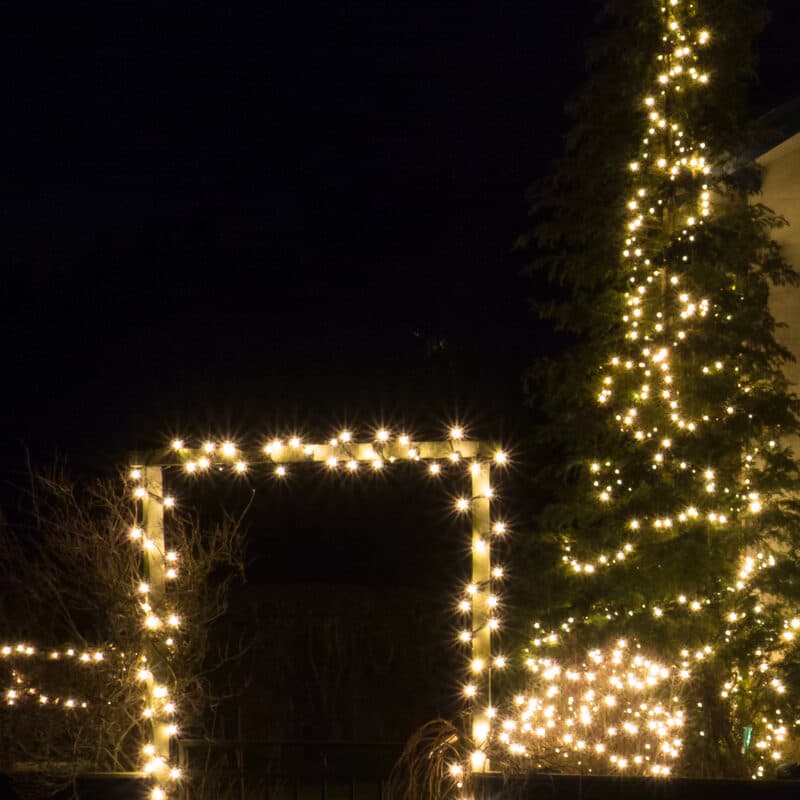
Roofline means every edge the lights follow: the eaves, the gable rakes, and the ridge if the customer wants it. Trace the eaves on satellite imagery, read the linear feet, and count the peaks; the free satellite tool does the trace with no account. A rake runs longer than it looks from above because the picture shows the footprint, not the slope, so add the rake from the pitch.
- Step 1: Trace the eaves and note the linear feet and the peaks the customer wants outlined.
- Step 2: Note the stories, the ground under each eave (grass, a slope, a deck, a bed) and where the outdoor outlets are.
- Step 3: Ask what the customer means by the roofline; for many it is the front only.
What the lights cost: C9 LED bulbs, socket wire and a timer
Commercial roofline work is C9 bulbs screwed into socket wire cut to the run. The Christmas Light Emporium lists a pack of 25 warm white faceted C9 LED bulbs at $33 on October 18, 2026, $1.32 a bulb: 0.84 watts each, UL listed for outdoor use, rated up to 60,000 hours. 1000Bulbs lists a 1,000 foot spool of C9 socket wire, 18 gauge SPT-1 with sockets at 12 inch spacing, at $424.76, about $0.42 a foot. Lights for Christmas lists a 15 amp photocell timer with two outlets at $11.00.
| Part | Listed price | Per foot |
|---|---|---|
| C9 socket wire, SPT-1, 12 inch spacing | $424.76 per 1,000 feet | $0.42 |
| C9 LED bulb, warm white faceted | $33 per pack of 25 | $1.32 |
| Photocell timer, 15 amp, two outlets | $11.00 each | one per house or circuit |
So a foot of lit roofline costs about $1.74 in parts before clips, plugs and cords from your supplier's invoice. Power math is short with LED: 0.84 watts a bulb means 100 bulbs draw 84 watts, about 0.7 amps at 120 volts, far under the timer's 15 amp rating. The supplier's tree guide says to start every run from a GFCI protected outdoor outlet and to limit daisy chaining, typically 3 to 4 sets before a new power feed.
How much to charge to hang Christmas lights: labor by the hour
Labor is the number the per foot price hides. The US Bureau of Labor Statistics puts the median pay for grounds maintenance workers at $19.27 an hour in May 2025, the closest published trade for a crew that hangs lights in the landscaping off season. Its employer costs release for June 2026 puts benefits at 30.0 percent of what private industry pays per hour worked, so a $19.27 wage costs about $27.53 an hour ($19.27 divided by 0.70) before the truck, the ladders and insurance. Fixr's survey puts an individual hired by the hour at $60 to $100; the gap pays for all of that. Time the job in crew hours (testing, ladder moves, clip work, cords, the walk around at dusk) and log the hours per foot from the first jobs.
Worked example: A 180 foot single story roofline, lease model, season one
- Roofline from the satellite trace: 180 linear feet, two gables (your own measurement).
- Socket wire: 180 feet × $424.76 ÷ 1,000 feet = $76.46.
- Bulbs: 180 at 12 inch spacing = 7.2 packs of 25, so 8 packs × $33 = $264. Timer: $11.00. Clips, plugs and cords: your invoice, left out here.
- Parts: $76.46 + $264 + $11 = $351.46, about $1.95 per foot.
- Labor: two people × 3 hours to install plus two people × 1.5 hours to take down (your own timing) = 9 crew hours × $27.53 = $247.77, about $1.38 per foot.
- Season one cost: $351.46 + $247.77 = $599.23, about $3.33 per foot before overhead, drive time and margin.
- Season two, lights already owned: $247.77 of labor plus replacement bulbs, about $1.38 per foot.
Result: About $3.33 per foot of cost in season one and about $1.38 per foot from season two. A lease price near the top of the survey's $2 to $5 per foot about breaks even in season one and earns from season two; a sell and install price puts the $351.46 of parts plus markup on the first invoice.
Wrap a tree with lights: price trees by the feet of string
Trees are priced by the feet of string they take and the time on a ladder. The Christmas Light Emporium's tree wrapping guide gives the formula: trunk circumference in inches divided by the gap between wraps in inches, times trunk height in feet, equals feet of string for the trunk. It recommends 3 to 4 inches between rows on trunks and 6 to 8 inches on branches; its example, a 30 inch trunk 6 feet to the first branch at 3 inch gaps, needs about 60 feet of string, times 1.5 to 2 for the canopy.
Put each tree on the quote as its own line with its height, the wrap spacing and whether branches are included. Fixr's survey gives the homeowner side: $75 to $125 of labor for a small tree of about 6 feet, $125 to $250 for 12 to 18 feet, $300 to $1,500 for a 28 foot tree, and $400 to $700 for a lift. Your line is your feet of string times your cost per foot, plus the hours.
Takedown and storage belong on the quote
Removal is the half of the job that gets forgotten in November and done in the cold in January. Fixr's survey says removal costs $125 to $350 per project or $0.50 to $0.65 per linear foot, and that most companies include it in the installation package. Include it and say so on the quote.
In a lease the lights are yours, labeled by customer and kept in your space, so next season starts with a box. In sell and install the customer keeps them; offer storage as a line. Either way, write the removal window on the quote.
Ladders, cords and the safety lines in the quote
The US Consumer Product Safety Commission estimated 15,000 holiday decorating injuries seen in emergency departments in November and December 2012, with falls the most common incident at 34 percent. That risk is the reason a customer pays a crew; price the ladder work and do it to the rule.
Under US OSHA's construction ladder rule, 29 CFR 1926.1053, a portable ladder reaching an upper landing extends at least 3 feet above it; a leaning ladder is set so the distance from the top support to the foot is about one quarter of the working length; ladders go only on stable and level surfaces unless secured; each worker keeps one hand on the ladder and carries no load that could cause a fall; and the top of a stepladder is not a step.
For the lights, CPSC says to check that outdoor lights carry a label certifying them for outdoor use, to plug them only into a GFCI protected receptacle or a portable GFCI, to discard sets with cracked sockets, frayed wires or loose connections, and to use extension cords rated for the job. Its holiday safety center adds: never string together more than three sets of incandescent lights, and never overload outlets. Write the rating of what you install on the quote, and name your general liability and workers' compensation coverage in one line.
Good to know: This is general information, not legal advice. Rules change; read the current text and ask your insurance agent, state licensing board or a lawyer before you rely on it.
The season: install dates, removal dates and the calendar
Installs run from late October through the week after Thanksgiving, lights stay up through New Year's, and removals fill January. That makes the calendar the pricing tool: a crew that hangs four houses a day in early November hangs two in December sleet, so the customer who books in October gets a date and the late caller gets a waiting list.
In MakeHay, the quote is a per linear foot line for the roofline plus per item lines for trees, wreaths and the timer, with install and removal as two visits on one job on the calendar; the weather overlay flags a visit from a rule you set, such as rain or cold, so a ladder day moves before the crew is in the truck (plan around the weather). Good/better/best packages put the three models side by side on one quote, and a deposit covers the lights bought in October for a November install.
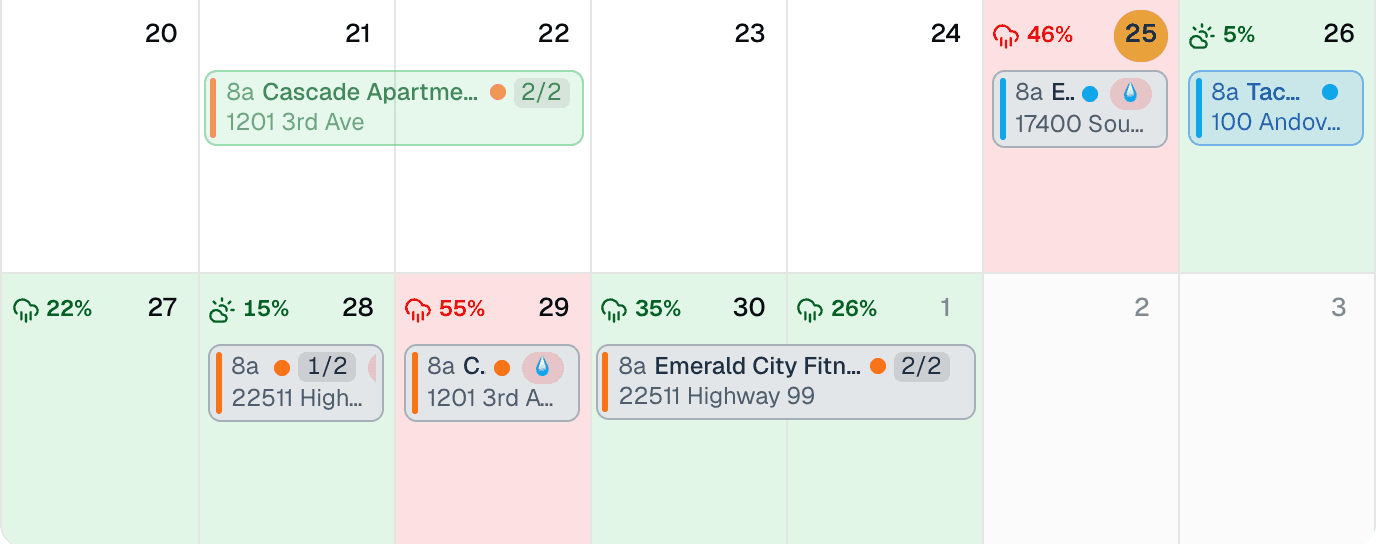
Install and removal as two visits on one job, with the forecast on the day.
Keep the roofline feet, the bulbs bought, the crew hours and the removal date on the job, so the renewal quote in September is a copy with a new date.
FAQ
How much should you charge to install the customer's own lights?
Labor plus a testing line. Price the crew hours from your wage and benefits cost, about $27.53 an hour for a $19.27 wage with benefits at 30 percent, and add the time to test someone else's strands. Fixr's homeowner survey puts an individual hired by the hour at $60 to $100.
How do you start a holiday lighting business from a landscaping or washing crew?
With the crew, the ladders and the truck you already have. The BLS handbook page for grounds maintenance workers says some of the work is seasonal and that workers provide other services in the winter months; lighting fills the gap between the last cleanup and the first plow.
Should holiday lights be leased or sold to the customer?
Lease if you want the repeat. In the worked example, season one costs about $3.33 per foot with the parts and about $1.38 per foot from season two. Sell and install if the customer wants to own the lights or you have nowhere to store them.
Is removal included in holiday light installation prices?
Usually. Fixr's homeowner survey says most companies include removal in the installation package and prices it on its own at $125 to $350 per project or $0.50 to $0.65 per linear foot. Include it and count its hours.
Sources
- Fixr: How Much Does It Cost to Install Christmas Lights? · Homeowner survey: roofline installation $2 to $5 per linear foot for materials and labor, labor $1.50 to $3.50 and strands $0.50 to $1.50 per foot, $3.50 to $6 per foot on high or difficult roofs of about 16 feet or more; trees: small (about 6 feet) $75 to $125 labor, medium (12 to 18 feet) $125 to $250, huge (28 feet) $300 to $1,500, a lift $400 to $700 for a one day job; about $60 to $100 per hour for an individual hired by the hour; removal $125 to $350 per project or $0.50 to $0.65 per linear foot and "Most companies include the cost for removal in the installation packages"; rentals $200 to $600 with installation; updated January 31, 2025. (accessed October 18, 2026)
- The Christmas Light Emporium: C9 Warm White Faceted ProCore LED Christmas Light Bulbs, pack of 25 · $33 for a pack of 25; 0.84 watts per bulb; E17 intermediate base; 120 volts; indoor/outdoor, IP67, UL listed for indoor and outdoor use; rated life up to 60,000 hours; listing as shown October 18, 2026. (accessed October 18, 2026)
- 1000Bulbs: 1000 ft., 12 in. socket spacing, 18 gauge copper C9 Christmas light string spool · $424.76 each; 1,000 feet; 1,000 intermediate (E17) sockets at 12 inch spacing; SPT-1, 18 AWG copper; suitable for indoor/outdoor use; bulbs not included; listing as shown October 18, 2026. (accessed October 18, 2026)
- Lights for Christmas: Photocell Timer, 15 amp, 2 outlets · $11.00; 15 amps maximum load at 110/120 volts; two outlets; six settings: always on, dusk to dawn, and 2, 4, 6 and 8 hour timers; UL rated; listing as shown October 18, 2026. (accessed October 18, 2026)
- The Christmas Light Emporium: How to Wrap Trees With Christmas Lights · Formula "(trunk circumference in inches ÷ spiral gap in inches) × trunk height in feet = feet of light string for the trunk"; "For trunks, 3 to 4 inches between rows"; "Branches look best at 6 to 8 inches"; example of a 30 inch circumference trunk, 6 feet to the first major branch, at 3 inch gaps, "about 60 feet of string"; "multiply by 1.5 to 2x for the canopy"; start from a GFCI protected outdoor outlet; "typically 3 to 4 sets daisy-chained before you need a new power feed". (accessed October 18, 2026)
- US Bureau of Labor Statistics, Occupational Outlook Handbook: Grounds Maintenance Workers · Median pay $19.27 per hour (May 2025), $40,080 per year; 1,299,200 jobs in 2025; "Some work is seasonal, available mainly in the spring, summer, and fall" and workers may "provide other services during the winter months, such as snow removal". (accessed October 18, 2026)
- US Bureau of Labor Statistics: Employer Costs for Employee Compensation, June 2026 · Private industry workers, June 2026: total compensation $46.89 per hour worked; wages and salaries $32.82, 70.0 percent; benefits $14.07, 30.0 percent; released September 9, 2026. (accessed October 18, 2026)
- OSHA: 29 CFR 1926.1053, Ladders · (b)(1): portable ladder side rails "shall extend at least 3 feet (.9 m) above the upper landing surface"; (b)(5)(i): non self supporting ladders set so "the horizontal distance from the top support to the foot of the ladder is approximately one-quarter of the working length"; (b)(6): "Ladders shall be used only on stable and level surfaces unless secured"; (b)(9): "The area around the top and bottom of ladders shall be kept clear"; (b)(13): "The top or top step of a stepladder shall not be used as a step"; (b)(21): at least one hand to grasp the ladder when climbing; (b)(22): no object or load "that could cause the employee to lose balance and fall". (accessed October 18, 2026)
- US CPSC: CPSC Estimates More Than 15,000 Holiday Decorating Injuries During November and December · Release dated December 5, 2013: an estimated 15,000 injuries involving holiday decorating seen in emergency departments in November and December 2012; falls 34 percent, lacerations 11 percent, back strains 10 percent; check outdoor lights for a label certifying them for outdoor use and plug them only into a GFCI protected receptacle or a portable GFCI; inspect sets for broken or cracked sockets, frayed or bare wires, or loose connections and discard damaged sets; extension cords rated for their use and free of cuts or fraying; "Heed the warning labels on ladders." (accessed October 18, 2026)
- US CPSC: Holiday Safety Education Center · Holiday decorating tips: "Never string together more than three sets of incandescent lights and never overload electrical outlets"; undated tips page. (accessed October 18, 2026)