Sealcoating Temperature Requirements, Rain and Cure Time
Sealcoating temperature requirements from data sheets and public specs: air and pavement temperature, rain window, dry time and a go or no-go routine.
The MakeHay team · · 11 min read
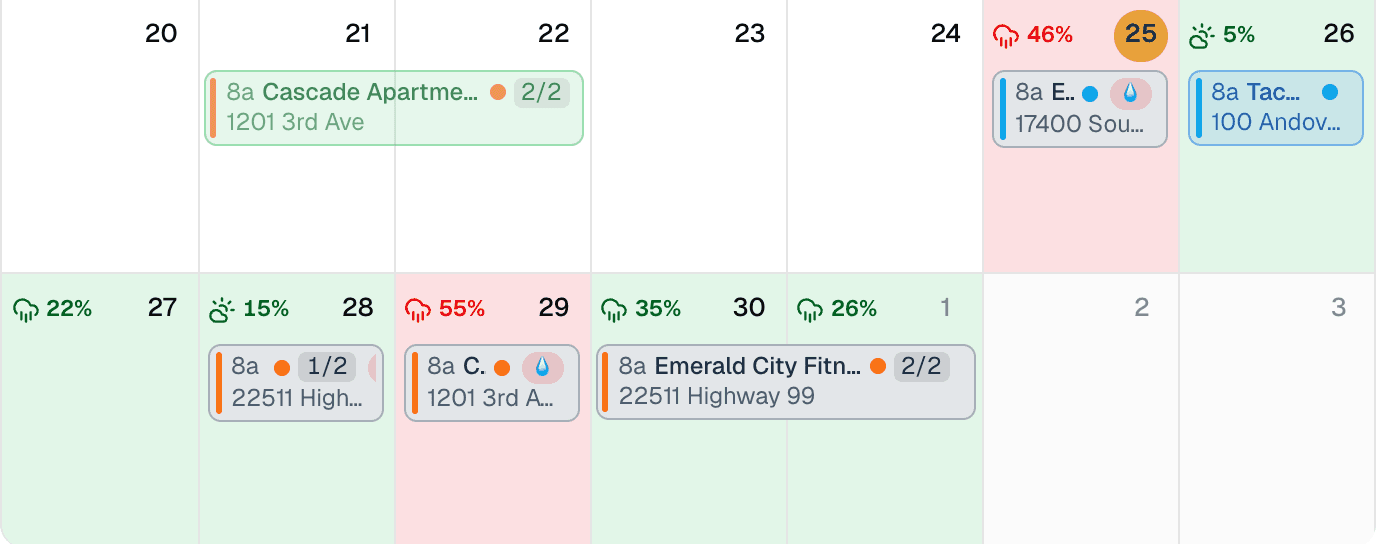
Sealcoating temperature requirements are three numbers on the sealer's data sheet: pavement surface and air at 50°F and rising while you apply, no drop below 50°F in the 24 hours after, and 24 hours before the lot opens to traffic. SealMaster's MasterSeal Concentrate TDS prints all three, and the maker's engineering specification adds a fourth rule, no rain forecast within 24 hours. This page collects those limits, the striping paint and crack filler limits, how to read the forecast for the day after, and a morning go or no-go routine.
Sealcoating temperature requirements on the sealer data sheet
All three numbers have to pass: the temperature floor, the hours it must hold, and the hours before the lot opens. The table puts each limit beside the document that prints it; the paint, crack sealant and new asphalt rows get their own sections below.
| Limit | Number | Where it is printed |
|---|---|---|
| Surface and air temperature while applying | 50°F minimum and rising | MasterSeal TDS; specification 6.2 |
| Temperature after the last coat | No drop below 50°F for 24 hours | MasterSeal TDS; specification 6.2; FAQ |
| Rain | None forecast within 24 hours | Specification 6.2; FAQ |
| Dry time | 2 to 6 hours at 73.4°F and 50% humidity; each coat dry before the next | MasterSeal TDS |
| Vehicle traffic | 24 hours after the final coat | MasterSeal TDS; specification 6.3; FAQ |
| Traffic marking paint | 24 hours after the sealer; then 50°F surface and air, held 24 hours | Specification 7.3; traffic paint TDS |
| New asphalt before its first sealcoat | 30 to 60 days, and no oil film when water is poured on it | Specification 4.1; FAQ |
| Crack sealant | Above the maker's minimum pouring temperature, on dry pavement | MnDOT Crack Sealing 101 |
Pavement temperature versus air temperature
Both readings count, and either one can fail on its own. The MasterSeal TDS and the traffic paint TDS each say surface and ambient, so a 54°F morning with pavement at 46°F is a no-go until the surface catches up. Read the surface with an infrared thermometer in the coldest spot. The words "and rising" matter too: a 52°F reading at 3 p.m. on a day that peaked at 56°F is falling into a night that will not hold 50°F.
Can you sealcoat in cold weather?
Not below the floor, and none of the SealMaster documents describe a cold weather procedure. What usually ends a shoulder season day is the 24 hours after: a sunny 58°F afternoon followed by a 41°F night fails the TDS, the specification and the FAQ. The maker's how-to page calls 60°F and rising the best weather, so 50°F is the line, not the plan.
Sealcoating humidity: how dew and shade stretch the dry time
The sealer dries by losing water, so humidity and shade slow it. The MasterSeal TDS lists a drying time of 2 to 6 hours at 50 percent humidity and 73.4°F; a muggy 80 percent day, a 55°F day or a strip in shade all afternoon is outside that condition, and the honest dry time is longer. Start on the shaded strips.
Dew is the overnight version of the same problem. The National Weather Service defines dew point as the temperature to which air must be cooled to reach saturation; when the overnight low meets it, water condenses on the fresh sealer. Look for a low well above the dew point on the hourly forecast.
Rain: before, during and the day after
The rule is no rain forecast within 24 hours of the last coat: SealMaster's specification says do not apply if rain is forecast within 24 hours, and its FAQ says the same of rain imminent within a 24 hour period. Neither document covers a shower that arrives mid-job. The sealer is a water emulsion that has not set, so stop, let the lot dry and recoat what washed.
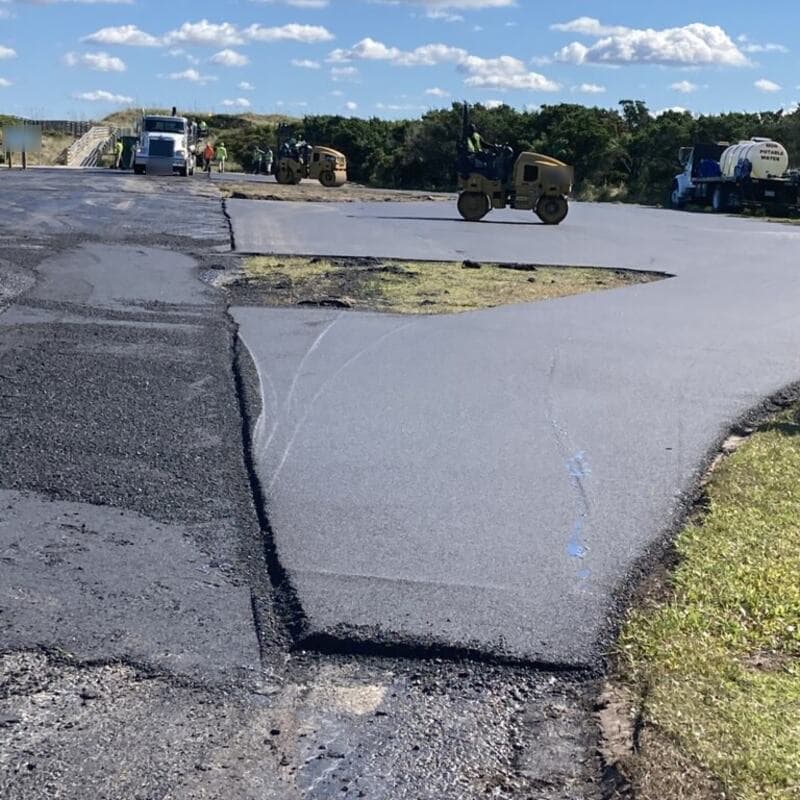
New asphalt is its own waiting period: SealMaster's FAQ says a minimum of 30 to 60 days, and its specification gives the field test, pour water on the surface and look for a film of oil. The traffic paint TDS wants 4 weeks before paint. Pricing that first sealcoat: how to price sealcoating per square foot.
How long until traffic, and how long until striping
Keep cars off for 24 hours after the final coat: the TDS, the specification and the FAQ all count the 24 hours from the last coat, and on a cool or humid day that is the minimum, not the target.
Striping paint has its own limits
SealMaster's acrylic traffic paint TDS says to let fresh sealer cure at least 24 hours before paint, wants surface and air at a minimum of 50°F with no drop below 50°F in the 24 hours after, and lists dry to no pick-up in under 30 minutes. Its coverage, 325 linear ft of 4 inch line per gallon, drives the line striping pricing post.
Crack filler does too
Crack sealing comes first and wants dry pavement. MnDOT's Crack Sealing 101 recommends spring or fall during dry conditions, says the pavement and crack must be dry before starting, and bars sealant below the manufacturer's minimum pouring temperature. Pricing is in how to price crack sealing per linear foot.
Reading the forecast for the job day and the day after
Read the chance of rain as a 12 hour number, not a daily one. The National Weather Service defines probability of precipitation as the chance of measurable precipitation, 0.01 inches or more, at any point in the forecast area over a period that is normally 12 hours. Its words map to percentages: slight chance is 20 percent, chance 30 to 50 and likely 60 to 70.
For each candidate day check: the morning temperature and whether it is climbing, the daytime chance of rain, the overnight low against 50°F, and the next day's chance of rain through 24 hours after your last coat. A daily page hides the overnight low; open the hourly view.
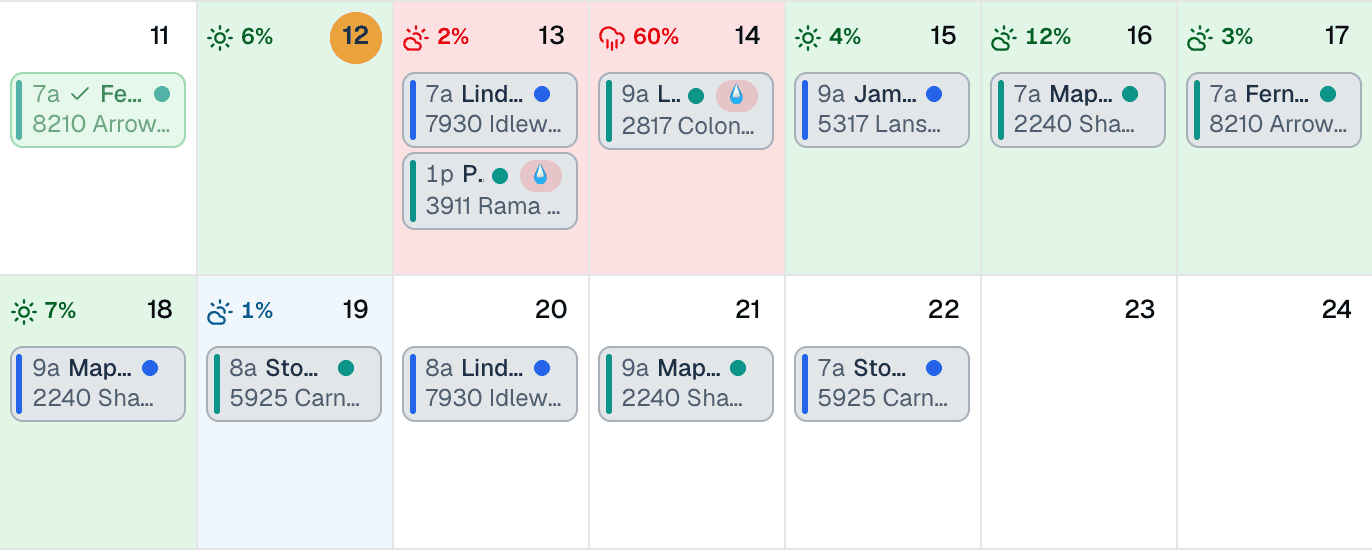
In MakeHay, every scheduled visit pulls the National Weather Service forecast for the job site's own coordinates, about a week ahead (US addresses). Rain is the max chance during the 06:00 to 20:00 work window, so you still check the overnight low yourself. The quick view offers up to three clearer days (Plan around the weather).
Worked example: A sample April week, day by day
- Pass rule, with the last coat down by 2 p.m.: 50°F and rising at the start, overnight low at or above 50°F, and no NWS 12 hour period at 30 percent or more (the lowest number NWS calls a chance) through 2 p.m. the next day.
- Monday: 47°F at 8 a.m. to 58°F, low 41°F, rain 10 percent. Fails: a late start would clear the 50°F floor, but the night drops to 41°F.
- Tuesday: 52°F to 63°F, low 52°F, rain 20 percent by day, 60 percent overnight. Fails: rain likely within 24 hours.
- Wednesday: 54°F to 67°F, low 53°F, rain 10 percent day, night and Thursday. Passes.
- Thursday: 56°F to 70°F, low 55°F, rain 20 percent through Friday daytime, 50 percent Friday night. Passes: the 24 hours end at 2 p.m. Friday, before Friday night's period.
- Friday: 57°F to 68°F, low 54°F, rain 20 percent by day, 50 percent overnight. Fails: a chance of rain inside the 24 hours.
Result: Wednesday and Thursday pass; Monday fails on the 41°F night, Tuesday and Friday on overnight rain of 60 and 50 percent.
The best time of year to sealcoat: when the season opens and closes
The season runs between the first and last stretches when nights hold 50°F, and NOAA's climate normals say roughly when that is. The US Climate Normals are 30 year averages for 1991 to 2020; look up the daily normal minimum temperature for the nearest station and note the dates it crosses 50°F in spring and fall. A normal is an average, so plenty of years run colder, and the forecast decides the day.
What to tell the customer before the job and when you reschedule
Put the weather terms on the quote so a reschedule is a clause, not an argument: pavement and air at 50°F and rising, 24 dry hours after the last coat, the lot closed for those 24 hours with striping after, and a move to the next clear day at no charge when the forecast fails.
Good to know: Sample wording: Sealer needs pavement and air at 50°F and rising, and 24 hours without rain or a drop below 50°F after the last coat. If the forecast fails that, the job moves to the next clear day and you get a reminder the day before. The lot stays closed for 24 hours after the final coat; striping follows.
In MakeHay, visit reminder emails go the day before, Change in a visit's quick view moves it to a new date or time with Undo on the message that appears, and the quote's Terms field carries the weather clause (weather-aware scheduling).
The morning-of checklist
- Air and pavement at 50°F and rising, the pavement read in the coldest spot on the lot.
- Surface dry: no standing water or dew film, cracks filled earlier and cured.
- Tonight's low at or above 50°F and above the dew point.
- No NWS chance of rain (30 percent or more) in any 12 hour period through 24 hours after the last coat.
- Daylight for both coats, with each coat dry before the next (the TDS drying time is 2 to 6 hours at 73.4°F and 50 percent humidity).
- Customer reminded: lot closed for 24 hours after the final coat, striping after.
In MakeHay, weather rules (Settings › Services, the Weather rules card, New rule) set Max rain %, Min temp °F and Max temp °F during the service and after it; the suggested sealcoating rule is max rain 40 percent, min temp 50°F, checked the day after; set Max rain % to 30 to match the pass rule above. Rules attach to a category, service or quote line (Plan around the weather, sealcoating software).
FAQ
What is the minimum temperature to sealcoat?
50°F for both the pavement surface and the air, and rising, per the MasterSeal Concentrate TDS, with no drop below 50°F during the 24 hours after. SealMaster's specification states it as 50°F and rising for not less than 24 hours, and its how-to page calls 60°F and rising the best weather for the work.
Can you sealcoat at 45 degrees?
No. At 45°F the pavement and the air are below the 50°F minimum on the MasterSeal TDS; the sealer waits until both reach 50°F and are still rising. A 45°F morning forecast to reach 60°F can become a go later, but only if tonight's low also holds 50°F, since the FAQ wants 50 degrees and rising for 24 hours.
How long does sealcoat take to dry before rain?
There is no safe short answer, so the documents forbid the situation: the specification says do not apply if rain is forecast within 24 hours, and the FAQ says the same for rain imminent within 24 hours. The TDS dry time of 2 to 6 hours is measured at 73.4°F and 50 percent humidity, and dry to the touch is not cured.
How long after sealcoating can you stripe?
At least 24 hours after the last coat. SealMaster's acrylic traffic paint TDS says to let fresh sealer cure at least 24 hours before paint, and the specification sets the same 24 hours before traffic marking paint. The paint then needs its own 50°F surface and air, held for 24 hours after, and is dry to no pick-up in under 30 minutes.
Sources
- MasterSeal Concentrate TDS · Both surface and ambient temperature shall be a minimum of 50°F and rising during application; do not apply if temperature is expected to drop below 50°F within a 24 hour period after; allow the final coat to dry for 24 hours prior to opening to vehicle traffic; drying time 2 to 6 hours at 50 percent humidity and 73.4 ± 3.6°F; allow each coat to dry thoroughly before applying successive coats; the 2 to 6 hours is the TDS test-table value, not a stated application wait. (accessed October 12, 2026)
- Engineering Specifications for Applying SealMaster Pavement Sealer to Bituminous Surfaces · Section 6.2: temperature must be a minimum of 50 degrees F and rising for not less than 24 hours, and do not apply if rain is forecast within 24 hours; 4.1: new asphalt cures at least 30 to 60 days, with the pour water oil film test; 6.3: cure a minimum of 24 hours before opening to traffic; 7.3: cure a minimum of 24 hours before traffic marking paint. (accessed October 12, 2026)
- Sealcoating FAQ · You must have 50 degrees and rising for a 24 hour period; do not apply sealcoating if rain is imminent within a 24 hour period; give the seal coat 24 hours after the final coat to cure before opening to traffic; new asphalt should cure a minimum of 30 to 60 days. (accessed October 12, 2026)
- How to Sealcoat a Parking Lot or Driveway · Sealcoating is best performed in warm, dry weather with a temperature at least 60°F and rising. (accessed October 12, 2026)
- Acrylic Traffic Paint Technical Data Sheet SMT-240 · Both surface and ambient temperature shall be a minimum of 50°F and shall not drop below 50°F within a 24 hour period following application; dry to no pick-up time under 30 minutes; allow freshly applied pavement sealer to cure for at least 24 hours prior to applying traffic paint; new asphalt 4 weeks; 325 feet of 4 inch line per gallon at 15 mils wet. (accessed October 12, 2026)
- Crack Sealing 101: Hot Mixed Asphalt Pavements (MnDOT, February 2010) · Recommend spring or autumn time frame during dry conditions; pavement and crack must be dry before starting crack sealing operations; sealant placement is not permitted if the material is below the manufacturer's recommended minimum application or pouring temperature. (accessed October 12, 2026)
- Forecast Terms · Probability of precipitation is the likelihood of measurable precipitation (0.01 inches or more) at any given point in the forecast area during a period that is normally 12 hours; 20 percent is slight chance, 30, 40 and 50 percent are chance, 60 and 70 percent are likely. (accessed October 12, 2026)
- National Weather Service Glossary: Dew Point · Dew point is the temperature to which air must be cooled in order to reach saturation, assuming air pressure and moisture content are constant. (accessed October 12, 2026)
- U.S. Climate Normals · A normal is the 30 year average of a variable calculated for a uniform period; the 1991 to 2020 normals cover temperature and precipitation as annual, seasonal, monthly, daily and hourly products searchable by station. (accessed October 12, 2026)