How to Price Crack Sealing Per Linear Foot (With the Math)
How to price crack sealing per linear foot: measure the cracks, convert feet to pounds of hot pour from the maker's chart, and set a minimum charge.
The MakeHay team · · 11 min read
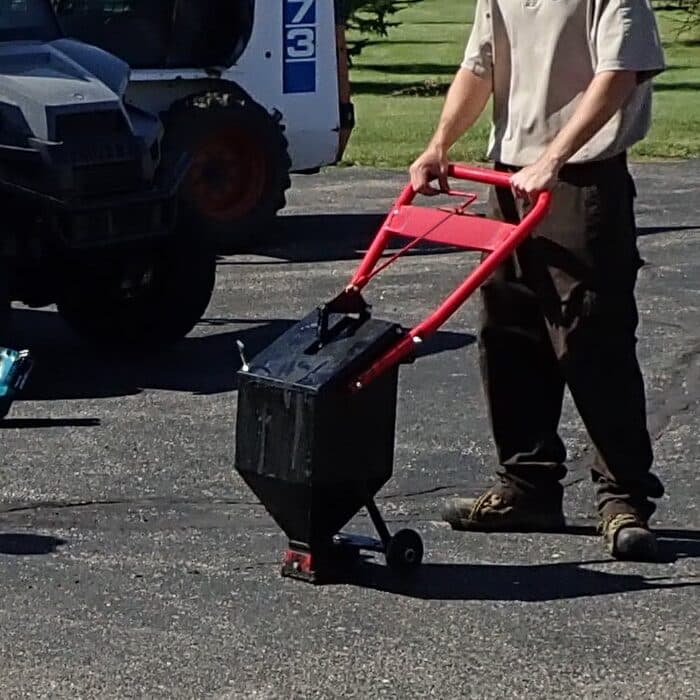
Crack sealing is priced per linear foot of crack, and the rate comes from the pounds of hot pour the cracks take, the hours spent cleaning and sealing them, and the margin on top. Here is how to price crack sealing per linear foot from a measured length, a coverage chart and a published wage, worked through on a 1,500 linear ft lot, for sealcoating crews and lot maintenance teams.
Why crack sealing is priced per linear foot
Crack sealing is priced per linear foot because sealant and labor both scale with the length of crack, not the area of the lot. SealMaster's cost FAQ lists footage, severity, prep, filler type and region as what moves the price, and puts typical crack sealing at $0.35 to $1.00 per linear ft.
Step 1: Measure the cracks
Measure every crack you intend to seal in linear feet, with a wheel on site, a sample section on a big lot, or a satellite trace for a bid sent before the visit.
- Measuring wheel: walk every crack and note widths as you go.
- Sample section: wheel one section of an evenly cracked lot, scale it to the lot's area, and walk the worst spots separately.
- Satellite trace: wide cracks show as dark lines, hairline cracks do not, so trace what shows and confirm on site.
The free satellite measurement tool traces a line along each crack: tap the points, then double-tap or click Finish line; more lines sum into one length. In MakeHay, the saved measurement fills a Per linear foot quote line's quantity and updates if you edit the trace (measure a property from satellite).
Tip: Write the width next to each length; Step 2 needs feet by width, not one total.
Step 2: Classify by width and depth, and when backer rod is needed
Sort the footage into three classes, 3/8, 1/2 and 3/4 inch, the widths the coverage charts are laid out by, and set anything wider aside for a different repair.
The Minnesota Department of Transportation's Crack Sealing 101, a US state guide, routs and seals transverse cracks up to 3/4 inch wide, cleans and seals longitudinal cracks without routing, and sends a pavement in poor condition to mastic or patching.
Depth matters as much as width: both charts assume depth equal to width, and Minnesota's standard rout is 3/4 by 3/4 inch, so a deeper unrouted crack swallows sealant you did not count. Backer rod is for a crack deeper than it is wide: the US FHWA checklist lists it as a material check (compatible with the sealant), and the rod gives the hot pour a floor at the depth the chart assumes instead of letting it sink. Price rod by the foot as its own line.
Step 3: Hot pour crack filler coverage from the maker's chart
Convert feet to pounds with the manufacturer's chart: feet in each width class divided by 100, times the pounds per 100 ft for that width, summed and rounded up to whole 30 lb boxes. Both SealMaster pages call the rates a guideline.
| Crack width by depth | CrackMaster Supreme DF | CrackMaster 3405 | Asphalt Kingdom hot rubber |
|---|---|---|---|
| 3/8 by 3/8 inch | 6.2 lbs | 6.9 lbs | not rated by width |
| 1/2 by 1/2 inch | 11.1 lbs | 12.3 lbs | not rated by width |
| 3/4 by 3/4 inch | 25.0 lbs | 27.8 lbs | not rated by width |
| Any width, blended | no blended rate | no blended rate | about 15 lbs (6.7 ft per lb) |
Asphalt Kingdom's 6.7 linear ft per lb sits between the charts' 1/2 inch and 3/4 inch rows: a sanity check on a mixed lot, not the estimate.
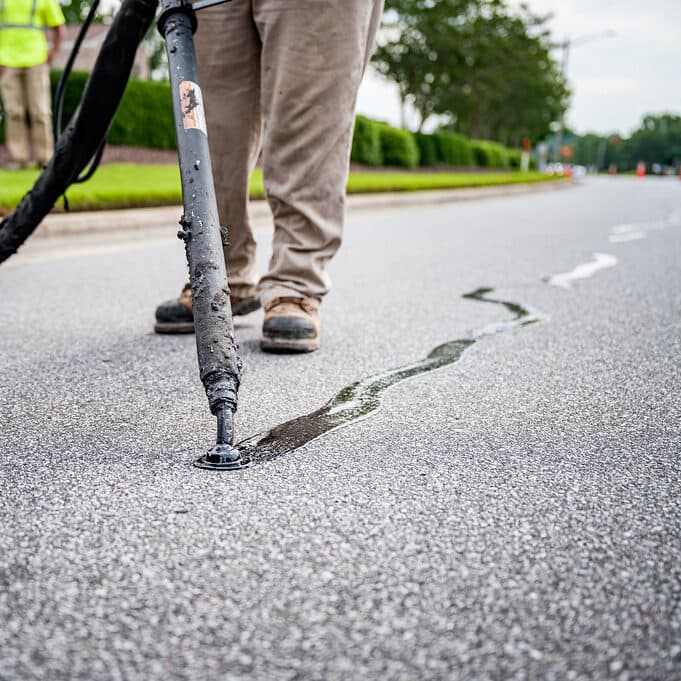
Minnesota's guide says to avoid wide, thick overbands and SealMaster's repair FAQ wants a thin band on each side; a heavy overband is the usual reason a job uses more pounds than the chart says. Price the pounds at what you pay: on October 12, 2026 Asphalt Kingdom's page for its hot pour rubberized crack filler showed $408 for the three-box minimum order, which is $136 per 30 lb box, or $4.53 per lb.
Step 4: Labor and the production rate to track
Labor per foot is your crew's hourly cost divided by the feet they finish in an hour, a rate nobody can publish for you. Track it on every job, with hot pour, cold pour and routed days logged separately.
Count the cleaning hours. The US FHWA checklist wants each crack blown clean, checked with a finger along the sidewalls and recleaned if dirt is found, with cleaning kept just ahead of sealing.
For a wage to start from, O*NET's profile for highway maintenance workers, built on US Bureau of Labor Statistics 2025 wage data, lists a median of $24.16 per hour. Add payroll taxes and insurance; the example uses the bare median.
Step 5: Minimum charge, mobilization and margin
Set the minimum at half a day plus one box, divided by one minus your margin, and carry it as a flat line whenever the per-foot total falls short.
Mobilization is real cost: the melter has to reach Asphalt Kingdom's heating range of 380 to 400°F before the first foot goes down, so a small lot pays the same warm-up as a large one.
Margin is the last step: price equals direct cost divided by one minus the margin, and the rate is that price divided by the feet. Check it against SealMaster's $0.35 to $1.00 per linear ft; above is fine when the quote shows the width classes that drove it; below is a sign to look for a cost you left out.
How to bid crack filling on a 1,500 linear ft lot
The lot measured 1,500 linear ft: 900 ft at 3/8 inch, 450 ft at 1/2 inch and 150 ft at 3/4 inch. Coverage comes from the CrackMaster Supreme DF chart; the box price is Asphalt Kingdom's $136 per 30 lb box of its own hot pour filler, standing in for what you pay; labor is two people for one 8 hour day at the O*NET median, which assumes the pair cleans and seals about 190 ft an hour (1,500 ÷ 8) with the melter warm-up inside the day; and the target is a 40 percent gross margin. Swap in your own logged rate.
Worked example: 1,500 linear ft lot, hot pour, clean and seal
- 3/8 inch cracks: feet ÷ 100 × lbs per 100 ft, so 900 ÷ 100 × 6.2 lbs = 55.8 lbs.
- 1/2 inch cracks: 450 ÷ 100 × 11.1 lbs = 49.95 lbs.
- 3/4 inch cracks: 150 ÷ 100 × 25.0 lbs = 37.5 lbs.
- Total: 55.8 + 49.95 + 37.5 = 143.25 lbs.
- Boxes: 143.25 ÷ 30 lbs = 4.78, so 5 boxes.
- Material: 5 × $136 = $680.
- Labor: 2 people × 8 hours × $24.16 = $386.56, rounded to $387.
- Labor per foot: $387 ÷ 1,500 ft = $0.26 per linear ft.
- Direct cost: $680 + $387 = $1,067.
- Price at a 40 percent margin: $1,067 ÷ 0.60 = $1,778.
- Rate: $1,778 ÷ 1,500 ft = $1.19 per linear ft.
- Quote line: 1,500 linear ft × $1.19 = $1,785.
- Minimum, labor: half a day for the pair, 2 people × 4 hours × $24.16 = $193.
- Minimum, direct cost: $193 + one box at $136 = $329.
- Minimum price: $329 ÷ 0.60 = $548, the flat line for any lot under about 460 ft ($548 ÷ $1.19).
Result: $1.19 per linear ft, $1,785 for the 1,500 linear ft lot: 5 boxes, 16 labor hours and $718 of gross margin over $1,067 of direct cost, with a $548 minimum for smaller lots.
The rate lands above SealMaster's typical range for two reasons: the 150 ft of 3/4 inch crack takes 37.5 of the 143 lbs, a quarter of the sealant for a tenth of the footage, and the boxes are priced at the three-box retail minimum rather than in bulk. A lot of hairline cracks only, priced from the 3/8 inch row, lands lower.
When to crack seal before sealcoating: spring or fall
Seal cracks in spring or fall on dry pavement, and before the sealcoat: the sealer goes over filled cracks, and Minnesota's guide says crack sealing is what keeps moisture out of the base and subgrade.
Minnesota's guide recommends spring or fall in dry conditions, when a crack is neither at its widest (winter) nor its narrowest (summer), and SealMaster's repair FAQ puts the ideal air temperature at 45 to 65°F where winters are cold. SealMaster's sealcoating how-to lists filling cracks as a step before the sealer and wants at least 60°F and rising for the sealcoat. A fall crack sealing visit sets up a spring sealcoat, priced with how to price sealcoating per square foot and checked against sealcoating temperature requirements.
In MakeHay, a weather rule on the crack fill service sets Max rain % and Min temp °F for the visit, with the forecast from the National Weather Service for each job site's own address (US job sites); see plan around the weather.
Hot pour versus cold pour
Hot pour is the production choice for roads and most lots; cold pour is for driveways. SealMaster's repair FAQ puts hot pour on highways, both on parking lots and cold applied material on home driveways: hot pour goes down as low as 40°F and cools in 15 to 20 minutes, while cold pour wants warm, dry weather and 24 hours of cure. Hot pour also needs the indirectly heated double boiler melter the US FHWA checklist calls for. Price them as two services.
What to put on the crack sealing estimate
Put the measured length, the width classes, the rate and the minimum on the quote, so the customer sees what was counted and what more footage costs.
- Linear feet measured, and how: wheel, sample section or satellite trace.
- Width classes with the feet in each, so a wider crack found on the day is a change order.
- The sealant by name, routed or clean and seal, the rate, the mobilization line and the minimum.
- When the lot reopens, and that any sealcoat comes after.
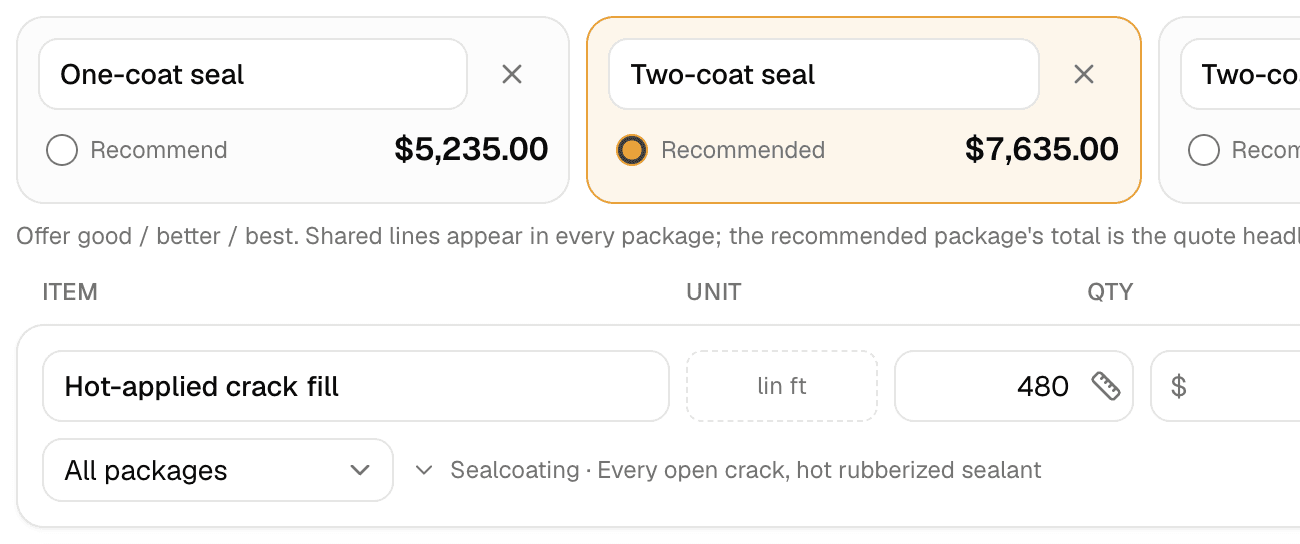
In MakeHay, the sealcoating starter price book carries Hot-applied crack fill as a Per linear foot line, the line striping list carries Crack fill the same way, and a flat Mobilization and lot prep line covers the minimum. Set This job repeats to every 12 months and the lot comes back each spring (set up recurring service).
FAQ
How much does crack filling cost per linear foot?
SealMaster's cost FAQ puts typical crack sealing at $0.35 to $1.00 per linear ft. Build your rate from pounds, hours and margin as in the example above, where 1,500 ft of mixed cracks at retail box prices lands at $1.19 per linear ft.
How many feet does a 30 lb box of crack filler cover?
Asphalt Kingdom rates its hot rubber crack filler at 200 linear ft per 30 lb box, or 6.7 ft per lb. By SealMaster's CrackMaster Supreme chart, 30 lbs covers about 484 ft of 3/8 inch crack, 270 ft of 1/2 inch or 120 ft of 3/4 inch.
Should you crack seal before sealcoating?
Yes. SealMaster's sealcoating how-to lists filling cracks as a step before the sealer, not instead of it, and Minnesota's guide explains why: crack sealing is meant to keep moisture out of the base and subgrade. Book crack sealing as its own spring or fall visit, as Minnesota's guide recommends, and the sealcoat for a day of at least 60°F and rising.
What temperature do you need for crack sealing?
Pavement at 40°F or warmer, per Asphalt Kingdom's FAQ; the US FHWA checklist uses 40°F and rising, with no rain imminent and no moisture in the crack, and SealMaster's repair FAQ calls 45 to 65°F ideal where winters are cold. Melt to the maker's range, 380 to 400°F for Asphalt Kingdom's filler, never above the safe heating temperature.
Sources
- CrackMaster Supreme DF (SealMaster) · Coverage chart in lbs per 100 ft of crack: 3/8 by 3/8 inch 6.2 lbs, 1/2 by 1/2 inch 11.1 lbs, 3/4 by 3/4 inch 25.0 lbs; the rates are a guideline and usage varies with application width and material above the surface; heat stabilized to 450°F; sold as a 30 lb box. (accessed October 12, 2026)
- CrackMaster 3405 (SealMaster) · Coverage chart in lbs per 100 ft of crack: 3/8 by 3/8 inch 6.9 lbs, 1/2 by 1/2 inch 12.3 lbs, 3/4 by 3/4 inch 27.8 lbs; sold as a 30 lb box. (accessed October 12, 2026)
- Crackfiller Questions (Asphalt Kingdom Help Desk) · 6.7 linear feet of coverage per pound of crack filler, 200 linear feet per 30 lb box; cracks can be filled as long as the pavement is 40°F or warmer; the best heating temperature is 380 to 400°F and higher than 400°F may severely damage the product. (accessed October 12, 2026)
- Buy Hot Pour Rubberized Asphalt Emulsion Crack Filler (Asphalt Kingdom) · Hot pour rubberized asphalt emulsion crack filler, 30 lb box, minimum order 3 boxes; the page shows $408.00 for the three-box minimum on October 12, 2026 (quantity defaults to 3), which is $136 per box, the per-box offer price in the page's structured data, in US dollars; each 30 pound box offers 200 linear feet of sealing. (accessed October 12, 2026)
- How Much does Asphalt Crack Filling Cost (SealMaster FAQ) · Typical costs for crack sealing range from $0.35 to $1.00 per linear foot (the page writes .35¢); the factors listed are size of project in linear feet, severity of cracking, surface preparation, cold or hot applied filler, and geographic location. (accessed October 12, 2026)
- How to Repair Cracks in Asphalt Pavement (SealMaster FAQ) · Hot rubberized crack sealants are ideally applied at an air temperature between 45° and 65°F in areas subject to cold winters; hot pour can be applied as low as 40°F and should cool 15 to 20 minutes before traffic; cold applied materials want warm, dry weather and 24 hours of cure before traffic; leave a thin overband and avoid thick overbands; hot pour on highways, both on parking lots, cold applied on home driveways. (accessed October 12, 2026)
- How to Sealcoat a Parking Lot or Driveway (SealMaster FAQ) · Cleaning and filling cracks with a suitable hot or cold pour crack filler is a step before the sealer is applied; sealcoating is best performed in warm, dry weather with a temperature of at least 60°F and rising. (accessed October 12, 2026)
- Crack Sealing 101: Hot Mixed Asphalt Pavements (Minnesota Department of Transportation, February 2010) · Crack sealing is intended to prevent moisture from entering the base and subgrade; crack seal or fill in spring or fall during dry conditions, when the crack is not too wide (winter) nor too small (summer); transverse cracks up to 0.75 inch wide are routed, cleaned and sealed; longitudinal cracks are cleaned and sealed, not routed; the standard rout is 3/4 by 3/4 inch; avoid wide, thick overbands; pavement and crack must be dry; active cracks open in winter and close in summer; pavements in poor condition call for a mastic product or patching instead. (accessed October 12, 2026)
- Pavement Preservation Checklist Series 1: Crack Seal Application (US Federal Highway Administration, November 2001) · Ambient or surface temperature meets manufacturer and agency requirements, typically 40°F and rising; sealing does not proceed if rain is imminent or there is moisture in the crack; backer rod, if used, is compatible with the sealant; hot applied sealant uses an indirectly heated double boiler melter with agitation; the reservoir is filled from the bottom up; cracks are blown clean and checked with a finger along the sidewalls; traffic waits until the sealant has cooled. (accessed October 12, 2026)
- Highway Maintenance Workers (O*NET OnLine) · Median wages (2025): $24.16 hourly, $50,260 annual; the source line reads Bureau of Labor Statistics 2025 wage data. (accessed October 12, 2026)