How to Price Sealcoating Per Square Foot, Step by Step
How to price sealcoating per square foot from sealer coverage, crew rate and production, plus prep, minimums and margin, with two worked examples.
The MakeHay team · · 11 min read
Here is how to price sealcoating per square foot: material from the data sheet's coverage and your supplier's price per gallon, labor from your team's hours at a loaded wage, prep and extras on their own lines, then overhead, a margin and a minimum charge.
How to price sealcoating per square foot: an output, not an input
A per square foot price comes out after you add up what the job costs and what you want to keep; it is not picked from a chart. In one line: price per sq ft = (sealer + labor + prep + overhead) ÷ (1 minus margin) ÷ the area, held above a minimum job charge.
Step 1: Square footage and pavement condition
Start with the pavement area and its condition, because both decide how much sealer the job drinks. AsphaltPro's commercial estimating article puts sealer going down at about 60 sq ft of normal pavement per gallon and up to 100 sq ft on well-maintained or new pavement, and says asphalt left untreated for five or six years needs more; those are applied figures, and Step 2 separates them from the concentrate you buy.
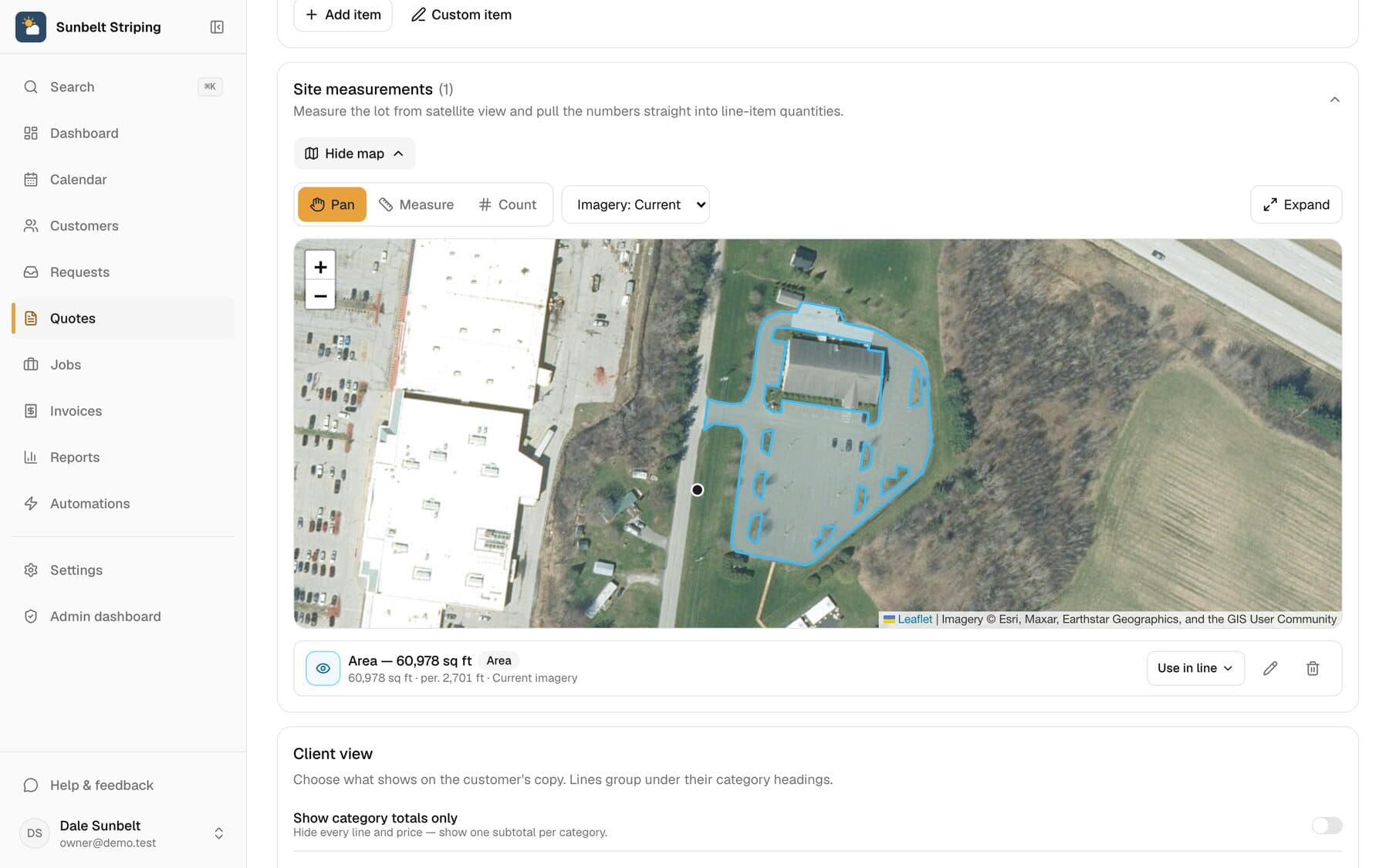
The free satellite measurement tool traces the lot, and Cut out removes islands so the square footage is pavement only. In MakeHay, a saved measurement fills a per square foot quote line with Use in line and updates the line when you edit the measurement.
Step 2: Material cost per square foot
Material cost per square foot is the price of a gallon divided by the square feet it covers, times the coats; the MasterSeal TDS calls for a minimum of two coats, so price both, and the water, sand and additive in its mix design come from your invoice.
Concentrate coverage is not mixed coverage
| Sealer | Concentrate, per gallon | As applied, per gallon |
|---|---|---|
| SealMaster concentrates | 100 to 120 sq ft | 70 to 82 sq ft, mixed |
| Asphalt Kingdom emulsion | Not stated | 100 sq ft sprayed, 50 to 60 sq ft by hand |
Asphalt Kingdom's sealer store listed a 55-gallon drum of asphalt emulsion sealer at $705 and a 275-gallon tote at $1,895 on October 12, 2026: $12.82 per gallon by the drum, $6.89 by the tote.
How much sealer do you need for one or two coats?
Gallons to order is area times coats divided by coverage, rounded up to the gallon, with coverage from the TDS's concentrate figure: 100 sq ft per gallon per coat for older or rough pavement, 120 for smooth or new. Buy the next full drum or tote and carry the rest to the next job. AsphaltPro's 60 sq ft per gallon describes sealer going down on normal pavement, close to the TDS's 70 to 82 sq ft for mixed material, so never apply it to concentrate gallons.
| Area | One coat at 100 | Two coats at 100 | Two coats at 120 |
|---|---|---|---|
| 1,200 sq ft | 12 gallons | 24 gallons | 20 gallons |
| 10,000 sq ft | 100 gallons | 200 gallons | 167 gallons |
| 40,000 sq ft | 400 gallons | 800 gallons | 667 gallons |
Step 3: Labor cost per square foot from team hours and a wage floor
Labor per square foot is your team's hours at a loaded hourly rate, divided by the square feet. Hours come from your own logs, unloading to loaded trailer, both coats and the wait between; divide the area by those team hours for a production rate in sq ft per team hour, and from then on labor per sq ft is the loaded rate divided by that production rate.
The wage floor is what an hour costs you, not the paycheck. The US Bureau of Labor Statistics' Occupational Outlook Handbook puts median pay for construction laborers and helpers at $22.44 per hour (May 2025), and the bureau's June 2026 Employer Costs for Employee Compensation release found wages were 70.0 percent of what private employers pay per hour worked, so wage divided by 0.70 is a loaded rate: $22.44 becomes $32.06 per hour. Count your own hours at the same rate.
Step 4: Cleaning, oil spots, crack fill and striping as separate lines
Prep is priced in hours and extras as their own lines, so neither hides in the sealer rate: blowing, edging and scrubbing oil spots are team hours at the loaded rate on a flat mobilization and lot prep line.
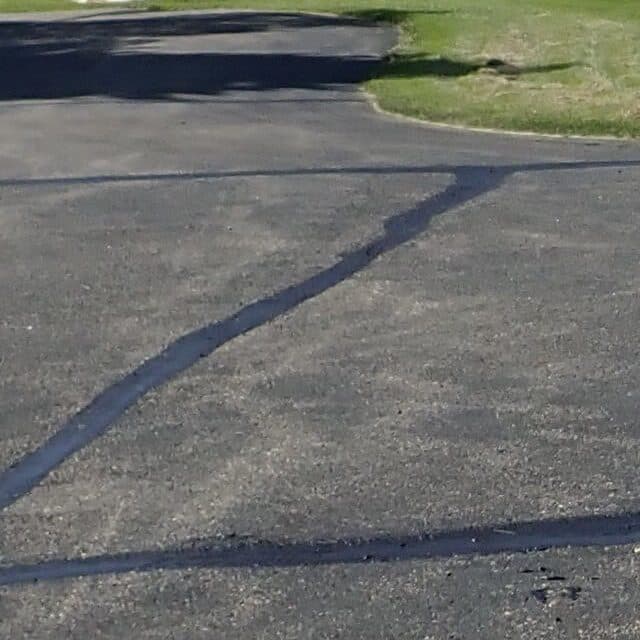
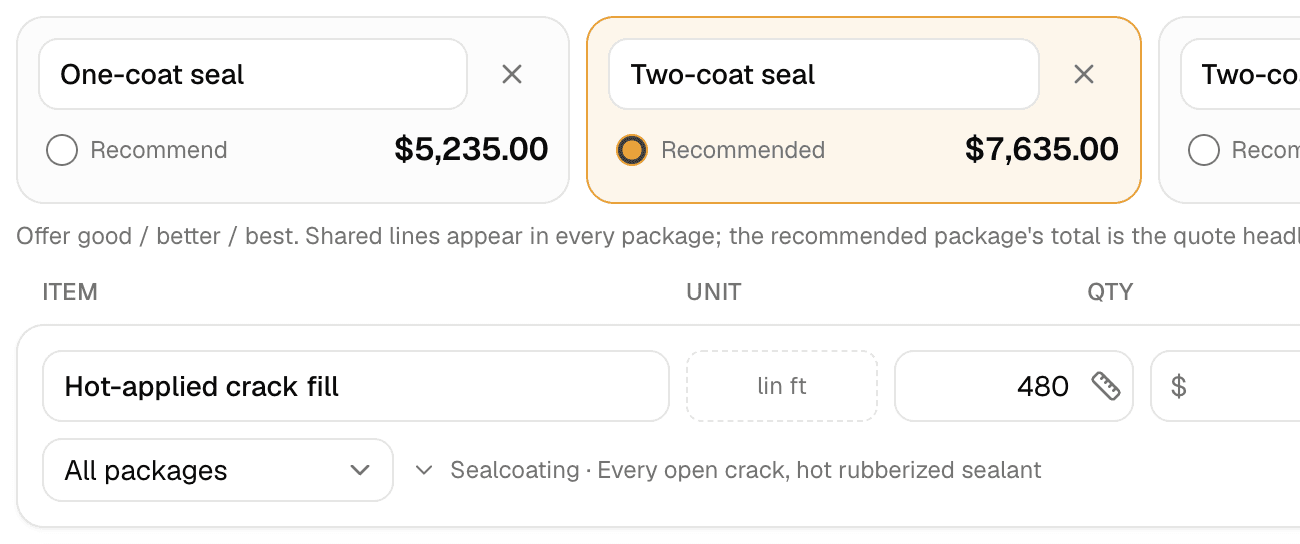
Crack fill is a linear foot line priced from your melter's output, as in How to Price Crack Sealing Per Linear Foot; oil-spot primer is an each line, and restriping after the seal is a per stall line, as in How to Price a Line Striping Job.
Step 5: Overhead, a minimum job charge and margin
Overhead per square foot is last year's overhead (truck, sprayer, insurance, yard, office hours) divided by last year's square footage sealed; it is small and easy to leave out.
Margin is the share of the price you keep after every cost, applied by dividing: price equals cost divided by one minus the margin. A 20 percent margin on the $536 driveway cost worked below is $670, not $643; multiplying by 1.20 is a 20 percent markup, only a 16.7 percent margin.
A minimum job charge covers the hours that do not shrink with the job: driving, setup, cleaning the sprayer. Two people for two hours at $32.06 is $128 before any sealer, so set the minimum at that labor plus the smallest container you would open, with overhead and margin on top, and quote it as a flat line whenever the per square foot total falls short.
Worked example: A 1,200 sq ft driveway, two coats, sealer by the drum
- Area 1,200 sq ft at 100 sq ft per gallon per coat: gallons = area × coats ÷ coverage = 1,200 × 2 ÷ 100 = 24.
- Material = 24 × $12.82 ($705 ÷ 55) = $308, or $0.26 per sq ft.
- Labor: two people for 3 hours from your log at the $32.06 loaded rate, 6 × $32.06 = $192; that is 1,200 ÷ 6 = 200 sq ft per team hour, the rate to reuse on the next driveway.
- Overhead: assume last year's $36,000 over 1,200,000 sq ft = $0.03 per sq ft, so $36 here.
- Cost = $308 + $192 + $36 = $536.
- Price = cost ÷ (1 minus margin) = $536 ÷ 0.80 = $670 at a 20 percent margin, above the $350 minimum this example assumes.
Result: $0.56 per sq ft, $670 for the 1,200 sq ft driveway, before sand and additive.
Worked example: A 30,000 sq ft lot, two coats, sealer by the tote
- Area 30,000 sq ft with the islands cut out, at 100 sq ft per gallon per coat: gallons = 30,000 × 2 ÷ 100 = 600.
- Material = 600 × $6.89 ($1,895 ÷ 275) = $4,134, or $0.14 per sq ft.
- Labor: three people for two 8-hour days at $32.06, 48 × $32.06 = $1,539, or 30,000 ÷ 48 = 625 sq ft per team hour.
- Prep: 6 team hours of blowing and scrubbing, 6 × $32.06 = $192, a flat mobilization and lot prep line.
- Overhead: the same $0.03 × 30,000 = $900.
- Cost = $4,134 + $1,539 + $192 + $900 = $6,765.
- Price = $6,765 ÷ 0.80 = $8,456 at a 20 percent margin.
Result: $0.28 per sq ft, $8,456 for the 30,000 sq ft lot, with crack fill and restriping as separate lines.
How much to charge for sealcoating: a check against published ranges
Charge your cost divided by one minus your margin, then check it: SealMaster's cost FAQ puts typical sealcoating at $0.10 to $0.30 per sq ft, moved by location, sealer, repairs, coats and size; the lot above lands at $0.28 per sq ft, inside that band, and the driveway at $0.56 above it, since a small job spreads the same setup over fewer square feet.
HomeAdvisor's driveway sealing page, a survey of what homeowners report paying (updated June 2026), gives $1.25 to $1.50 per sq ft; a survey hides the square footage, coats, prep and region behind each figure.
Commercial sealcoating pricing is a different market from driveways
A lot prices lower per square foot than a driveway and higher in total: mobilization spreads over more area and sealer comes by the tote. The same survey lists emulsion sealer at $0.08 to $0.10 per sq ft, against the lot's $0.14 by the tote for two coats, and labor at $1.15 per sq ft, a homeowner price that carries the contractor's setup and margin, against the lot's $0.05 of bare loaded wages.
What goes on the quote: a sealcoating quote template
A sealcoating quote states the coats, the prep, the deposit and the weather terms: the coats and product on the sealer line, crack fill in linear feet, oil spots as a count, and weather terms from the data sheet numbers in Sealcoating Temperature Requirements, Rain and Cure Time.
Terms to copy onto the quote: "Two coats of the sealer named on the line above, applied at the manufacturer's coverage, over blown and edged pavement. Crack fill, oil-spot primer and restriping are priced as separate lines. The date moves if rain is forecast, or if the temperature is forecast below 50°F on the day of work or the day after. Keep vehicles off until the day after the final coat."
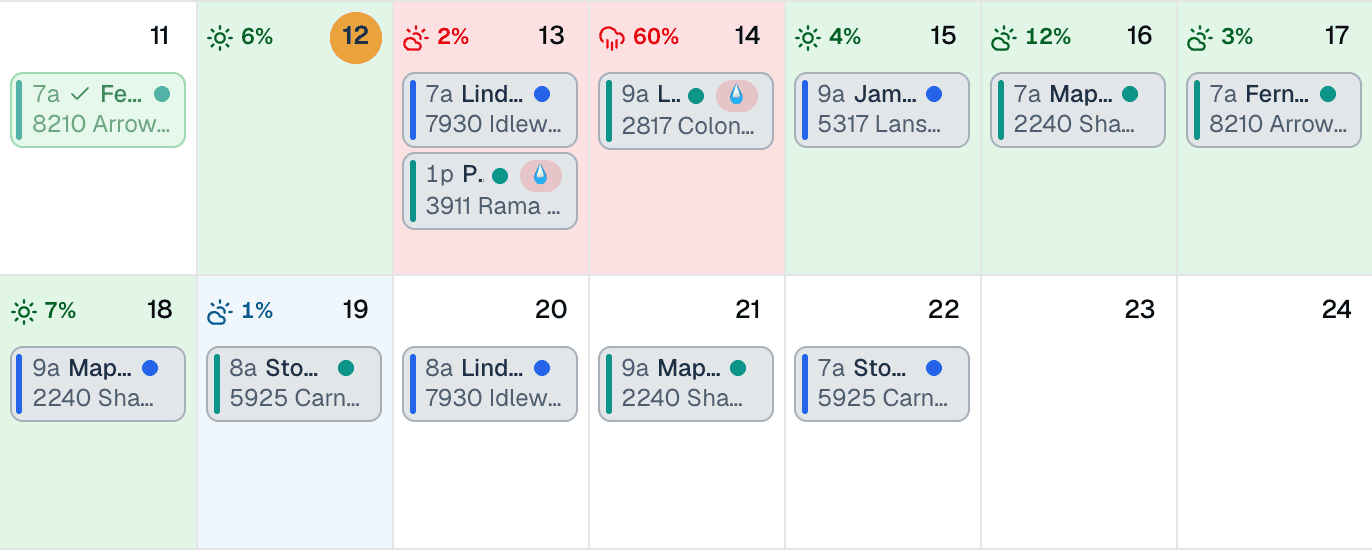
In MakeHay, Deposit takes a percent of the total or a dollar amount, and with Stripe connected the customer pays it by card as they approve; Valid until and Terms sit beside it. The suggested sealcoating weather rule is max rain 40 percent and min temp 50°F, checked again the day after, and each visit pulls the National Weather Service forecast for its job site (US addresses).
A price list you can copy
A sealcoating price list needs four units: per square foot for the sealer, per linear foot for crack fill, each for spots and stalls, and a flat price for mobilization.
| Line | Unit |
|---|---|
| Sealcoat, two coats | Per square foot |
| Sealcoat, one coat | Per square foot |
| Hot-applied crack fill | Per linear foot |
| Oil-spot primer | Each |
| Restripe after seal, per stall | Each |
| Mobilization and lot prep | Flat price |
In MakeHay, these six lines are the sealcoating starter list; reprice them under Settings › Services.
FAQ
How much should you charge for sealcoating per square foot?
Charge what your costs and margin add up to, then compare: the worked lot above comes to $0.28 per sq ft and the driveway to $0.56, SealMaster's FAQ puts typical sealcoating at $0.10 to $0.30 per sq ft, and a homeowner survey reports $1.25 to $1.50 per sq ft for driveways.
How much does it cost to sealcoat 1,000 square feet?
At SealMaster's typical $0.10 to $0.30 per sq ft, 1,000 sq ft is $100 to $300; at the homeowner survey's $1.25 to $1.50 per sq ft for driveways it is $1,250 to $1,500. Neither is a quote: a job this small is set by your minimum charge, since setup hours do not shrink, so price the setup first and the sealer second.
How many square feet does a 5-gallon pail of sealer cover?
It depends on whether the pail is concentrate or ready to use. The MasterSeal TDS rates a gallon of concentrate at 100 to 120 sq ft per coat once mixed, so a 5-gallon pail covers about 500 to 600 sq ft per coat; by hand, Asphalt Kingdom's store page says 50 to 60 sq ft per gallon.
How often should a parking lot be sealcoated?
SealMaster's FAQ says sealcoating is typically recommended every 3 years, with sealer quality, coats, traffic and region moving the interval. New asphalt comes first: the coal tar TDS says a new surface cures a minimum of four weeks at 70°F before the first coat.
Sources
- SealMaster MasterSeal Concentrate Technical Data Sheet · One gallon of concentrate covers approximately 100 to 120 sq ft per coat; mixed material goes on at 70 to 82 sq ft per gallon; per 100 gallons of concentrate, 15 to 25 gallons of water, 0.5 to 2 gallons of Top Tuff polymer additive and 200 to 500 lbs of 40 to 70 mesh sand; a minimum of two coats; surface and ambient temperature at least 50°F and rising, with no drop below 50°F within 24 hours after; final coat dries 24 hours before vehicle traffic. (accessed October 12, 2026)
- SealMaster Coal Tar Concentrate Pavement Sealer Technical Data Sheet · One gallon of concentrate covers approximately 100 to 120 sq ft per coat; mixed material at 0.11 to 0.13 gallon per sq yd (70 to 82 sq ft per gallon); per 100 gallons of concentrate, 30 to 40 gallons of water, 1 to 2 gallons of Pave Gel polymer additive and 200 to 500 lbs of sand, and sand shall be used in every mix; two coats, a third on entrances and drive lanes; new asphalt cures a minimum of four weeks at 70°F before sealing. (accessed October 12, 2026)
- Asphalt Sealer | Ships to the US and Canada | Asphalt Kingdom · Asphalt Emulsion Sealer 55 gallon drum $705.00 and 275 gallon sealing tote $1,895.00, October 12, 2026; coverage of 100 sq ft per gallon for a single coat when sprayed, 50 to 60 sq ft per gallon by hand; 5,500 sq ft of coverage per drum. (accessed October 12, 2026)
- Construction Laborers and Helpers, Occupational Outlook Handbook, US Bureau of Labor Statistics · Median pay $22.44 per hour ($46,680 per year), May 2025. (accessed October 12, 2026)
- Employer Costs for Employee Compensation Summary, US Bureau of Labor Statistics · Private industry employer compensation costs averaged $46.89 per hour worked in June 2026; wages and salaries averaged $32.82 and were 70.0 percent of the total, benefits $14.07 and 30.0 percent. (accessed October 12, 2026)
- Cost to Sealcoating an Asphalt Parking Lot or Driveway, SealMaster FAQ · The typical cost of sealcoating ranges from 10 cents to 30 cents a square foot depending on location, sealer type, repairs needed, number of coats, size of the area and mobilization. (accessed October 12, 2026)
- How Much Does It Cost to Seal an Asphalt Driveway? HomeAdvisor · Homeowner cost survey updated June 17, 2026: professional sealing $1.25 to $1.50 per sq ft for materials and labor; typical totals $282 to $868, average $575; labor $1.15 per sq ft; emulsion sealer $0.08 to $0.10 per sq ft. (accessed October 12, 2026)
- How Often Should you Sealcoating a Parking Lot or Driveway? SealMaster FAQ · Sealcoating is typically recommended every 3 years; the interval depends on sealer quality, mix design, number of coats, amount applied, traffic and geographic area. (accessed October 12, 2026)
- Estimate Your Commercial Project, AsphaltPro Magazine · Most sealing products cover about 60 sq ft of normal pavement per gallon; well-maintained or new pavement may cover up to 100 sq ft per gallon; older, oxidized pavement needs more; sealcoating is bid by the square foot. (accessed October 12, 2026)