How to Price a Line Striping Job by Stall and by the Foot
How to price a line striping job from stall counts and linear feet, with per stall and per foot rates, paint math, ADA add-ons and a 60-stall example.
The MakeHay team · · 11 min read
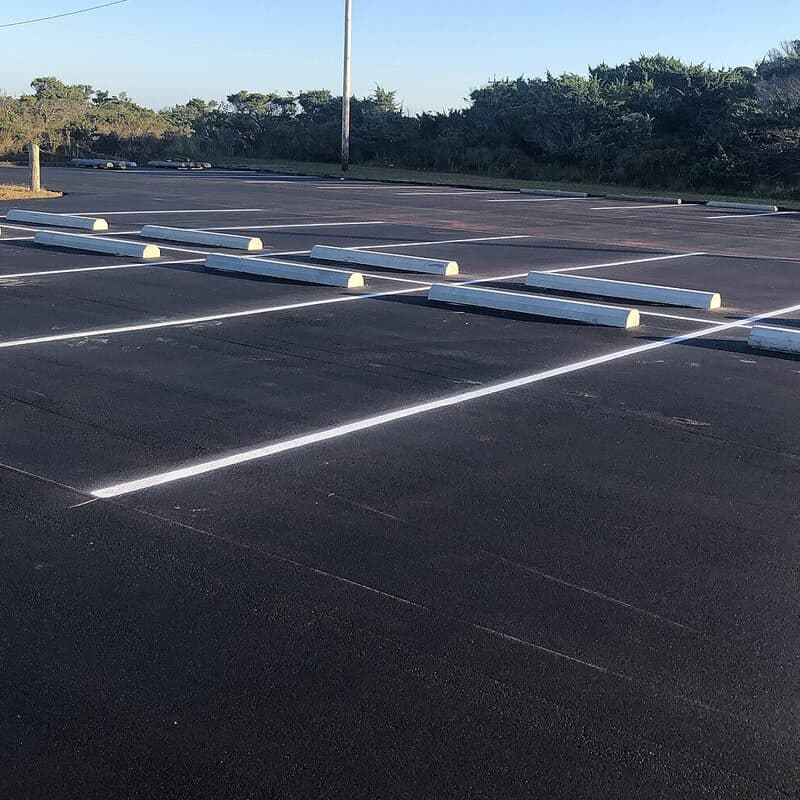
How to price a line striping job comes down to six numbers: stalls and markings, the linear feet they make, the gallons those feet take, labor hours, stencils and extras, and the trip. Price each, add overhead and margin, then check per stall and per linear foot. Every number below has a source, and a 60-stall restripe is worked through line by line.
How to price a line striping job: feet of line, stencils and the trip
A striping quote prices lines by the linear foot, markings by the piece, and the trip as a flat charge. Keep them apart; a per-stall price hiding two arrows cannot be checked.
Step 1: Count stalls and measure linear feet
Tally stalls by type (standard, ADA car, ADA van), lines that are not dividers (aisle lines, fire lanes, crosswalks, hatching), markings by the piece, curb in linear feet, and the divider style: single, double or hairpin.
How many linear feet in a parking stall, by layout
A standard stall in San Diego's municipal code is 8 ft wide and 18 ft long, so depth, not width, sets the paint. With single lines, neighbors share a divider: each stall adds one 18 ft line and each row one closing line. AsphaltPro's estimating guide works its break-even example at 20 linear ft per stall; plan on 20, so the row's closing lines and some waste are covered.
| Divider | Linear ft per stall | Stall assumed |
|---|---|---|
| Single line, shared, plus a closing line per row | 18, plan on 20 | 8 ft by 18 ft |
| Double line | 36 | 8 ft by 18 ft |
| Hairpin, joined at the aisle end | 37 | 8 ft by 18 ft |
Counting from satellite or on site
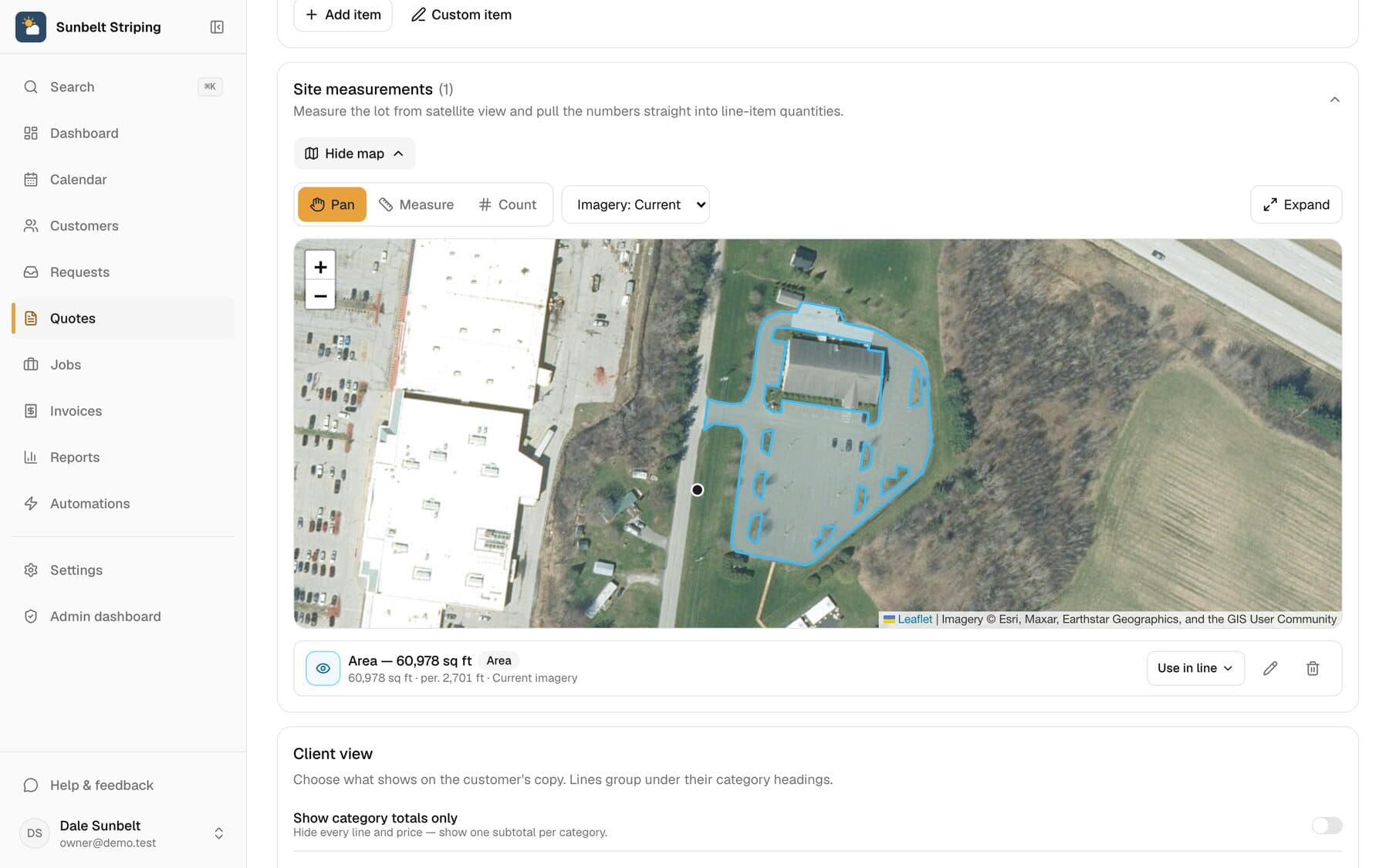
On site, use a clicker and a wheel. From the office, the free satellite tool counts items by tapping and measures lines for linear feet, with no account. In MakeHay, a saved measurement fills a quote line's quantity with Use in line and updates the line if the measurement is edited later.
Step 2: Paint per linear foot from the manufacturer's coverage
Paint is priced from the data sheet. Three waterborne traffic paints publish about 320 linear ft of 4-inch line per gallon at 15 mils wet. Ohio DOT's spec puts its Type 1A paint at 16 gallons per mile of 4-inch line (330 ft per gallon) and its Type 1 paint, applied at 50°F and above, at 22 gallons per mile (240 ft per gallon), so a DOT-thickness line takes more. Divide the lot's linear feet by the coverage, round up to whole gallons, and multiply by your supplier's price per gallon.
How much paint to stripe a parking lot: published coverage
| Product | Per gallon | Film |
|---|---|---|
| INSL-X Acrylic Fast-Set Traffic Paint (Benjamin Moore) | 320 linear ft | 15 mils wet, 9 dry |
| Aexcel 72R-A002 Fast Dry Waterborne Traffic Marking Paint | About 320 linear ft | 15 mils |
| SealMaster Acrylic Traffic Paint (SMT-240) | 325 ft | 15 mils wet |
Beads, second coats, rough asphalt and new pavement
Glass beads are a second material line for reflective lots: Benjamin Moore's sheet calls for 6 pounds of beads per gallon, dropped onto the wet film. A second coat doubles the paint. Coverage falls with pavement porosity (SealMaster's sheet), so plan on more on rough asphalt. New asphalt and new concrete cure first (30 days on Aexcel's sheet, 4 weeks for asphalt on SealMaster's), and fresh sealer gets 24 hours before paint on SealMaster's sheet, 48 hours on Benjamin Moore's.
Step 3: Labor hours and a wage floor you can cite
Labor is hours times a wage, and the wage has a public floor: the US Bureau of Labor Statistics puts the May 2025 median pay for painters, construction and maintenance at $23.75 per hour; payroll taxes, insurance and the truck go into the overhead markup in Step 6, so the example uses the bare wage here. Hours come from your own timing: clock three restripes and divide by the stalls. AsphaltPro's guide turns those costs into a break-even per 4-inch linear foot (its example is 35 cents), the floor for the striping line.
Step 4: Stencils, arrows, ADA stalls and curbs as separate items
Each marking is its own item. SealMaster's striping cost FAQ lists handicapped stalls at $25 to $30 each, directional arrows at $15 to $20 each, word stencils at $3 to $5 per letter, fire lanes at $40 to $75, crosswalks at $50 to $75 each and curb painting at $1 per linear ft.
The ADA count is not yours to choose: US federal ADA rules require at least 1 accessible space in a lot of 1 to 25 and 3 for 51 to 75, one of every six van accessible. Counts, signs and layout are in the ADA parking striping checklist.
Step 5: Mobilization, night closures and a minimum job charge
The trip is a flat line. SealMaster's FAQ puts mobilization at $250 to $350. Put it first on the quote so nobody reads it as a per-stall number. Add the lot closure (cones, barricades, an after-hours team); night work dries slower (Aexcel's sheet), and a lot stays closed to traffic for two hours after painting.
Set a minimum job charge: mobilization plus the least work the team can do once unloaded. Weather belongs in this step because a washed-out trip costs the whole mobilization: all three paint sheets set 50°F as the floor, Aexcel adds no rain expected within 24 hours and humidity under 80 percent, and SealMaster wants 50°F held for 24 hours after painting.
In MakeHay, the suggested striping weather rule in setup is max rain 20 percent and min temp 50°F, and the forecast behind the warning is the National Weather Service's for the lot's address (US addresses); see Plan around the weather.
Step 6: Overhead, margin and the per-stall and per-foot check
Direct cost plus overhead plus margin is the price: overhead is a markup on direct cost, margin a share of the final price, and AsphaltPro's guide says the two are different numbers from the same inputs. Price = direct cost × (1 + overhead) ÷ (1 minus margin), both as decimals (your accountant has them).
Then divide the stall line price by stalls and by feet. SealMaster's FAQ lists parking stalls at $4 to $5 each before its new-layout markup, and AsphaltPro's break-even example, 35 cents per 4-inch linear foot at 20 linear ft per stall, is $7 per stall before profit. The two disagree, which is useful: a break-even above a market range means the market price only works at higher production than the example assumed. Under your own break-even, a cost is missing; far above the market range, recheck the hours or say on the quote why this lot costs more.
Worked example: A 60-stall restripe, line by line
- Count: two rows of 30 stalls, single 4-inch lines, 18 ft stalls, 31 lines per row. Linear feet = lines × stall depth = 62 × 18 ft = 1,116 linear ft.
- Paint: gallons = linear ft ÷ coverage = 1,116 ÷ 320 = 3.49, so buy 4. At $53.50 per gallon (a retail stand-in: a two-gallon case of Rust-Oleum 2300 System traffic paint, $106.99 at WebstaurantStore, October 12, 2026; use your own supplier's price and coverage), paint = 4 × $53.50 = $214.
- Labor: 3 hours for two people, a placeholder for your own timing. Labor = 2 × 3 hours × $23.75 per hour (the BLS median) = $143.
- Direct cost of the stall lines = $214 + $143 = $357.
- Overhead and margin, with 25 percent and 20 percent as placeholders for your accountant's figures: $357 × 1.25 = $446, then $446 ÷ 0.80 = $558.
- Check: $558 ÷ 60 stalls = $9.30 per stall; $558 ÷ 1,116 linear ft = $0.50 per linear ft. That is above AsphaltPro's $7 break-even, so no cost is missing, and above SealMaster's $4 to $5, so recheck the 6 person-hours before the quote goes out.
- Items: 3 ADA stalls (the US federal minimum for 51 to 75 spaces) × $30 = $90 and 4 arrows × $20 = $80, both at the top of SealMaster's ranges; mobilization $250, the bottom of its range.
- Job total = $558 + $90 + $80 + $250 = $978.
Result: $9.30 per stall for the stall lines ($0.50 per linear ft), $978 for the 60-stall restripe, $16.30 per stall all in.
Restripe vs new layout: why the price is different
A restripe follows lines already there; a new layout has none, so every line is measured and snapped first. SealMaster's FAQ adds 20 to 30 percent to the job cost for a new layout. The extra is mostly hours: chalk lines, the ADA count and placement, the local code's aisle width (24 ft for stalls square to the aisle in San Diego's code), and a drawing the customer signs off.
Price it as the restripe plus a layout line in hours, or apply the percentage and say so on the quote. A restripe after sealcoating keeps its layout; the sealcoating pricing guide carries it as its own item.
How much to charge for parking lot striping: a price list you can copy
Charge by the item: standard and ADA stalls as each lines, curb and crack fill per linear foot, and the trip as one flat line. The published ranges below are a starting point; your own Step 6 numbers replace them.
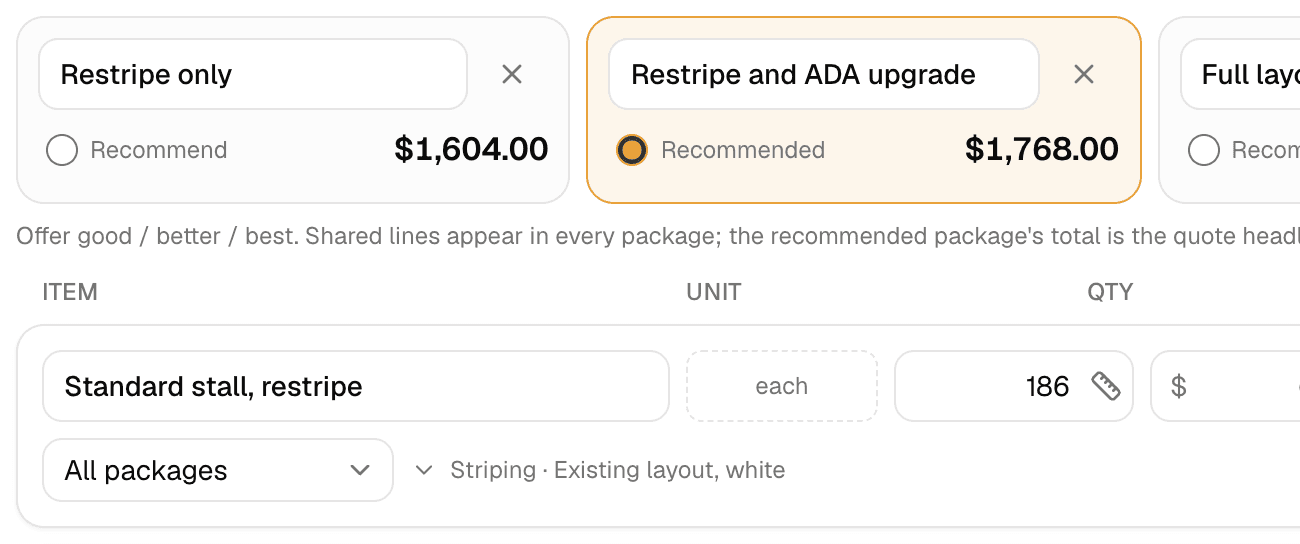
In MakeHay, the line striping starter list carries "Standard stall, restripe", "ADA stall with symbol and hatching", "Directional arrow" and "Stencil (fire lane, visitor, no parking)" as Each items, "Curb painting" and "Crack fill" as Per linear foot, and "Lot closure and mobilization" as a Flat price. Put your numbers beside them under Settings › Services; the quote builder prices a lot from the counts.
| Item | Unit | Published range |
|---|---|---|
| Standard stall, restripe | Each | $4 to $5; $7 break-even (AsphaltPro) |
| ADA stall with symbol and hatching | Each | $25 to $30 |
| Directional arrow | Each | $15 to $20 |
| Stencil (fire lane, visitor, no parking) | Each | $3 to $5 per letter; fire lane $40 to $75 |
| Curb painting | Per linear foot | $1 per linear ft |
| Crack fill | Per linear foot | See the crack sealing guide |
| Lot closure and mobilization | Flat price | $250 to $350 |
FAQ
What is the parking lot striping cost per stall?
Two published numbers bracket it: SealMaster's striping cost FAQ lists $4 to $5 per parking stall before its new-layout markup, and AsphaltPro's break-even example works out to $7 per stall before profit. Both cover the lines alone; mobilization, ADA stalls and arrows sit on top, and one trip spread over fewer stalls is why the 60-stall example above lands at $16.30 per stall all in.
Should you price per stall or per linear foot?
Both, on different lines. Per stall is fast to count and check on a restripe, so keep it as an each item. Per linear foot is the honest unit for double lines, hairpins, aisle lines, fire lanes, hatching and a new layout. Check the finished price both ways.
How many stalls does a gallon of paint cover?
About 16 with single lines and about 9 with double lines or hairpins. A gallon at 15 mils covers about 320 linear ft of 4-inch line; a single line stall takes 18 to 20 linear ft (320 ÷ 20 = 16) and a double line stall 36 (320 ÷ 36 = 8.9). Rough asphalt or a second coat cuts both numbers.
How much to charge for handicap stalls?
SealMaster's FAQ lists handicapped stalls at $25 to $30 each against $4 to $5 for a standard stall; the difference is the hatched access aisle, the symbol and the color changes. US federal ADA rules set the count (one of every six van accessible) and the widths. Price the stall with its aisle as one item and the sign as another; read the ADA checklist in Step 4 before the bid.
Sources
- Acrylic Fast-Set Traffic Paint TP-3380, TP-2310 technical data sheet (Benjamin Moore, INSL-X) · Theoretical spread rate "4 inch line 320 Lineal Feet" per gallon at a recommended wet film of 15 mils (9 mils dry); beads "at a rate of 6 pounds of beads per gallon of paint"; do not apply when air or surface temperatures are below 50°F; recoat time one hour; asphaltic seal coat dry for at least 48 hours before this paint. (accessed October 12, 2026)
- 72R-A002 Red Fast Dry Waterborne Traffic Marking Paint product data sheet (Aexcel) · "COVERAGE: APPROX. 320 LINEAR FEET OF 4 INCH LINE APPLIED @ 15 MILS"; not applied below 50°F, above 80 percent relative humidity or within 24 hours of expected precipitation; lots closed to traffic for two hours minimum after painting; new concrete and asphalt aged 30 days; evening and night applications dry slower. (accessed October 12, 2026)
- Acrylic Traffic Paint SMT-240 technical data sheet (SealMaster) · "One gallon of SealMaster Traffic Paint will provide 325 feet of 4-inch line at 15 mils wet thickness"; coverage varies with pavement porosity and application thickness; surface and air at least 50°F and not below 50°F for 24 hours after; new asphalt cures 4 weeks; fresh sealer cures at least 24 hours before paint. (accessed October 12, 2026)
- 642 Traffic Paint (Ohio DOT construction manual of procedures) · "Type 1A Traffic Paint shall be applied at the rate of 16 gallons per mile of 4-inch solid line" (5,280 ft ÷ 16 = 330 ft per gallon, arithmetic done for this post); Type 1 at 22 gallons per mile (5,280 ÷ 22 = 240 ft per gallon); Type 1A applied between 35°F and 50°F; glass beads "at the rate of 15 pounds per 100 square feet of Type 1 traffic paint applied"; Type 1 applied at 50°F and above. (accessed October 12, 2026)
- How Much Does it Cost to Stripe a Parking Lot? (SealMaster FAQ) · Per item ranges seen October 12, 2026: parking stalls $4 to $5 each; handicapped stalls $25 to $30 each; directional arrows $15 to $20 each; word stencils $3 to $5 per letter; pedestrian crosswalks $50 to $75 each; fire lanes $40 to $75; curb painting $1 per linear foot; mobilization $250 to $350; add 20 to 30 percent to job cost for a new layout. (accessed October 12, 2026)
- Estimate Your Commercial Project (AsphaltPro magazine) · "If each stall requires 20 linear feet of striping and you count 50 stalls to stripe, you know you need at least $350 in the price to break even on the striping alone", from a break-even example of 35 cents per 4-inch linear foot; overhead as a line item; profit margin and markup are different figures from the same inputs. (accessed October 12, 2026)
- Accessible Parking Spaces (ADA.gov) · Minimum accessible spaces per lot: 1 for 1 to 25 total spaces, 2 for 26 to 50, 3 for 51 to 75, 4 for 76 to 100; "At least one of every six spaces must be van accessible"; car spaces at least 96 inches wide with a 60 inch access aisle; van spaces 132 inches wide with a 60 inch aisle, or 96 inches wide with a 96 inch aisle; counted separately for each lot or garage. (accessed October 12, 2026)
- Painters, Construction and Maintenance: Occupational Outlook Handbook (US Bureau of Labor Statistics) · "2025 Median Pay $49,400 per year, $23.75 per hour"; "The median annual wage for painters, construction and maintenance was $49,400 in May 2025." (accessed October 12, 2026)
- San Diego Municipal Code, Chapter 14, Article 2, Division 5: Parking Regulations · Minimum off-street parking space dimensions: unobstructed single space 8 ft wide by 18 ft long for most uses (8 ft 3 inches wide for retail and restaurants), 9 ft wide by 18 ft long with one side against a wall or column; aisle widths 24 ft for stalls square to the aisle, 18 ft one way or 22 ft two way at 60 degrees, 12 ft one way or 20 ft two way at 45 degrees. (accessed October 12, 2026)
- Rust-Oleum 2300 System 1 Gallon Flat Yellow High-Performance Traffic Zone Striping Paint 2348402, 2/Case (WebstaurantStore) · "$106.99/Case" for a case of 2 gallons, $53.50 per gallon, retail single case price seen October 12, 2026 (yellow; $103.98 per case at 2 or more). (accessed October 12, 2026)