Snow Plow Log Template: The Records That Win Slip and Falls
A snow plow log template with the fields courts have relied on: times, areas, salt and rate, temperatures, the forecast you acted on, how long to keep it.
The MakeHay team · · 11 min read

A snow plow log template earns its keep the day a slip-and-fall letter arrives. A Newfoundland court dismissed a claim after the salting log showed four timed applications that day and the court found an adequate system in place; a New York appeals court let a case go on to trial even though certified weather observations were filed to show a storm in progress, because the plaintiff's testimony and the defendant's own records left questions open. Here are the fields, the forecast to save and how long to keep it.
Why the side with better records usually wins
The side with timed, specific records usually wins because the court can see what was done and when. In Hawkins v. Village Mall, 2015 CarswellNfld 124, a Newfoundland case described in a Landscape Ontario column (Visnja Jovanovic, September 15, 2019), the plaintiff slipped in a very slippery mall lot; the log showed the lot plowed by a loader and salted at 4:47 a.m., 3:00 p.m., 5:30 p.m. and 8:00 p.m., the court found an adequate system in place, and the claim was dismissed.
Pipero v New York City Transit Authority (Appellate Division, First Department, January 21, 2010) shows the other half. Certified records of the weather made the Transit Authority's prima facie case of a storm in progress, but the plaintiff's testimony that it had not snowed that day raised a triable question about the storm, and with the defendant's own records raised more about negligent snow and ice removal and unsalted stairs, so the denial of summary judgment stood. Neither case is legal advice; both show what the paper did.
The snow plow log template, field by field
A plow log entry answers who cleared which area, with what, when, in what weather. The Landscape Ontario column lists the time of removal, the equipment, the precise location, who did the work, the weather and the temperature; SIMA's claims documentation list adds digital time sheets with service start and end times and before and after photos.
| Field | Why a court cares | Sample entry |
|---|---|---|
| Time in and out | Service start and end | 2:10 a.m. to 3:05 a.m. |
| Areas, in order | Ties the pass to the fall | Main lot, east drive, walks |
| Equipment | What touched the surface | Truck 2, 8 ft blade |
| People | Who can testify | Driver by full name |
| Air and pavement temperature | Sets the salt rate, shows refreeze | Air 24°F, pavement 21°F |
| Sky and precipitation | Changes the duty | Light snow, stopped 2:40 a.m. |
| Observations | Refreeze, drifting, blocked drain | Refreeze at the dock drain |
| Photos | Before and after, time stamped | 2:12 a.m. and 3:02 a.m. |
A filled-in entry for one 2-inch night
- Main lot, 40,000 sq ft, and two walks. Trigger met: 2 inches at the stake, 1:30 a.m. Forecast saved 9:40 p.m.: 1 to 3 inches ending by 3 a.m.
- In 2:10 a.m., out 3:05 a.m. Air 24°F, pavement 21°F, light snow, stopped 2:40 a.m., dark.
- Plowed main lot, then east drive, piled at the northwest corner per the site map; walks cleared by machine.
- Salted the lot 2:50 a.m., dry rock salt at 2.75 lb per 1,000 sq ft, the MPCA row for 20 to 25°F falling with snow: 110 lb, spreader setting 3. Refreeze at the dock drain, spot salted 3:00 a.m. Signed by the driver.
In MakeHay, a repeating job's visits are marked Done or Skip with the time, and Skip carries a reason (Weather, Customer asked, Not needed, Other); see mark a visit done or skipped. The Session updates card sends dated photos to the customer and keeps them in the portal gallery (send a photo update). MakeHay has no application log; rate, product and temperature go in your own sheet.
The salt application log: product, rate, location, temperature, sky
Keep the salt log as its own record, one line per application; the salt is what gets asked about first. The Landscape Ontario salting log carries the time, the type of salt or ice melt, the amount, the spreading equipment, the precise location, who did it, the weather, the temperature and sun, overcast or dark; SIMA adds quantifiable amounts of bagged and bulk material and annual calibration records.
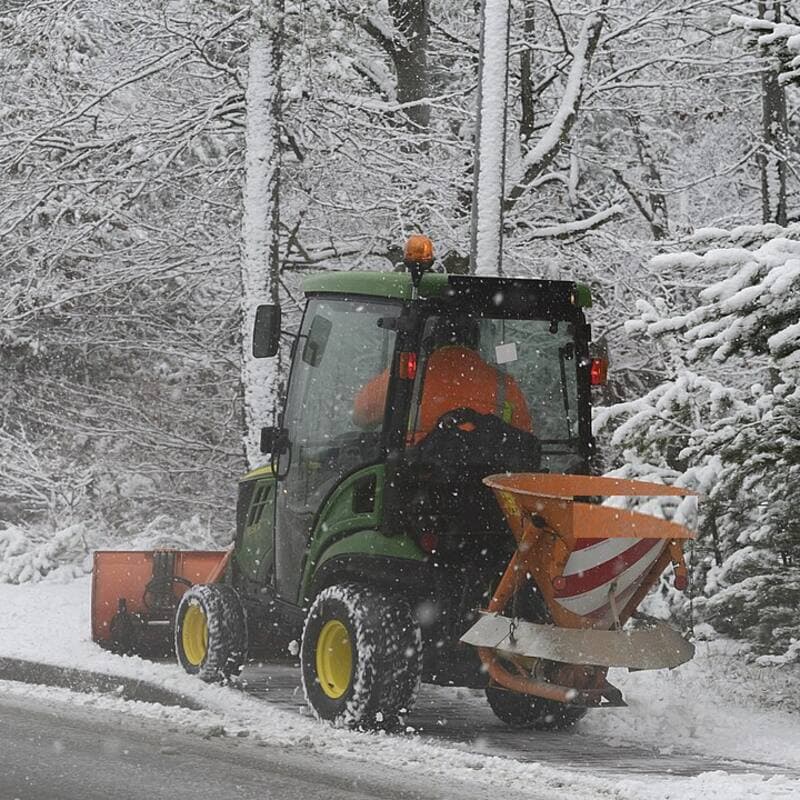
Write the rate as pounds per 1,000 sq ft and the total pounds, with the table row it came from; the salt post carries the MPCA factsheet rows (dry salt 1.5 lb per 1,000 sq ft at 30°F falling with snow, 2.75 lb at 20 to 25°F). The factsheet also asks for the amount of material your truck or sander delivers at each setting and speed: run a measured strip each season, weigh the drop, and write the pounds per setting on the log's first page.
Save the forecast you acted on
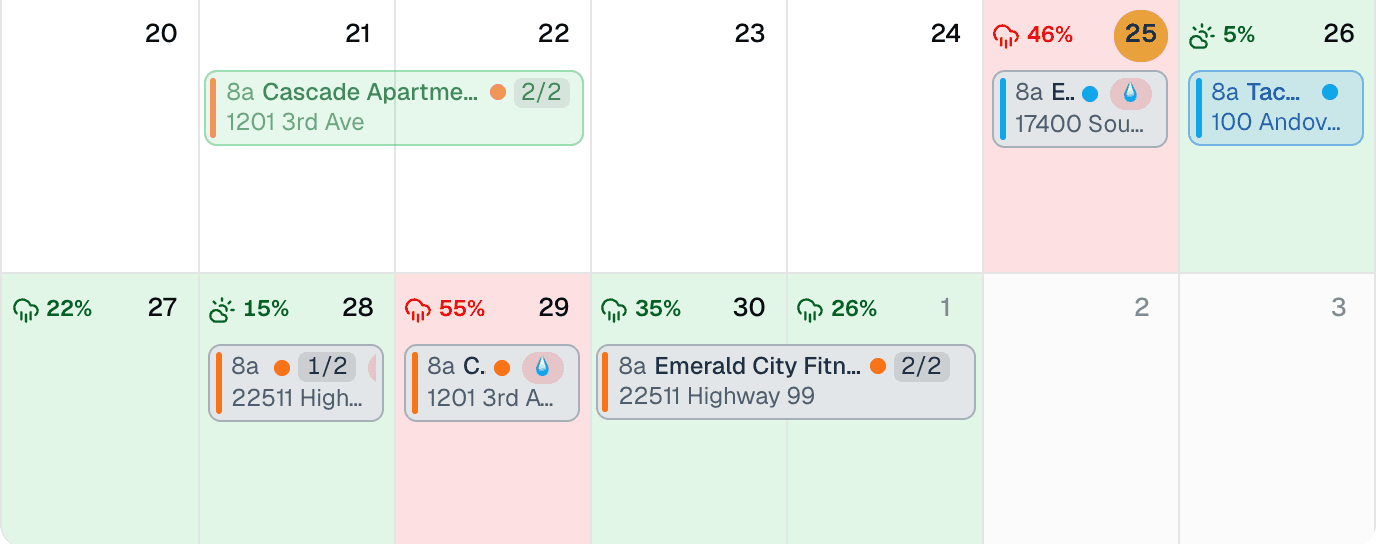
Save the forecast when you decide, because claims turn on whether mobilizing was reasonable on what you knew then. SIMA's list asks for screen shots or printouts of the forecasts you relied on to mobilize, warning that this forecasted information will not be available again, so record it. Open the National Weather Service point forecast for each site's address, screenshot it with the clock showing, and file it with that night's log, beside the pre-storm email to the manager that SIMA also asks for.
In MakeHay, every scheduled visit carries the National Weather Service forecast for the job site's own coordinates, about a week ahead (plan around the weather, US addresses only; see snow removal software). Past forecasts are not archived, so the screenshot is still your job.
Certified weather records: how to order them and what they cost
When a claim lands, order certified observations from NCEI; a forecast screenshot is not an observation. The National Weather Service's past weather page says certified weather data for use in litigation is available only through the National Centers for Environmental Information, and NCEI's data certification page certifies archive data as evidence for a court of law; Local Climatological Data, COOP observations and GHCN-Daily can be ordered online.
| Pages | Certification fee | Shipping | Total |
|---|---|---|---|
| 1 to 40 | $168 | $12 | $180 |
| 41 to 80 | $336 | $12 | $348 |
| 81 to 120 | $504 | $12 | $516 |
The same page says most orders start at $191, next-day delivery adds $17, and orders cannot be canceled once processed, so pick the nearest station and the exact dates first.
What snow removal documentation slip and fall claims turn on
Beyond the log, claims turn on patrols, the site map and the manager's instructions. SIMA's list calls for separate documentation for patrol and active weather events, so a visit where nothing was spread still gets a line: time, surfaces checked, temperature, what was found.
The site map on SIMA's list identifies, at a minimum, where to pile snow, catch basins, accessible spots and emergency doors, plus priority areas, pedestrian routes and the service order; name areas in the log exactly as the map does. Instructions from the owner or manager go in a follow-up email the same day; SIMA's example is being told not to service a certain area. The trigger and the excluded areas belong in the contract; see the trigger depth post and the seasonal contract post.
In MakeHay, the customer's Messages tab keeps the thread with photos; a contract PDF can go out for an e-signature with a Certificate of Completion, IP address, device and times recorded; Request document collects the manager's site map as a PDF (request documents and signatures).
How long to keep snow removal records
Keep every winter's logs at least four years, and the lot's whole file while the contract runs. The clock on a slip-and-fall suit is the state's personal injury limitation period: New York's CPLR 214, subdivision 5, gives three years for an action to recover damages for a personal injury; the Illinois Code of Civil Procedure's personal injury section gives two years.
Both run longer for a child. New York's CPLR 208 extends the time for a person under a disability because of infancy to three years after the disability ceases, and its ten-year cap on that extension does not apply to infancy in an action other than medical, dental or podiatric malpractice; Illinois' section on minors lets a person under 18 at the time sue within two years after turning 18. Four years clears the longer adult period with a year to spare; a lot beside a school or playground deserves the whole file for the child's longer period.
Three states that limit hold-harmless clauses
Illinois, Colorado and Connecticut limit what a hold-harmless clause can do to you. Illinois' 815 ILCS 675/10 (effective August 25, 2016) voids six provisions in a snow removal and ice control services contract: any requiring the provider or the receiver to indemnify, hold harmless or defend the other for the other's own acts or omissions. Colorado's Senate Bill 62 of 2018, effective August 8, 2018, voids indemnify, hold-harmless and defend provisions only where the provider is prohibited by express contract terms or in writing from mitigating a snow, ice or other mixed precipitation risk, excepting public roads and bodies, utilities, airport deicing and insurance. Connecticut's section 21a-433 (contracts on or after July 1, 2019) voids a clause requiring the provider to indemnify the receiver for acts it is not required or is instructed not to perform, or to hold the receiver harmless for the receiver's own acts, under the same written-prohibition condition and not on municipal or state property. The seasonal contract post has the full section.
Good to know: This is general information, not legal advice. Statutes and rules change; read the current text and ask your state licensing board or a lawyer before you rely on it.
The snow removal log book you can copy
One page per site per event. The fields follow the Landscape Ontario column, SIMA's list and the MPCA factsheet, with an observations line and a signature added.
- Site name as the site map names it, and the map's revision date.
- Date, trigger measured (inches, where, when), forecast saved (source, time).
- Time in and out; areas cleared, in order; where the snow was piled.
- Equipment (truck, blade, walk machine, spreader) and people, by full name.
- Air and pavement temperature; sky and precipitation, with the time it stopped.
- Salt line: time, product, rate in lb per 1,000 sq ft, total pounds, spreader setting, location.
- Observations: refreeze, drifting, blocked drains, cars over hazards, areas not reached.
- Photos (count, times, where stored) and instructions received, from whom, with the confirming email.
- Signature of the person who did the work, same shift.
FAQ
Do I need to log a site that was only checked?
Yes. SIMA's list asks for separate documentation for patrol and active weather events, patrol being the monitoring of sites between events for potential hazards. A patrol line with the time, surfaces checked, temperature and what was found shows the site was watched; a blank night shows nothing.
Is a phone photo with a timestamp enough?
It is one field, not the log. SIMA asks for before and after photos with the time sheet, so a dated photo of a cleared lot supports the entry but says nothing about the rate, the product or who was there. Keep the original file with its metadata and note its time in the log.
What does a certified weather record cost?
On NCEI's data certification page on October 13, 2026, 1 to 40 pages costs $168 plus $12 shipping, $180 in total; 41 to 80 pages costs $348. Most orders start at $191, next-day delivery adds $17, and orders cannot be canceled once processed, so settle the station and the dates first.
Who signs the log?
The person who did the work, on the same shift, by full name. The Landscape Ontario column lists the contractors performing the removal and the salting among the fields it recommends, and a signed entry names the witness who can say what the lot looked like at 3:05 a.m. A rewrite from the office a week later is not the same record.
Sources
- Battle of Evidence: The side with the best records often wins a slip and fall lawsuit (Landscape Ontario) · By Visnja Jovanovic, Moodie Mair Walker LLP, published September 15, 2019. Snow log fields: "The time of snow removal, equipment used to remove the snow, precise location of snow removal, snow contractors performing the snow removal, weather, temperature, etc." Salt log fields: "The time of salting, type of salt or ice-melt, amount of salt used, equipment used to spread salt, precise location of salting, snow contractors performing the salting, weather, temperature, sun/overcast/dark." Hawkins v. Village Mall (the page gives the defendant's full corporate name, with Shopping, a 2006 incorporation year and Inc.), 2015 CarswellNfld 124: the log also showed the lot plowed by a loader; the plaintiff slipped in a mall parking lot in very slippery conditions; "The log showed that it salted the Village Mall parking lot at 4:47 a.m., 3:00 p.m., 5:30 p.m. and 8:00 p.m."; "the court concluded that a system was in place that was adequate to respond to the risk" and "the plaintiff's case was dismissed." The column does not name the court; the CarswellNfld citation places it in Newfoundland. (accessed October 13, 2026)
- Protect others, protect yourself (SIMA Snow and Ice Resource Center) · A 14-item claims documentation list, including: "Follow-up emails for when a property manager or owner gives you direction that may impact your liability later" (for example being told not to service a certain area); "Pre-storm communication to property owners or managers" sharing the forecast and the plan; "Accurate salt recording for all services" with "actual, quantifiable amounts of materials used, including bagged and bulk materials"; "Digital time sheets showing service start/end times with before and after photos, if possible"; "Calibration records, showing that this is done annually (at a minimum)"; "Screen shots or printouts of the forecasts you relied on to mobilize for a weather event. This forecasted information will not be available again, so record it"; "Separate documentation for patrol and active weather events. Patrol is when sites are monitored between weather events for potential hazards"; "Site maps that clearly identify (at a minimum) where to pile snow, catch basins, handicap spots, emergency doors," plus priority areas, pedestrian access routes, hours of operation and the order of serviced areas. (accessed October 13, 2026)
- Pipero v New York City Tr. Auth., 2010 NY Slip Op 00390 (New York State Law Reporting Bureau) · 69 AD3d 493, Appellate Division, First Department, January 21, 2010. The order denying the defendant's motion for summary judgment was "unanimously affirmed, without costs." "Defendant made a prima facie showing that plaintiff fell during a storm in progress by submitting certified weather records showing that snow began the day before plaintiff's accident and, while the intensity decreased, continued through the end of the day of plaintiff's fall." "In opposition, plaintiff raised a triable issue of fact as to whether a storm was in progress at the time of the accident based on his deposition testimony that it had not snowed on the day of his accident." "Furthermore, even if a storm was in progress at the time of the incident, plaintiff's testimony and defendant's own records raise issues of fact as to whether defendant gratuitously and negligently performed snow and ice removal operations and as to whether its failure to place sand or salt on the stairs created or exacerbated a dangerous condition." (accessed October 13, 2026)
- Finding past weather...Fast (National Weather Service) · "Certified weather data for use in litigation is available only through the National Centers for Environmental Information" in Asheville, N.C.; "Ordering instructions are located online at: https://www.ncei.noaa.gov/services/certification" or by phone. (accessed October 13, 2026)
- Data Certification (NOAA National Centers for Environmental Information) · The Department of Commerce certifies data maintained in the NCEI archive to meet the authentication requirements for records submitted as evidence in a court of law. Orderable online for certification: Local Climatological Data (LCD), Edited Local Climatological Data (LCD), Record of Climatological Observations (COOP), Global Historical Climatology Network Daily (GHCN-D). Certified Data Cost Breakdown on October 13, 2026: 1 to 40 pages $168.00 plus $12.00 shipping, $180.00 total; 41 to 80 pages $336.00 plus $12.00, $348.00; 81 to 120 pages $504.00 plus $12.00, $516.00; 121 to 160 pages $672.00 plus $12.00, $684.00; 161 to 200 pages $840.00 plus $12.00, $852.00. "Most orders start at $191.00." UPS Next-Day delivery of certified paper copies adds $17.00 per order; international shipping adds $55.00 per order. "Orders for certified copies cannot be canceled once they are processed." (accessed October 13, 2026)
- Winter Parking Lot and Sidewalk Maintenance Factsheet (Minnesota Stormwater Manual, MPCA) · Key information needed: "Pavement temperature (it will be different than air temperature)", "Parking lot area (or drive lane distance) = Length x Width", "Amount of material your truck or sander delivers at each setting and speed". Deicing table, "Application Rate in lbs./per 1000 square foot area", dry salt (NaCl) column: 1.5 at 30°F falling with snow (1.25 pre-wetted with salt brine), 2.75 at 20 to 25°F falling with snow. "Develop your own application rates using the guidelines as a starting point and modify them incrementally over time to fit your needs." (accessed October 13, 2026)
- New York Civil Practice Law and Rules section 214, Actions to be commenced within three years (New York State Senate) · Subdivision 5: "an action to recover damages for a personal injury except as provided in sections 214-b, 214-c, 214-i and 215;" among the actions to be commenced within three years. Page shows the revision of February 25, 2022. (accessed October 13, 2026)
- New York Civil Practice Law and Rules section 208, Infancy, insanity (New York State Senate) · Subdivision (a): "If a person entitled to commence an action is under a disability because of infancy" or insanity when the cause of action accrues, and the usual period is three years or more, the time is extended to "three years after the disability ceases or the person under the disability dies, whichever event first occurs"; a period shorter than three years is extended by the period of the disability; the time "shall not be extended by this provision beyond ten years after the cause of action accrues", "except, in any action other than for medical, dental or podiatric malpractice, where the person was under a disability due to infancy". Page shows the revision of February 15, 2019. (accessed October 13, 2026)
- 735 ILCS 5, Article XIII, Section 202, Personal injury (Illinois General Assembly) · "Actions for damages for an injury to the person ... shall be commenced within 2 years next after the cause of action accrued". Source line: effective January 1, 2016. (accessed October 13, 2026)
- 735 ILCS 5, Article XIII, Section 211, Minors and persons under legal disability (Illinois General Assembly) · Subsection (a): if the person entitled to bring an action under Sections 201 through 210 of the article, at the time the cause of action accrued, "is under the age of 18 years or is under a legal disability, then he or she may bring the action within 2 years after the person attains the age of 18 years, or the disability is removed." Source line: effective January 1, 2015. (accessed October 13, 2026)
- 815 ILCS 675/10, Certain indemnity agreements void (Illinois General Assembly) · "A provision, clause, covenant, or agreement that is part of or in connection with a snow removal and ice control services contract is against public policy and void if it does any of the following:" six numbered items, each requiring or having the effect of requiring a service provider or a service receiver to indemnify, hold harmless from any tort liability, or defend against any tort liability the other party "for damages resulting from the acts or omissions of" that other party or its agents or employees. Source line: effective August 25, 2016. (accessed October 13, 2026)
- Snow Removal Service Liability Limitation, Senate Bill 62 of 2018 (Colorado General Assembly) · Status "Became Law"; signed by the Governor 05/30/2018; session law chapter 328, effective 08/08/2018. Summary: "The act creates the 'Snow Removal Service Liability Limitation Act'"; it "applies when a snow and ice removal service provider is prohibited, by express contract terms or in writing, from mitigating a snow, ice, or other mixed precipitation risk" and "makes void provisions of snow removal agreements that require one party to indemnify the other party for damages, hold the other party harmless for damages, and provide for the defense of the other party in a liability lawsuit." "The act does not apply to snow removal contracts with public bodies and public utilities; services provided on public roads; deicing or ice control services provided at airports; and an insurance policy, as surety bond, or workers' compensation." (accessed October 13, 2026)
- Connecticut General Statutes section 21a-433, Snow removal and ice control services contracts, in Chapter 420l (Connecticut General Assembly) · Subsection (b): a provision that "(1) Requires or has the effect of requiring a service provider to indemnify a service receiver for acts that the service provider is not required to perform, or is instructed by the service receiver not to perform," or "(2) requires, or has the effect of requiring, a service provider to hold a service receiver harmless from any tort liability for damages resulting from the acts or omissions of the service receiver or the service receiver's agents or employees is against public policy and void if it prohibits the service provider, by express contract terms or in writing, from mitigating a specific snow, ice or other mixed-precipitation event or risk." Subsection (c): does not apply to contracts "to be performed on municipal or state-owned roadways or property." Source: Public Act 161 of 2019, section 38, "effective July 1, 2019, and applicable to contracts entered into on and after July 1, 2019." (accessed October 13, 2026)