Do Contractors Need a Website? What a Site Does for You
Do contractors need a website? When a Google Business Profile and reviews are enough, when a site pays, and what a site must do to earn its keep.
The MakeHay team · · 11 min read
Do contractors need a website? Not every one, and not on day one. A Google Business Profile with steady reviews books plenty of work for a crew that does one service in one town. A site starts to pay when the work spreads over more services or more towns, when commercial bids need a company behind the phone number, or when the phone itself is the bottleneck. This post says which is which, and what a site has to do to earn its keep.
The short answer for a one-crew company
Start with the profile. It is free, it puts you on the map for searches near the job, and Google's own help page says local results rank mainly on relevance, distance and prominence (its summary line calls the third one popularity), that complete and accurate information makes a business more likely to show up, and that there is no way to pay for a better local ranking. A website is a second thing to keep current, and a stale site does a kind of harm a bare profile never does.
The test is whether a stranger holding a phone can find the service they need in their town, see that you have done that work before, and send you the job without calling. If the profile does all three today, the site can wait.
What a Google Business Profile can hold, and what it can't
A profile holds more than many owners fill in. Per Google's help pages: a description of up to 750 characters with no URLs in it, services with a price and a description, hours, photos, and up to 20 service areas within about two hours of driving time from where the business is based. A business that goes to the customer, like a plumber working from home, should remove that address from the profile.
- It cannot hold a page per service. The description is one block of text for everything you do, and the services list is names, prices and a short description, not before-and-after photos.
- It cannot hold a page per town. Service areas tell Google where you work; they are not a page a person in that town reads.
- It cannot run a request form that asks for the address and photos. The profile offers a phone number and a website link.
- It is not permanent. Google turned off the free websites it built from Business Profiles in March 2024 and redirected visitors to the profile until June 10, 2024, as coverage of Google's notice reported.
Google Business Profile vs website: who owns what
The profile is Google's page about you. The site is your page. Google's guidelines ask that the profile's website link represent the individual business location and warn against URLs that redirect users elsewhere. That is the division of labor: the profile wins the map pack and holds the reviews; the site holds what the profile has no field for, and runs the request form the profile cannot.
When a profile and reviews are enough
A profile and reviews are enough when all of these are true: one service or a tight bundle, one town or a short drive around it, residential customers who search by service and town, and an owner who answers the phone. Then the reviews do the convincing. BrightLocal's 2026 survey of 1,002 US adults found 97 percent read online reviews for local businesses, 47 percent will not use a business with fewer than 20 reviews, and 74 percent look for reviews written in the last three months. Put the hours you would spend on a site into asking for a review after every finished job.
Keep the asking inside Google's rules. Its tips page says offering incentives, like free or discounted goods or services, in exchange for reviews is strictly prohibited, that customers must be signed in to a Google Account to leave one, and that replying to reviews, with a constructive reply and a follow-up on negative ones, shows customers their feedback matters; the same survey found 89 percent of consumers expect a business to respond. How to get Google reviews as a contractor has the script and the rules.
When a contractor needs a website: four signs
More than one service
A sealcoating company that also stripes, patches and crack seals needs a place where each service has its own explanation, its own photos and its own request path. The profile's description is one block of 750 characters for all of it. Google's mobile-first indexing page says Google uses the mobile version of a site's content for indexing and ranking, so a page per service that reads well on a phone is what gets each service found on its own.
More than one town
Distance is one of Google's three local ranking factors, and a profile sits at one spot. Service areas tell Google where you go, but a person in the next town over sees the businesses near them first. A page for each town you serve, with jobs done there, is how a site answers a search the profile cannot win on distance. Local SEO for contractors covers the page per town.
Commercial work and bids that need credibility
A property manager, an HOA board or a facilities buyer rarely picks from the map pack alone. They look for a company: who runs it, how long it has been around, insurance and license, the properties it has done. BrightLocal found 54 percent of consumers visit the business's website after reading positive reviews, up from 32 percent in 2019, and 66 percent do further research before they decide. A bid with no site behind it asks the buyer to trust a phone number.
The phone is the bottleneck
If leads come in while you are on a roof or under a truck, every missed call is a lead who dialed the next name. A request form asks what you would ask on the phone, the address, the job, a few photos, and lets you quote the easy ones from the pictures. The same survey found that after reading positive reviews, 20 percent of consumers contact the business and 20 percent make an appointment; a form catches those at midnight too.
What a contractor website should do
Three jobs. If a site does these three on a phone, it is enough; everything else is decoration.
Be found
One page per service and one per town, each with a plain title that names the service and the place. Phone, address (or service area) and hours as text on the page, marked up as LocalBusiness structured data, which Google's documentation says can carry hours, phone, address, coordinates and price range. Responsive design, which Google recommends as the easiest pattern to maintain. What pages a contractor website needs lists the pages and what to skip.
Show proof
Your own photos of your own jobs, with the town and the service in the caption. Your Google reviews pulled onto the site rather than retyped, so the count and the dates match what Google shows. License and insurance named. The owner's name and a face. BrightLocal found 92 percent of consumers care about star ratings, so the rating belongs on the site, not only on the map.
Take a request
A form on the contact page that asks for the address, the service, a few photos and the best way to reach the person, and that emails you the moment it lands. Reply the same day; a lead who filled in a form at noon is calling someone else by evening.
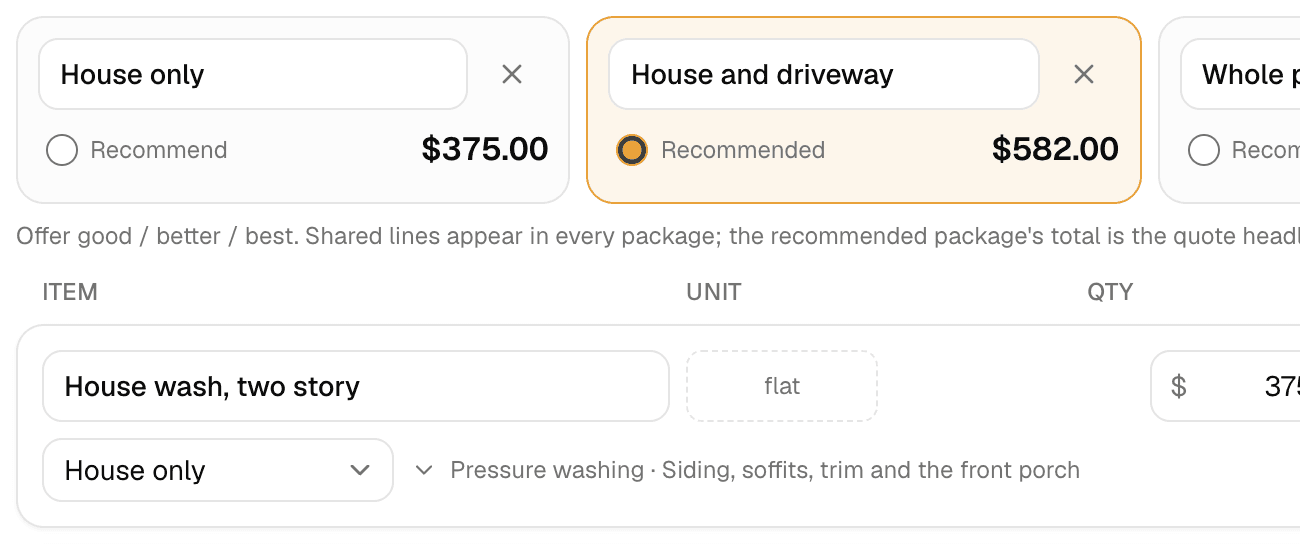
MakeHay does the request half for free: a request form to embed on any website or share as a link; every request lands in Requests with the customer's details, photos and the job site address, and the owner is emailed. A request with an address can start a draft quote in one tap. For the site itself, the Website add-on is $197 a month or $1,970 a year: a person at MakeHay builds it from your account, a short questionnaire and your photos, usually a first version within 1 to 2 business days, with a page per service and per town, the request form as the contact page, your Google reviews on the site refreshed weekly, hosting and HTTPS included, and a domain free for the first year. The editor is yours after the first version.
What a site must not be
- An under-construction page. A placeholder tells the buyer you are not ready and ranks for nothing.
- A brochure from the year you started, or stock photos of a crew that is not yours. Buyers compare the pictures to the truck in the driveway.
- A form that goes nowhere. Send a test request from your own phone every month.
- A page you do not own. A site built inside another company's product can be switched off on their schedule, as the Business Profile websites were.
- A desktop site shrunk down. Google indexes and ranks the mobile version, and Pew Research Center reports that 91 percent of US adults own a smartphone and 16 percent are smartphone-only internet users.
What to do Monday
- Step 1: Fill every field on the profile: the description, every service with a price where you have one, hours, service areas, and remove the address if customers never come to you.
- Step 2: Ask the last five customers for a review by the link Google provides, with no reward attached.
- Step 3: Count the signs: more than one service, more than one town, commercial bids, missed calls. Two or more means a site this season; one means next year; none means keep the money.
- Step 4: If a site is due, write the service list and the town list, gather your own job photos, and decide who owns the domain before anyone builds a page.
FAQ
Is a Google Business Profile enough for a contractor?
For one service in one town with residential customers and a phone that gets answered, yes. The profile is free, ranks on relevance, distance and prominence, and holds the reviews that 97 percent of consumers read. It stops being enough when you need a page per service or per town, a request form that takes photos, or a company page a commercial buyer will check.
Does a website help a contractor rank on Google Maps?
Indirectly. Google says prominence takes in how many websites link to the business and how many reviews it has, and that complete information helps; the website link is one of the profile's fields. A site also wins the ordinary search results a profile does not, such as a service plus a town you are not based in. There is no way to pay for a better local ranking.
Can a contractor use a Facebook page instead of a website?
As a photo feed, yes. As the website link on the profile, it is weak: Google's guidelines want a website that represents the individual business location, count pages created on social media sites among the URLs that refer users elsewhere, and a page inside another company's product can change or close on their schedule, as the free Business Profile websites did in 2024. A page on a domain you own is the one thing that stays yours.
How much does a contractor website cost?
It depends on who builds it and what is included: a domain, hosting, HTTPS, the build, photos and updates. How much a contractor website costs sets builders' published prices, domain renewals and the MakeHay add-on side by side.
Sources
- Mobile Fact Sheet (Pew Research Center, November 20, 2025) · States that 98% of US adults own a cellphone of some kind, that about nine in ten (91%) own a smartphone, and that 16% of US adults are smartphone-only internet users; based on a survey of 5,022 US adults from February 5 to June 18, 2025. (accessed October 17, 2026)
- Internet, Broadband Fact Sheet (Pew Research Center, November 20, 2025) · States that 96% of US adults say they use the internet and that 78% subscribe to a broadband internet service at home, from the 2025 survey. (accessed October 17, 2026)
- Local Consumer Review Survey 2026 (BrightLocal, February 11, 2026) · Survey of 1,002 US adults: 97% read online reviews for local businesses; 47% will not use a business with fewer than 20 reviews; 74% seek reviews written in the last three months; 92% care about star ratings when choosing a business; 89% expect a response to their reviews; after reading positive reviews, 54% visit the business's website (up from 32% in 2019), 66% do more research, 20% contact the business and 20% make an appointment. (accessed October 17, 2026)
- Tips to improve your local ranking on Google (Google Business Profile Help) · States that local results are mainly based on relevance, distance and popularity, under a section headed Prominence that says prominence means how well-known a business is and is also based on how many websites link to the business and how many reviews it has; that businesses with complete and accurate info are more likely to show up in local search results; and that there is no way to request or pay for a better local ranking on Google. (accessed October 17, 2026)
- Guidelines for representing your business on Google (Google Business Profile Help) · States that a service-area business should hide its business address from customers, with the example of a plumber working from a home address; asks for a website that represents the individual business location and says not to provide URLs that redirect or refer users to other landing pages, including pages created on social media sites; says no links of any type are allowed in the business description. (accessed October 17, 2026)
- Manage your service areas for service-area and hybrid businesses (Google Business Profile Help) · States that a business can have up to 20 service areas, that the overall area's boundaries should not be more than about 2 hours of driving time from the business, that a service area cannot be set as a radius, and that a service-area business that does not serve customers at its address should remove the address from its profile. (accessed October 17, 2026)
- Edit your Business Profile (Google Business Profile Help) · States that the description field must not exceed 750 characters and must not include URLs or HTML code; that the website field takes the full URL including http:// or https://; and that main hours are set on the profile. (accessed October 17, 2026)
- Manage your services on your Business Profile (Google Business Profile Help) · States that businesses in certain categories, like service businesses, might have the option to showcase their offerings; that a service can be chosen from suggestions or created as a custom service; that info such as price and description can be added to a service; and that custom service names must not carry prices or phone numbers. (accessed October 17, 2026)
- Tips to get more reviews (Google Business Profile Help) · States that offering incentives, like free or discounted goods or services, in exchange for customers to post reviews is strictly prohibited; that customers must be signed into a Google Account to leave a review; that businesses can ask customers to visit a Google link or scan a QR code; and that replying shows customers their feedback matters, with constructive replies and follow-up on negative reviews showing that the business cares. (accessed October 17, 2026)
- Mobile site and mobile-first indexing best practices (Google Search Central, last updated December 10, 2025) · States that Google uses the mobile version of a site's content, crawled with the smartphone agent, for indexing and ranking; that the mobile site should contain the same content as the desktop site; and that Google recommends responsive web design because it is the easiest design pattern to implement and maintain. (accessed October 17, 2026)
- Local Business (LocalBusiness) structured data (Google Search Central, last updated September 8, 2026) · Documents the LocalBusiness markup properties for a business's address, opening hours, telephone, geographic coordinates and price range, and states that search results may display a prominent knowledge panel with details about a business, with no guarantee that structured data features will appear. (accessed October 17, 2026)
- Websites Created With Google Business Profiles To Shut Down In March (Search Engine Journal, Kristi Hines, February 29, 2024) · Reports, reproducing Google's notice text, that in March 2024 websites made with Google Business Profiles would be turned off and visitors redirected to the Business Profile, that the redirect would work until June 10, 2024, and that sites not updated by then would send visitors to a 404 error page. (accessed October 17, 2026)