How Much Sealer Do I Need? Coverage, Sand, Water and Coats
How much sealer do I need for a driveway or lot: concentrate versus mixed coverage from the data sheet, sand and water per 100 gallons, coats, and drums.
The MakeHay team · · 11 min read
The answer to "how much sealer do I need" is one formula: pavement area divided by the data sheet's concentrate coverage, times the coats, plus a waste factor, rounded up to the drums or totes the supplier sells. SealMaster's MasterSeal TDS rates a gallon of concentrate at 100 to 120 sq ft per coat, so a 1,200 sq ft driveway with two coats needs 24 gallons at the low end. Water, sand and additive come from the same sheet.
How much sealer do I need: the formula and the two coverage numbers
You need area times coats divided by coverage, and the coverage must be the concentrate figure, because that is what you buy. The MasterSeal TDS prints both on one page: a gallon of concentrate covers approximately 100 to 120 sq ft per coat, and the mixed material (concentrate plus water, sand and additive) goes down at 70 to 82 sq ft per gallon. Divide by 70 and you order a third more concentrate than the job takes.
Pricing the gallons is a separate job, covered in How to Price Sealcoating Per Square Foot; this post stops at the order.
Step 1: Square footage, minus islands and buildings
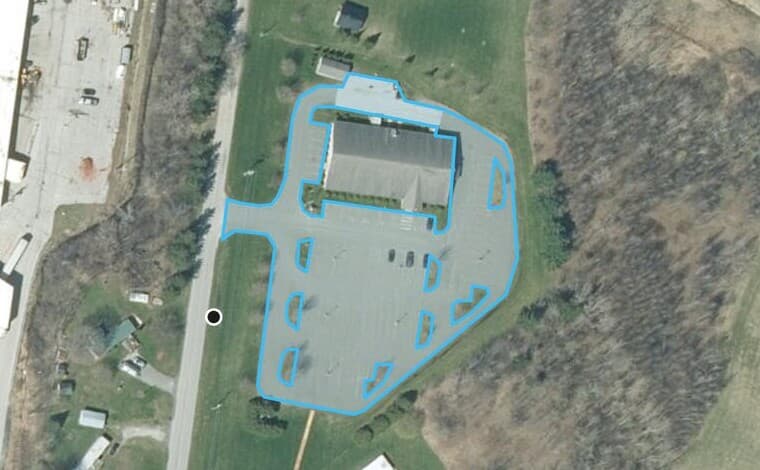
Start with pavement only, with every planted island, building footprint and dumpster pad taken out, because a gallon covers pavement. AsphaltPro's commercial estimating article says sealcoating is most likely bid by the square foot, and the gallon count comes from the same number, so one careful trace serves both the quote and the order.
The free satellite measurement tool traces the lot from its address and Cut out removes islands and buildings from the total. In MakeHay, the saved measurement fills a per square foot line's quantity with Use in line and updates the line if the trace is edited.
Step 2: Sealcoating coverage per gallon from the data sheet
Take coverage from the data sheet of the sealer you will pour, on the line that says concentrate. SealMaster's sealcoating FAQ says coverage rates vary by product and tells you to follow the specification sheets; another brand's sheet may not match the two below.
| Sealer | Concentrate, per gallon per coat | Mixed material, per gallon per coat |
|---|---|---|
| MasterSeal asphalt emulsion | 100 to 120 sq ft (11.1 to 13.3 sq yd) | 70 to 82 sq ft (7.77 to 9.11 sq yd) |
| Coal tar concentrate | 100 to 120 sq ft (11.1 to 13.3 sq yd) | 70 to 82 sq ft (0.11 to 0.13 gallon per sq yd) |
AsphaltPro's estimator's rule is about 60 sq ft of normal pavement per gallon, up to 100 sq ft on well-maintained or new pavement. That is sealer going down, not concentrate in the drum: it sits below the TDS's 70 to 82 sq ft for mixed material. Use it to check a mixed-gallon total, never to size a concentrate order.
Step 3: Sealcoat mix ratio per 100 gallons: water, sand and additive
The mix design is published per 100 gallons of concentrate, so scale it to your gallon count and the water, sand and additive fall out.
| Sealer | Water | Sand (40 to 70 mesh) | Polymer additive |
|---|---|---|---|
| MasterSeal asphalt emulsion | 15 to 25 gallons | 200 to 500 lb | 0.5 to 2 gallons Top Tuff |
| Coal tar concentrate | 30 to 40 gallons | 200 to 500 lb | 1 to 2 gallons Pave Gel |
Sand is never left out. The coal tar TDS says that in all cases sand shall be used in the mix design, SealMaster's FAQ answers "Is sand required" with yes, clean silica sand, and the "How often" FAQ gives the reason: sand provides traction and safety for vehicle and pedestrian traffic.
Step 4: Two coats, and when a third is specified
Two coats is the minimum, so the formula multiplies by two unless the job says otherwise. The MasterSeal TDS calls for a minimum of two coats and the coal tar TDS says apply two coats.
A third coat is optional and local. Both TDS pages and the sealcoating FAQ use the same wording: a third coat may be applied to high traffic areas such as entrances, exits and drive lanes. Measure those lanes as their own shape and add one coat's worth of gallons for that area only: a 6,000 sq ft drive lane at 100 sq ft per gallon adds 6,000 ÷ 100 = 60 gallons of concentrate.
Step 5: Pavement condition changes the number
Pavement condition decides where in the 100 to 120 sq ft range you land. The MasterSeal TDS says application rates may vary with pavement porosity; the coal tar TDS says coverage rates may vary with pavement age and porosity. AsphaltPro puts it in field terms: older, more oxidized pavement requires more material, and a pavement untreated for five or six years will absorb more of your product.
The examples below use 100 sq ft per gallon for a lot that is gray, open-textured or past the every 3 years interval SealMaster's FAQ calls typical, and 120 for smooth, recently sealed pavement. New asphalt waits: SealMaster's sealcoating FAQ says a minimum of 30 to 60 days, and the coal tar TDS a minimum of four weeks at 70°F. The temperature post covers the 50°F floor and the day-after check.
Worked example: A 1,200 sq ft driveway, two coats of asphalt emulsion
- Concentrate: gallons = area × coats ÷ concentrate coverage = 1,200 × 2 ÷ 100 = 24 gallons.
- Water at 20 gallons per 100 (mid-range of the TDS's 15 to 25): 24 × 0.20 = 4.8 gallons.
- Sand at 300 lb per 100 (inside the TDS's 200 to 500): 24 × 3 = 72 lb, two 50 lb bags.
- Additive at 1 gallon per 100 (inside the TDS's 0.5 to 2): 24 × 0.01 = 0.24 gallon, a quart.
- Mixed material, before sand adds its volume: 24 + 4.8 + 0.24 = 29 gallons; 2,400 ÷ 29 = 83 sq ft per mixed gallon, just above the TDS's 70 to 82.
- Order with a 10 percent waste factor (an assumption of this example): 24 × 1.10 = 26.4, so 27 gallons; Asphalt Kingdom listed no 5-gallon sealer pail on October 13, 2026, so the smallest order is one 55-gallon drum at $705.
Result: $12.82 per gallon of concentrate ($705 ÷ 55), one $705 drum for the 1,200 sq ft driveway, with 28 gallons left for the next one.
Worked example: A 40,000 sq ft lot, two coats, older pavement
- Concentrate at 100 sq ft per gallon (the low end, for an oxidized lot): 40,000 × 2 ÷ 100 = 800 gallons.
- Water at 20 gallons per 100: 800 × 0.20 = 160 gallons.
- Sand at 300 lb per 100: 800 × 3 = 2,400 lb, forty-eight 50 lb bags.
- Additive at 1 gallon per 100: 800 × 0.01 = 8 gallons.
- Mixed material: 800 + 160 + 8 = 968 gallons; 80,000 ÷ 968 = 83 sq ft per mixed gallon.
- Order with the same 10 percent waste factor: 800 × 1.10 = 880 gallons; three 275-gallon totes plus one drum is exactly 880 gallons at 3 × $1,895 + $705 = $6,390, while four totes are 1,100 gallons at $6,795.
Result: $6.18 per gallon by the four-tote bundle ($6,795 ÷ 1,100) with 220 gallons over, or $7.26 per gallon ($6,390 ÷ 880) for three totes and a drum that cover the 40,000 sq ft lot with only the waste allowance to spare.
How much sealcoat for a parking lot: buying it by the drum or the tote
A lot's order rounds up to whole containers, and the container sets the price per gallon more than anything else. Asphalt Kingdom's sealer store, read on October 13, 2026, listed asphalt emulsion sealer by the drum, the skid, the tote and the tanker load; the four listings below are the ones a driveway or lot order lands on, and the per-gallon column is this post's division, not the store's.
| Container | Gallons | Price | Per gallon |
|---|---|---|---|
| 55-gallon drum | 55 | $705 | $12.82 |
| Skid of four drums | 220 | $1,745 | $7.93 |
| 275-gallon tote | 275 | $1,895 | $6.89 |
| Four 275-gallon totes | 1,100 | $6,795 | $6.18 |
The same page says a drum gives 5,500 sq ft of coverage, 100 sq ft per gallon for a single coat with a sprayer (100 sq ft per 2 gallons for a double spray), and 50 to 60 sq ft per gallon by hand. It does not say whether the product is concentrate or ready to use, so ask before adding water: a ready-to-use sealer takes the mixed coverage.
Crack filler for the same job
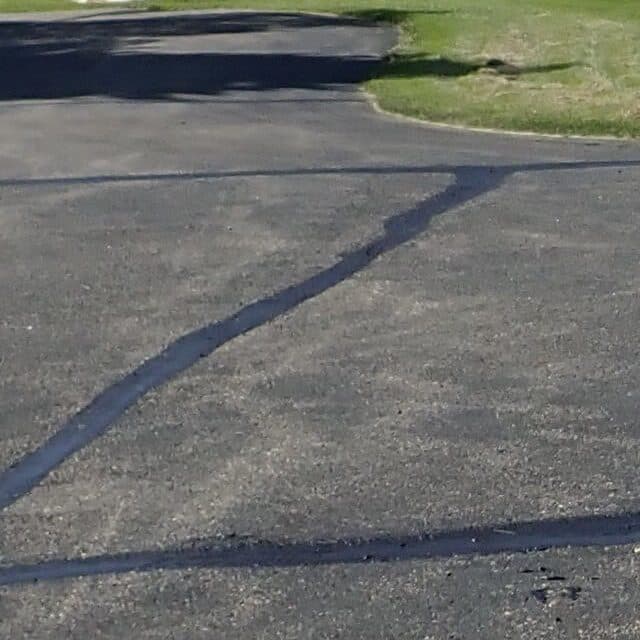
Crack filler is ordered by the pound from measured crack footage, not from the lot's square footage, and it goes down before the first coat. Measure the cracks in linear feet, then use the pounds per foot method in How to Price Crack Sealing Per Linear Foot to turn feet into boxes of sealant and a per linear foot line.
Putting the order on the quote
The customer's quote shows square feet and coats; the gallons, sand and water stay on your side as cost in a sealcoating price book.
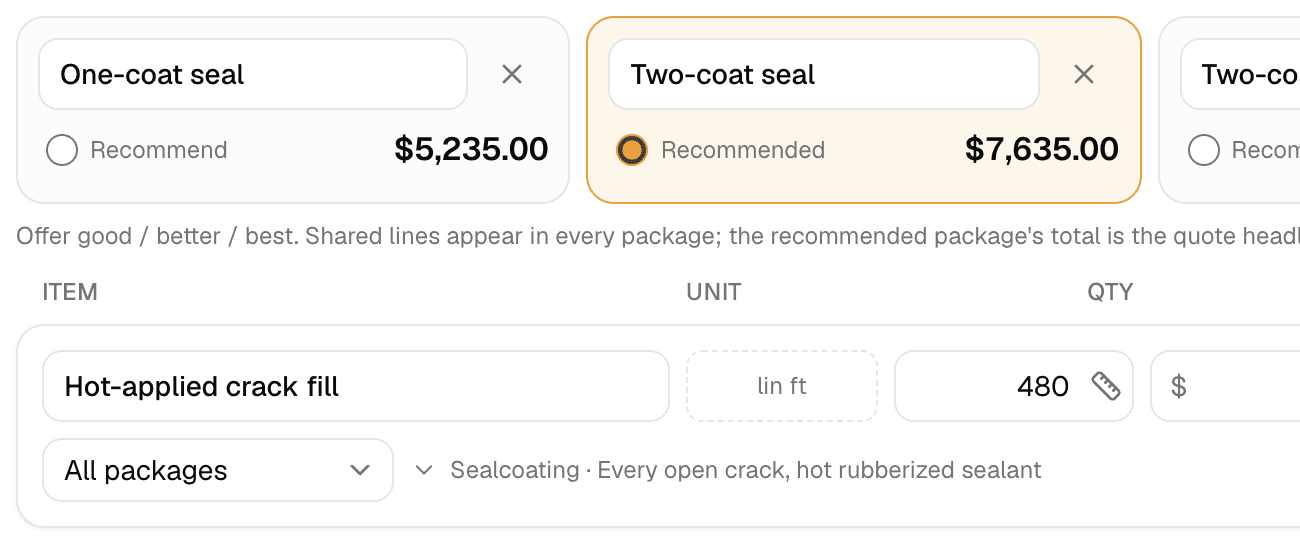
In MakeHay, the sealcoating starter list carries "Sealcoat, two coats" and "Sealcoat, one coat" per square foot and "Mobilization and lot prep" as a flat price (the parking lot maintenance list carries "Sealcoat, two coats" too); reprice them under Settings › Services. On the invoice, Cost & markup on each line takes Your cost ($) and Markup (%), with the margin shown only to you, so the drum price lands there and never on the customer's copy. The suggested sealcoating weather rule is max rain 40 percent and min temp 50°F, checked the day after.
FAQ
How many gallons of sealer per square foot do I need?
At the MasterSeal TDS's 100 to 120 sq ft per gallon of concentrate per coat, one coat takes 0.0083 to 0.01 gallon per sq ft and two coats 0.0167 to 0.02, so a 10,000 sq ft lot needs 167 to 200 gallons of concentrate for two coats before waste. Those are concentrate figures; mixed material goes down at 70 to 82 sq ft per gallon.
How many square feet does a 55-gallon drum cover?
Asphalt Kingdom's store page says a 55-gallon drum of its asphalt emulsion sealer gives 5,500 sq ft of coverage, 100 sq ft per gallon for one coat with a sprayer. At the MasterSeal TDS's 100 to 120 sq ft per gallon of concentrate, a drum covers 5,500 to 6,600 sq ft per coat, or 2,750 to 3,300 sq ft with two coats.
Is a sealer calculator online right?
Only if it says which coverage it divides by and how many coats it multiplies by. SealMaster's FAQ says coverage rates vary by product and to follow the specification sheets, so a calculator that assumes one number for every sealer, or divides by the 70 to 82 sq ft mixed figure as if it were concentrate, orders the wrong amount. Check it against the formula above.
Can you thin the sealer more to stretch it?
No. The water is part of the published coverage: the MasterSeal TDS allows 15 to 25 gallons per 100 of concentrate and the coal tar TDS 30 to 40, and each sheet's coverage assumes that mix. SealMaster's "How often" FAQ says that if the sealer is a low solids material (watered down) then durability will be compromised, and that application rates must follow the manufacturer's recommendations.
Sources
- SealMaster MasterSeal Concentrate Technical Data Sheet · "One gallon of MasterSeal Concentrate will cover approximately 100 to 120 square feet (11.1 to 13.3 square yards) per coat"; mixed material applied "at a rate of 70 to 82 square feet (7.77 to 9.11 square yards) per gallon"; mix design per 100 gallons of concentrate: water 15 to 25 gallons, Top Tuff Polymer Additive 1/2 to 2 gallons, sand (40 to 70 mesh) 200 to 500 lbs; "apply a minimum of two coats"; "A third coat ... may be applied to high traffic areas such as entrances, exits, and drive lanes"; "Application rates may vary due to pavement porosity and method of application"; surface and ambient temperature a minimum of 50°F and rising. (accessed October 13, 2026)
- SealMaster Coal Tar Concentrate Pavement Sealer Technical Data Sheet · "One gallon of SealMaster Coal Tar Concentrate will cover approximately 100 to 120 square feet (11.1 to 13.3 square yards) per coat when properly mixed and applied"; mixed "at a rate of .11 to .13 gallon per square yard (70 to 82 square feet per gallon) per coat"; per 100 gallons of concentrate: water 30 to 40 gallons, Pave Gel Polymer Additive 1 to 2 gallons, sand 200 to 500 lbs (40 to 70 mesh AFS rating); "in all cases sand shall be used in the mix design"; "apply two coats"; a third coat may be applied to entrances, exits and drive lanes; "Coverage rates may vary due to pavement age and porosity"; new asphalt should cure a minimum of four weeks at 70°F before sealing. (accessed October 13, 2026)
- Sealcoating FAQ, SealMaster Pavement Maintenance 101 · "Coverage rates will vary based on the product. Follow the specification sheets for application rates." "Apply two coats of sealer. A third coat may be applied to high traffic areas such as entrances, exits and drive lanes." "Yes, clean silica sand should be included in the mix design." "New asphalt should cure a minimum of 30 to 60 days." (accessed October 13, 2026)
- How Often Should you Sealcoating a Parking Lot or Driveway? SealMaster FAQ · "Typically, sealcoating is recommended every 3 years to provide adequate pavement protection"; "If the sealer is a low solids material (watered down) then durability will be compromised"; "Sand provides traction and safety for both vehicle and pedestrian traffic"; "Two coats of sealer should always be applied to achieve optimum sealcoating results"; "The application rate and coverage rates must follow manufacturers recommendations to achieve successful results." (accessed October 13, 2026)
- Estimate Your Commercial Project, AsphaltPro Magazine · "Most sealing products on the market today will cover about 60 square feet of 'normal' pavement per gallon of sealer"; "If you're sealing a well-maintained or new pavement, you may cover up to 100 square feet per gallon of sealer"; "If you're working on an older, more oxidized pavement, you will require more material"; an older pavement untreated "for five or six years, or ever, will absorb more of your product"; "you'll most likely be bidding by the square foot." (accessed October 13, 2026)
- Asphalt Sealer | Ships to the US and Canada | Asphalt Kingdom · Prices shown on October 13, 2026: Asphalt Emulsion Sealer (55 Gallon Drums) $705.00; Asphalt Emulsion Sealer Skid (Four 55 Gallon Drums) $1,745.00; Asphalt Emulsion Sealer (275 Gallon Sealing Totes) $1,895.00; Asphalt Emulsion Sealer Bulk Buy (4) 275 Gallon Totes $6,795.00; no 5-gallon sealer pail listed. "5,500 square feet of coverage per drum"; "When using a sealcoat sprayer" the sealer "provides a coverage of 100 square feet per gallon for a single coat or 100 square feet per 2 gallons for a double spray"; by hand, "ranging from 50 to 60 square feet per gallon for hand application". The page does not state whether the emulsion sealer is concentrate or ready to use. (accessed October 13, 2026)