How to Calculate Asphalt Tonnage for a Driveway or Lot
How to calculate asphalt tonnage from square feet and compacted depth, with waste, a driveway and a lot example, and where to find what a ton costs.
The MakeHay team · · 11 min read
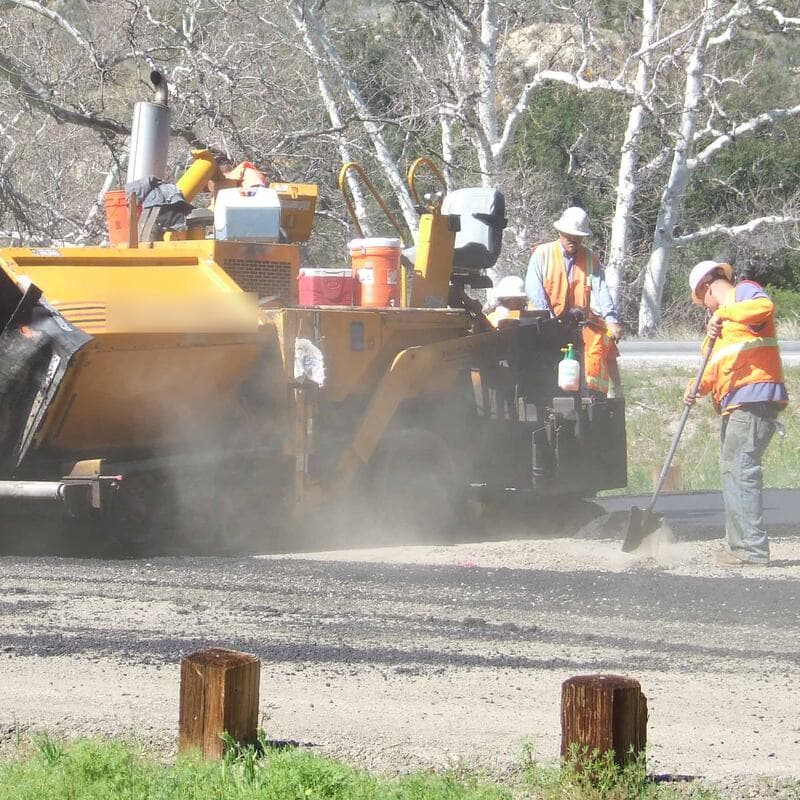
Here is how to calculate asphalt tonnage: divide the paved area in square feet by 9 to get square yards, multiply by the compacted thickness in inches and by 110 lb per sq yd per inch, then divide by 2,000 for short tons. Cubic feet times 146.7 lb per cubic foot, divided by 2,000, gives the same answer. Add waste, round up to whole tons, and that figure is the order and the quote quantity.
How to calculate asphalt tonnage: the formula and its constants
The formula is weight equals area times thickness times density. Plants sell hot mix by the short ton, which the Virginia DOT's 2020 Road and Bridge Specifications, a US state spec, define as 2,000 pounds, so the estimate has to end in tons. Two versions follow, and running both catches a slipped decimal.
In cubic feet
Tons = (sq ft × inches ÷ 12) × 146.7 ÷ 2,000. The 146.7 figure is the per-square-yard figure below converted (110 × 12 ÷ 9), so the two versions agree, and a slipped decimal in one shows up against the other.
In pounds per square yard per inch
Tons = sq ft ÷ 9 × inches × 110 ÷ 2,000. Highway specs write asphalt quantities as pounds per square yard per inch, the way a paver's application rate is checked, and VDOT's Section 315.05 checks overlay rates against 110 pounds per square yard per inch. Step 3 covers the heavier base course figure and when the plant's own number replaces the default.
Step 1: Area in square feet
Measure the pavement that gets asphalt, not the parcel. For a driveway, that is the drivable surface from the garage to the street. For an overlay, cut out islands and buildings. For a patch, measure the saw-cut rectangle, which runs larger than the failed spot.
The free satellite measurement tool traces a driveway or lot on dated imagery, found by address for US sites or by panning the map, and reads out square feet, no account needed. In MakeHay, a saved measurement fills a per square foot quote line with Use in line and stays linked if you edit it; the math here turns that square footage into the per-ton line's quantity.
Step 2: Compacted thickness per lift
Use the compacted thickness the spec or the customer's engineer calls for, because the 110 figure is a compacted weight. The loose mat behind the screed sits higher than the finished lift; only the thickness after rolling belongs in the formula.
Lift limits come from the mix. VDOT places its asphalt courses in layers no thicker than four times the mix's nominal maximum aggregate size and no thinner than 2.5 times it, so a 3 inch driveway may be one lift or two. Two lifts of the same mix add up to the same tons; run the formula per lift when the lifts are different mixes, as in the patch example below, and add them.
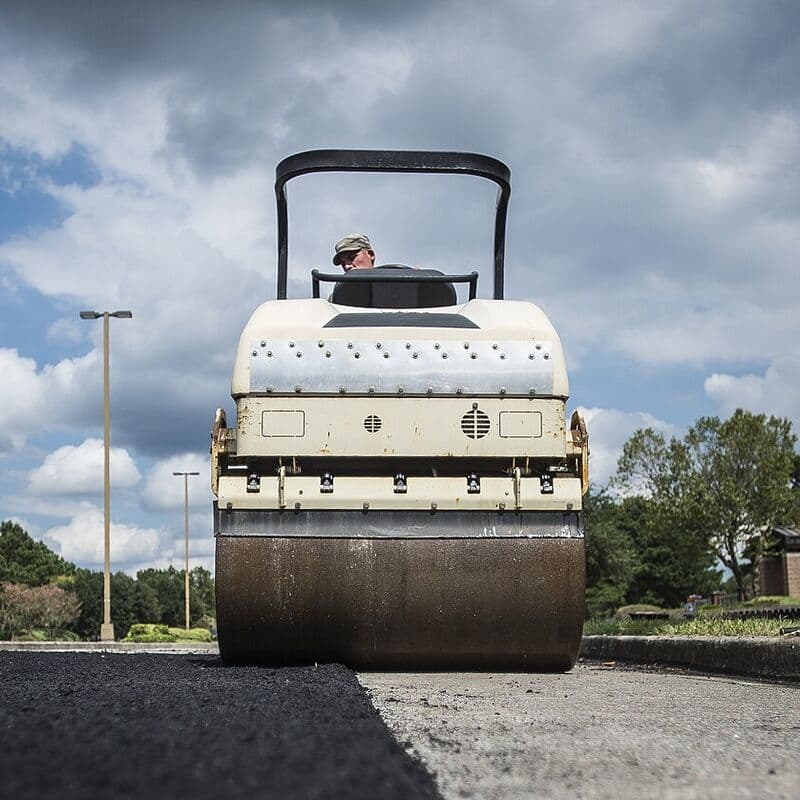
Compaction needs a hot, dry mat, so the forecast belongs next to the thickness. In MakeHay, the starter weather rule for paving is max rain 20 percent and min temp 50°F, checked against the National Weather Service forecast for the job site (US addresses), with a warning on the calendar when it trips.
Step 3: Asphalt density lb per cubic foot, or per square yard per inch
The density to use is the compacted unit weight of the mix the plant is selling you, and the working default is 110 lb per sq yd per inch, the rate VDOT's Section 315.05 checks overlays against, which converts to 146.7 lb per cubic foot (110 × 12 ÷ 9). Base course carries a heavier rate: the same spec deducts excess base course at 115 lb per sq yd per inch. When the plant hands over a mix design, take its bulk specific gravity (Gmb), which Pavement Interactive says is used to determine the weight per unit volume of the compacted mixture, and multiply it by water's 62.424 lb per cubic foot (the USGS table's 39.2°F row) for that mix's density in pounds per cubic foot; that number beats the default.
| Compacted thickness | Sq yd per ton | Sq ft per ton |
|---|---|---|
| 1 inch | 18.18 | 163.6 |
| 1.5 inches | 12.12 | 109.1 |
| 2 inches | 9.09 | 81.8 |
| 3 inches | 6.06 | 54.5 |
Step 4: Waste, handwork and rounding to the truck
The formula gives the asphalt compacted in place; the order has to cover what does not. Mix sticks to the truck bed and gets raked off at joints, and handwork around manholes and inside a patch wastes more than a paver on a straight pull. Pick an allowance you can defend, small for machine-laid work and larger for hand patches, then round up: the plant bills the scale ticket, so a fraction of a ton becomes a whole one. The examples below carry a small allowance on machine-laid work and double it on the hand patch; your own scale tickets against past estimates set yours. On a big pull the last truck sets the order: a partial load still costs a trip, so ask the plant what its trucks carry and order in loads.
How to estimate asphalt for a driveway, an overlay and a patch
Worked example: A 600 sq ft driveway at 3 inches compacted
- Area: 600 sq ft ÷ 9 = 66.67 sq yd.
- Weight: tons = sq yd × inches × 110 ÷ 2,000 = 66.67 × 3 × 110 ÷ 2,000 = 11.0 tons.
- Check: 600 × 0.25 ft = 150 cubic feet × 146.7 = 22,005 lb, or 11.0 tons.
- Waste at 5 percent: 11.0 × 1.05 = 11.55 tons, rounded up to 12 tons.
- Mix at Kentucky's 2025 average of $105.11 per ton: 12 × $105.11 = $1,261.
Result: $2.10 per sq ft of mix, $1,261 for the 600 sq ft driveway, before base, grading, trucking, labor and margin.
Worked example: A 20,000 sq ft parking lot overlay at 1.5 inches compacted
- Area: 20,000 sq ft ÷ 9 = 2,222.22 sq yd.
- Weight: 2,222.22 × 1.5 × 110 ÷ 2,000 = 183.33 tons.
- Waste at 5 percent: 183.33 × 1.05 = 192.5 tons, rounded up to 193 tons.
- Mix at $105.11 per ton: 193 × $105.11 = $20,286.
Result: $1.01 per sq ft of mix, $20,286 for the 20,000 sq ft parking lot overlay, with milling, tack and trucking on their own lines.
Worked example: A 200 sq ft full-depth patch, 4 inches of base under 2 inches of surface
- Area: 200 sq ft ÷ 9 = 22.22 sq yd.
- Base lift at 115 lb per sq yd per inch: 22.22 × 4 × 115 ÷ 2,000 = 5.11 tons.
- Surface lift at 110: 22.22 × 2 × 110 ÷ 2,000 = 2.44 tons.
- Waste at 10 percent for handwork: 5.11 × 1.10 = 5.62 tons of base, rounded up to 6 tons; 2.44 × 1.10 = 2.68 tons of surface, rounded up to 3 tons.
- Mix at the 2025 averages: 6 × $102.63 = $616 plus 3 × $105.11 = $315, $931 together.
Result: $4.66 per sq ft of mix, $931 for the 200 sq ft patch, before saw cutting, excavation, haul-off and base stone.
Where online calculators get the asphalt tonnage formula wrong
Wrong answers come from a divisor or a density.
- Dividing square feet by 3 for square yards. A yard is 3 feet, but a square yard is 9 sq ft, so the order triples.
- Treating inches as feet, or forgetting the 12. Three inches is 0.25 ft.
- Using the loose mat depth. The density is a compacted weight, so only the compacted thickness belongs in the formula.
- Mixing up tons. A short ton is 2,000 pounds in VDOT's definitions; a calculator built on the heavier metric tonne returns too few tons.
- One density for every mix, and no waste. Base course carries a heavier rate in VDOT's deductions, and the answer is not an order until waste is added and rounded up.
What a ton costs: a public hot mix asphalt price per ton
A public, dated unit price is the Kentucky Transportation Cabinet's list of average unit bid prices for jobs awarded in 2025, a US state DOT record: its largest item by dollars, the CL2 ASPH SURF 0.38D surface mix, averaged $105.11 per ton across 1,011,658 tons on 331 contracts, and the matching base mix, CL2 ASPH BASE 1.00D, averaged $102.63 per ton. Those are highway quantities bid by the thousand tons; a 12 ton driveway order is priced on its own at the plant window, so the public figure is a reference, not a quote price.
Plant quotes move because the liquid binder in the mix changes price month to month. The Indiana DOT's monthly PG asphalt binder index, a US state average of weekly selling prices, was $517 per ton in January 2025, $479 in December 2025, $627 in June 2026 and $568 in September 2026. Highway contractors recover the difference through an asphalt adjustment pay item (on 277 Kentucky contracts in 2025); a driveway quote has no such clause unless you write one, so get the plant quote dated and reprice a job that waits a season.
For a sanity check, HomeAdvisor's cost guide, a US survey of homeowners, puts an installed asphalt driveway at $7 to $15 per sq ft and describes driveways as about 2 to 3 inches thick. Against the $2.10 per sq ft of mix in the driveway example, the gap is base, grading, trucking, labor and margin.
Turning tons into a quote line
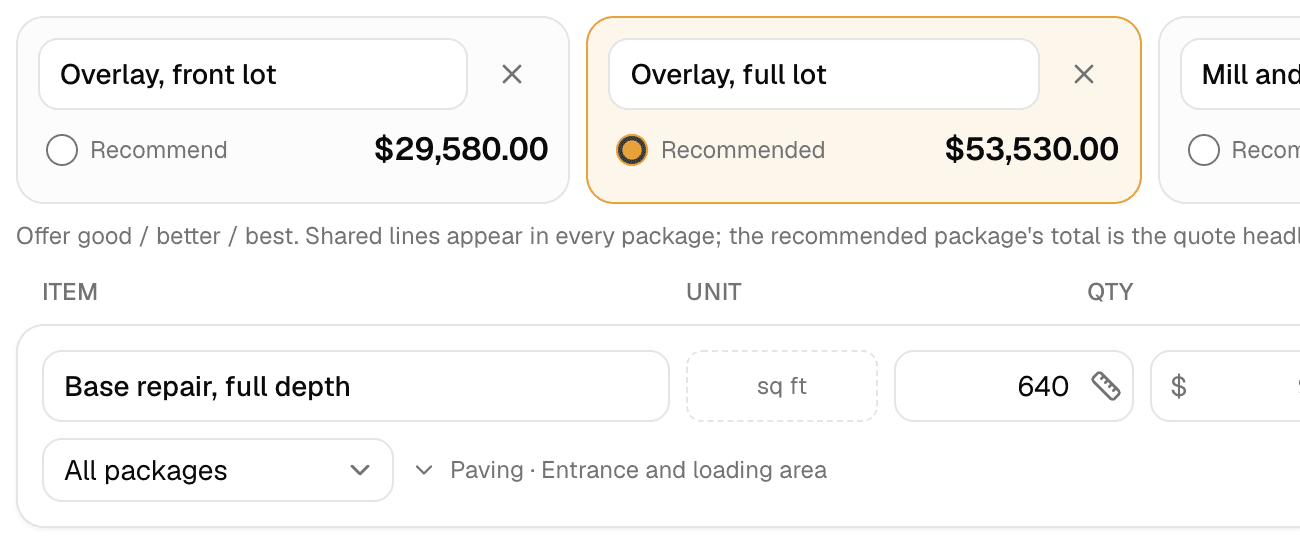
The rounded tons become the quantity on a per-ton line, and the per-ton price is the plant quote plus hauling and placement per ton plus margin. In MakeHay, the asphalt paving starter list carries "Hot mix asphalt, per ton" as an Each item, "Mill and fill" and "Base repair, full depth" as Per square foot lines, and "Grading and compaction" and "Trucking and mobilization" as Flat price lines; per-ton pricing is an Each line in the price book, not a special unit.
Keep the per-ton line to the mix. Saw cutting, haul-off, milling, tack, base stone and grading each get their own line in their own unit, so a thickness change touches one quantity. The maintenance that comes back to that mat in later seasons is priced in how to price sealcoating per square foot and how to price crack sealing per linear foot, and the asphalt paving page shows that price book.
FAQ
How many tons of asphalt does a two-car driveway need?
Call a two-car driveway 20 by 30 ft, which is 600 sq ft. At 3 inches compacted, 600 ÷ 9 × 3 × 110 ÷ 2,000 is 11.0 tons; at 2 inches it is 7.3 tons. Add your waste allowance and round up to whole tons, which puts 12 tons or 8 tons on the order.
How much area does a ton of asphalt cover?
At 110 lb per sq yd per inch, one short ton of 2,000 pounds covers 18.18 sq yd per inch of compacted depth: about 164 sq ft at 1 inch, 82 sq ft at 2 inches and 54.5 sq ft at 3 inches. Divide by your waste factor for the area a ton covers on the ground.
How much does hot mix asphalt cost per ton?
The answer that counts is the plant's dated quote for your mix and quantity. For a public reference, Kentucky's 2025 average unit bid prices put a surface mix on 331 state contracts at $105.11 per ton on highway quantities. The liquid binder inside that mix moves faster: Indiana's PG binder index ran from $459 per ton in February 2026 to $627 in June, which is why a spring quote does not hold in fall.
How thick should driveway asphalt be?
Thick enough for the load and the base under it, a design question for the spec or the customer's engineer, not for the tonnage formula. HomeAdvisor's homeowner survey describes residential driveways as about 2 to 3 inches thick, and VDOT limits any single lift to 2.5 to 4 times the mix's nominal maximum aggregate size.
Sources
- 2020 Road and Bridge Specifications, Virginia Department of Transportation · Section 315.05: nuclear density testing applies when overlays are placed "at an application rate less than 125 pounds per square yard, based on 110 pounds per square yard per inch, on any surface"; Section 315.07: excess base course is deducted "at a weight of 115 pounds per square yard per inch of depth"; Section 315.05: courses are placed "in layers not exceeding four times the nominal maximum size aggregate" and "no less than 2.5 times the nominal maximum size aggregate"; Section 101.02 definitions: "Ton. A short ton; 2,000 pounds avoirdupois." The spec's old URL at virginiadot.org now redirects to VDOT's Road and Bridge Specifications page, not to this PDF. (accessed October 12, 2026)
- Kentucky Average Unit Bid Prices for All Awarded Jobs for 2025, Kentucky Transportation Cabinet · 595 contracts awarded, $1,314,649,899 in total; item 301, CL2 ASPH SURF 0.38D (the sheet's description continues with the binder grade, PG 64), unit TON, quantity 1,011,658, average price $105.11, 331 contract occurrences, overall rank 1 at 8.09 percent of awarded dollars; item 212, CL2 ASPH BASE 1.00D (same binder grade), unit TON, quantity 197,097, average price $102.63, 102 contract occurrences; ASPHALT ADJUSTMENT, unit DOLL, 277 contract occurrences; a spreadsheet opened October 12, 2026. (accessed October 12, 2026)
- Average Monthly Price, PG Asphalt Binder Index, Indiana Department of Transportation · Binder Index (BI) per ton: January 2025 $517.00, December 2025 $479.00; 2026 through September: January $467.00, February $459.00, March $504.00, April $606.00, May $609.00, June $627.00, July $597.00, August $582.00, September $568.00, so February and June are the 2026 low and high; "The monthly PG asphalt binder index (BI) is determined by averaging the weekly selling prices in Indiana as listed in the Poten & Partners Asphalt Weekly Monitor publication." (accessed October 12, 2026)
- HMA Weight-Volume Terms and Relationships, Pavement Interactive · Bulk specific gravity of the compacted asphalt mixture (Gmb): "This value is used to determine weight per unit volume of the compacted mixture."; "Multiplying Gmm by the unit weight of water gives Theoretical Maximum Density (TMD)." The page gives no typical density figure. (accessed October 12, 2026)
- Water Density, USGS Water Science School · Table "Water's density varies with temperature": 62.424 lb per cubic foot at 39.2°F (4.0°C). (accessed October 12, 2026)
- How Much Does It Cost to Pave a Driveway in 2026?, HomeAdvisor · A homeowner cost survey: "Installing an asphalt driveway costs an average of $7 to $15 per square foot"; "asphalt driveways are about 2 to 3 inches thick"; resurfacing at "$1,800 to $4,200 for an average two-car driveway"; October 12, 2026. (accessed October 12, 2026)