How to Price Asphalt Patching: Potholes Per Sq Ft and Ton
How to price asphalt patching: the FHWA repair methods, cold patch by the bag or hot mix by the ton, team time per patch, a minimum charge and sq ft rates.
The MakeHay team · · 10 min read
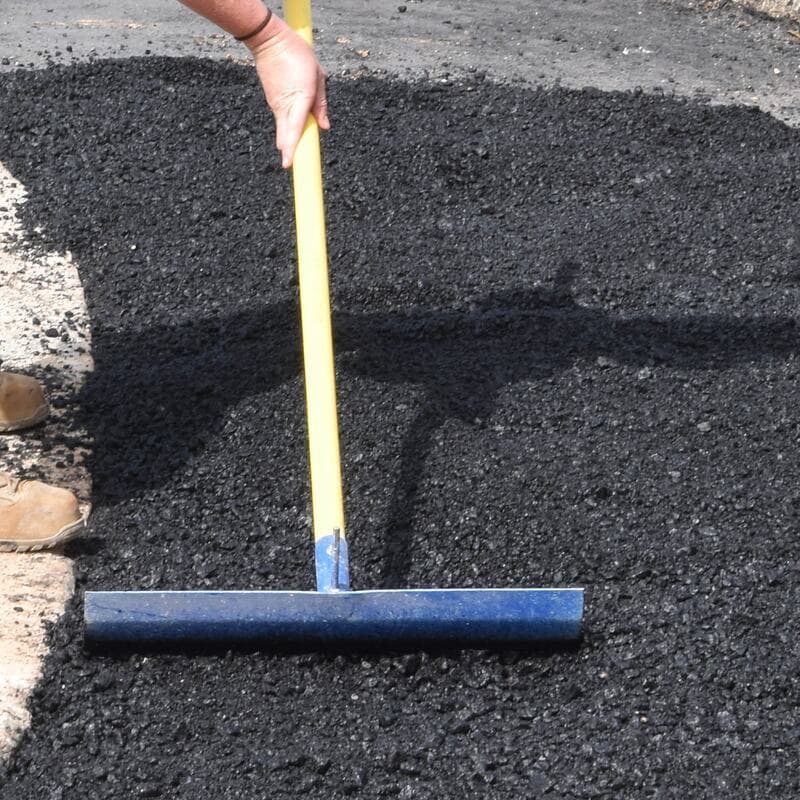
Here is how to price asphalt patching: pick the method, measure each hole's area and depth, cost the material by the bag or the ton, add time on site and the trip, and set a minimum so three small holes still pay. The rate per square foot runs higher on a small job because the trip costs the same for 6 sq ft as for 200.
How to price asphalt patching: the four methods and what FHWA found
The method decides the material, the team and the minutes, so pick it first. The US Federal Highway Administration's 1999 manual of practice on pothole repair collects the good practices from the SHRP maintenance studies, and FHWA's write-up of those studies names the four techniques tested: throw-and-roll, edge seal, semi-permanent and spray injection.
FHWA's Focus article on the study reports that more than 1,250 cold-mix patches were placed at 8 test sites across the United States and Canada, that 56 percent survived to the last check in 1995, and that throw-and-roll proved as effective as semi-permanent in most situations and more cost-effective. This post prices those two.
Step 1: Measure and classify the patch: area, depth, edges, water
Measure the cut, not the hole. Pavement Interactive's patching page splits patches into full-depth, from the pavement surface to the subgrade, and partial, which do not extend through the full depth of the existing pavement.
- Area: length times width of the cut, per hole; the saw line runs into sound pavement, past the hole.
- Depth: inches to firm material; it sets bags or tons.
- Edges: a hole inside alligator cracking is a base problem, not a pothole.
- Water: standing water means drying time, or a material that tolerates it.
The free satellite tool measures the lot's total square footage; a pothole shows in the imagery only sometimes, so the tape wins.
Step 2: Cold patch vs hot mix: material by the bag or by the ton
Cold patch comes by the bag, hot mix by the ton. Pavement Interactive says HMA is typically used for permanent patches while cold mix is often used for temporary emergency repairs; FHWA adds that with quality materials a cold-mix patch can last several years.
A dated bag price: Home Depot listed Road Rescue 50 lb asphalt repair at $33.98 for pickup at its Williston, Vermont store on October 13, 2026, covering 7 sq ft at a depth of 1 inch. That is $4.85 per sq ft per inch of depth, so a 2 sq ft hole 2 inches deep uses 0.57 of a bag.
The formula for tons from area and depth, and the waste allowance, live in how to calculate asphalt tonnage; its 200 sq ft patch example supplies the tons below, priced at Kentucky's 2025 average unit bid prices, a US state DOT record: $105.11 per ton for a surface mix and $102.63 for a base mix, highway quantities that stand in for the plant's dated quote. Ask the plant about its smallest load, and a hotbox keeps a small load workable.
Step 3: Team time per patch
For the semi-permanent patch, Pavement Interactive, quoting FHWA, lists: remove water and debris; square up the sides so they are vertical with intact pavement all around; place the material mounded in the center and tapering to meet the pavement flush; compact from the center out with a vibratory plate or a single-drum roller; check for a slight crown.
Throw-and-roll is three steps: place the material without any preparation or water and debris removal, compact it with the patching truck tires, usually 4 to 8 passes, and check for a slight crown.
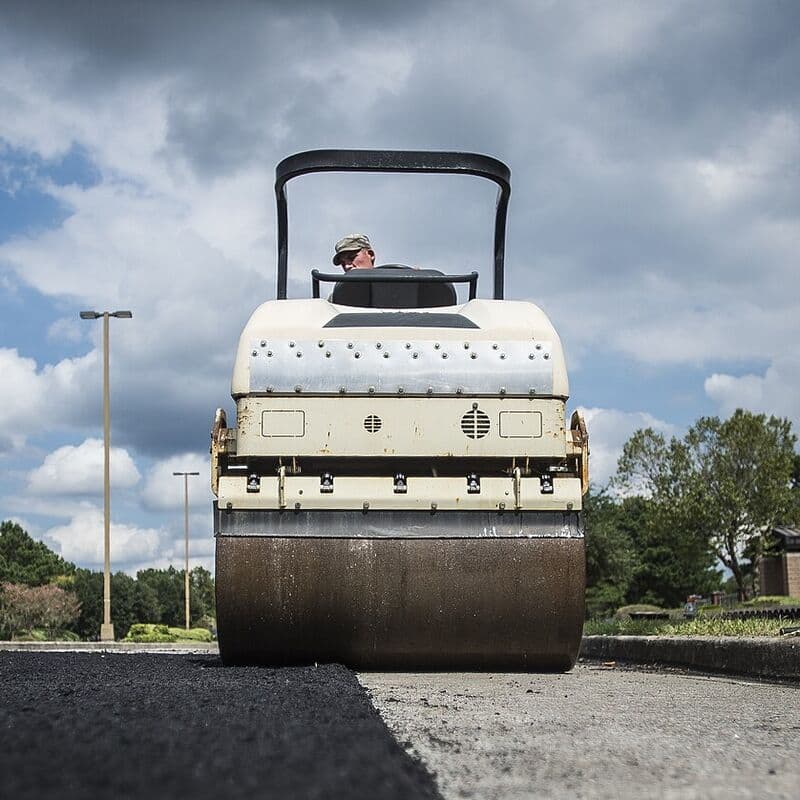
Neither page gives minutes per patch, so this post uses labeled planning figures: two people and 10 minutes per small hole for bagged cold patch, and four people on site for 2 hours on a 200 sq ft partial-depth patch or 4 hours on a full-depth cut-out with hot mix. Replace them with your own timesheets.
The wage floor is public: O*NET's wages page for highway maintenance workers, from BLS May 2025 data, gives a US median of $24.16 per hour. The examples use the bare median; burden, insurance and margin sit on top.
Step 4: Asphalt repair minimum charge and mobilization
The minimum charge is the trip plus the first labor hour, before margin, and it is why three holes cost more per foot than one 200 sq ft cut-out. The trip costs the same for two bags or nine tons: an hour of travel for two people at the BLS median is $48.32, and 30 miles at the IRS business mileage rate of 76 cents a mile (July 1 to December 31, 2026) is $22.80, so the truck costs $71.12 before any work.
Spread $71.12 over the 6 sq ft of three small holes and it is $11.85 per sq ft; over 200 sq ft it is $0.36. Price the trip as its own line, or fold it into a minimum covering the trip, the first hour of two people ($48.32) and margin. Three holes and a sealcoat on one visit pay the trip once, the case for selling the maintenance visit, not the hole.
Step 5: Pothole repair cost per square foot, by method and depth
The table is this post's own arithmetic from Steps 2 to 4, not a survey. Cold patch: the bag at $4.85 per sq ft per inch, and 10 minutes of two people per 2 sq ft hole, a third of a labor hour at $24.16, or $8.05 a hole. Hot mix: the tons from the tonnage post's 200 sq ft patch, 3 tons of surface mix at $105.11 ($315) for the 2 inch lift, and 6 tons of base at $102.63 plus the same 3 of surface ($931) for full depth, with four people for 2 or 4 hours. Add the trip, equipment and margin.
| Method and depth | Material per sq ft | Labor per sq ft | Cost per sq ft |
|---|---|---|---|
| Cold patch, 2 inches, 2 sq ft holes | $9.71 | $4.03 | $13.74 |
| Cold patch, 3 inches, 2 sq ft holes | $14.56 | $4.03 | $18.59 |
| Hot mix, 2 inches partial depth, 200 sq ft | $1.58 | $0.97 | $2.55 |
| Hot mix, full depth (4 inch base, 2 inch surface), 200 sq ft | $4.66 | $1.93 | $6.59 |
Worked example: Three driveway potholes, 2 sq ft each and 2 inches deep, with bagged cold patch
- Material: 3 holes × 2 sq ft × 2 inches = 12 sq ft of 1 inch coverage; 12 ÷ 7 = 1.71 bags, rounded up to 2; 2 × $33.98 = $68.
- Labor on site: 3 × 10 minutes = 30 minutes for two people = 1 labor hour × $24.16 = $24.
- Trip: 1 hour × 2 people × $24.16 = $48.32, plus 30 miles × $0.76 = $22.80; $71.
- Total: $68 + $24 + $71 = $163; $163 ÷ 6 sq ft = $27.17 per sq ft.
Result: $27.17 per sq ft, $163 for the three holes, before burden and margin; the trip is 44 percent of it.
Worked example: A 200 sq ft full-depth parking lot patch with hot mix
- Mix: 6 tons of base and 3 tons of surface, waste included, from the tonnage post; 6 × $102.63 = $616 plus 3 × $105.11 = $315; $931.
- Labor on site: 4 people × 4 hours = 16 labor hours × $24.16 = $387.
- Trip: 1 hour × 4 people × $24.16 = $96.64, plus 30 miles × $0.76 = $22.80; $119.
- Total: $931 + $387 + $119 = $1,437; $1,437 ÷ 200 sq ft = $7.19 per sq ft.
Result: $7.19 per sq ft, $1,437 for the 200 sq ft patch, before the saw, haul-off and margin; the trip is 8 percent of it.
Throw and roll pothole repair or a cut-out: what to tell the customer
Offer two prices, in the study's terms: FHWA found throw-and-roll as effective as semi-permanent in most situations and more cost-effective, with quality materials keeping a patch in service for several years, and Pavement Interactive says permanent patches typically use HMA. The throw-and-roll holds the hole until the lot is resurfaced; the cut-out with hot mix is the repair where the base is sound.
Say what the price leaves out: a crack running from the hole is a crack sealing line, and a sealcoat over the patch waits for the mix to cure, which the sealcoating temperature post covers.
How to estimate asphalt repair from photos
Quote from photos for the method and the count; inspect before the price is final. Ask for one photo of each hole with a tape or a boot in it for scale, a wide shot of the edges, and whether water stands in it after rain. Class each hole as a throw-and-roll or a cut-out; the small ones go against your minimum, the cut-outs per sq ft at the depth you expect.
In MakeHay, a request form carries the built-in Job site address question and a Photo upload answer type, and Convert to customer + quote makes the customer, job site and draft quote. Write "subject to inspection" in the quote's Terms field and ask for a deposit, a percent or a dollar amount; with Stripe connected (US businesses) the customer pays it by card as they approve.
Putting the patch on the quote
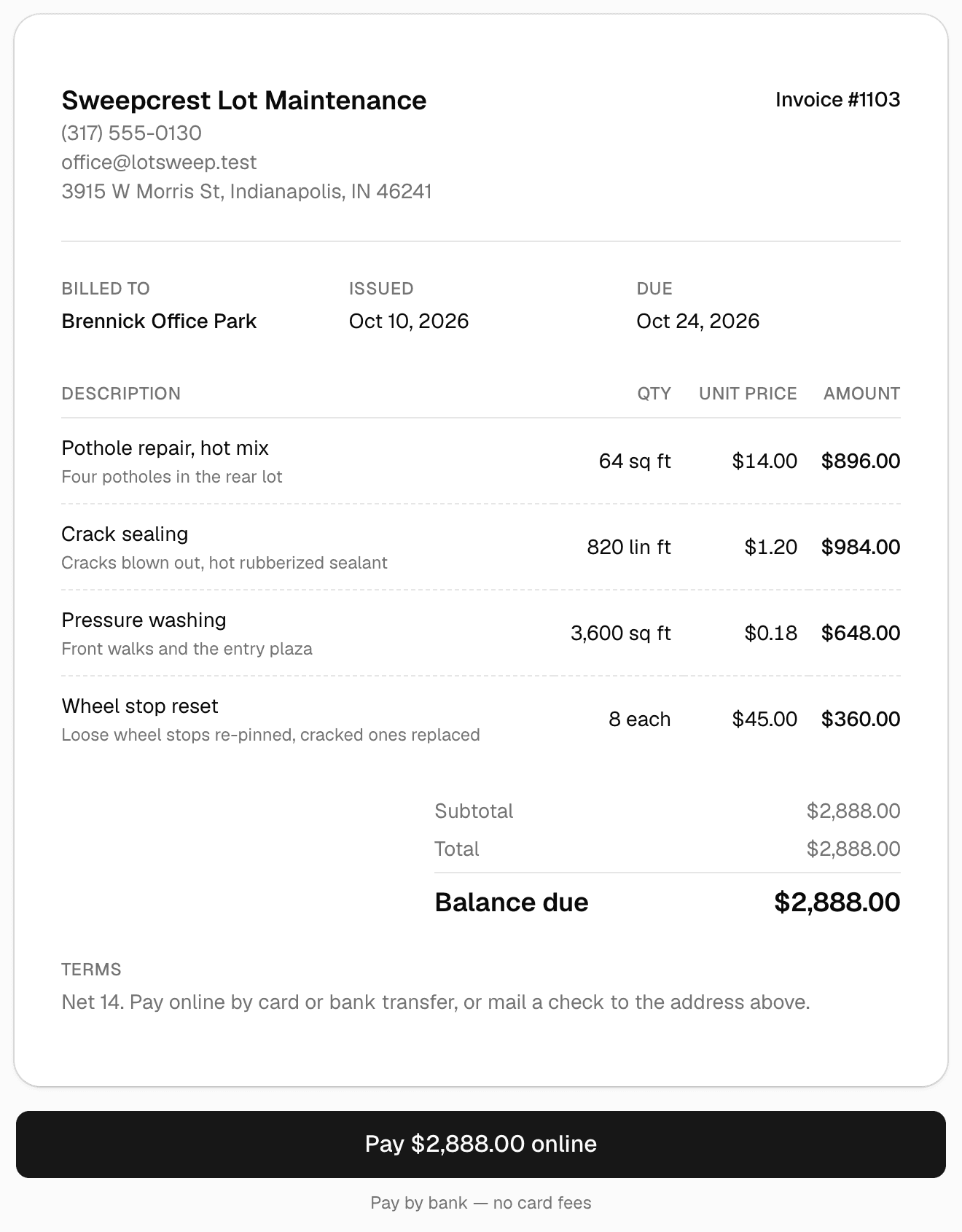
In MakeHay, the asphalt paving starter list carries "Hot mix asphalt, per ton" as an Each item, "Base repair, full depth" and "Mill and fill" as Per square foot lines, and "Grading and compaction" and "Trucking and mobilization" as Flat price lines in the price book; a flat minimum is its own line, and per-ton is an Each line, not a special unit. The parking lot maintenance demo invoice bills 64 sq ft of pothole repair with hot mix per square foot.
FAQ
How much does it cost to fix a pothole?
At this post's inputs, three 2 sq ft holes 2 inches deep cost $163 with bagged cold patch, labor at the BLS median and a 30 mile trip, or $27.17 per sq ft before margin; the trip is $71 of it. A 200 sq ft cut-out with hot mix costs $1,437, or $7.19 per sq ft.
How many square feet does a 50 lb bag of cold patch cover?
Home Depot's listing for Road Rescue 50 lb asphalt repair says 7 sq ft at a depth of 1 inch, at $33.98 a bag at the Williston, Vermont store on October 13, 2026. That is 3.5 sq ft at 2 inches, so a 2 sq ft hole 2 inches deep takes more than half a bag.
Is cold patch permanent?
Pavement Interactive says HMA is typically used for permanent patches and cold mix for temporary emergency repairs. FHWA's study of more than 1,250 cold-mix patches said that, with quality materials, patches can remain in service for several years. Sell it as a hold-over, and the hot mix cut-out as the repair.
Can you sealcoat over a new patch?
Not the same week. New asphalt has to cure before its first sealcoat, and the sealer maker's waiting period and water test are in the sealcoating temperature post. Price the patch and the sealcoat as two visits, or patch early in the season and seal at the end of it.
Sources
- Materials and Procedures for Repair of Potholes in Asphalt-Surfaced Pavements, Manual of Practice (FHWA publication listing) · The publication page: publication year 1999, described as a "Manual containing a compendium of good practices for asphalt concrete pothole repair" stemming from the SHRP pavement maintenance studies; cited for the manual's existence and title only, no figure is taken from the PDF it links. (accessed October 13, 2026)
- A Better Fix for Potholes, Focus, Federal Highway Administration, January 2000 · "Starting in 1991, more than 1,250 cold-mix pothole patches were placed at 8 test sites across the United States and Canada"; the four techniques named as "throw and roll, edge seal, semipermanent, and spray injection"; "Overall, 56 percent of all patches survived until the final round of performance monitoring in 1995"; "the throw-and-roll technique proved as effective as the semipermanent procedure in most situations" and "is more cost-effective, making it a good patching choice"; "if quality materials are used, pothole patches can remain in service for several years." (accessed October 13, 2026)
- HMA Patching, Pavement Interactive · Patches are "full-depth where they extend from the pavement surface to the subgrade" or "partial where they do not extend through the full depth of existing pavement"; "Typically some form of HMA is used for permanent patches, while cold mix is often used for temporary emergency repairs"; semi-permanent steps (quoting FHWA 1998): "Remove all water and debris from the pothole", "Square up the pothole sides so they are vertical and have in-tact pavement on all sides", "The material should mound in the center and taper down to the edges so that it meets flush with the surrounding pavement edges", "Compact the patching material starting in the center and working out toward the edges" using "a vibratory plate compactor or a single-drum vibratory roller", "Check the compacted patching material for a slight crown"; throw-and-roll: "Place the patching material into the pothole without any preparation or water/debris removal", "Compact the patching material using the patching truck tires (usually 4 to 8 passes)", "If a depression is present add more patching material and compact." (accessed October 13, 2026)
- Highway Maintenance Workers, local and national wages (O*NET OnLine, Bureau of Labor Statistics 2025 wage data) · United States hourly wages from 2025 wage data: median $24.16 per hour, "10% of workers earn $17.42 or less", "10% of workers earn $34.60 or more"; annual median $50,260. (accessed October 13, 2026)
- Road Rescue 50 lbs. Asphalt Repair AP-50, The Home Depot · $33.98 per 50 lb bag for pickup at the Williston, Vermont store (ZIP 05495) on October 13, 2026; "Covers 7 sq. ft. at a depth of 1 in."; "Works in any weather: hot or cold, wet or dry". (accessed October 13, 2026)
- Standard mileage rates, Internal Revenue Service · Business standard mileage rate: 76 cents per mile for July 1 to December 31, 2026 (IR 2026 29), and 72.5 cents per mile for January 1 to June 30, 2026 (IR 2025 128). (accessed October 13, 2026)
- Kentucky Average Unit Bid Prices for All Awarded Jobs for 2025, Kentucky Transportation Cabinet · 595 contracts awarded, $1,314,649,899 in total; item 301, CL2 ASPH SURF 0.38D (binder grade PG 64), unit TON, quantity 1,011,658, average price $105.11, 331 contract occurrences, overall rank 1 at 8.09 percent of awarded dollars; item 212, CL2 ASPH BASE 1.00D (same binder grade), unit TON, quantity 197,097, average price $102.63, 102 contract occurrences; a spreadsheet opened October 13, 2026, the same figures the tonnage post cites. (accessed October 13, 2026)