How to Price Excavation by the Hour or by the Cubic Yard
How to price excavation two ways: the machine hour from published equipment rates plus wages, or the bank yard with swell, trucking, dump fees and 811.
The MakeHay team · · 11 min read
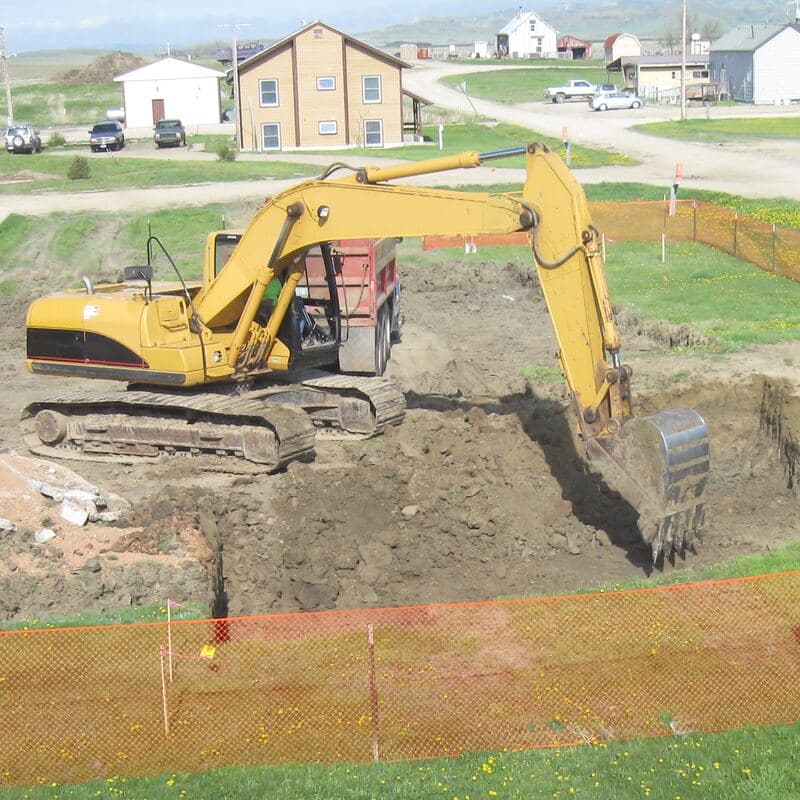
Here is how to price excavation both ways. The hour is the machine plus the operator, with a published equipment schedule as the floor. The cubic yard is that same cost divided by the yards moved in the hour, plus swell, trucking and dump fees. Price the hour when the ground is unknown; price the yard when the hole can be measured.
The hourly rate for an excavator and operator, from published rates
Start with the machine. FEMA's schedule of equipment rates, applicable to disasters declared on or after July 1, 2025, covers ownership and operation: depreciation, overhead, all maintenance, field repairs, fuel, lubricants, tires and OSHA equipment. It is a cost floor for a machine you own, not a market price, and labor costs of the operator are not included.
| Code | Machine | Horsepower | Rate per hour |
|---|---|---|---|
| 8281 | Hydraulic excavator, 313 GC class, with bucket | to 90 | $95.01 |
| 8282 | Hydraulic excavator, 320 GC class, with bucket | to 150 | $107.93 |
| 8283 | Hydraulic excavator, 330 GC class, with bucket | to 201 | $150.99 |
Then the seat. O*NET's wage page for operating engineers and other construction equipment operators shows a median of $28.78 an hour in the Bureau of Labor Statistics 2025 data; the BLS Occupational Outlook Handbook puts construction equipment operators at $59,600 a year in May 2025. A median is the middle of the country: use your operator's wage, plus payroll taxes, insurance and idle days.
The hourly price is machine rate plus loaded wage plus markup, and it is right when nobody can see what is in the ground: a demolition cleanup, an unmarked septic, fill of unknown depth. Quote a minimum of hours, mobilization as its own line, and say when the clock starts.
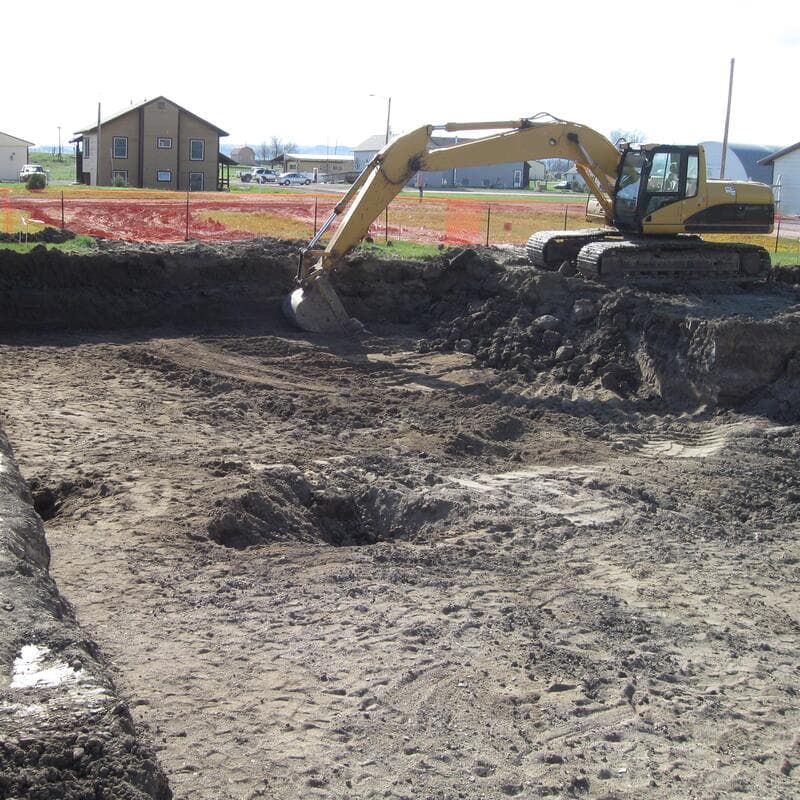
Excavation cost per cubic yard: the same hour, divided
A per yard price is the hourly cost divided by the yards the machine moves in that hour. Time three jobs: bank yards dug (length by width by depth in feet, divided by 27) over machine hours is the pace. Loaded hourly cost divided by pace is the cost per bank yard before trucking.
The yard is right when the hole can be measured before the dig: a basement, a pool, a footing trench from a plan. The customer sees a quantity and a unit price, and a change in depth is a change in yards, not an argument about hours. The risk is the ground: a pace timed in loam will not hold in wet clay or rock, which is why the clauses below matter more on a per yard quote.
Bank yards versus loose yards: swell, and what the truck carries
The hole is measured in bank yards, material in place. The truck carries loose yards, and there are more of them. The Engineering ToolBox's bulking factor table says soil or rock from the borrow expands when dropped on the truck or stockpiled; its example takes 300 cubic meters of clay at 40 percent swell to 420.
| Material | Swell | 100 bank yards become |
|---|---|---|
| Loam | 15 to 25 percent | 115 to 125 loose yards |
| Earth, soil | 20 to 30 percent | 120 to 130 loose yards |
| Clay | 20 to 40 percent | 120 to 140 loose yards |
| Rock | 40 to 80 percent | 140 to 180 loose yards |
So price the dig per bank yard, which the customer can measure, and the haul per loose yard or per load, which the truck can measure, and say which yard you mean on the quote.
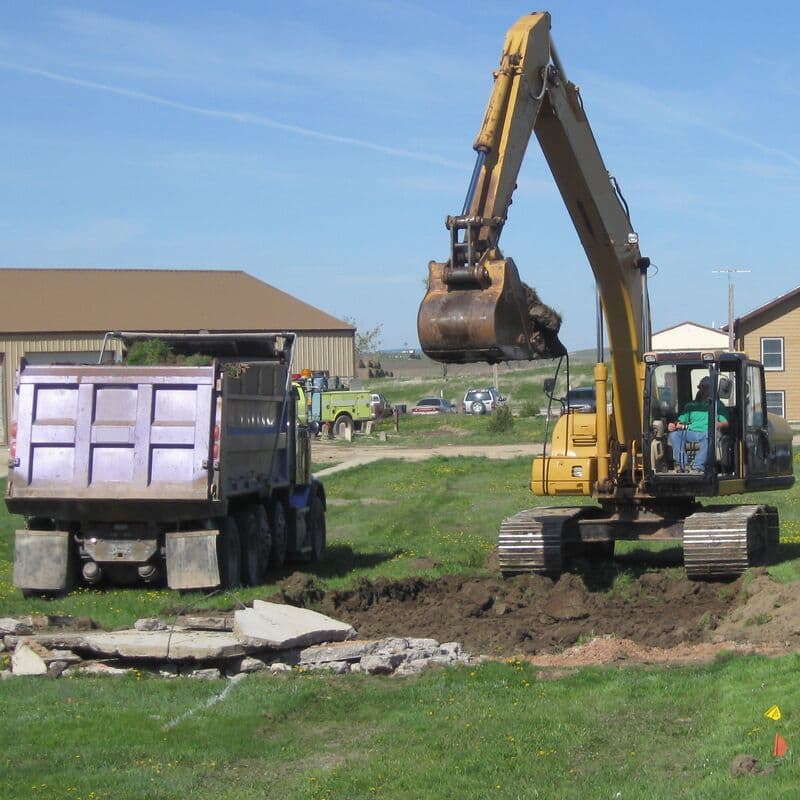
Haul-off, trucking and dump fees
Trucking is the second machine and often the larger number. FEMA's schedule lists dump trucks by bed: 7 cubic yards at $55.28 an hour, 12 at $120.74, 14 at $122.94 and 18 at $147.99, no driver in the rate. Loose yards over bed size is the load count; loads times the timed round trip is the truck hours; and the excavator waits whenever trucks are short.
Dump fees depend on where the dirt goes and what it is. Washington County, Utah lists clean dirt and tile at $0.00 a ton in its 2026 column and construction and demolition at $32.00. Orange County, California charges clean soil the full disposal rate of $92.70 a ton from October 12, 2026 and wants pre-tested soil certification for loads over 5 cubic yards or 8 tons. Quote trucking by the hour or the load, the dump fee as a pass-through from the scale tickets, and the soil test if asked. A nearby job that wants fill is the cheapest dump there is.
Call 811 before you dig, and price the private locate
The national 811 page calls 811 the free national before-you-dig service, says to contact it a few business days before you begin any digging, and says utilities mark the approximate location of buried lines with paint or flags. The ticket goes in when the quote is signed; the dig date is after the marks.
The marks stop at the meter. North Carolina 811's FAQ says to contact 811 three working days before digging, that locators mark publicly managed lines for free, that contacting 811 will not get your private lines marked, and that anything between the meter and the building is a private utility line; sprinkler systems and propane lines from the tank are its examples. A private locator is a separate line on the quote, and on a lot with a septic, a well or a pool it is the line that saves the job. US OSHA's 29 CFR 1926.651 says the same for the crew: the estimated location of underground installations shall be determined prior to opening an excavation.
Rock, water and the unknown: the clauses that protect the price
Federal contracts carry a clause worth copying in plain words. The FAR's Differing Site Conditions clause covers subsurface or latent physical conditions at the site which differ materially from those indicated in the contract, and unknown physical conditions of an unusual nature which differ materially from those ordinarily encountered. The contractor gives written notice promptly, before the conditions are disturbed, and the price is adjusted.
- Rock: "Price assumes material the bucket can dig. Rock, boulders larger than the bucket, or material needing a hammer or blasting is billed at the hourly rate shown, after notice to the owner."
- Water: OSHA 1926.651(h)(1) says employees shall not work in excavations with accumulated water unless adequate precautions are taken, water removal among them. Price the pump as its own line; FEMA lists a 3 inch diesel trash pump at $13.06 an hour and a 4 inch at $27.38.
- Buried debris, old foundations, tanks, mud: notice, a photo, and the hourly rate until the ground is what the quote described.
Good to know: This is general information, not legal advice. Contract terms and excavation rules vary by state; read the current text and ask your state licensing board or a lawyer before you rely on it.
Mobilization, trench safety and the minimum charge
Mobilization is the hours before the first bucket. FEMA's tri-axle equipment trailer is $15.80 an hour and the truck pulling it is its own rate, but the real number is the operator's time loading, driving and unloading, twice. Quote one line per move.
Trenches add rules with a cost. Under 29 CFR 1926.652, each employee in an excavation shall be protected from cave-ins by an adequate protective system, except when the excavation is made entirely in stable rock, or is less than 5 feet deep and examination of the ground by a competent person provides no indication of a potential cave-in. Under 1926.651, a trench 4 feet or more deep needs a ladder within 25 feet of travel, and spoils stay 2 feet from the edge. Box, sloping and ladders go on the quote as what they are. The minimum charge is mobilization plus the fewest hours worth starting the machine for.
Worked example: A basement dig, 40 ft by 30 ft by 7 ft deep, priced both ways
- Bank yards: 40 ft × 30 ft × 7 ft = 8,400 cu ft, ÷ 27 = 311 bank cubic yards.
- Loose yards at 25 percent swell (earth is 20 to 30 percent): 311 × 1.25 = 389 loose cubic yards.
- Loads in a 12 cubic yard truck: 389 ÷ 12 = 32.4, so 33 loads.
- Machine hours at your timed pace, say 40 bank yards an hour: 311 ÷ 40 = 7.8, call it 8 hours.
- Machine: 8 hours × $107.93 (FEMA, 320 GC class) = $863.44. Operator: 8 hours × $28.78 (O*NET median) = $230.24, before burden.
- Trucking: 33 loads × a 1 hour timed round trip = 33 truck hours × $120.74 (FEMA, 12 cubic yard truck) = $3,984.42, before drivers' wages. Three trucks keep the machine moving; the truck hours stay 33.
- Dump fee: the facility's rate per ton from the scale tickets; this example assumes clean dirt taken at no charge, as Washington County, Utah lists it.
Result: About $5,078 in machine, operator and truck time for 311 bank yards, about $16.33 a bank yard, before driver wages, any dump fee, mobilization, locates and markup. The hourly version is $107.93 + $28.78 = $136.71 an hour for the excavator and operator, trucking billed by the hour beside it.
The excavation deposit and stage billing on the quote
Excavation spends money before the customer sees a hole: the locate, the trucks, the box rented. A deposit covers that, and a job that runs more than a few days bills in stages: after the dig, the backfill, the grade. How much deposit a contractor should ask for covers the deposit and how to bill a job in stages covers the rest.
In MakeHay the quote carries line items in your units, per item or flat, so the dig can be one line priced per item with the bank yards as the quantity and the trucking another line with the truck hours as the quantity, on the same quote (create and send a quote), with a deposit on the quote that the customer pays when they approve and sign online. Once approved, the quote becomes an invoice in one click, or bills in stages.
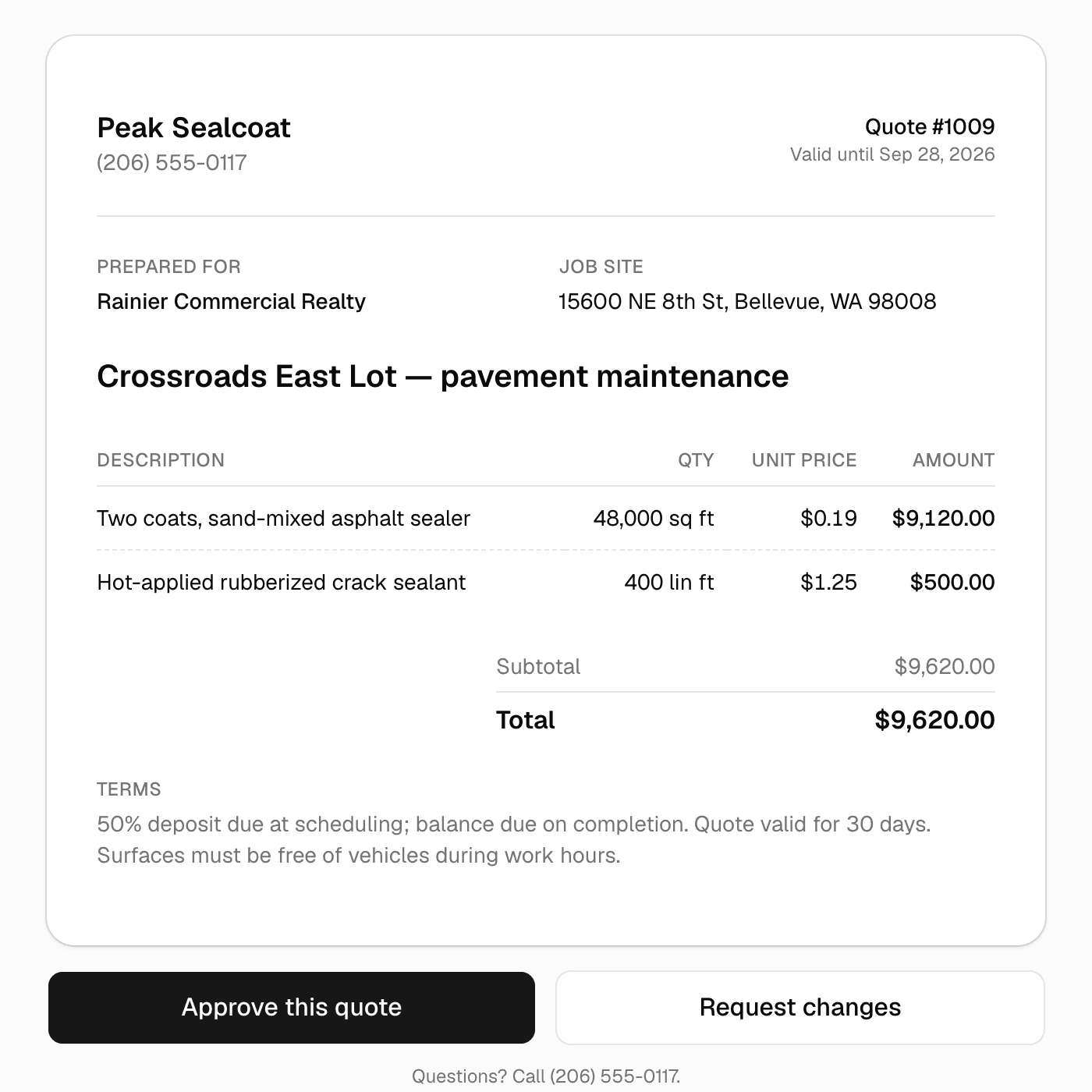
The customer sees the quantity, the unit and the price for each line, then approves and signs from the link.
Write the clauses in the quote's notes: the yard you priced, the pace you assumed, the rock and water rates, the locate, the minimum. A customer who read them before signing does not argue after.
FAQ
What does an excavator cost per hour to run?
FEMA's 2025 equipment schedule, which covers maintenance, repairs, fuel and tires but not the operator, lists a 150 horsepower class hydraulic excavator at $107.93 an hour, a 90 horsepower class at $95.01 and a 201 horsepower class at $150.99. Add the operator's loaded wage; the 2025 BLS median is $28.78 an hour.
How many loose yards is a bank yard?
More than one. The Engineering ToolBox's bulking table puts earth and soil at 20 to 30 percent swell, clay at 20 to 40 percent and rock at 40 to 80 percent, so 100 bank yards of earth is 120 to 130 loose yards in the truck. Price the dig per bank yard and the haul per loose yard or per load.
Does 811 mark private utility lines?
No. The national 811 service is free and marks public lines with paint or flags within a few business days; North Carolina 811's FAQ says contacting 811 will not get private lines marked, and that anything between the meter and the building is a private line for a private locator. Price that locate as its own line.
Sources
- FEMA: Schedule of Equipment Rates · Rates applicable to major disasters and emergencies declared on or after July 1, 2025; each rate covers depreciation, overhead, all maintenance, field repairs, fuel, lubricants, tires and OSHA equipment; "Labor costs of the operator are not included in the rates and should be approved separately from equipment costs." Rows: 8280 hydraulic excavator to 45 HP $57.14 an hour; 8281 to 90 HP $95.01; 8282 to 150 HP $107.93; 8283 to 201 HP $150.99; 8542 skid steer loader to 105 HP $60.67; 8601 tri-axle equipment trailer 30 ft $15.80; dump trucks 8720 7 CY $55.28, 8721 9 CY $100.63, 8722 12 CY $120.74, 8723 14 CY $122.94, 8724 18 CY $147.99; trash pumps 8467 3 inch $13.06 and 8466 4 inch $27.38; page updated April 8, 2026. (accessed October 18, 2026)
- O*NET OnLine: Operating Engineers and Other Construction Equipment Operators · Median wages $28.78 hourly and $59,850 annual, credited to Bureau of Labor Statistics 2025 wage data. (accessed October 18, 2026)
- BLS Occupational Outlook Handbook: Construction Equipment Operators · "The median annual wage for construction equipment operators was $59,600 in May 2025"; operating engineers and other construction equipment operators $59,850; the occupation operates "bulldozers, trench excavators, road graders, and similar equipment." (accessed October 18, 2026)
- The Engineering ToolBox: Soil and Rock, Bulk Factors · Soil or rock from the borrow expands when dropped on the truck or stockpiled; one cubic from the borrow does not translate to one cubic at the dump; example of 300 cubic meters of clay at 40 percent swell becoming 420; bulking (swell) factors in percent: clay 20 to 40, earth 20 to 30, loam 15 to 25, sand dry or wet 20 to 30, gravel dry or wet 20 to 30, gravel wet with clay 50 to 60, rock 40 to 80, limestone 75 to 80, soil 20 to 30. (accessed October 18, 2026)
- 811: the national before-you-dig service · "811 is the free national before-you-dig service"; contact 811 "a few business days before you begin any digging"; the request asks that "the approximate location of buried utilities be marked with paint or flags." (accessed October 18, 2026)
- North Carolina 811: Frequently Asked Questions · Says to contact 811 three working days before you plan on digging; utilities "send out locators to mark your publicly managed underground lines for FREE"; "Contacting 811 will NOT get your private lines marked"; "Any underground facility between the meter and the home/building is considered to be a private utility line"; "You must contact a private line locator directly"; examples include ground sprinkler systems and propane lines from the tank to the home or building. (accessed October 18, 2026)
- OSHA: 29 CFR 1926.651, Specific excavation requirements · (b)(1): the estimated location of utility installations "shall be determined prior to opening an excavation"; (b)(2): "Utility companies or owners shall be contacted within established or customary local response times"; (c)(2): a stairway, ladder or ramp in trench excavations "4 feet (1.22 m) or more in depth" with no more than 25 feet of lateral travel; (j)(2): materials or equipment kept "at least 2 feet (.61 m) from the edge of excavations"; (h)(1): "Employees shall not work in excavations in which there is accumulated water" unless adequate precautions have been taken, including water removal. (accessed October 18, 2026)
- OSHA: 29 CFR 1926.652, Requirements for protective systems · (a)(1): "Each employee in an excavation shall be protected from cave-ins by an adequate protective system" except when "Excavations are made entirely in stable rock" or "Excavations are less than 5 feet (1.52m) in depth" and "examination of the ground by a competent person provides no indication of a potential cave-in." (accessed October 18, 2026)
- Acquisition.gov: FAR clause 52.236, part 2, Differing Site Conditions · Covers "Subsurface or latent physical conditions at the site which differ materially from those indicated in this contract" and "Unknown physical conditions at the site, of an unusual nature, which differ materially from those ordinarily encountered"; the contractor gives written notice promptly, before the conditions are disturbed; "an equitable adjustment shall be made under this clause and the contract modified in writing accordingly." (accessed October 18, 2026)
- Washington County Solid Waste District, Utah: Landfill Fees · 2026 rate column: "Clean Dirt and Tile (per ton)" $0.00; "Construction & Demolition (per ton)" $32.00; "Municipal Solid Waste (per ton)" $37.15. (accessed October 18, 2026)
- OC Waste & Recycling, Orange County, California: Landfill Fees · Per-ton fee for vehicles carrying more than 880 pounds $92.70, July 1, 2026 through June 30, 2027; clean soil $92.70 effective October 12, 2026, "All landfills are accepting non-tested soil at the full disposal rate"; "Vehicles carrying more than 5 cu. yards or 8 tons, pre-tested soil certification is required." (accessed October 18, 2026)