How to Price a Concrete Driveway per Square Foot: The Math
How to price a concrete driveway per square foot: measure the slab and apron, figure the yards at 4 or 6 inches, add base, rebar, forms, finish and labor.
The MakeHay team · · 11 min read
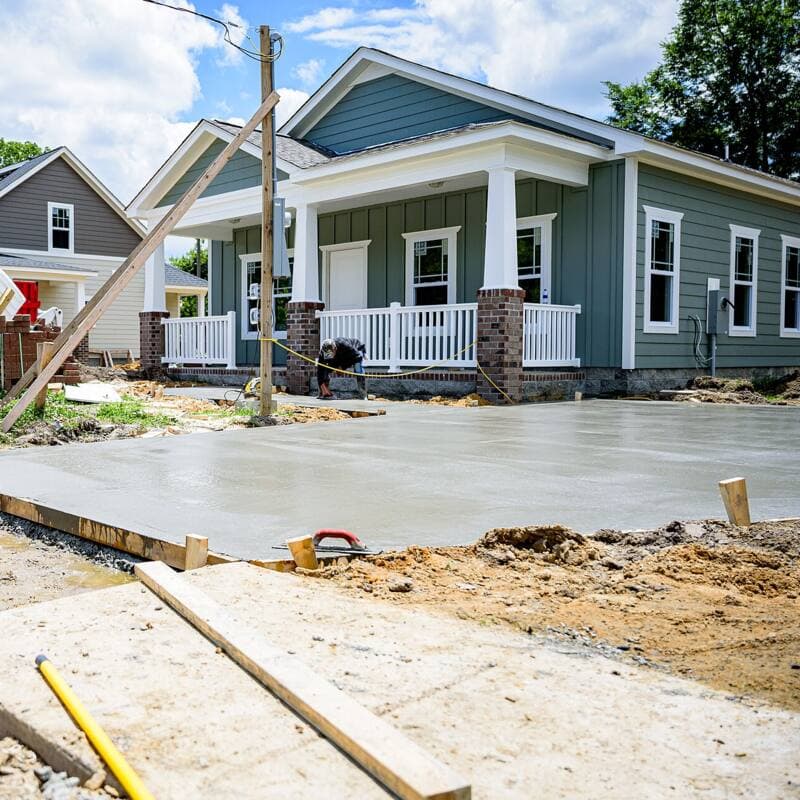
Here is how to price a concrete driveway per square foot so the number holds up on pour day. Measure the slab and apron as separate shapes, turn square feet and thickness into cubic yards, price the concrete delivered, then add base, steel, forms, finish, removal and labor. The per square foot rate is the last line.
Measure the driveway as separate shapes
A driveway is rarely one rectangle. Measure the main slab, the apron at the street and any pad or walk as their own shapes, because each can carry a different thickness and finish. Length times width gives each shape's square feet.
- Step 1: Wheel the main slab: length from the garage slab to the apron, width at the widest point, a second width if it flares.
- Step 2: Measure the apron on its own; many towns require it thicker than the rest.
- Step 3: Note the drop from garage to street. Concrete Network, citing the Portland Cement Association, puts the minimum fall at 1/8 inch per foot away from the house, so a flat lot may need grading.
- Step 4: Photograph the old surface, the soil at the edges and the access from the street; those decide removal, base and the pump.
How many yards of concrete for a driveway
The formula is the one on Concrete Network's calculator page: length times width times thickness, all in feet, gives cubic feet; divide by 27 for cubic yards. Inches become feet when you divide by 12, so a 4 inch slab is 0.333 feet thick.
| Thickness | Cubic feet per 100 sq ft | Cubic yards per 100 sq ft |
|---|---|---|
| 4 inches | 33.3 | 1.23 |
| 5 inches | 41.7 | 1.54 |
| 6 inches | 50.0 | 1.85 |
Never order the exact amount. The same page says to include a margin of safety and gives a budget rule of thumb: add a quarter inch to the slab thickness, so a 4 inch slab goes into the formula at 4.25 inches. A short truck costs a second delivery fee and a cold joint across the drive.
Four inch vs six inch concrete driveway
Concrete Network's driveway essentials say to place concrete at a minimum thickness of 4 inches, and that going to 5 inches adds roughly 20 percent to the concrete cost while raising load capacity by nearly 50 percent, a figure it credits to the Tennessee Concrete Association. Its thickness page says 4 inches is enough for passenger vehicles, a large RV calls for 5 or 6 inches, and many municipalities require a 5 or 6 inch apron. Quote both when the customer parks a truck or trailer.
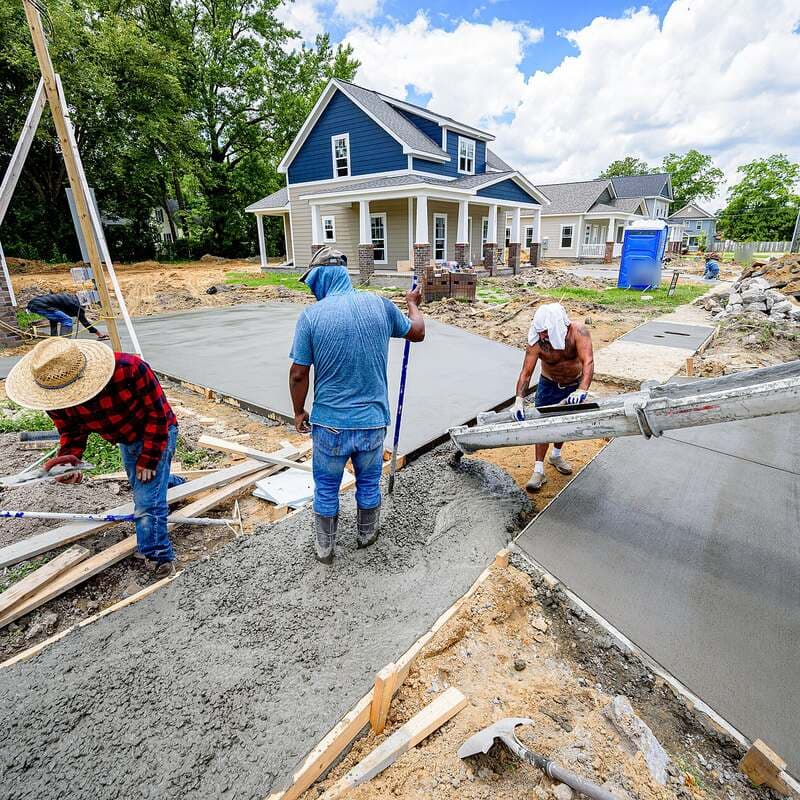
Base, steel, forms and joints
Concrete Network's thickness page says contractors typically install a well graded, compacted gravel subbase and that local codes commonly call for a 4 inch minimum slab on one. Its essentials guide gives a depth only for expansive soils: 2 to 8 inches of crushed rock. Price the base as tons of stone at your supplier's price plus the hours to spread and compact it.
Rebar or wire mesh for a driveway
The rule in the same guide: wire mesh for driveways 4 to 5 inches thick, rebar for 5 inches or more, bars about 12 inches apart with blocks under the steel to hold it centered. It also says reinforcement will not prevent cracks; it holds them together, which is worth a sentence on the quote. Steel is cheap next to concrete: Ernest Maier, a Maryland building supplier, lists #4 rebar at $0.51 per foot in 20 foot sticks, $10.20 a stick, and Kuhlman Corporation lists a 20 foot #4 grade 60 bar at $14.96. Count the sticks from the grid; price mesh by the roll at your supplier's figure.
Forms are your lumber, stakes and the hours to set and strip them, priced per linear foot of edge. Control joints come at a maximum spacing of 10 feet on a 4 inch slab, one quarter of the thickness deep, with isolation joints at the sidewalk and the garage slab. The American Concrete Institute's FAQ on saw cuts says cuts typically fall within 4 to 12 hours after placing, sooner in hot weather: a return trip on pour day, so put it in the labor hours.
Concrete price per yard, delivery and the short load fee
Your supplier's quote is the number that goes on the estimate. For a published reference, Fixr's concrete delivery survey, a homeowner cost guide updated January 31, 2025, lists $125 to $133 per cubic yard before delivery, a standard 10 cubic yard truck, $55 to $65 delivery per full load, a short load fee of $15 to $17 per cubic yard under a full truck, and a waiting fee averaging $75 an hour when the pour runs long.
| Strength | Per cubic yard, delivered | Full 10 yard load |
|---|---|---|
| 3,000 psi | $160 to $170 | $1,505 to $1,595 |
| 4,000 psi | $180 to $190 | $1,705 to $1,795 |
| 5,000 psi | $200 to $210 | $1,905 to $1,995 |
Ask the plant for its minimum, its short load fee and any fuel charge, then write the strength on the quote. Bagged mix is for a patch: the same Maryland supplier lists a bag of Quikrete Concrete Mix at $6.95, and a driveway takes hundreds.
Labor by the hour, then the finish
Price the crew in hours before you price the slab in square feet. O*NET, the US Department of Labor's occupation database, reports a median wage of $27.41 an hour for cement masons and concrete finishers, $57,020 a year, from 2025 Bureau of Labor Statistics data. Add payroll taxes, insurance and the truck, then multiply by the hours: removal if there is one, a day for base and forms, the pour and finish, and the return for saw cuts and stripping.
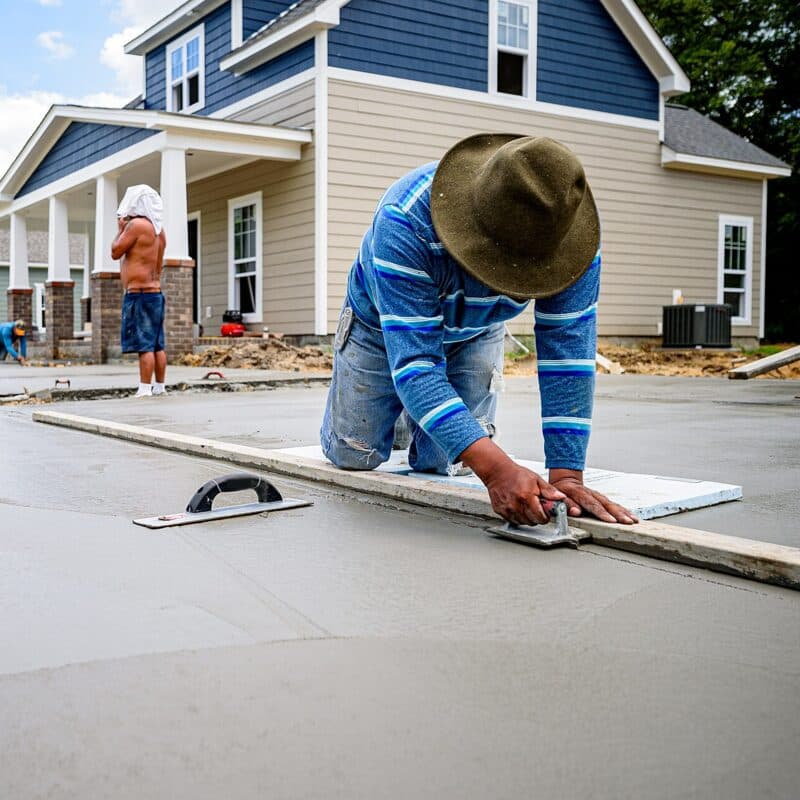
The finish sets the hours and the market band. Concrete Network's guide describes the plain sequence: screed, float before bleed water builds, then a broom for traction. Exposed aggregate adds a retarder and a wash the next morning; stamping adds mats, release and a crew that can keep up with the set. Fixr's driveway survey, updated January 31, 2025, prices plain at $6 to $8 per square foot, broom finished and exposed aggregate at $8 to $12, and stamped at $12 to $18. Concrete Network also says to start curing right after finishing and keep cars off for at least a week; price the compound and put the week in the quote.
Removal, access and the pump
An old slab is its own job. Fixr's survey puts breaking up and hauling away old concrete at $1 to $4 per square foot depending on depth and reinforcement. Dump fees come from your landfill's schedule; Larimer County, Colorado, for example, charges $40 per cubic yard for rubble plus a state surcharge, and broken concrete takes more room in the truck than it did in the ground. If the truck cannot back to the forms, a line pump and operator go on the quote at the pump company's hourly rate and minimum.
Worked example: An 800 sq ft drive at 4 inches with a 96 sq ft apron at 6 inches
- Slab: 20 ft × 40 ft = 800 sq ft. With the quarter inch budget rule, 800 × (4.25 ÷ 12) = 283 cubic feet, ÷ 27 = 10.5 cubic yards.
- Apron: 16 ft × 6 ft = 96 sq ft. 96 × (6.25 ÷ 12) = 50 cubic feet, ÷ 27 = 1.85 cubic yards. Order 12.5 yards.
- Concrete at 4,000 psi delivered, $180 to $190 per yard: 12.5 × $180 = $2,250 to 12.5 × $190 = $2,375.
- Delivery: one full load at $55 to $65, plus a short load fee on the last 2.5 yards at $15 to $17 per yard, $38 to $43; $93 to $108 in all.
- Steel: the 6 inch apron gets #4 rebar on a 12 inch grid, 12 sticks at $10.20 to $14.96 = $122 to $180; the 4 inch slab gets mesh at your supplier's price.
- Labor: two people for a day of base and forms (16 hours) plus four on pour day (32 hours) = 48 hours × $27.41 = $1,316 in wages before burden and the saw cut return.
- Cited hard costs: $2,250 + $93 + $122 + $1,316 = $3,781 low, $2,375 + $108 + $180 + $1,316 = $3,979 high, before base stone, forms, mesh, curing, burden, overhead and profit. Per square foot: $3,781 ÷ 896 = $4.22 and $3,979 ÷ 896 = $4.44.
- The broom finish band in the homeowner survey: 896 × $8 = $7,168 to 896 × $12 = $10,752. The gap is the uncited lines and your margin.
Result: About 12.5 yards of concrete, $3,781 to $3,979 in cited hard costs, $4.22 to $4.44 per square foot before the uncited lines, against a market band of $8 to $12 per square foot for a broom finish.
Writing the quote and getting paid in stages
Show the arithmetic: one line per shape with its square feet, thickness and finish, then base, steel, removal and the pump as their own lines (writing a service quote customers approve covers the wording). Concrete is bought before it is poured, so ask for a deposit and bill the rest when the slab is down. Check your state's cap: Maryland's home improvement deposit section says a person may not receive a deposit of more than one third of the contract price. How much deposit a contractor should ask for lists other states, and billing a job in stages covers the draw after the pour.
Good to know: This is general information, not legal advice. Deposit caps and contract rules differ by state and change; read the current statute or ask your licensing board before you rely on it.
In MakeHay, a quote carries line items in your own units, so the slab goes in per square foot, the forms per linear foot and the pump as a flat item; the free satellite tool traces the existing drive before the site visit, and a saved measurement fills a quote line. A deposit on the quote is collected when the customer approves and signs online, and the balance can be billed in stages after the pour. Good, better and best, such as 4 inch broom, 5 inch broom and 5 inch exposed aggregate, go out as packages on one quote.
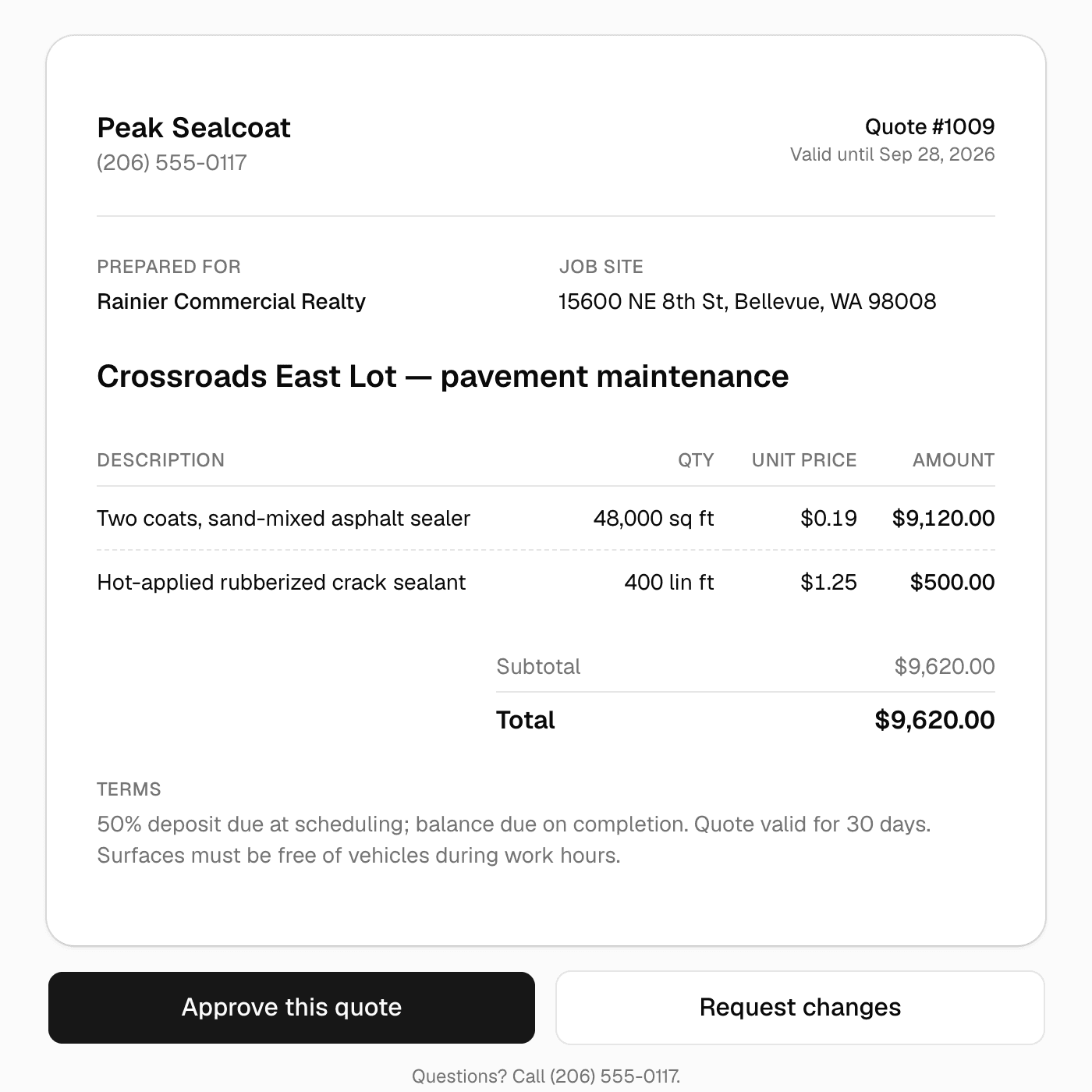
The customer sees each shape, thickness and finish as its own line before approving.
FAQ
What is the concrete driveway cost per square foot?
Fixr's homeowner survey, updated January 31, 2025, puts a new concrete driveway at $6 to $20 per square foot: plain $6 to $8, broom finished or exposed aggregate $8 to $12, stamped $12 to $18, with a national average of $5,184 for a 24 by 24 foot broom finished drive at 5 inches. That is the market band, not your cost.
What is the concrete driveway removal cost on top of the new slab?
Fixr's survey prices breaking up and hauling away old concrete at $1 to $4 per square foot, depending on depth and reinforcement. Add your landfill's rubble fee; Larimer County, Colorado charges $40 per cubic yard plus a state surcharge.
How thick should a residential concrete driveway be?
Concrete Network's guide says a minimum of 4 inches, with 5 or 6 inches for heavier vehicles such as a large RV, and that many municipalities require a 5 or 6 inch apron.
Sources
- Concrete Network: Concrete Calculator, how much concrete do you need · The volume formula is length times width times thickness, with cubic feet divided by 27 for cubic yards; "Never order the exact amount of needed concrete. Include a margin of safety"; rule of thumb to add a quarter inch to the slab thickness for the slab concrete budget. (accessed October 18, 2026)
- Concrete Network: 8 Concrete Driveway Construction Essentials for a Problem-Free Pour · "Place concrete at a minimum thickness of 4 inches"; going from 4 to 5 inches adds approximately 20 percent to the concrete cost and raises load capacity nearly 50 percent, credited to the Tennessee Concrete Association; thickened edges of 1 to 2 inches extending 4 to 8 inches in; 2 to 8 inches of crushed rock on expansive soils; wire mesh for 4 to 5 inch driveways and rebar for 5 inches or more, spaced approximately 12 inches, with blocks under the reinforcement to keep it centered; "Reinforcement won't prevent cracks, but it will help hold them together"; control joints at a maximum spacing of 10 feet for a 4 inch slab, one quarter of the thickness deep; isolation joints at sidewalks and the garage slab; slope a minimum of 1/8 inch per foot away from structures, credited to the Portland Cement Association; screed, float, then broom, skip the steel trowel; start curing right after finishing, skipping it can cut strength up to 50 percent in extreme cases, wait at least a week before driving on it; page updated March 12, 2026. (accessed October 18, 2026)
- Concrete Network: How Thick Should a Concrete Driveway Be? · Thickness ranges 4 to 6 inches or more; 4 inches is sufficient for passenger vehicles; 5 or 6 inches for heavier use such as a large RV; many municipalities require a 5 or 6 inch apron; local codes commonly stipulate a minimum of 4 inches on a well graded, compacted gravel subbase; the thicker the subbase, the more weight the slab supports. (accessed October 18, 2026)
- American Concrete Institute: When should saw cuts be made on a concrete slab? (Technical Questions FAQ) · Saw cuts should occur before random drying shrinkage cracks form and typically within 4 to 12 hours after placing the slab depending on temperature and weather (citing ACI 302.1R-15); in hot weather they may be needed within 1 hour; conventional saw cuts generally go one fourth the depth of the slab (citing ACI 327R-14). (accessed October 18, 2026)
- Fixr: How much does concrete delivery cost? · Homeowner cost survey: "ranging from $125 to $133 per cubic yard without delivery"; a standard truck carries 10 cubic yards; full load delivery $55 to $65 per load; short load fee $15 to $17 per cubic yard; waiting fee averaging $75 per hour; delivered 3,000 psi $160 to $170, 4,000 psi $180 to $190, 5,000 psi $200 to $210 per cubic yard, with full load totals $1,505 to $1,595, $1,705 to $1,795 and $1,905 to $1,995; updated January 31, 2025. (accessed October 18, 2026)
- Fixr: How much does it cost to pour a concrete driveway? · Homeowner cost survey: new driveways mostly $6 to $20 per square foot; plain $6 to $8, broom finished $8 to $12, exposed aggregate $8 to $12, stamped $12 to $18 per square foot; national average $5,184 (a 24 by 24 foot broom finish driveway, 5 inches thick) with an average range of $3,460 to $6,910; breaking up and hauling away old concrete $1 to $4 per square foot depending on depth and reinforcement; driveways need to be at least 4 inches thick; updated January 31, 2025. (accessed October 18, 2026)
- Ernest Maier: 1/2 inch steel rebar (#4), priced per foot, sold in 20 foot lengths · #4 (1/2 inch) steel rebar at $0.51 per foot, "Sold in 20' increments", which is $10.20 a stick; Maryland building supplier listing, October 18, 2026. (accessed October 18, 2026)
- Kuhlman Corporation: Reinforcing steel rebar, #4 bar, 1/2 inch diameter by 20 feet, grade 60 · A 20 foot #4 grade 60 bar listed at $14.96 each, October 18, 2026. (accessed October 18, 2026)
- Ernest Maier: Concrete products · "Hot Quikrete Concrete Mix" listed at $6.95 under Bagged Products, October 18, 2026; the listing does not state the bag weight. (accessed October 18, 2026)
- O*NET OnLine: Cement Masons and Concrete Finishers · Median wages of $27.41 hourly and $57,020 annual for 2025, from Bureau of Labor Statistics Occupational Employment and Wage Statistics data; 204,800 employed in 2025. (accessed October 18, 2026)
- Larimer County, Colorado: 2026 Landfill Fee Schedule · Rubble, materials over 1,000 pounds per cubic yard, at "$40 per cubic yard + CO surcharge"; cubic yards figured as length times width times height in feet divided by 27; 2026 pricing approved by the Board of County Commissioners. (accessed October 18, 2026)
- Maryland General Assembly: Business Regulation, deposits on home improvement contracts (Section 617 of Title 8) · "A person may not receive a deposit of more than one-third of the home improvement contract price" before or at the time the contract is signed. (accessed October 18, 2026)