How to Write a Service Quote Customers Approve Faster
How to write a service quote that gets approved: scope, lines in the customer's units, options, exclusions, expiry date, deposit terms and a one-tap yes.
The MakeHay team · · 11 min read
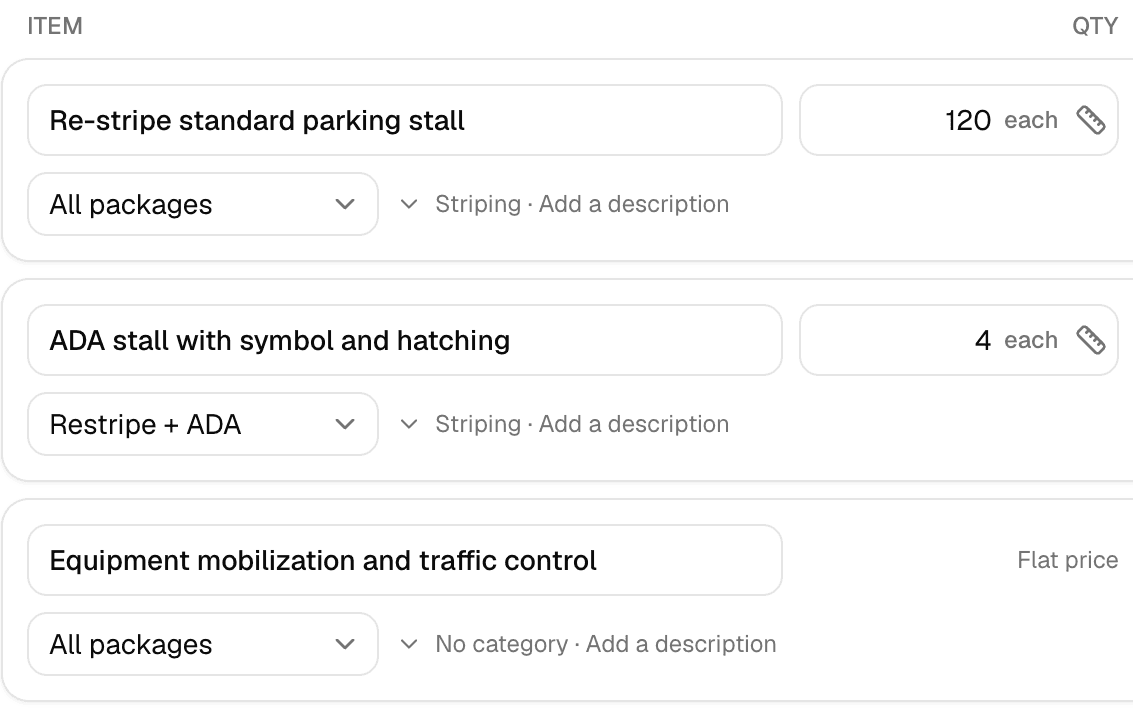
How to write a service quote customers approve: say what you will do and where, price it in the customer's units, name what is left out, hold the price until a date, state the deposit and payment terms, and make saying yes one tap. A quote that does all six reads like a plan, and a plan is what people sign.
Quote vs estimate: decide which one you are sending
A quote is a firm offer: this work, at this price, if the customer accepts before the date on it. An estimate is an educated guess that can move once the crew sees the site. Use the word you mean. Measured the lot or counted the trees? Send a quote and stand behind the number. Pricing from a phone call? Send an estimate, say what could change it, and firm it up after a visit or photos.
What to include in a quote, from the top of the page down
Put the parts in the order the customer reads them. People look at the total first, then scan upward for what it buys.
- Who and where: your business name, phone and license number; the customer's name; the job site address.
- Scope in one paragraph: what you will do, to what, and what the finished result looks like.
- Line items in the customer's units: quantity, unit, rate and line total.
- Options, if you offer them: a base package that solves the problem, and one or two steps up.
- Exclusions: what is not in this price.
- Timing: an approximate start, how long the work takes, what moves it.
- The price: subtotal, tax, any discount, the total.
- Terms and approval: expiry date, deposit, balance due date, how to pay, how to say yes.
Line items in the customer's units, not yours
A line that reads sealcoat parking lot with one price invites a counteroffer. A line that reads sealcoat, two coats, per square foot, with the measured square footage shown, invites a nod. A quantity times a rate looks like arithmetic, and arithmetic feels fair.
| Work | Unit |
|---|---|
| Sealcoating, pressure washing, lot striping | Per square foot, with the measured area shown |
| Crack sealing, gutters, fence | Per linear foot |
| Bollards, signs, stalls, trees | Per item, per stall or per inch of trunk |
| Mowing, fertilization, snow, detailing | Per visit or per season, with the visit count |
| Small repairs, one-day jobs | Flat price for the job |
Measure before you quote whenever the unit is area or length. The free satellite measuring tool gives square feet and linear feet from the address; for the rate side, see how to price sealcoating per square foot.
Good better best pricing without writing three quotes
Options change the question from whether to hire this company into which of these to pick, an easier yes. Keep it to two or three. The base option has to solve the problem on its own; a thin base reads as a trick. Each step up adds something the customer can picture: a second coat, crack sealing first, a longer warranty. Price each option as a total, with the one you would choose for your own property in the middle.
What is excluded, and why that line saves the job
Most disputes about a service job start with something the customer assumed was included. The fix is a short list, on the quote, of what is not.
- Work you can see is needed but did not price: the sunken drain, the rotten fascia, the third coat.
- Conditions you are not responsible for: cars left on the lot, a sprinkler head nobody mentioned.
- Things the customer handles: moving vehicles, a locked gate, permit fees.
- What happens if the scope grows: a written change order before the extra work starts.
California writes that last line into the contract itself: a home improvement contract there carries a note about extra work and change orders, and a change order is effective only when written and signed before the extra work begins. The rule protects both sides wherever you work.
A quote expiration date that protects your price
Sealer, salt, fuel and labor all move, so an open-ended quote is a bet against your suppliers. Put a date on it. The date gives the customer a reason to decide and you a reason to follow up, and when someone comes back after it, honoring the old price is a favor, not an obligation. Shorter when prices swing, longer for seasonal work booked months ahead.
Deposit and payment terms, in one line each
Say how much is due when, and how to pay it, before the customer asks. A one-visit job usually needs no deposit; special-order materials need one that covers them; a project that runs for weeks wants a small deposit and progress payments tied to finished stages. Some states cap the deposit on residential work; the caps are in how much deposit a contractor should ask for.
Write each progress payment as a dollar amount tied to a stage, not a percentage tied to a date. New York requires each progress payment on a home improvement contract as a sum in dollars and cents tied to the state of completion, and California ties each to the work, materials and equipment it pays for. Then one line for the balance: due on completion, by card, bank transfer or check, with any fee you pass on stated up front (see can a contractor charge a credit card fee).
How the customer approves: make saying yes one tap
The quote that gets approved is the one the customer can approve from the phone it arrived on, the moment the decision is made. Printing, signing, scanning and emailing back is four chances to stall. Put the approve step on the quote: a link that opens on a phone, a button that records the name and the date, and a way to pay the deposit from the same page.
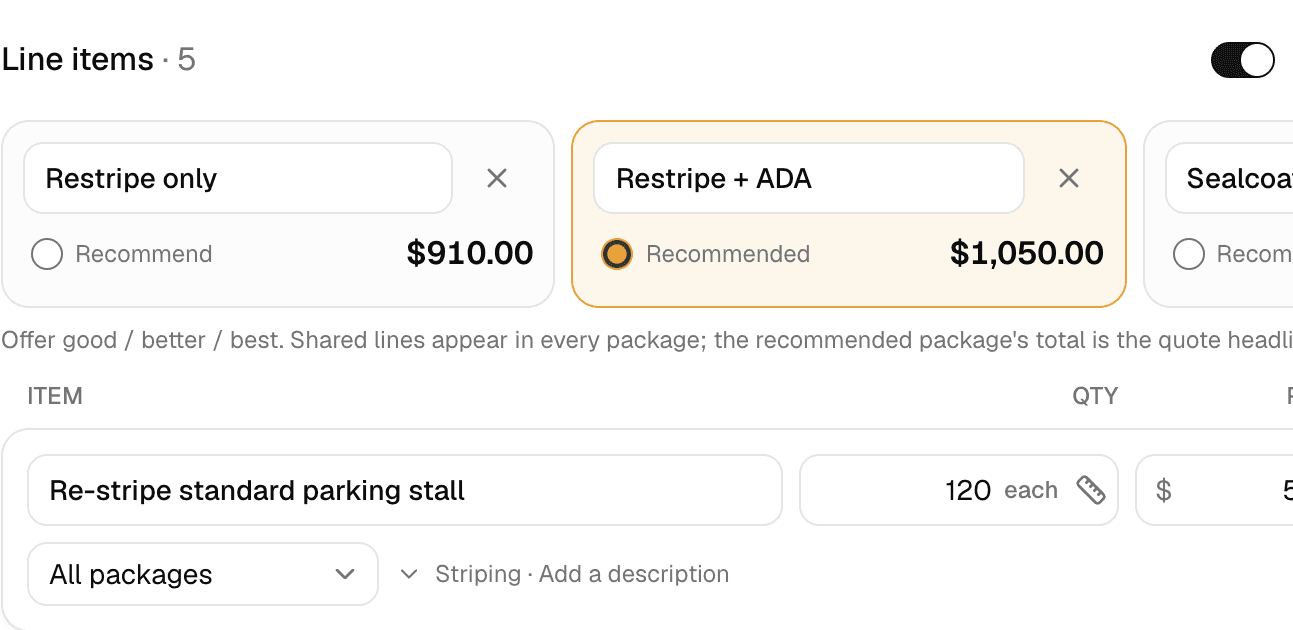
In MakeHay, every line is priced in your units (per sq ft, per linear ft, per item or flat), options go out as good, better and best packages on one quote, and a deposit sits on the quote itself. The customer opens a link and approves and signs online; quote tracking shows sent, viewed and approved. Changes become a revision, and an expired quote can be extended.
Home improvement contract requirements: what the law adds
On residential work in many states, the approved quote is the home improvement contract, and the statute says what it must contain. The four states checked here all want the basics above (a description of the work and materials, the price, both signatures, a signed copy to the customer) and each adds requirements of its own. A state missing from the table was not checked, which is not the same as having no rule.
| State | Covers | What it adds to the basics | Statute |
|---|---|---|---|
| California | Home improvement agreements over $500 | Fixed headings; the Downpayment statement (not over $1,000 or 10 percent, whichever is less); progress payments in dollars and cents; the change order note; lien, insurance and three-day cancellation notices; key statements in 12-point boldface | BPC 7159 |
| New York | Home improvement contracts | License number; approximate dates and what could change them; materials with make or model; progress payments in dollars and cents; a lien notice in bold type and a notice that payments taken before completion must be deposited under the lien law or covered by a bond; a three-business-day cancellation notice | GBL 771 |
| Maryland | Home improvement contracts | Contractor and salesperson license numbers; approximate dates; the Commission's phone number and website; a notice on consumer protections and the right to buy a performance bond | Bus. Reg. 8‑501 |
| Minnesota | Every proposal, estimate, bid, quotation and contract | A detailed summary of the services; specific materials; the total price or its basis; performance guidelines before signing; a signed copy at no charge | 326B.809 |
The three-day right to cancel when you sell at the customer's home
Separate from any state rule, the US Federal Trade Commission's Cooling-Off Rule applies when the customer agrees to the sale away from your place of business, for $25 or more at the buyer's residence or $130 or more elsewhere. The buyer may cancel until midnight of the third business day. The contract has to say so in bold type of at least 10 points next to the signature, the seller hands over two copies of a Notice of Cancellation form and says the right out loud, and after a cancellation every payment comes back within 10 business days.
Two exclusions matter here. A visit the buyer asked for to repair or maintain the buyer's personal property is outside the rule, with no similar exclusion for work on the house or the land. A genuine immediate emergency is excluded only when the buyer made the contact and signs a separate, dated, handwritten waiver. When in doubt, carry the notice.
Good to know: This is general information, not legal advice. Statutes and rules change; read the current text and ask your state licensing board or a lawyer before you rely on it.
A service quote template to copy, section by section
Lay the page out in this order. The wording is a starting point, not legal language.
- Step 1: Heading: Quote (or Estimate), your business name, phone and license number, the date, a quote number.
- Step 2: Customer and site: the customer's name and the job site address.
- Step 3: Scope: Clean and sealcoat the measured parking area with two coats of commercial sealer, restripe the existing layout, clean up the same day.
- Step 4: Line items: quantity, unit, rate and line total for each part.
- Step 5: Options: Good, Better and Best as three totals, each with a line saying what the step up adds.
- Step 6: Not included: a few short lines.
- Step 7: Timing and price: approximate start, how long it takes, then subtotal, tax, discount and the total in large type.
- Step 8: Terms: This price is good until the date. Deposit amount and when it is due. Balance due on completion by card, bank transfer or check. Extra work needs a written change order first.
- Step 9: Approval: Approve this quote online at the link, or sign and date below.
Then send it the same day the customer asked. A quote that arrives while the problem is still on the customer's mind competes with nothing. What to send after that is in quote follow-up emails for contractors.
FAQ
What is the difference between a quote and an estimate?
A quote is a firm offer at a fixed price until the date on it; an estimate is an approximation that can change once the work is seen up close. Use the word that matches what you are promising. Minnesota's licensing law requires both to be in writing with a summary of the services, the materials and the price or its basis.
Should a quote include terms and conditions?
Yes, in plain lines: the expiry date, the deposit, when the balance is due and how to pay, what is excluded, and that extra work needs a written change order first. On residential work in some states the quote becomes a home improvement contract with set wording; California requires a contract over $500 to carry the Downpayment statement, a progress payment schedule, a change order note, a lien warning and a three-day cancellation notice.
Does a customer have to sign a quote for it to count?
Treat a quote as approved only when the customer has said yes in a form you can show later: a signature, or an online approval that records the name and the date. New York, Maryland and Minnesota each require the contract signed by the parties, with a signed copy handed to the customer before the work starts.
Sources
- California Business and Professions Code section 7159 (2025), Home improvement contracts · Applies to home improvement agreements whose aggregate contract price exceeds $500; requires the Contract Price, Description of the Project and Significant Materials, Approximate Start Date and Approximate Completion Date headings; a Downpayment heading with the statement that the downpayment may not exceed $1,000 or 10 percent of the contract price, whichever is less; a Schedule of Progress Payments in dollars and cents tied to specific work or materials; a Note About Extra Work and Change Orders, with a change order effective only when written and signed before the work begins; a mechanics lien warning, insurance notices and a Three-Day Right to Cancel notice; text in at least 10-point type with the key statements in at least 12-point boldface; a copy signed and dated by both parties given to the buyer before work starts. Page shows the section updated January 1, 2026. (accessed October 17, 2026)
- New York General Business Law section 771, Home improvement contracts (New York State Senate) · A home improvement contract must be in writing and signed by all the parties; must contain the contractor's name, address, telephone number and license number, approximate or estimated start and substantial completion dates with contingencies that could change them, a description of the work and materials including make and model, the agreed consideration, a lien notice in clear and conspicuous bold face type, a notice that the contractor is legally required to deposit all payments received prior to completion in accordance with the lien law or instead post a bond, contract of indemnity or irrevocable letter of credit, and, where progress payments are provided for, a schedule showing the amount of each payment as a sum in dollars and cents tied to the state of completion, each bearing a reasonable relationship to the work, materials or expenses at that point; a notice that the owner may cancel until midnight of the third business day after signing; legible and in plain English; a signed copy given to the owner before work begins. (accessed October 17, 2026)
- Maryland Business Regulation section 8‑501, Home improvement contracts (statute text) · Each home improvement contract must be in writing, legible, clearly describe each document it incorporates and be signed by each party; must include the contractor's name, address, telephone number and license number, the name and license number of each salesperson, approximate start and substantial completion dates, a description of the home improvement and the materials, the agreed consideration, the number and amount of any monthly payments, a notice with the Commission's telephone number and website stating that contractors must be licensed, and a notice about consumer protections and the right to buy a performance bond; the owner must be given a copy signed by the contractor before work begins. (accessed October 17, 2026)
- Minnesota Statutes section 326B.809, Written contract required (Office of the Revisor of Statutes) · Agreements between a licensee and a customer, including proposals, estimates, bids, quotations, contracts, purchase orders and change orders, must be in writing and include a detailed summary of the services to be performed, a description of the specific materials to be used or a list of standard features to be included, and the total contract price or a description of the basis on which the price will be calculated; written performance guidelines given before signing; both parties sign and date; a signed and dated copy of each document given to the customer at no charge. No dollar threshold is stated. (accessed October 17, 2026)
- Cooling-Off Period for Sales Made at Home or Other Locations (Federal Trade Commission) · The rule covers door-to-door sales valued at more than $25 and requires sellers to disclose the buyer's right to cancel within three business days of the transaction. (accessed October 17, 2026)
- 16 CFR 429.0, Definitions (Cooling-Off Rule), Cornell Legal Information Institute · A door-to-door sale is one in which the buyer's agreement is made at a place other than the seller's place of business, with a purchase price of $25 or more at the buyer's residence or $130 or more at other locations; excludes a transaction where the buyer initiated the contact and specifically requested the seller to visit the home to repair or perform maintenance on the buyer's personal property (additional goods or services sold during that visit are not excluded), and a bona fide immediate personal emergency where the buyer initiated the contact and gives a separate dated and signed statement in the buyer's handwriting waiving the right to cancel within 3 business days. (accessed October 17, 2026)
- 16 CFR 429.1, The Rule (Cooling-Off Rule), Cornell Legal Information Institute · The contract or receipt must carry, in bold face type of at least 10 points next to the buyer's signature, the statement that the buyer may cancel the transaction at any time prior to midnight of the third business day after the date of the transaction; the seller must furnish two copies of a Notice of Cancellation form in 10-point bold face; the seller must inform each buyer orally of the right to cancel at the time of signing; within 10 business days after receiving a cancellation notice the seller must refund all payments and return any trade-in. (accessed October 17, 2026)