Quote Follow-Up Emails for Contractors: What to Send When
Quote follow-up emails for contractors: a day 2, day 5, day 10 and expiry timeline, a template for each step, what to say against other bids, when to stop.
The MakeHay team · · 10 min read
A quote with no answer is usually a quote the customer has not decided on, not a no. Four short emails, each asking one thing, bring most of those decisions out: day 2 checks the quote arrived, day 5 asks what is holding it up, day 10 offers a change to the scope or the price, and the expiry email says the number ends on a date. Then stop. Here is the timeline, a template for each step, and the rules that get a follow-up into the inbox.
Why a sent quote goes quiet
Silence after a quote has ordinary causes, none of them a decision against you. The email never arrived, or sits unopened under forty others. The customer is waiting on a spouse or a board. Or the customer is collecting other bids, which is what the US Federal Trade Commission's home improvement advice tells them to do: get multiple estimates, do not pick the lowest bidder automatically, and ask for an explanation when the estimates differ a lot. A follow-up finds out which it is by asking briefly. About nine in ten US adults own a smartphone, so a follow-up that needs a scroll, a zoom or an attachment gets closed.
How to follow up on a quote without landing in spam
The plumbing comes before the wording. Google's sender guidelines for mail to Gmail accounts ask every sender, whatever the volume, to authenticate the sending domain with SPF or DKIM, to send over TLS, and to keep the share of recipients marking the mail as spam under 0.3 percent, with under 0.1 percent recommended. Senders of close to 5,000 messages or more a day have more to meet, including DMARC and one-click unsubscribe on marketing mail. A contractor is nowhere near that, but the authentication rule still applies, and a quote from a free address with a mismatched reply-to is the kind of message that gets filtered.
The second set of rules is the CAN-SPAM Act, laid out in the FTC's compliance guide. Headers have to be truthful, subject lines cannot mislead, and a commercial message must carry a physical postal address and an opt-out honored within 10 business days. The line is the message's primary purpose: mail about a transaction the recipient asked for is exempt from most of the Act apart from truthful routing, while a promotion mixed in makes it commercial if the subject reads as an ad or the transactional content does not appear mainly at the beginning. The penalty named is up to $53,088 per email. So keep a follow-up about the price, its dates and its approval, and put your business address in every signature.
The quote follow-up timeline: four emails, then stop
Count business days from the day the quote went out and send in the morning so the customer can answer during the workday. If the customer answers at any step, the sequence ends there.
| Day | The job of the email | The one question |
|---|---|---|
| Day 2 | Confirm the quote arrived | Did it come through? |
| Day 5 | Find what is holding the decision | What would help you decide? |
| Day 10 | Offer a change to scope or price | Would a different option fit? |
| Expiry | State the end date for the price | Approve by the date, or close? |
Day 2: did it arrive?
The most common reason for silence is the most boring one: the quote is in a spam folder or went to the wrong address. This email asks nothing about the decision.
- Step 1: Subject: Your [service] quote for [site address]
- Step 2: Hello, the quote for [site address] went out on [day]. This is a check that it came through and opens for you.
- Step 3: If anything is unclear, reply here or call the number below.
- Step 4: Your name, business name, phone, business address.
Day 5: the follow up email after sending an estimate
The customer has read the quote and not acted. Ask what would help, not whether they have decided: the first gets an answer like a board meeting date or a lower bid elsewhere, both things you can work with, and the second gets silence.
- Step 1: Subject: Anything holding up the [site address] quote?
- Step 2: Hello, following up on the quote for [site address]. Is there anything that would help you decide: a different start date, a change to the scope, or a question about the price?
- Step 3: If the timing is not right, say so and this will not keep landing in your inbox.
- Step 4: Your name, business name, phone, business address.
Day 10: the option email
Ten days of silence usually means the price, the scope or the timing is off. Offer one concrete change rather than a discount: a smaller scope, a phased plan, a later start or a second package gives the customer something to say yes to without you cutting margin to find the objection.
- Step 1: Subject: A second way to do the [site address] job
- Step 2: Hello, in case the full scope is more than the property needs this year, here is a smaller option: [the part of the work to do now], with [the rest] later. The price is on the updated quote. Same crew, same materials.
- Step 3: If the original scope is the one you want, the first quote stands.
- Step 4: Your name, business name, phone, business address.
Expiry: the last email
Every quote should carry a date after which the price is no longer promised; how to write a service quote customers approve covers the rest of what belongs on it. Send the expiry email a few days before that date. It is not a pressure tactic: material prices move and the calendar fills, so say that plainly and offer two exits, approve or close.
- Step 1: Subject: The [site address] quote closes on [date]
- Step 2: Hello, the quote for [site address] is good through [date]. After that the material pricing and the dates are no longer held.
- Step 3: To go ahead, approve it from the link in the quote. If the job is off for now, no reply is needed and the quote closes on its own.
- Step 4: Your name, business name, phone, business address.
What to say when a customer is comparing bids
The customer who replies "another company came in lower" is doing what the FTC told them to do, and the same advice tells them to ask why the estimates differ. So explain. The FTC's list of what a written estimate should include is the frame: the work, the materials, the completion date and the price. Most bid gaps live in the first three: one bid includes crack filling and the other does not, one uses two coats, one starts in three weeks and the other in three months. Never name the other company, and never cut the price without changing the scope; a cut with no change says the first number was padded.
- Step 1: Subject: Comparing the two quotes for [site address]
- Step 2: Hello, thanks for the note about the second bid. The fastest way to compare is line by line: what is included, the materials, and the completion date. This quote includes [the scope], [the materials and how much of them], and [the completion date].
- Step 3: If the other quote covers the same scope, send it over and the difference gets explained line by line.
- Step 4: Your name, business name, phone, business address.
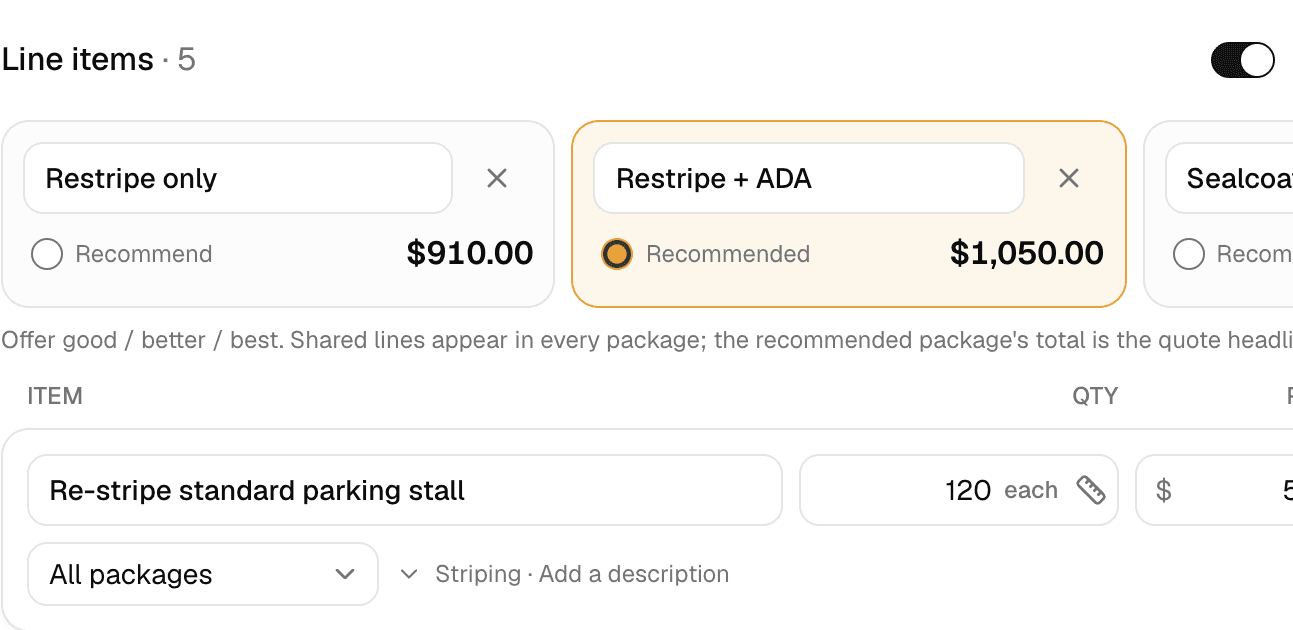
In MakeHay, quote tracking shows whether each quote was sent, viewed or approved, so the day 2 email goes only to customers who have not opened theirs. The automated quote follow-up sends one nudge by email after the number of days you pick (2, 3, 5 or 7), with the total and a link back to the quote, only while the quote is unanswered, never after its valid-until date and never to a customer who unsubscribed; the subject line and opening are yours to change in your email templates, and every automated email ends with an unsubscribe link. The other steps are sent by hand. Good, better and best packages put the option email's second choice on the quote, and an expired quote can be extended.
When to stop following up, and how to stop cleanly
Four emails is the ceiling, and three things end the sequence early. A reply ends it, because a scheduled email into the middle of a conversation reads as a form letter. A no ends it; send one line of thanks and close the quote. An unsubscribe ends it on the spot: CAN-SPAM requires an opt-out to be honored within 10 business days, Google recommends that senders to Gmail fulfill unsubscribe requests within 48 hours, and Gmail shows an Unsubscribe link next to a sender's name and warns the recipient it may take a few days. The right number for a two-truck business is the same day.
Stopping cleanly means the address does not slide into a newsletter list because the customer once asked for a price. A quote request is consent to talk about that quote, not to marketing mail, and a promotion sent later is a commercial message with every CAN-SPAM requirement attached. To stay in touch, ask in the expiry email whether a reminder next season would be welcome.
After a yes, send one confirmation the same day: the date, the arrival window, and how the deposit and balance are paid. For a residential job signed at the customer's home, the FTC's Cooling-Off Rule gives the customer three business days to cancel a sale of more than $25, so date it. How much deposit to ask for covers the deposit.
Quote follow-up subject lines and the habits that get emails ignored
- A subject with no job in it. "Following up" says nothing; the site and the service do.
- Resending the whole quote. The customer has it. Link to it and ask the one question.
- Two questions in one email. The day 5 and day 10 emails each take one.
- A pitch in a follow-up. A seasonal special turns relationship mail into an ad with CAN-SPAM's commercial rules attached.
- Pressure wording at expiry. "Last chance" reads as a tactic; a date the price is held until reads as a fact.
- A reply-to nobody answers.
FAQ
How many times should you follow up on a quote?
Four times at most: an arrival check on day 2, one question on day 5, an option on day 10, and an expiry notice a few days before the quote's end date. Any reply, a no or an unsubscribe ends the sequence early. After the expiry date, close the quote; a customer who comes back later gets a fresh quote.
Should a quote follow-up be an email or a phone call?
Email first, for a record the customer can forward to a spouse or a board, then one call at the day 5 step if the customer prefers it. The day 2 check and the expiry notice should be in writing either way.
Does the CAN-SPAM Act apply to a quote follow-up email?
Mostly not, as long as the email stays about the quote. The FTC's compliance guide treats a message whose primary purpose is a transaction the recipient asked for as exempt from most of the Act apart from truthful headers. Add a promotion and it can become commercial, with the ad disclosure, a postal address and an opt-out honored within 10 business days, and penalties of up to $53,088 per email.
What should a quote follow-up say when a competitor was cheaper?
Ask to compare line by line on scope, materials and completion date, which is what the FTC tells homeowners to do when estimates differ, and explain what your price includes. Do not name the other company, and do not cut the price without changing the scope.
Sources
- CAN-SPAM Act: A Compliance Guide for Business (Federal Trade Commission) · Lists the main requirements: no false or misleading header information, no deceptive subject lines, identify the message as an ad, include a valid physical postal address, tell recipients how to opt out, honor opt-out requests within 10 business days; a message whose primary purpose is transactional or relationship content is exempt from most provisions apart from truthful routing information, while mixed content is judged by the subject line and whether the transactional content appears mainly at the beginning of the message; each separate email in violation is subject to penalties of up to $53,088, a figure the page says was updated in January 2024. (accessed October 17, 2026)
- Email sender guidelines (Gmail Help) · Requirements for all senders to personal Gmail accounts from February 1, 2024: SPF or DKIM authentication for sending domains, valid forward and reverse DNS, a TLS connection, spam rates in Postmaster Tools below 0.3 percent (the spam rate section recommends staying below 0.1 percent), messages formatted to RFC 5322; senders of 5,000 messages a day or more must also set up SPF, DKIM and DMARC and support one-click unsubscribe for marketing and subscribed messages; the page advises against mixing content types, such as promotions in sales receipts. (accessed October 17, 2026)
- Email sender guidelines FAQ (Gmail Help) · Recommends that senders fulfill unsubscribe requests within 48 hours; defines a bulk sender as any sender of close to 5,000 messages or more to personal Gmail accounts within a 24-hour period; states that one-click unsubscribe is required only for marketing and promotional messages, with account-related notices exempt, and that recipients, not Google, determine what kind of message they received. (accessed October 17, 2026)
- Unsubscribe from an email (Gmail Help, computer) · Tells a Gmail user to click Unsubscribe next to the sender's name, and states that after unsubscribing it may take a few days to stop receiving emails from the mailing list. (accessed October 17, 2026)
- How To Avoid a Home Improvement Scam (FTC Consumer Advice, July 2022) · Advises homeowners to get multiple estimates, not to automatically choose the lowest bidder, and to ask for an explanation if there is a big difference among the estimates; states that a written estimate should include a description of the work to be done, materials, completion date, and the price; advises against paying the full amount up front; says a contract signed in the home or away from the seller's permanent place of business should include a written statement of the right to cancel within three business days. (accessed October 17, 2026)
- Cooling-off Period for Sales Made at Home or Other Locations (Federal Trade Commission) · The rule covers door-to-door sales valued at more than $25 and gives buyers the right to cancel within three business days of the transaction; the page says it is unfair and deceptive for sellers to fail to give consumers the disclosures about their right to cancel. (accessed October 17, 2026)
- Mobile Fact Sheet (Pew Research Center, November 20, 2025) · States that about nine-in-ten (91%) of US adults own a smartphone, from a survey conducted February 5 to June 18, 2025. (accessed October 17, 2026)