How to Bill a Job in Stages: Draws, Liens, Final Invoice
How to bill a job in stages: a deposit inside your state's cap, draws tied to the quote's lines, lien releases, retainage and what to do about a late draw.
The MakeHay team · · 11 min read
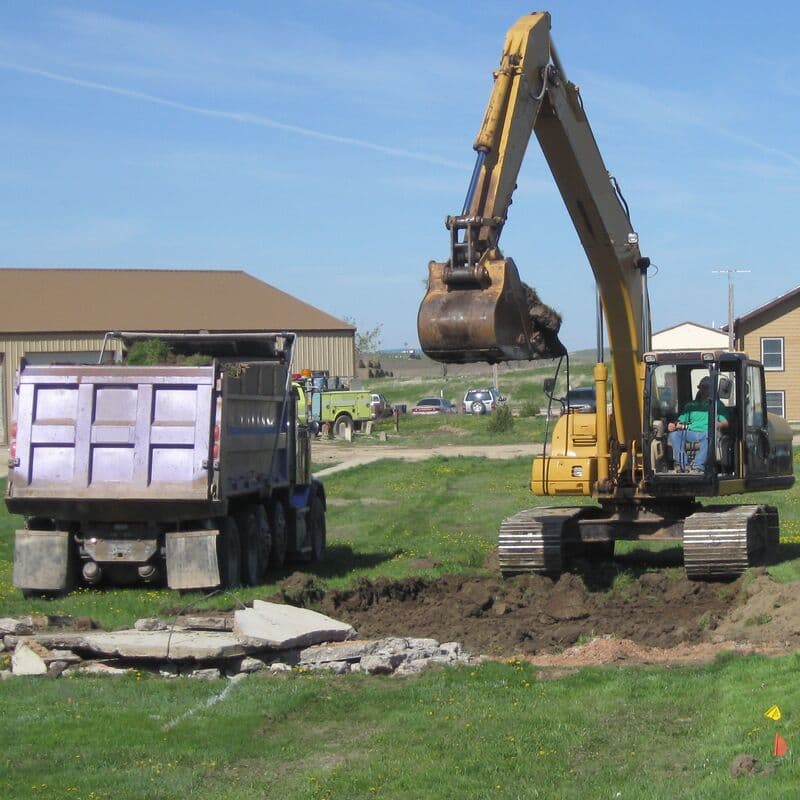
Here is how to bill a job in stages so the money arrives as the work does: a deposit inside your state's cap, a draw after each milestone that points back to a line on the approved quote, a lien release traded for each payment, and a final invoice for what is left.
When billing in stages fits, and when one invoice is enough
One invoice at the end works for a job that starts and finishes the same day with materials you already carry. Stage billing earns its paperwork when any of these is true:
- The job runs across more than one trip, so wages go out before the customer's money comes in.
- You buy materials for this job alone: ready mix by the yard, rebar, a culvert, fill hauled in.
- Rented equipment sits on your card until the invoice is paid.
- The customer's lender or a general contractor releases money by stage.
- One unpaid invoice would decide whether you make payroll.
Excavation and concrete fit every line. A foundation job moves dirt on the first day, pours days later after the inspection, and has a truckload of concrete and steel delivered in between.
A milestone payment schedule that matches the quote
Pick milestones a customer can see from the driveway: the hole is dug, the footings are poured, the walls are stripped, the backfill is done. A milestone the customer can confirm with their own eyes is a draw that is easy to approve.
Write the schedule into the quote and tie each payment to the lines it covers. California's home improvement contract statute requires, when there are progress payments, a Schedule of Progress Payments in which each payment is stated in dollars and cents and names the work and materials it covers, with the statement that it is against the law for a contractor to collect payment for work not yet completed, or for materials not yet delivered. That is a sound rule everywhere: the draw for the pour comes after the pour.
| Stage | Due when | Covers |
|---|---|---|
| Deposit | The quote is approved | Your state's cap on the contract price |
| First draw | The hole is dug and inspected | The excavation and hauling lines |
| Second draw | The footings and walls are poured | The concrete, rebar and forming lines |
| Final | Backfill and cleanup are done | What is left, less what has been paid |
Bill change orders with the draw that follows the work; one that waits for the final invoice is the one that gets argued about.
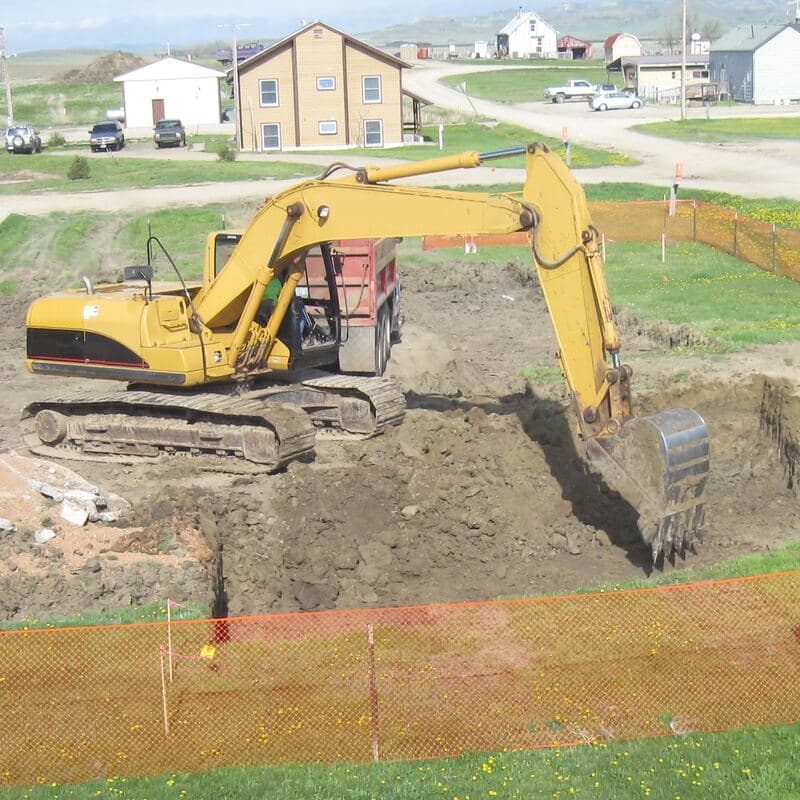
Contractor deposit limits by state: California and Maryland
The deposit is the stage states regulate most closely. California Business and Professions Code section 7159 applies to home improvement contracts over $500 and requires the contract to state, in at least 12-point boldface, that the down payment may not exceed $1,000 or 10 percent of the contract price, whichever is less. On a $30,000 foundation job that is $1,000.
Maryland's cap is looser. Under its home improvement law (Business Regulation Article, title 8, section 617), a person may not receive a deposit of more than one third of the contract price before or at the time the contract is signed. The same $30,000 job could carry a $10,000 deposit there, and the section lists no exception for custom-ordered materials.
Both caps apply to home improvement work for the owner of the home; a commercial job follows the contract and the state's prompt payment law instead. How much deposit a contractor should ask for walks through more states.
Good to know: This is general information, not legal advice. Statutes change and the details depend on the state and the kind of property; read the current text and ask your licensing board or a construction lawyer before you rely on it.
Lien waivers in plain words
A mechanics lien is the claim a contractor, subcontractor, laborer or material supplier can record against the property when they are not paid. California's licensing board tells homeowners how to protect themselves from one: pay with joint checks, get a signed conditional release from each possible claimant before paying, and an unconditional release from each one paid.
So expect to sign a release at every draw. The two kinds do different jobs:
- A conditional release takes effect only when the payment clears. California's statutory form for a progress payment opens with a notice that it is effective on receipt of payment and that a person should not rely on it unless satisfied the claimant has been paid.
- An unconditional release says you have been paid and waive the lien for that work. Sign it after the money is in the bank, never for a check that has not cleared.
- Each release covers work through a date, with exceptions on the California form for retentions, unpaid extras and earlier progress payments not yet received. Fill those in.
The same statute says a waiver signed to get a progress payment that is not paid in exchange is void unless it substantially follows the statutory form. The trade of release for payment is the whole mechanism; keep the two on the same day.
The preliminary notice is the other half. California requires it from subcontractors and suppliers, not the direct contractor; it can be delivered before work begins and up to 20 days after, and payment is required only for work done 20 days before the notice and afterward, so a sub or supplier who serves it late has given up the early work.
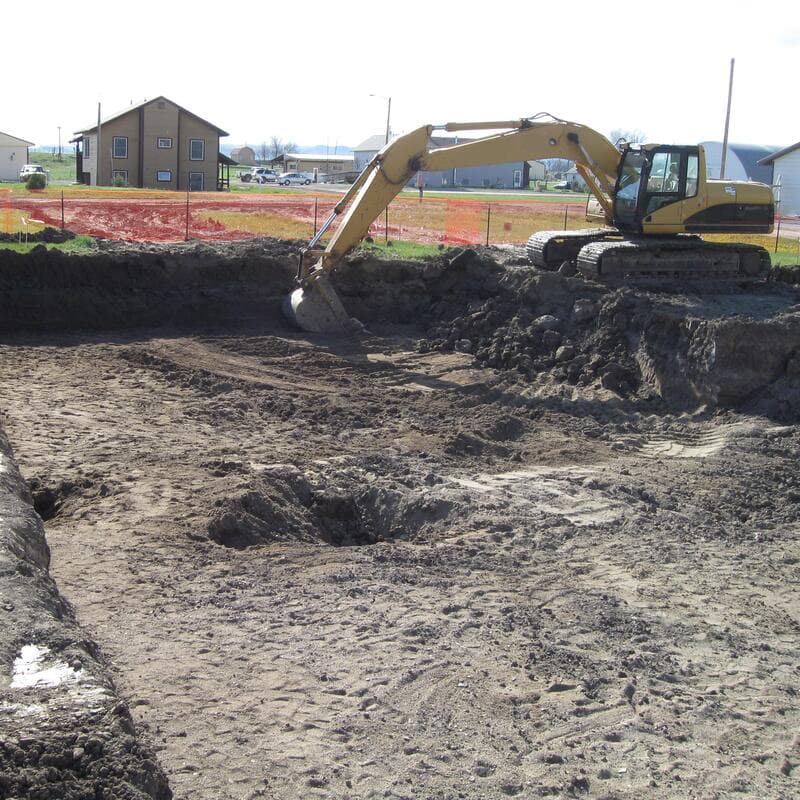
Progress billing for contractors: writing the draw invoice
A draw invoice has one job: let the customer, or their lender, approve it without a phone call. It carries:
- The quote number and the contract price.
- The stage name from the schedule and the quote lines it covers, at the quote's amounts.
- What was done and when, with a photo of the milestone if the customer was not on site.
- A running total: contract price, billed before this invoice, this invoice, and what remains.
- The payment terms, the ways to pay, and a line saying the lien release follows when the payment clears.
Bill the day the milestone is reached. New York's prompt payment law for private construction contracts makes the calendar month the billing cycle when the parties agree to nothing else and lets the contractor invoice for interim payments at the end of each cycle; the parties may set a different cycle, and a milestone is the shortest one there is.
In MakeHay the deposit goes on the quote as a Deposit and with Stripe connected the customer pays it by card as they approve (ask for a deposit on a quote). Each draw is an invoice started from scratch for the customer and job site with one line for the stage; the final invoice comes from the approved quote with Create invoice, an online deposit comes off the balance on its own, and the draws are taken off by lowering the lines (bill a job in stages). Card and bank payments run through Stripe (connect Stripe), and the invoice list shows what is unpaid and overdue (track unpaid invoices).
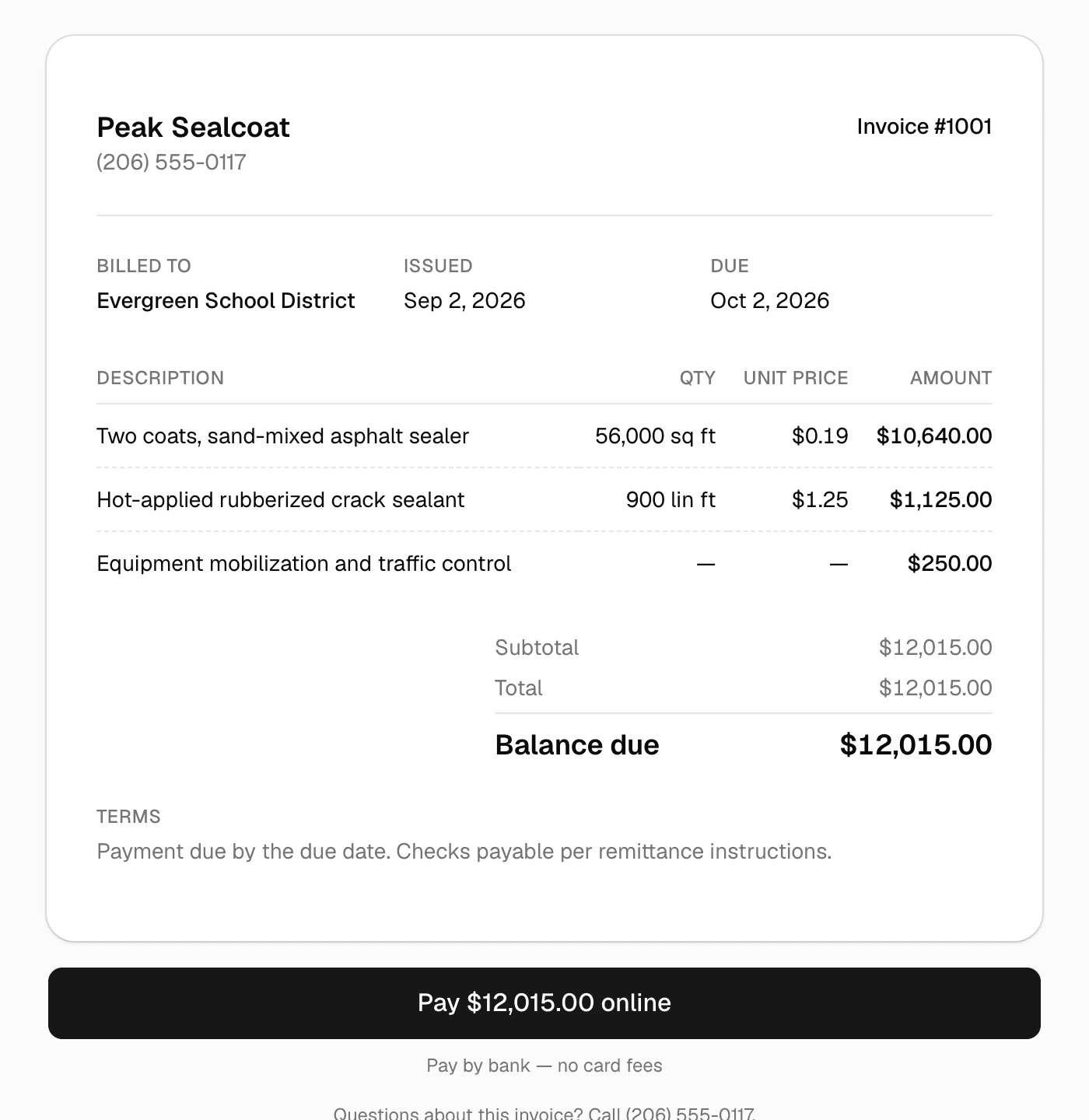
The customer's view of an invoice: the lines it covers, what is due and the button to pay it.
Retainage on commercial work
Retainage is the slice of each draw a commercial owner or general contractor holds back until the job is accepted. The contract decides it unless a statute caps it, and New York does: under General Business Law section 756-c an owner may retain no more than five percent of the contract sum, a contractor no more than five percent from its subcontractors, and the owner must release it within thirty days after final approval of the work, with interest at one percent a month if late. That law covers private construction contracts of $150,000 or more and leaves out one, two and three family homes.
Price it in. Five percent of every draw held for the length of the job is a loan to the owner; carry it in your margin, and invoice the retainage as its own line, with its release date, when acceptance comes through.
When a draw is late
A late draw is a cash problem the same week, so the response is written into the contract before the job starts and followed the day the due date passes.
- Step 1: The day after the due date, send the invoice again and ask whether anything on it is disputed. New York gives a private owner twelve business days to approve or disapprove an invoice and thirty days after approval to pay; Texas gives an owner thirty-five days from receiving a payment request.
- Step 2: If part is disputed, bill the rest. Texas lets an owner withhold no more than 110 percent of the disputed difference on a detached single-family house, duplex, triplex or quadruplex and no more than 100 percent of it on other property.
- Step 3: Charge the interest the statute or the contract allows. Texas sets one and a half percent each month from the day after the due date; New York sets one percent a month, or the contract's higher rate.
- Step 4: Give written notice before you stop work. New York requires it at least ten calendar days before a contractor suspends performance over a late payment. A contract clause that says the same works in any state.
- Step 5: Protect the lien. The release signed for the last draw was conditional on a payment that never came, so it is not in force; the deadlines for notice and recording run from the dates on the job.
Make paying easy so that lateness is rarely a choice. Nacha says a payment on the ACH Network can be processed in a matter of hours on the same business day, the network settles four times a day, and the Same Day ACH per-payment limit is $1 million, so a draw paid by bank can arrive the same business day. The SBA's finance guide suggests accepting checks only from well-known or in-state banks; a pay link skips the question.
FAQ
How many stages should a job have?
One for the deposit, one for each milestone the customer can confirm by looking, and one final. For a foundation that is usually deposit, excavation, pour and final. More stages than visible milestones means invoices for nothing the customer can see, and those are the ones that wait.
Can a contractor bill for materials before they are delivered?
In California, not beyond the down payment: the home improvement contract must state that collecting payment for materials not yet delivered is against the law, and the down payment is capped at $1,000 or 10 percent of the price, whichever is less. Elsewhere the contract governs; a deposit sized to the order, with the supplier's invoice attached to the draw, is the usual way to cover a special order.
What is the difference between a conditional and an unconditional lien release?
A conditional release waives the lien only once the payment it names has been received; California's form says a person should not rely on it unless satisfied the claimant has been paid. An unconditional release waives the lien outright, so it is signed after the money clears.
Does retainage apply to residential jobs?
Usually not by statute. New York's prompt payment law, which caps retainage at five percent, covers private construction contracts of $150,000 or more and excludes individual one, two and three family dwellings. On a homeowner's job the contract decides, and the final invoice is the hold-back.
Sources
- California Business and Professions Code section 7159 (California Public Law) · Subdivision (b) defines a home improvement contract as one whose aggregate price exceeds $500; (d)(8)(C) requires, if a down payment will be charged, the statement in at least 12-point boldface type that the down payment may not exceed $1,000 or 10 percent of the contract price, whichever is less; (d)(9) requires, if payments other than the down payment are made before the project is completed, a Schedule of Progress Payments in which each payment is stated in dollars and cents and specifically references the work or services to be performed and materials and equipment to be supplied, and the statement that it is against the law for a contractor to collect payment for work not yet completed, or for materials not yet delivered, though a contractor may require a down payment. (accessed October 18, 2026)
- Maryland Business Regulation Article, title 8, section 617 (Maryland General Assembly) · Subsection (b): a person may not receive a deposit of more than one third of the home improvement contract price before or at the time of execution of the contract; the section states no exception for custom-ordered materials. (accessed October 18, 2026)
- California Contractors State License Board: How to Prevent a Mechanics Lien · A consumer page: a contractor, subcontractor, laborer or materials supplier may record a lien claim if not paid; subcontractors and suppliers must give a preliminary notice (not required from laborers or the direct contractor), which may be delivered before work begins or supplies are delivered and up to 20 days thereafter, and after that payment is required only for work done 20 days before the notice is delivered and afterward; the simplest way to prevent liens is to pay with joint checks; before paying, get a signed conditional release from possible lien claimants, and after paying an unconditional release signed by each claimant paid; the owner may withhold the next payment until the unconditional releases for the previous one arrive; a notice of completion filed within 15 days of completion cuts a contractor's time to record a lien from 90 to 60 days and a subcontractor's or supplier's from 90 to 30 days. (accessed October 18, 2026)
- California Civil Code section 8132, conditional waiver and release on progress payment (California Public Law) · If a claimant must sign a waiver and release to get a progress payment and is not in fact paid in exchange, the waiver is null, void and unenforceable unless it is in substantially the statutory form; that form opens with the notice that the document waives the claimant's lien, stop payment notice and payment bond rights effective on receipt of payment, and that a person should not rely on it unless satisfied that the claimant has received payment; it is effective only on the claimant's receipt of payment from the bank the named check is drawn on; its exceptions are retentions, extras not yet paid for, earlier progress payments covered by a conditional release but not received, and contract rights. (accessed October 18, 2026)
- New York General Business Law section 756, definitions (New York State Senate) · A construction contract is a written or oral agreement for construction, reconstruction, alteration, maintenance, moving or demolition where the project cost equals or exceeds $150,000; the definition excludes public works contracts and contracts for an individual one, two or three family residential dwelling, among other residential exclusions. (accessed October 18, 2026)
- New York General Business Law section 756-a, construction contracts (New York State Senate) · The parties may establish a billing cycle by mutual agreement; otherwise the billing cycle is the calendar month within which the work is performed; a contractor is entitled to invoice the owner for interim payments at the end of the billing cycle and to submit a final invoice for payment in full upon reaching substantial completion; an owner shall approve or disapprove all or a portion of an invoice within twelve business days; payment of an interim or final invoice is due from the owner not later than thirty days after approval of the invoice. (accessed October 18, 2026)
- New York General Business Law section 756-b, remedies for late payment (New York State Senate) · Subdivision 1(a): the owner pays the contractor interest at the rate of one percent per month or fraction of a month on the unpaid balance, or at a higher rate consistent with the construction contract; subdivision 2(a)(ii): the contractor must give the owner written notice at least ten calendar days before the contractor's intended suspension, and may suspend performance if the owner has not cured after the tenth day. (accessed October 18, 2026)
- New York General Business Law section 756-c, retainage (New York State Senate) · An owner may retain no more than five per centum of the contract sum as retainage; a contractor or subcontractor may also retain no more than five percent, and not more than was withheld from it by the owner; the owner must release retainage to the contractor no later than thirty days after the final approval of the work, with interest at one percent per month on late release. (accessed October 18, 2026)
- Texas Property Code section 28.002, prompt pay required (Texas Public Law) · Subsection (a): the owner shall pay the amount to the contractor, less any amount withheld as authorized by statute, not later than the 35th day after the date the owner receives the written payment request; subsection (b): the contractor must pay its subcontractor not later than the seventh day after the date the contractor receives the owner's payment. (accessed October 18, 2026)
- Texas Property Code section 28.003, exception for good faith dispute (Texas Public Law) · Subsection (a): for construction of or improvements to a detached single-family residence, duplex, triplex or quadruplex, an owner in a good faith dispute may withhold not more than 110 percent of the difference between the amount the obligee claims is due and the amount the obligor claims is due; subsection (b): for other real property, not more than 100 percent of the difference. (accessed October 18, 2026)
- Texas Property Code section 28.004, interest on overdue payment (Texas Public Law) · Subsection (a): an unpaid amount required under the chapter begins to accrue interest on the day after the date on which the payment becomes due; subsection (b): an unpaid amount bears interest at the rate of one and one-half percent each month. (accessed October 18, 2026)
- Nacha: The ABCs of ACH · ACH payments can be processed in a matter of hours on the same business day, or scheduled for the following day or two business days away; the ACH Network reaches all U.S. bank and credit union accounts, is open for processing 23 and a quarter hours every business day and settles payments four times a day; Same Day ACH has a $1 million per-payment limit, which will increase tenfold to $10 million on September 17, 2027. (accessed October 18, 2026)
- Nacha: Same Day ACH · Same Day ACH sends and receives ACH debit and credit payments within hours, on the same business day, and reaches nearly every bank and credit union account in the U.S.; its timeline shows the per-transaction dollar limit raised from $100,000 to $1 million in 2022; 1.4 billion Same Day ACH payments worth $3.9 trillion in 2025; 403 million payments valued at $1.1 trillion in the first quarter of 2026. (accessed October 18, 2026)
- U.S. Small Business Administration: Manage your business, the Manage your finances section · Lists accounts receivable among the bookkeeping tasks someone must manage; says standard practices for accepting checks include only taking checks from well-known or in-state banks, or requiring checks be only for the exact amount owed; notes small processing fees for each credit or debit card transaction; states that the IRS requires a report when a business gets more than $10,000 in cash, or a cash equivalent, from one buyer in a single transaction or two or more related transactions. (accessed October 18, 2026)