How to Get Paid Faster as a Contractor: Invoice Habits
How to get paid faster as a contractor: invoice the day the job ends, put a pay link on every invoice, take ACH, set a due date, remind on a schedule.
The MakeHay team · · 11 min read
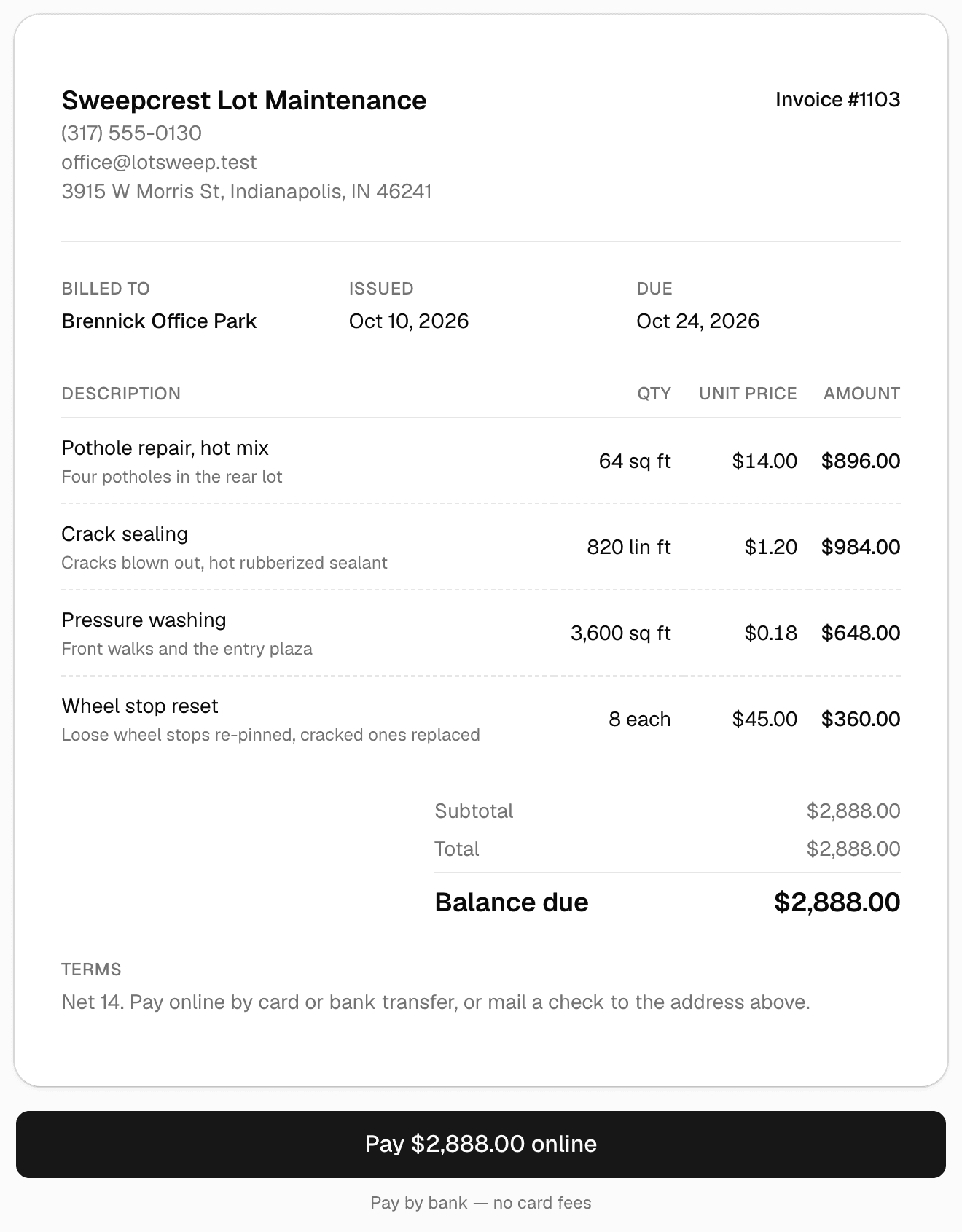
How to get paid faster as a contractor comes down to habits, not chasing: invoice the day the job ends, put a way to pay on the invoice itself, take bank transfers as well as cards, collect a deposit when you buy before you build, print a real due date, and remind on a schedule. Checks are still common on commercial work, and they are the slowest money there is. The Federal Reserve counted 9.2 billion check payments in 2024, down 5.9 percent a year since 2021, while ACH transfers reached 39.7 billion payments averaging $2,622 each.
Invoice the day the job ends, from the site
The fastest invoice is the one that leaves before the truck does. A customer who just watched the crew finish a sealcoat, a restripe or a fall cleanup is ready to pay; the same customer two weeks later has to be reminded what the job was. If the quote already holds the line items, the invoice is the approved quote with the final quantities checked. Add the photos you took while packing up, so it doubles as proof the work is done, and send it from the driveway.
The written request also matters where a prompt payment statute applies. Texas, for example, gives an owner on a covered improvement contract until the thirty-fifth day after receiving a written payment request to pay. The clock starts with the written request. Your own terms work the same way: the due date counts from the day the invoice goes out.
Contractor invoice payment terms that customers actually read
Pick one set of terms, print them on every invoice, and write them as a date, not a phrase. Due on receipt works for one-visit residential work paid by card. A commercial customer with an accounts payable process needs a calendar date they can enter, so write the date, and keep it short enough that your crew is not financing the customer's lot.
For a sense of what a statute treats as reasonable: New York's prompt payment article gives an owner on a covered construction contract twelve business days to approve or disapprove an invoice and makes payment due no later than thirty days after approval, unless the contract sets its own terms. It covers contracts of $150,000 or more and excludes one, two and three family homes, so it will not govern a driveway, but it shows the shape of the terms large customers expect: approval, then a fixed count of days.
- State the amount due, the due date and how to pay, in that order, above the line items.
- If a deposit was paid, show it as a credit against the total so the balance is obvious.
- Keep the terms the same on the quote and the invoice. A customer who approved the quote has already accepted them.
Put a pay link on the invoice itself
A PDF attached to an email asks the customer to find a checkbook, an envelope and a stamp. A link on the invoice asks them to tap once. The Small Business Administration's guidance on payment methods says to accept the methods that are cost effective, secure and give customers a positive experience, and it says that taking checks means writing a policy to avoid bad or fraudulent ones. A customer who pays by link never hands you a check that can bounce.
Cards carry a processing fee on online payments, so decide up front whether you absorb it or pass it on; the rules on surcharges differ by state and card network, and can a contractor charge a credit card fee walks through them. Either way, decide before the first invoice goes out, not after a customer asks.
ACH payments for contractors: the transfer that replaces the check
ACH is the network behind direct deposit and bank-to-bank bill pay, and it reaches every bank and credit union account in the United States. According to Nacha, which runs the network, a payment can be processed in hours on the same business day or scheduled one to two business days out, the network settles payments four times a day, and Same Day ACH, launched in 2016, carries payments up to $1 million each, a limit set to rise to $10 million in September 2027.
For a contractor, ACH is the natural home for the larger invoices customers used to pay by check: a commercial lot, a seasonal snow contract, a full-season lawn program. The money comes straight from the customer's checking account, with no card limit in the way. Nacha reported 403 million Same Day ACH payments in the first quarter of 2026, up 23.6 percent on the year before, so a customer asked to pay by bank transfer is being asked for something ordinary. Offer card and bank transfer on the same link and let the customer pick.
Collect a deposit when you buy before you build
A deposit paid at approval is money you never have to chase, and it covers what you commit to before day one: special-order materials, a reserved date, a permit. Keep it to what those cost, because some states cap residential deposits by statute; how much deposit a contractor should ask for covers the caps in five states and the quote wording to copy. Collect it online, at the moment the customer approves the quote, and keep the job off the calendar until it lands.
An invoice reminder schedule that runs without you
A late invoice is often not a dispute. It is an email that slid off the first screen. The fix is a reminder that goes out on a fixed schedule whether or not you remembered, with the pay link in it.
- Step 1: The day after the due date: a short note that the invoice is past due, with the amount, the due date it carried and the pay link. Texas's statute, for comparison, starts interest on the day after payment is due, so the day after is a reasonable first touch.
- Step 2: One week past due: the same note again, plus a line asking whether anything on the invoice needs correcting. A missing purchase order number is a common cause.
- Step 3: One month past due: a plainer message. State the balance, say that work on the account pauses until it is settled, and give a phone number.
- Step 4: Two months past due: stop emailing and start the steps below.
In MakeHay, overdue invoice reminders are an automation you switch on: the first reminder is emailed the day after the due date and the rest follow a week apart, up to three per invoice, each with the balance and a pay button when you take online payments, from a template you can edit. That covers the first touches above; the later ones are yours. An invoice is created from the approved quote in one click, and with Stripe connected the customer pays by card or bank transfer from the link on it. Unpaid and overdue invoices sit in one list, and a check or cash payment is recorded against the invoice.
Late fees on contractor invoices: what two statutes actually say
A late fee is only worth printing if you can collect it, and that depends on your state and on what the customer agreed to in writing. Texas Property Code chapter 28, the prompt payment statute for contractors and subcontractors, says an unpaid amount bears interest at one and one-half percent each month, beginning the day after the payment becomes due, until delivery of the payment or a judgment. It covers a contractor who contracts with a private owner to improve real property, and improvement includes landscaping, driveways and roads. An owner with a good faith dispute may withhold up to 110 percent of the disputed difference on a house of up to four units, and up to 100 percent on other property.
New York's prompt payment article sets the deadlines described above but states no interest rate in the section this post opened, and it applies only to construction contracts of $150,000 or more, with one, two and three family homes excluded. Elsewhere the rules vary by state, and a fee the customer never agreed to is hard to collect anywhere. If you charge one, put it on the quote and the invoice before the work starts.
Good to know: This is general information, not legal advice. Statutes change and most states have rules this post did not check; read the current text for your state and ask a lawyer before you print a late fee or interest rate on an invoice.
What to do when a customer doesn't pay
- Step 1: Call. Ask whether the invoice was received and whether anything on it is in dispute, and write down the answer and the date. A dispute over whether the work was done properly is what Texas's prompt payment statute lets an owner withhold for, so settle it first.
- Step 2: Send a final written demand with the balance, the original due date, the reminders already sent and a date by which you expect payment. Keep a copy.
- Step 3: Pause future work on the account, and say so. A customer with a second visit coming has a reason to settle the first.
- Step 4: Escalate the way the Small Business Administration describes for a bounced check: a registered letter and a waiting period where your state requires them, then small claims court or a collection agency.
- Step 5: Where lien rights apply, look up your state's notice deadlines early, before they pass.
Then fix the cause. A customer who paid late once will do it again unless the next job carries a deposit, a pay link and, for repeat work, a saved payment method charged after each visit. In MakeHay that is autopay for repeat customers.
The Monday checklist
- Connect online payments so every invoice carries a pay link with card and bank transfer on it.
- Pick the due date terms, print the same terms on quotes and invoices, and switch on overdue reminders once.
- Add a deposit to the quote for every job with materials bought ahead, and move repeat customers to autopay.
- Invoice today's jobs today, before the truck leaves the last site.
FAQ
How long should a contractor give a customer to pay an invoice?
As short as the customer's process allows. Due on receipt suits one-visit residential work with a pay link. A commercial customer with an approval step needs a calendar date; New York's prompt payment article, for large covered contracts, gives the owner twelve business days to approve an invoice and thirty days after approval to pay, a useful ceiling for what to expect from a large customer.
Is ACH faster than a check for a contractor?
Yes, and it is the same tap for the customer as a card. Nacha says an ACH payment can be processed on the same business day or scheduled one to two business days out; a mailed check adds the post, the deposit and the hold on top. The Federal Reserve's payments study counts checks falling 5.9 percent a year by number from 2021 to 2024.
Can a contractor charge interest on a late invoice?
It depends on the state and the contract. Texas's prompt payment statute sets interest at one and one-half percent each month on an unpaid amount a private owner owes a contractor, starting the day after it is due. New York's article sets deadlines but states no rate in the section checked. Elsewhere the rules vary by state, and the customer has to have agreed to the fee in writing. This is not legal advice; check your state.
What is the best way to get paid on the day of the job?
Have the invoice ready before the job ends, send it from the site with a pay link, and ask the customer to pay while you are there. For repeat work, a saved payment method charged after each visit removes the invoice step entirely.
Sources
- Federal Reserve Payments Study: National Payment Volumes, Top-Line Data (CY 2015 to 2024), Federal Reserve Board · States that in 2024 check payments fell to 9.2 billion by number, declining 5.9 percent per year by number from 2021 to 2024, and that ACH payments totaled 39.7 billion with an average value of $2,622; page last updated July 1, 2026. (accessed October 17, 2026)
- What is the ACH Network? (Nacha) · States that ACH reaches all U.S. bank and credit union accounts, that payments can be processed in a matter of hours on the same business day or scheduled the following day or two business days away, that the network settles payments four times a day, and that Same Day ACH launched in 2016 with a current per-payment limit of $1 million, rising to $10 million on September 17, 2027. (accessed October 17, 2026)
- Same Day ACH (Nacha) · States that Same Day ACH debuted in September 2016, that the per-transaction limit rose from $100,000 to $1 million in 2022, and that the first quarter of 2026 carried 403 million Same Day ACH payments, up 23.6 percent from the first quarter of 2025, valued at $1.1 trillion. (accessed October 17, 2026)
- Texas Property Code section 28.001, Definitions (texas.public.law) · Defines a contractor as a person who contracts with an owner to improve real property or perform construction services, an owner as a person or entity other than a governmental entity with an interest in the improved real property, and an improvement as including clearing, grading, filling or landscaping land, driveways, roads and furnishing trees or shrubbery; verified May 26, 2025. (accessed October 17, 2026)
- Texas Property Code section 28.002, Prompt Pay Required (texas.public.law) · States that an owner who receives a written payment request from a contractor for an amount allowed under the contract shall pay the amount, less any statutory withholding, not later than the 35th day after the date the owner receives the request, and that a contractor pays each subcontractor its share within seven days of receiving the owner's payment; verified May 26, 2025. (accessed October 17, 2026)
- Texas Property Code section 28.003, Exception for Good Faith Dispute; Withholding (texas.public.law) · States that on a detached single-family residence, duplex, triplex or quadruplex an owner with a good faith dispute may withhold not more than 110 percent of the difference between the amount claimed due and the amount the owner says is due, and on other real property not more than 100 percent; a good faith dispute includes whether the work was performed in a proper manner; verified May 26, 2025. (accessed October 17, 2026)
- Texas Property Code section 28.004, Interest on Overdue Payment (texas.public.law) · States that an unpaid amount bears interest at the rate of one and one-half percent each month, that the amount begins to accrue interest on the day after the date on which the payment becomes due, and that interest stops on the earlier of delivery, mailing with delivery within three days, or entry of a judgment; verified May 26, 2025. (accessed October 17, 2026)
- New York General Business Law section 756-a, Construction contracts (New York State Senate) · States that a contractor may invoice for interim payments at the end of each billing cycle and a final invoice at substantial completion, that an owner shall approve or disapprove all or part of an invoice within twelve business days, that payment is due not later than thirty days after approval of the invoice, that the contract's own terms supersede the article where it does not provide otherwise, and states no interest rate for late payment; page revision dated November 26, 2023. (accessed October 17, 2026)
- New York General Business Law section 756, Definitions (New York State Senate) · Defines a construction contract as an agreement for the construction, reconstruction, alteration, maintenance, moving or demolition of a building, structure or improvement to real property where the total cost equals or exceeds one hundred fifty thousand dollars, and excludes public works and contracts for an individual one, two or three family residential dwelling. (accessed October 17, 2026)
- Manage your finances (U.S. Small Business Administration) · States that a business should accept payment methods that are cost effective, secure and provide a positive experience for customers; that accepting checks calls for a policy to avoid bad or fraudulent checks; that for a bounced check some states require a registered letter and a waiting period, and that collecting may mean small claims court or a collection agency; and that card transactions and online payments carry processing fees. (accessed October 17, 2026)