How to Price Fence Repair: Posts, Panels and Gate Hinges
How to price fence repair: a trip charge plus a line per post, picket run and gate, with the 811 call, fast-setting concrete, hinge prices and wage data.
The MakeHay team · · 11 min read
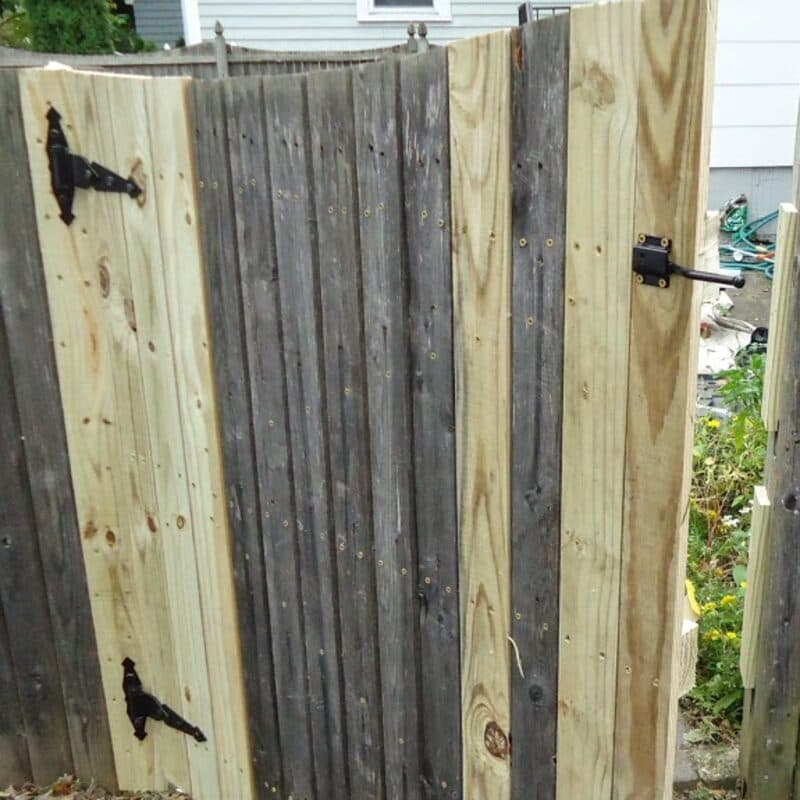
Here is how to price fence repair so a small job still pays. A repair is not a fence priced per linear foot; it is a trip, a short list of parts and a few hours. So the quote is a trip charge plus one line per repair: a post, a run of pickets, a gate. Price each from your yard's list and your own timing.
What fence repair cost is made of: the trip, the parts, the hours
Three things go into every repair price. The trip costs the same for one picket or a whole gate, so it is its own line and the customer sees why a small job has a floor. The parts come from your yard's list. The hours are yours to time, with the federal data as the floor: O*NET's summary for fence erectors, with Bureau of Labor Statistics wage data for 2025, lists a median of $23.07 an hour, and the occupation's tasks include "Construct and repair barriers, retaining walls, trellises, and other types of fences, walls, and gates." Your loaded rate sits above the median once burden, the truck and overhead are on it.
Price each repair in the unit that fits: per item for a post or a hinge set, per picket for a run, flat for a gate rebuild. A customer who sees four lines can drop one and approve the rest. When the job turns into a new fence, pricing fence installation per linear foot takes over.
How to price a job to replace fence pickets and panels
Pickets are the cheapest part and the quickest repair. HEP Sales, a lumber yard in Waterloo, New York, lists a 1 x 6 x 6 Southern Pine No. 2 pressure treated dog-ear fence board at $3.99 each on October 18, 2026, and a 2 x 4 x 8 Southern Pine No. 1 pressure treated rail at $6.59. Count the pickets that are split, rotted at the bottom or missing, and put a per picket line on the quote with the count.
- Replace a rail that is rotted at the post or that the fasteners pulled through; the new rail carries the pickets, so price it first.
- A whole panel between two posts is a rails-and-pickets line, not a new fence; count pickets by the section width over the picket width plus the gap.
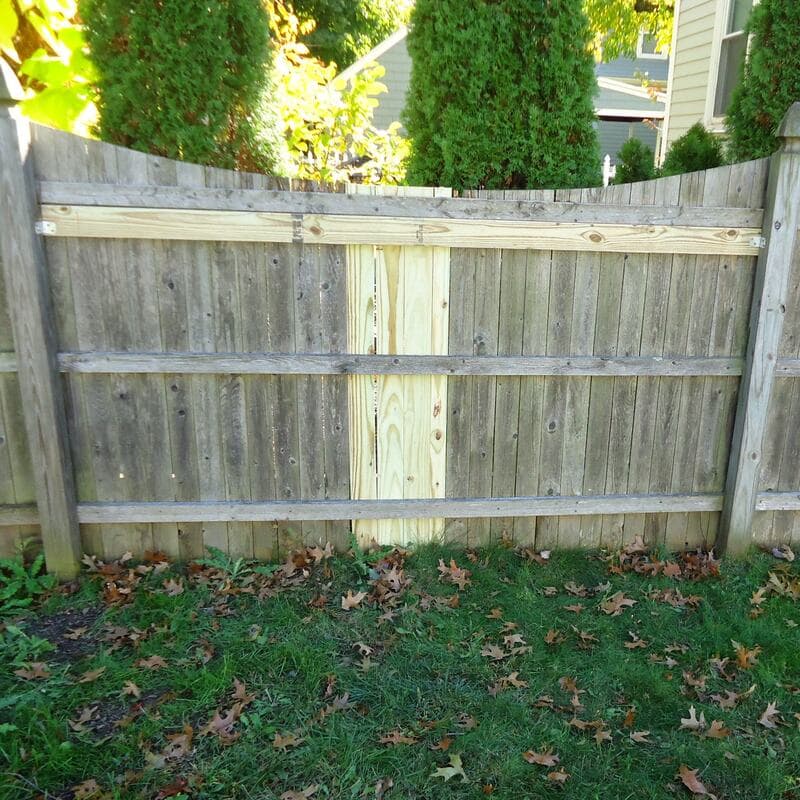
One warning from the Forest Products Laboratory's guide to protecting wood fences: horizontal rails need more decay protection than vertical boards, and "Keep boards off the ground." A picket that touches soil will go again; trim the new one clear of the grade.
How to price a job to replace a fence post
A post is a dig, and the dig is most of the price. The post itself is cheap: the same yard lists a 4 x 4 x 8 Southern Pine No. 2 pressure treated post at $13.39. Check the end tag: YellaWood's page on ground contact lumber lists fence posts among the uses for its ground contact grade, treated with more preservative than above ground lumber, and says the end use is noted at the top of the tag.
- Step 1: Call 811. 811 Before You Dig calls itself "the free national before-you-dig service", names fence installation among the jobs that need it, and says to contact 811 "a few business days before you begin any digging".
- Step 2: Dig out the old post and its footing: cut the rails free, rock the stub out with a bar or a jack, lift the old concrete.
- Step 3: Size the hole to Quikrete's rule: a diameter "3 times the width of the post", about 12 inches for a 4 inch post, and a depth of one third to one half of the height above ground, at least 2 feet for a 6 foot fence.
- Step 4: Add about 6 inches of gravel, set the post plumb against the rails, pour the dry fast-setting mix to 3 to 4 inches below grade and soak it with about a gallon of water per 50 lb bag.
- Step 5: The mix sets hard in 20 to 40 minutes; Quikrete says to wait about 4 hours before building on the post or loading it, so hang the rails last.
Price the concrete by the bag. Quikrete's quantity calculator takes the hole depth for fixed post and hole pairings (a 4 inch post in a 12 inch hole is one row) and gives the number of 50 lb bags. Klem's, a hardware store in Spencer, Massachusetts, lists the 50 lb bag at $12.99 on October 18, 2026. Dig time doubles in clay, roots or a footing that will not come out; say so on the quote.
How to price a job to fix a sagging gate
A gate drags on the latch side for one of three reasons, each with its own part and price: the frame has racked, the hinges have worn or pulled their screws, or the hinge post has leaned. Lift the latch side by hand. If the gate squares up and the post stays put, the frame or the hinges are the fix; if the post moves, the post is.
| Fix | Part | Price |
|---|---|---|
| Racked frame | National Hardware V852 series anti-sag gate kit: top bracket, bottom corner bracket, cable, turnbuckle, mounting screw | $14.99 a kit |
| Worn hinges | National Hardware T-hinge, 5 1/2 inch frame leaf, zinc, 48 lb rating | $6.99 each |
| Heavy or wide gate | National Hardware gate caster, rubber wheel, spring, 125 lb safe working load, fasteners not included | your supplier's price |
The anti-sag kit runs a cable from the top hinge corner to the bottom latch corner and the turnbuckle pulls the frame square; it is the cheapest fix. New hinges fix a gate whose screws have chewed out the wood; use longer screws into sound wood. Paul B Hardware's page for the gate caster says fasteners are not included, so add the bolts to the line.
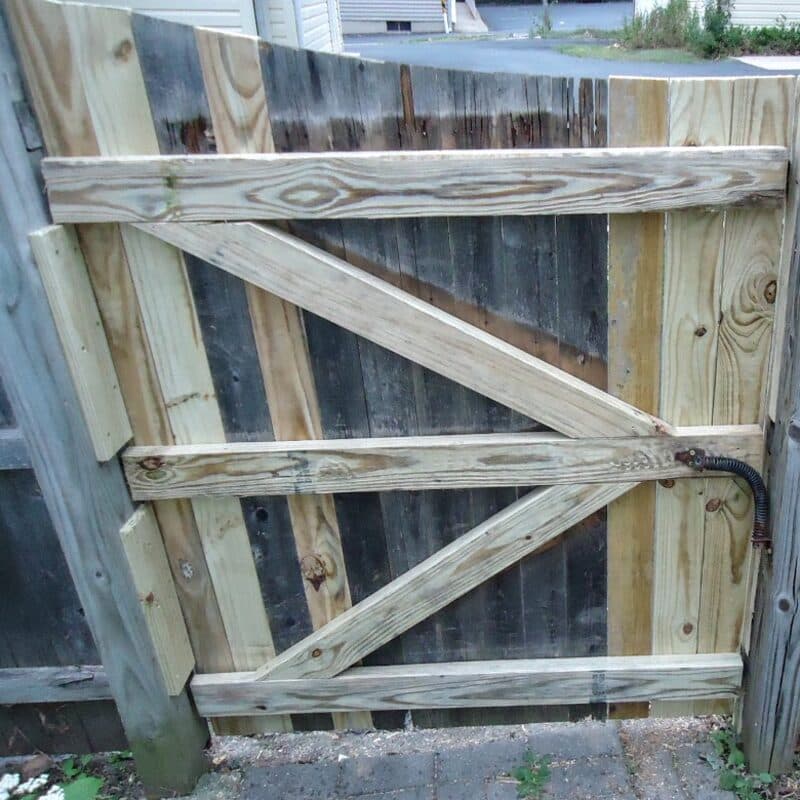
When the frame is past a cable, rebuild it: two new rails and a diagonal brace from the bottom hinge corner to the top latch corner, the old boards screwed back on if sound. Price that flat as a gate rebuild line. A gate that has had all three fixes is a new gate; fence gate pricing in the installation guide covers that line.
Leaning fence repair: straighten the post or replace it
A leaning run is a post problem. Push each post at the top. One that moves in the ground but is sound at the grade line can be straightened: dig beside the footing, pull it plumb, brace it, and pour fast-setting mix in the gap; Quikrete's page says the mix is poured dry, soaked with water, and sets hard in approximately 20 to 40 minutes. One that is soft at the grade line is a replacement, and a run of them is a new fence.
Posts fail at the ground because that is where the wood stays wet. The Forest Products Laboratory guide recommends a preservative treatment for posts, "preferably a pressure treatment for below ground use", and YellaWood says its ground contact lumber "provides twice the protection against rot, fungal decay, and termite attack." Specify ground contact posts.
Matching new wood to an old fence
A new picket is pale beside a gray fence, and the customer will ask. New wood weathers toward the rest over its first seasons; to match it now, stain the whole run, not the one board. YellaWood's staining page says to stain pressure treated wood "within six weeks after construction" so long as it is dry enough, checked with a sprinkle test (water that beads up means wait and test again; water that soaks in means it is ready), and to clean the wood first. So matching is a second visit and a second line, per linear foot; pricing fence staining per linear foot has the arithmetic.
A worked repair quote
Worked example: One rotted post, one sagging gate, six pickets
- Trip charge: your flat number, one line.
- Post: 1 × $13.39, plus 2 bags of fast-setting mix (your count from Quikrete's calculator for a 12 inch hole) × $12.99 = $25.98; gravel from your own stock.
- Gate: 1 anti-sag kit × $14.99, plus 2 T-hinges × $6.99 = $13.98.
- Pickets: 6 × $3.99 = $23.94.
- Parts: $13.39 + $25.98 + $14.99 + $13.98 + $23.94 = $92.28.
- Labor: about 5 hours by your own timing, the gate and pickets filling the concrete's 4 hour wait.
- At the bare federal median of $23.07 an hour, 5 hours is $115.35 before burden, overhead and profit; your loaded rate goes in its place.
Result: $92.28 of parts, about 5 hours of labor at your loaded rate, and the trip charge, each on its own line, the stain visit quoted separately.
Writing the repair quote so it gets approved
Ask for photos before the visit: the post at the grade line, the gate from the latch side, the run from one end. Put every repair on its own line with its count, the trip charge above them, and name the parts so the quote reads like a bill of materials. Add a line that dig time is priced for normal soil, with roots, rock or a stubborn footing billed by the hour, and one that new wood looks new until it weathers or is stained.
In MakeHay, a request form on your site takes the customer's photos and the job site address, and a request with an address can start a draft quote in one tap. Quote lines carry your units, per item for the post and the hinges, per linear ft for the stain, flat for the trip, and the customer approves and signs online from a link. An approved quote becomes an invoice in one click.
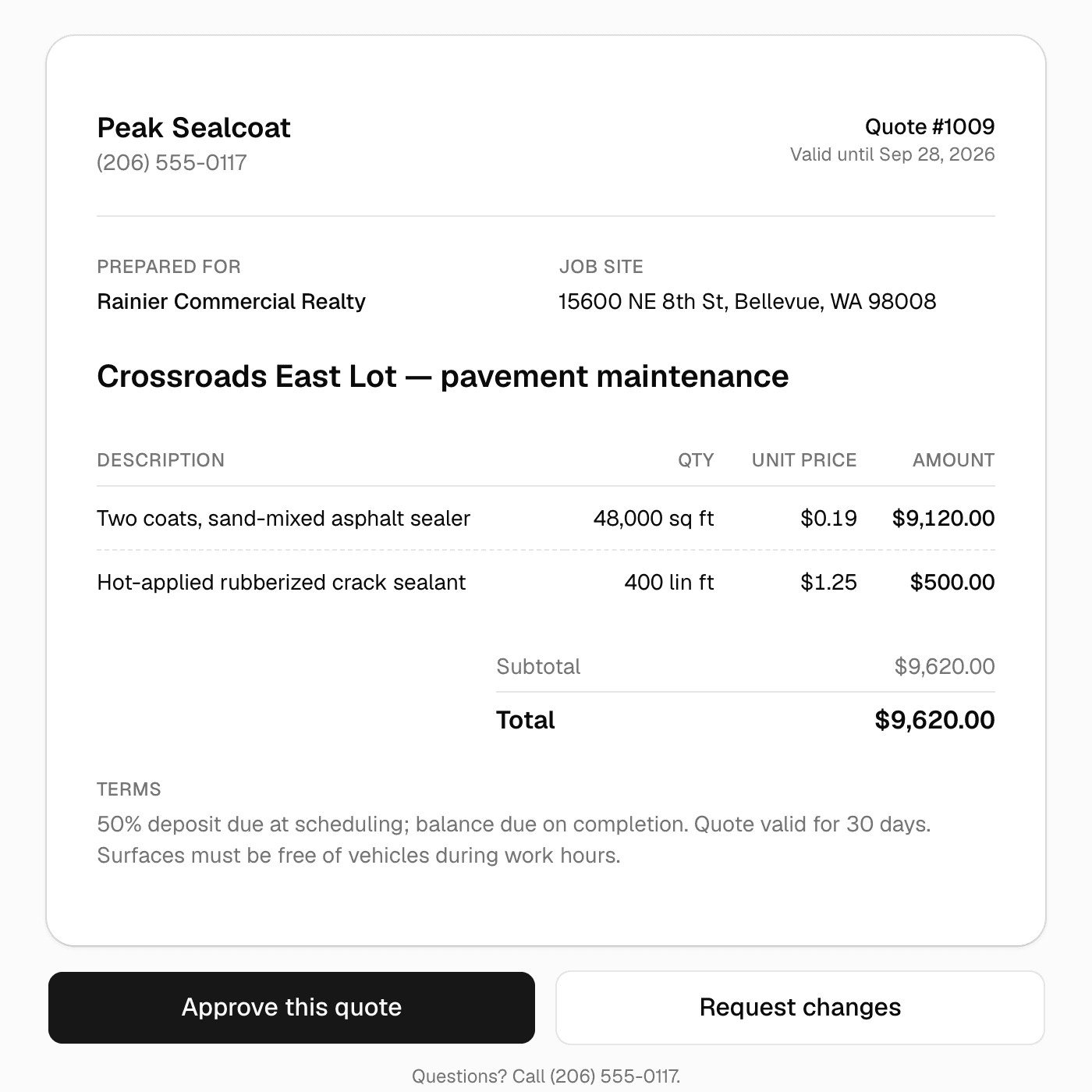
The customer sees the trip charge and each repair as its own line before approving.
FAQ
When is fence repair or replacement the better call?
Count the posts that are soft at the grade line. One or two are a repair priced per post. A run of them, or rails rotted at most posts, is a new fence, and the honest quote carries both prices, the repair line by line and the replacement per linear foot.
Do you need to call 811 to replace one fence post?
Yes. 811 Before You Dig says anyone who plans to dig should contact 811, names fence installation among the jobs, calls the service free, and says to call a few business days before digging; utilities mark their lines with paint or flags.
Why does a new post need fast-setting concrete?
It saves a trip. Quikrete's fast-setting mix is poured dry into the hole and soaked with water, sets hard in approximately 20 to 40 minutes, and the post-setting page says to wait about 4 hours before loading the post, so the rails go back on the same visit.
Why do the new fence boards look different?
Fresh pressure treated wood is pale beside boards that have weathered gray, and it darkens toward them over its first seasons. The match now is a stain of the whole run once the new wood passes YellaWood's sprinkle test, usually within six weeks of construction; quote it as its own visit.
Sources
- O*NET OnLine: Fence Erectors, summary report · Median wages (2025) "$23.07 hourly, $47,980 annual", wage data attributed to the Bureau of Labor Statistics; the full task list includes "Construct and repair barriers, retaining walls, trellises, and other types of fences, walls, and gates." (accessed October 18, 2026)
- 811 Before You Dig: the national before-you-dig service · Calls 811 "the free national before-you-dig service"; says anyone who plans to dig should contact 811, including for small jobs such as "installing fences and mailboxes"; says to contact 811 "a few business days before you begin any digging"; crews mark "the approximate location of buried utilities" with "paint or flags". (accessed October 18, 2026)
- Quikrete: Setting Posts · "Dig post hole so diameter of the hole is 3 times the width of the post", about 12 inches wide for a 4 inch post; the depth should be one third to one half of the post height above ground, so "a 6-foot tall fence would require a hole depth of at least 2 feet"; "Add about 6 inches of QUIKRETE All-Purpose Gravel into the bottom of the hole"; fill with Fast-Setting Concrete "up to 3 to 4 inches below ground level", "about a gallon of water per 50 lb bag"; the mix "will set hard in 20 to 40 minutes"; "Wait about 4 hours to begin constructing your fence or applying heavy weight to your post"; links the Quantity Calculator, whose Set Posts section takes the hole depth in inches for fixed post and hole pairings (a 4 inch post in a 12 inch hole among them) and gives the number of 50 lb bags of Fast-Setting Concrete. (accessed October 18, 2026)
- Quikrete: Fast-Setting Concrete Mix · "a special blend of fast-setting cements, sand and gravel designed to set hard in approx. 20 to 40 minutes"; "Pour dry mix into hole and soak with water"; sold in "50 lb. bags, 56 per pallet"; fence posts among the listed uses. (accessed October 18, 2026)
- HEP Sales: 1 x 6 x 6 Southern Pine No. 2 pressure treated rough sawn dog-ear fence board · $3.99 each, pressure treated for above ground use, listed for same-day pickup at the Waterloo, New York store (0446 Waterloo-Geneva Road) on October 18, 2026. (accessed October 18, 2026)
- HEP Sales: 2 x 4 x 8 Southern Pine No. 1 pressure treated (CA), surfaced four sides · $6.59 per piece for one, $6.38 each at 26 pieces and $6.28 each at 130; Waterloo, New York store, October 18, 2026. (accessed October 18, 2026)
- HEP Sales: 4 x 4 x 8 Southern Pine No. 2 pressure treated (CA), surfaced four sides · $13.39 per piece for one, $12.98 each at 11 pieces and $12.68 each at 52; 144 in stock at the Waterloo, New York store on October 18, 2026. (accessed October 18, 2026)
- HEP Sales: National Hardware V852 series anti-sag gate kit · "National Hardware V852 Series Anti-Sag Gate Kit, Steel, Zinc, 1-Piece", $14.99 each; the page lists the contents as a top bracket, a bottom corner bracket, a rope clip, a cable, a turnbuckle and a mounting screw; 8 in stock at the Waterloo, New York store on October 18, 2026. (accessed October 18, 2026)
- HEP Sales: National Hardware T-hinge, 5 1/2 inch frame leaf, 48 lb · "T-Hinge, 5 1/2 in wide frame leaf, 1.993 in high frame Leaf, Steel, Zinc, Tight Pin, 48 lb", $6.99 each, sold singly; 4 in stock at the Waterloo, New York store on October 18, 2026. (accessed October 18, 2026)
- Paul B Hardware: National Hardware Gate Caster · "designed to support the weight of large gates and assist with opening and closing"; "Rubber wheel and metal body construction"; spring loaded for uneven ground; "Safe Working Load (SWL) of 125 lbs"; "Fasteners not included", mounting with 5/16 inch hardware; no price shown on the page. (accessed October 18, 2026)
- Klem's: Quikrete Fast Setting Concrete Mix, 50 lb, gray · "$ 12.99 EA" regular price for the 50 pound bag, "51 In Stock" at Klem's, 117 West Main Street, Spencer, Massachusetts, October 18, 2026. (accessed October 18, 2026)
- YellaWood: Ground Contact Lumber · Ground contact lumber is approved for components "placed close to, on or directly in the ground (ground level decks, fence or deck posts, landscaping, walkways, etc.)"; above ground lumber is for "applications that are six inches or more above the ground" and is treated with less preservative; ground contact lumber "provides twice the protection against rot, fungal decay, and termite attack"; the intended end use is read from "the end usage which is noted at the top of the tag". (accessed October 18, 2026)
- YellaWood: Staining Pressure Treated Wood · Says to "stain pressure treated wood within six weeks after construction" so long as the wood is sufficiently dry; a sprinkle test: "If it beads up, you'll need to wait several days to test again", and water that absorbs into the wood means it is ready for staining; "it's important to clean the wood to remove any dirt or blemishes from boards" before staining. (accessed October 18, 2026)
- USDA Forest Service Treesearch: Protecting wood fences for yard and garden (abstract) · Abstract of University of Wisconsin-Extension publication A3052 by De Groot, Feist, Eslyn and Gjovik of the Forest Products Laboratory: posts need an in-depth preservative treatment, "preferably a pressure treatment for below ground use"; horizontal rails need more decay protection than vertical boards; "Keep boards off the ground"; for untreated posts, "choose posts with mostly heartwood" of a naturally decay-resistant species. (accessed October 18, 2026)