How to Price Fence Installation per Linear Foot (Wood)
How to price fence installation per linear foot: posts per section, hole depth and concrete, pickets and rails from a yard's list, gates and labor.
The MakeHay team · · 11 min read
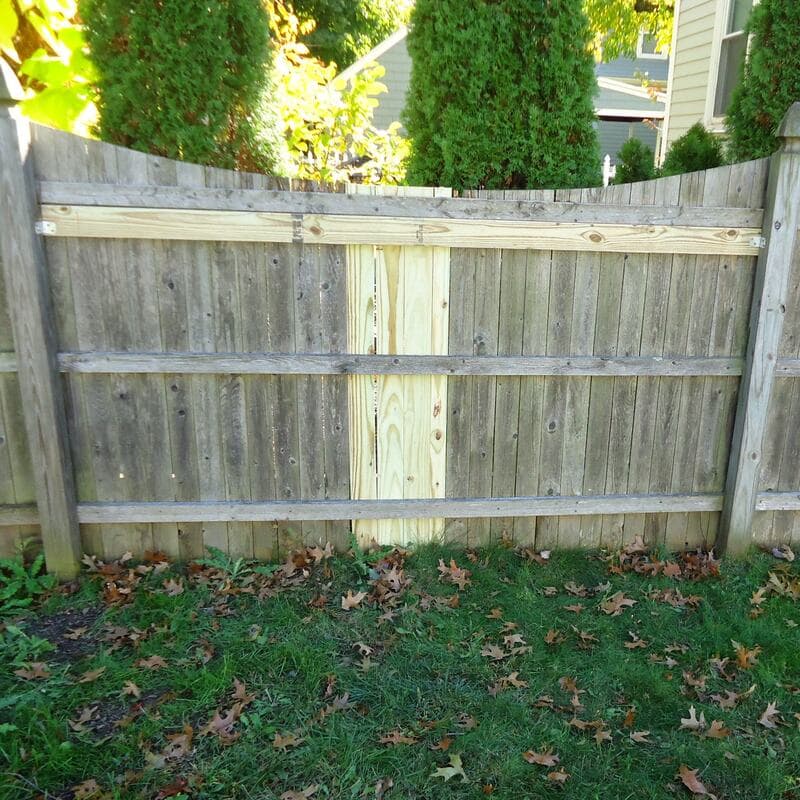
Here is how to price fence installation per linear foot without guessing at a market number. Measure the run from the property line, count posts by the section, price one section from your yard's list (a post, the rails, the pickets, the concrete), price each gate on its own, add tear-out and hard digging, put labor underneath from the federal wage data, and divide by the feet.
What fence installation cost per linear foot is made of
A per linear foot price is a total divided by the feet. The total has six parts: the feet, the posts and what holds them in the ground, the boards and rails per section, each gate, the extras the site adds, and the labor hours. Price each part on its own line and the division at the end is honest. The worked job below is a 6 foot wood privacy fence priced from one lumber yard's October 18, 2026 list; swap in your own yard's numbers.
Step 1: Measure the linear feet from the property line
The fence goes where the property line is, not where the old fence or the lawn edge is. Wisconsin Rapids requires the whole fence to sit on the applicant's own property and recommends a surveyor when the lines are unknown; Rockledge, Florida asks for a survey or site plan with the permit.
- Step 1: Find the survey pins or ask for the survey (the closing papers usually include one), then stake and string the line.
- Step 2: Walk the line with a measuring wheel, or trace it on satellite imagery for a first number and confirm on site.
- Step 3: Record every corner (each one is a post) and every gate with its width and swing (each one is its own quote line).
- Step 4: Note the slope, the trees, the old fence to remove and how far the truck can park from the line.
The free satellite measurement tool traces a line on imagery and returns the linear feet with no account, enough to quote a straight back-yard run before you drive out; where trees hide the line, the wheel on site wins.
Step 2: Posts per foot, then fence post depth and concrete
Wood fence is built in sections, and the common section is 8 feet because rails come in 8 foot lengths. Divide the board run by 8 and round up for the sections; add one for the posts, since a run of sections has a post at each end, then one for every corner and one wherever a gate interrupts a section.
Depth sets the post length and the concrete. Quikrete's post-setting page gives the rule: dig the hole three times the width of the post (about 12 inches wide for a 4 inch post), to a depth of one-third to one-half of the post's height above ground, at least 2 feet for a 6 foot fence. Put about 6 inches of gravel in the bottom, set the post, fill with the mix to 3 to 4 inches below grade, and wait about 4 hours before building on it. An 8 foot post with 2 feet in the ground leaves 6 feet above, which is why 8 foot 4 x 4s are the stock post for a 6 foot fence; where the ground freezes, ask the building department before you buy posts.
The bag count per hole comes from your hole size: Quikrete's page links a calculator that returns the number of 50 lb bags of its fast-setting mix, which sets hard in about 20 to 40 minutes, rounded up to the whole bag. Ordinary mix in 80 lb bags costs less where speed does not matter. Count bags on one real hole, then multiply by the posts.
Step 3: Price one section from the yard's list, then multiply
Price one 8 foot section as a kit, then multiply by the sections. The table uses one yard's list, HEP Sales in Waterloo, New York, on October 18, 2026.
| Item | Count per section | Unit price | Line |
|---|---|---|---|
| 4 x 4 x 8 pressure treated post, No. 2 | 1 | $13.39 | $13.39 |
| 2 x 4 x 8 pressure treated rail, No. 1 | 3 | $6.59 | $19.77 |
| 1 x 6 x 6 pressure treated dog-ear picket | 18 (96 in ÷ 5.5 in, rounded up) | $3.99 | $71.82 |
| 80 lb concrete mix | 2 (your own count per hole) | $6.99 | $13.98 |
| Section total | $118.96 | ||
| Per linear foot of materials | $118.96 ÷ 8 | $14.87 |
The picket count comes from the width: the yard lists its 1 x 6 picket as typically 5 1/2 inches wide, and 96 inches divided by 5.5 is 17.5, so a butted section takes 18; a shadowbox or spaced style changes that. Fasteners, gravel and sales tax come off your receipt as their own line, and the stack price applies once the count clears it.
Step 4: Fence gate pricing as its own line
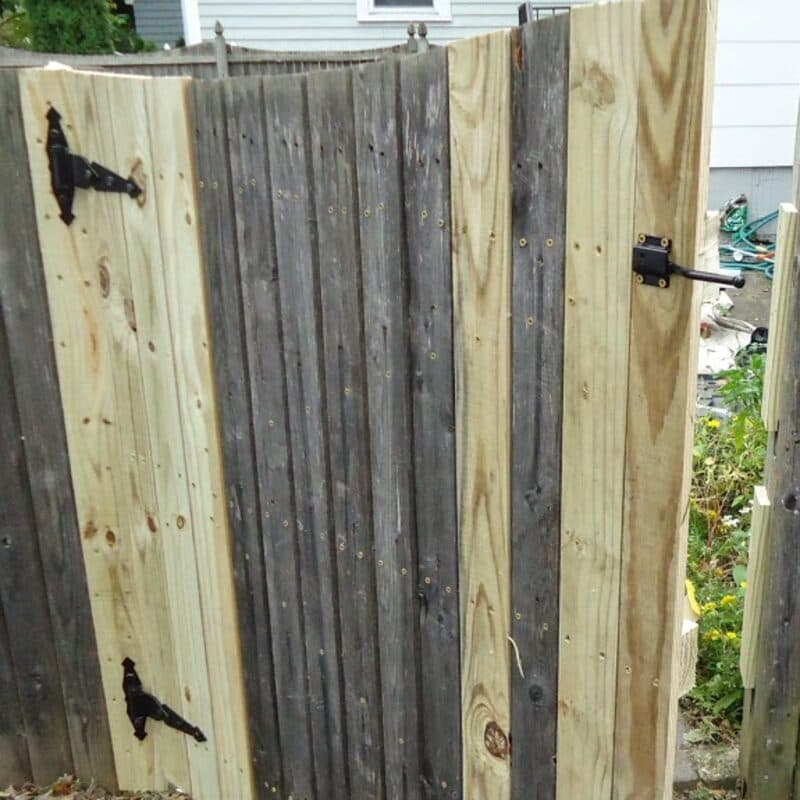
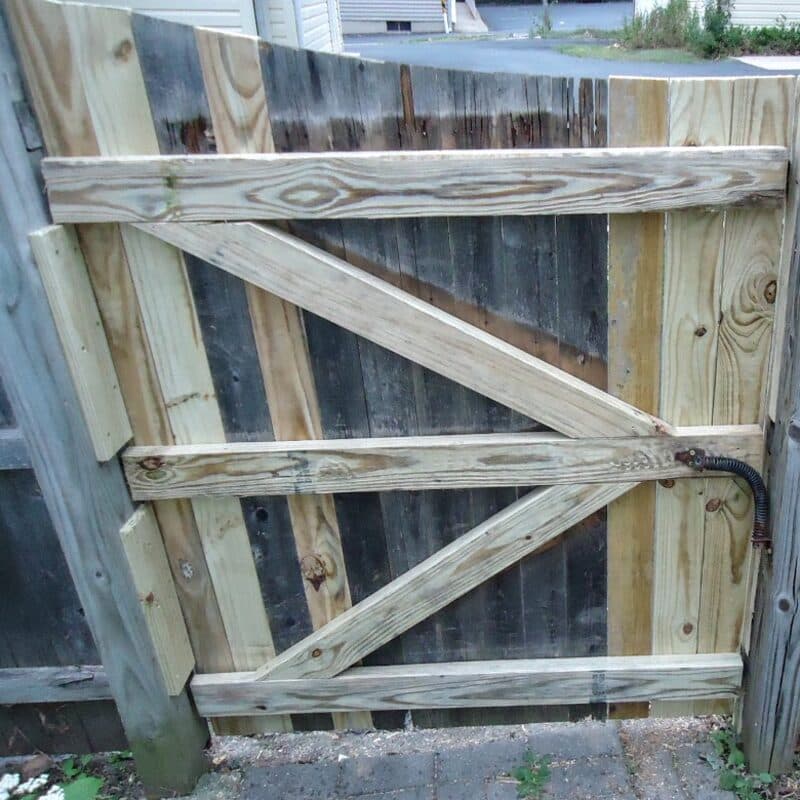
A gate is a small piece of carpentry with hardware, and it takes more time per foot than any section, so it never goes into the per foot number. Price the frame, the pickets, the hardware and the hang as a flat line per gate. From the same yard's gate hardware list: a 5 1/2 inch T-hinge rated for 48 lb is $6.99 each, and an anti-sag gate kit (the cable and turnbuckle that keeps a wood gate square) is $14.99; the latch is at your price. A gate post carries a swinging load, so it gets the deeper end of the depth rule.
Step 5: Tear-out, slope, rock and the carry
The site adds cost that no per foot number sees. Price each of these as its own line so it comes off when the site is easy.
- Tear-out and haul: cutting up the old fence, breaking out the old footings, loading, and the dump fee from your landfill's sheet.
- Slope: stepped (each section level) or racked (rails follow the ground). Stepped takes longer and wastes picket length; quote the method.
- Rock and roots: a hole that needs a bar or a core drill takes several times the minutes of a clean hole. Set a per hole rate.
- The carry: if the truck cannot reach the line, every post, bag and board goes by hand. Time it.
Call 811 before digging, then the permit and the HOA
Every post hole is a dig, and the national before-you-dig service says every digging project, regardless of depth, requires contacting 811 a few days in advance; it names installing fences among the projects, and the request is free. The utilities mark their lines with paint or flags before the dig; put that lead time on the schedule.
Permits are local. Wisconsin Rapids charges a $40 fence permit fee, limits fences to 4 feet in a front yard and 6 feet in a rear yard, and keeps them 2 feet back from a public right-of-way. Rockledge, Florida caps most fences at 6 feet and requires the finished side to face outward. Read your own city's page, put the fee on the quote as a pass-through, and quote the finished-side rule before the neighbor raises it. An HOA adds a second approval; make the quote conditional on its letter.
Good to know: This is general information, not legal advice. Fence height, setback and permit rules are set by each city and county and by HOA covenants; read the current text and ask the building department before you rely on it.
Step 6: Labor from the federal wage data
The federal wage series for this trade is Fence Erectors, which O*NET reports from Bureau of Labor Statistics data at a median of $23.07 an hour for 2025. That is a wage, not a billing rate: your cost per hour adds payroll taxes, insurance, the truck and the auger, and your billing rate adds overhead and margin.
Hours come from your own pace: time the last three jobs from the first string line to the last picket and write down the feet per crew day. Post setting has a wait built in before the post bears load, so a two day job often runs posts on day one and boards on day two.
Worked example: 150 feet of 6 foot privacy fence with one 4 foot gate
- Board run: 150 ft minus the 4 ft gate = 146 ft. Sections: 146 ÷ 8 = 18.25, rounded up to 19.
- Posts: 19 sections + 1 to close the run + 1 where the gate interrupts a section = 21 posts.
- Posts: 21 × $13.39 = $281.19 (single-piece price; $12.98 each at 11 or more).
- Rails: 19 sections × 3 rails × $6.59 = $375.63.
- Pickets: 19 sections × 18 pickets × $3.99 = $1,364.58.
- Concrete: 21 posts × 2 bags (your own count per hole) × $6.99 = $293.58.
- Gate: 2 T-hinges × $6.99 = $13.98, plus the anti-sag kit $14.99, plus 3 rails ($19.77) and 9 pickets ($35.91) = $84.65, latch at your price.
- Materials: $281.19 + $375.63 + $1,364.58 + $293.58 + $84.65 = $2,399.63, before fasteners, gravel and tax.
- Labor at the median: 2 people × 2 days × 8 hours (your own pace) = 32 hours × $23.07 = $738.24, before burden.
- Cost per foot: ($2,399.63 + $738.24) ÷ 150 ft = $20.92 per linear foot.
Result: $20.92 per linear foot of cost ($2,399.63 of materials and $738.24 of wages at the federal median), before fasteners, tax, labor burden, tear-out, hard digging, the permit fee, overhead and margin. Add each as its own line and divide again for the price.
Putting it on the quote
Show the customer the parts: the feet and the per foot rate, a line per gate, lines for tear-out and hard digging, the permit fee as a pass-through, and the depth and concrete method in one sentence. A customer who sees the arithmetic compares quotes on method, not on the bottom line alone.
In MakeHay, a satellite measurement of the line gives the linear feet straight into a quote, and the quote carries line items in your units, per linear foot for the fence and per item for each gate. Materials bought up front can be covered by a deposit on the quote, the customer approves and signs online, and the fencing page shows the setup for the trade.
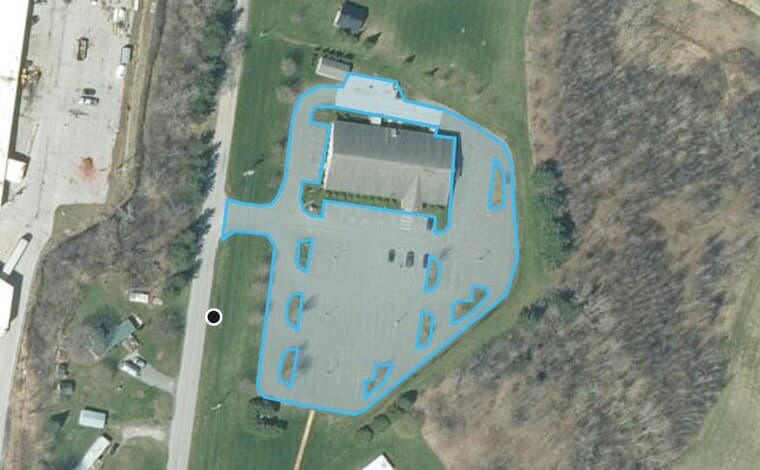
A traced property line gives the linear feet for the fence before the site visit.
FAQ
How many fence posts do I need?
Divide the board run by the section length (8 feet for a standard wood fence) and round up; add one post to close the run, one per corner and one wherever a gate interrupts a section. A 146 foot run is 19 sections and 20 posts; one gate makes 21.
How deep should fence posts be set?
Quikrete's post-setting directions put the hole at one-third to one-half of the post's height above ground, at least 2 feet for a 6 foot fence, three times the post width across, with about 6 inches of gravel in the bottom. Where the ground freezes, the building department may require more.
Do you need to call 811 for fence posts?
Yes. The national before-you-dig service says every digging project, regardless of depth, requires contacting 811 a few days in advance, and it lists installing fences among those projects. The request is free.
Should a gate be priced per linear foot?
No. A gate takes a frame, hinges, a latch, an anti-sag brace and more hours per foot than any section. Price each gate as a flat line with its hardware (one yard lists a T-hinge at $6.99 and an anti-sag kit at $14.99).
Sources
- 811 Before You Dig: the national before-you-dig service · States that "every digging project, regardless of depth, requires contacting 811 a few days in advance"; names "installing fences and mailboxes" among the projects; calls 811 "the free national before-you-dig service"; says to contact 811 "a few business days before you begin any digging", wait for utilities to mark their lines with paint or flags, and "dig carefully around any utility marks". (accessed October 18, 2026)
- Quikrete: Setting Posts · "Dig post hole so diameter of the hole is 3 times the width of the post" (about 12 inches wide for a 4 inch wood post); "The depth of the hole should be one third to one half the post height above ground", which for a 6 foot fence "would require a hole depth of at least 2 feet"; "Add about 6 inches of QUIKRETE All-Purpose Gravel into the bottom of the hole"; fill with Fast-Setting Concrete "up to 3 to 4 inches below ground level", "about a gallon of water per 50 lb bag"; the mix "will set hard in 20 to 40 minutes"; "Wait about 4 hours to begin constructing your fence or applying heavy weight to your post"; links the Quantity Calculator, whose Set Posts section takes the hole depth and the post and hole width and gives the number of 50 lb bags of Fast-Setting Concrete, rounded up to the whole bag. (accessed October 18, 2026)
- Quikrete: Fast-Setting Concrete Mix (No. 1004) · "a special blend of fast-setting cements, sand and gravel designed to set hard in approx. 20 to 40 minutes"; sold in "50 lb. bags, 56 per pallet"; "Sets posts without mixing" (pour the dry mix into the hole and soak with water); lists fence, mailbox, deck and lamp posts among its uses. (accessed October 18, 2026)
- HEP Sales: 1 x 6 x 6 Southern Pine No. 2 pressure treated rough sawn dog-ear fence board · $3.99 each, pressure treated for above ground use, "typically measures 3/4 in thick by 5 and a half inches wide", 264 available for same-day pickup at the Waterloo, New York store on October 18, 2026. (accessed October 18, 2026)
- HEP Sales: 2 x 4 x 8 Southern Pine No. 1 pressure treated (CA), surfaced four sides · "$6.59/ pc" for one, $6.38 each at 26 pieces and $6.28 each at 130; "typically measures 1 and a half inches thick by 3 and a half inches wide"; Waterloo, New York store, October 18, 2026. (accessed October 18, 2026)
- HEP Sales: 4 x 4 x 8 Southern Pine No. 2 pressure treated (CA), surfaced four sides · $13.39 per piece for one, $12.98 each at 11 pieces and $12.68 each at 52; actual size about 3 1/2 inches on each side; 144 in stock at the Waterloo, New York store on October 18, 2026. (accessed October 18, 2026)
- HEP Sales: Quikrete 1101‑80 Concrete Mix, 80 lb bag · $6.99 per 80 lb bag, no quantity pricing listed; described as a 4000 psi average compressive strength blend of Portland cement, sand and gravel or stone; 283 bags in stock at the Waterloo, New York store on October 18, 2026. (accessed October 18, 2026)
- HEP Sales: Gate and Shed Hardware · Category list on October 18, 2026: National Hardware T‑hinge, 5 1/2 inch frame leaf, 48 lb rating, $6.99 each; National Hardware V852 series anti-sag gate kit, steel, zinc, $14.99 each; 21 items in the category including gate hinges, gate kits and gate springs. (accessed October 18, 2026)
- O*NET OnLine: Fence Erectors, summary report · Median wages (2025) "$23.07 hourly, $47,980 annual"; employment (2025) 30,600; projected growth 2025 to 2035 "Faster than average (5% to 6%)"; wage data attributed to the Bureau of Labor Statistics. (accessed October 18, 2026)
- City of Wisconsin Rapids: Fence · "Fence Permit Fee: $40"; "Fences are limited to 4 feet in height in front yards and 6 feet in rear yards"; "Fences must be at least two feet from public right-of-ways or alleys"; "the entirety of the fence must be located upon the property"; "If exact property lines are unknown, the City recommends contacting a professional surveyor"; failing to call for required inspections "may lead to a fine". (accessed October 18, 2026)
- City of Rockledge, Florida: Fences and Hedges, Residential · "No fence may exceed six (6) feet in height" unless another section allows it; an opaque fence in front of the front building setback line may not exceed "three (3) feet in height", or four feet at no more than 40 percent opaqueness; "The finished side of the fence must face outward"; a corner-lot fence is set back "at least ten (10) feet from the side corner property line"; the permit requires a "Survey/Site Plan showing location of fence (2 copies)"; repairing or replacing up to two sections of twenty linear feet in six months "shall not require a permit". (accessed October 18, 2026)