Estimate Exterior Painting From Photos: What to Ask For
How to estimate exterior painting from photos: the shot list to send, wall area from satellite and a door for scale, what photos miss, and when to go firm.
The MakeHay team · · 11 min read
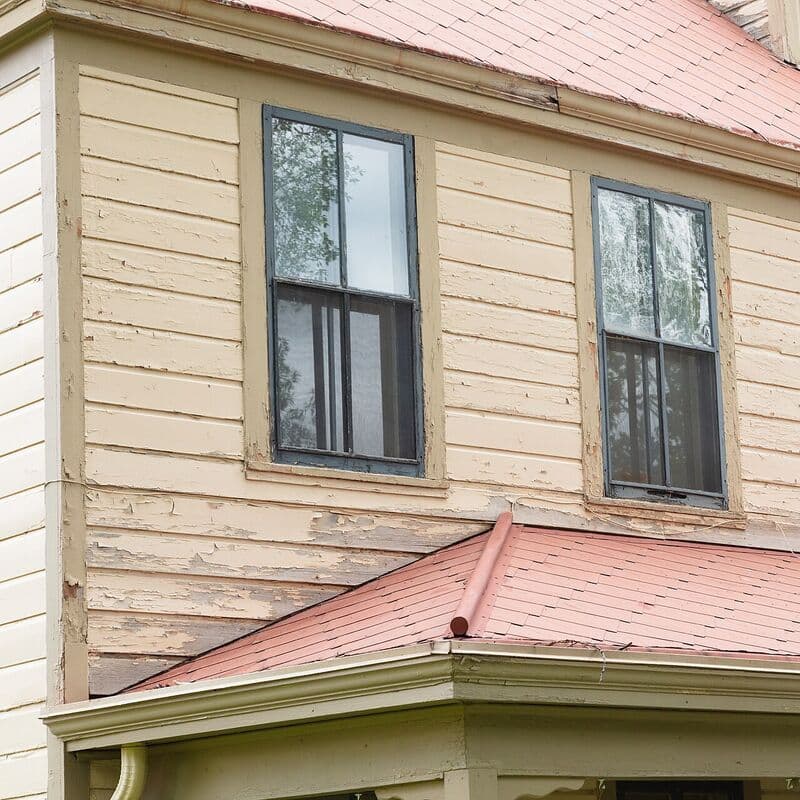
Here is how to estimate exterior painting from photos when the customer is two towns over and wants a number this week: ask for a fixed set of pictures, pull the perimeter from satellite imagery, use the front door as the ruler for height, turn the wall area into gallons and hours, and send a range that names what the visit will settle.
Which photos to ask for, and how to ask for them
Ask for a specific list, not "send some pictures." A homeowner with a phone sends what you name and little else, so name everything.
- Step 1: Each side of the house, square on, with the ground and the roofline both in the frame. One more for each wing or bump-out.
- Step 2: Every place the paint is failing, close enough to see whether it is peeling, cracked, chalking or blistered, and one step back to show where on the wall it sits.
- Step 3: The soffit and fascia on two sides, and the gutter line.
- Step 4: The front door with the siding beside it, filling the frame, so its height can be read against the courses.
- Step 5: Every place the siding meets the ground, a deck, a porch roof or a chimney.
- Step 6: Trim, shutters, railings and the garage door, with a count typed in the message.
The door is the ruler. A door retailer's size guide puts the standard exterior door at 80 inches by 36 inches, 6 feet 8 inches tall, and says 96 inches is now very common for newer homes. Ask which the house has, then count door heights from grade to the eave in the square-on photo: two and a half standard doors is 16 feet 8 inches of wall. Ask for daylight and a level phone; a shot looking up from the porch stretches the wall and hides the eave.
Measure wall area from satellite and the photos
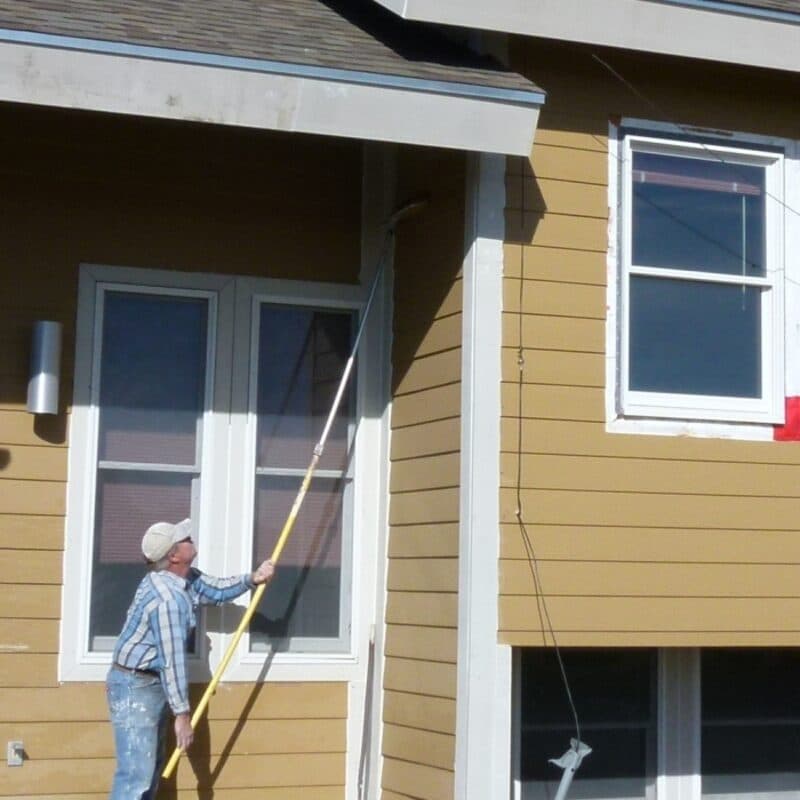
Google Maps' own help page says that on a computer you right-click your starting point, select Measure distance, and click anywhere on the map to add points along the path. Trace the outside wall corner to corner and the total is the perimeter. The free satellite tool traces the same outline for square feet and linear feet with no account.
- Step 1: Perimeter: trace the wall line, not the roof edge; overhangs sit outside it.
- Step 2: Height: door heights to the eave in the square-on photo, times 6 feet 8 inches for a standard door; a split level gets its own height per side.
- Step 3: Gross wall: perimeter times height.
- Step 4: Openings: count the doors and windows and take out their area. A standard door at 3 feet by 6 feet 8 inches is 20 sq ft; read a window's size against the door beside it.
- Step 5: Gables: half the width times the rise, read against the door; add them back in.
- Step 6: Everything else by the count: windows for the trim, doors, shutters, columns, the garage door.
What photos cannot tell you: lead, rot and moisture
A photo shows peeling; it does not show what is under it. The EPA's sources of lead page says a home built before 1978 is more likely to have lead-based paint, and its chart puts the likelihood at 24 percent of homes built from 1960 to 1977, 69 percent from 1940 to 1959 and 87 percent before 1940. The year built comes from the county assessor's listing or the customer; ask for it with the photos.
Rot is found by hand. This Old House's trim repair guide says to take a screwdriver or awl to areas that are nearly horizontal and do not drain well, and that if the tool's tip pushes easily into a suspect board, the rot has to come out; probe anywhere there is end grain, which wicks up water. Peeling at a sill in a close-up is the flag.
Moisture is a number only a meter gives. The Wisconsin Historical Society's paint failure page says paint cannot adhere to any surface with a moisture content above 15 percent, that the only way to determine it is with a moisture meter, and that wood that feels soft or has rotted will not hold paint and has to be replaced first.
What a photo can tell you is where the water comes from. Sherwin-Williams' moisture peeling page lists worn out or missing caulking, clogged gutters, leaking roofs, interior moisture migrating to the exterior walls and painted surfaces too close to bare ground, says siding should be installed not less than 6 inches above the ground, and does not recommend painting over cracked or peeling paint. Peeling under a gutter joint or along the bottom course is a repair line the close-up shows before anyone drives out.
The lead paint rule for homes built before 1978
Once the year built says pre-1978, the federal rule is part of the price. The EPA's Renovation, Repair and Painting Program page says the federal government banned the sale of lead-based paint for use in homes in 1978, that approximately three-quarters of US homes built before then still contain some, and that anyone paid to perform work that disturbs paint in that housing must be certified in lead-safe work practices, including all firms, even sole proprietorships.
The exemption is narrow. The EPA's page for contractors exempts minor repair and maintenance that disturbs 20 square feet or less on the exterior of a home or building, and says a certified renovator may declare specific components lead-free using an EPA recognized test kit. One wall of peeling clapboard passes 20 square feet before lunch, so a pre-1978 house with peeling in the photos is a lead job unless a test says otherwise, and the range should say so. Pricing exterior house painting covers the certification and the lead line.
Good to know: This is general information, not legal advice. Read the current EPA rule and your state's lead program before relying on it.
A photo estimate versus a firm price after the visit
The range is a real number with its edges stated: wall area, the coverage figure the paint maker publishes and your own pace, run at the low and the high end of each. Benjamin Moore's page for Regal Select Exterior states 275 to 375 sq ft per gallon, 1 or 2 recommended coats, a 1 hour dry time and a 4 hour recoat. The low end is rough siding, the high end smooth painted boards; a photo cannot feel the surface, so run both.
The wage floor is public. The Bureau of Labor Statistics' Occupational Outlook Handbook puts the median pay for painters at $23.75 an hour, $49,400 a year, in May 2025. Your loaded rate sits above the wage; the hours come from your own timed jobs.
Worked example: A two story house, 44 by 26 on the satellite view, two and a half doors to the eave
- Perimeter from the trace: 2 × (44 + 26) = 140 linear feet.
- Height from the photo: 2.5 door heights × 80 inches = 200 inches, about 16.7 feet; gross wall 140 × 16.7 = 2,338 sq ft.
- Openings: 2 doors at 3 × 6.67 = 20 sq ft each and 14 windows at 3 × 4 = 12 sq ft each, 40 + 168 = 208 sq ft; net 2,338 minus 208 = 2,130 sq ft.
- Gables: two ends 26 feet wide with a rise read at 5 feet against the door, ½ × 26 × 5 = 65 sq ft each; net wall area 2,130 + 130 = 2,260 sq ft.
- Gallons for two coats: 2 × 2,260 = 4,520 sq ft; at 375 sq ft per gallon that is 12.1, so 13 gallons; at 275 it is 16.4, so 17 gallons.
- Labor from your own pace: two painters for 3 days of 8 hours is 48 hours; at the BLS median of $23.75 the wages alone are $1,140 before burden, overhead and profit, so use your loaded rate × 48, then again at your slow pace for the high end.
- Not in the range yet: a lead line if the house is pre-1978, rot repair by the board, a substrate primer.
Result: Send 13 to 17 gallons and the low and high labor hours at your rates as a range, with the open items named. The firm price replaces it after the visit, when the year built, the probe, the meter and the count are known.
A painting request form that brings the photos in with the address
In MakeHay, the request form goes on your website or out as a link, and a request lands in Requests with the customer's details, the photos and the job site address; the owner is emailed (work a request). A request with an address can start a draft quote in one tap, a satellite measurement of the footprint goes straight into the quote, and the customer approves and signs the quote online after the visit.

The request form takes the customer's details and the job site address, and the photos land in the same request.
Put the shot list and the year built in the reply to every request. Turning website requests into booked jobs covers the reply; estimating pressure washing without a site visit uses the same trace for the wash before the paint.
Sending the range so it stays a range
Write the range as two numbers with the list between them: what it includes (two coats, the product by name, the window and door count), what the visit settles (lead, rot, moisture, substrate), what moves it most (a pre-1978 build year and rot at the sills, each its own line), and the next step (the visit date, then a quote the customer approves from a link).
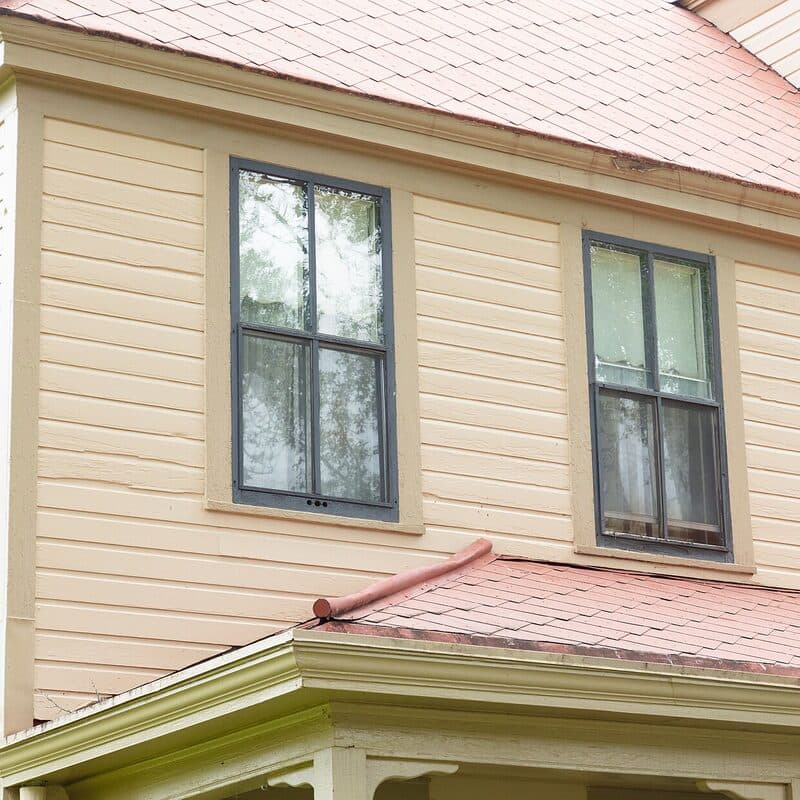
A customer who got the range with its edges named reads the firm price as the visit doing its job.
FAQ
Can you estimate exterior painting from photos alone?
A range. Square-on photos plus the satellite footprint give the perimeter, the height by door count and the openings, and the paint maker's coverage figure turns the area into gallons. Lead, rot, moisture and substrate are settled only at the wall, so the firm price follows the visit.
How do you get the wall height from a photo?
Count door heights. A door retailer's size guide puts the standard exterior door at 80 inches, 6 feet 8 inches, and says 96 inches is very common on newer homes; ask which the house has, then count door heights to the eave in a square-on photo. Two and a half standard doors is 16 feet 8 inches.
How much paint does a house take when you only have photos?
Net wall area times coats, divided by the coverage the maker publishes. Benjamin Moore's Regal Select Exterior page states 275 to 375 sq ft per gallon and 1 or 2 coats; two coats on 2,260 sq ft is 4,520 sq ft, 13 to 17 gallons across that range, and the visit decides which end.
Does the lead rule apply when the customer only sent photos?
The rule follows the house, not how you quoted it. Paid work that disturbs more than 20 square feet of paint on the exterior of housing built before 1978 is covered and the firm must be certified; a certified renovator may declare specific components lead-free using an EPA recognized test kit. Ask for the year built with the photos.
Sources
- US Door & More: What is the Standard Door Size for Residential Homes? · Retailer help page: the standard exterior door size is "80 inches by 36 inches", which the page equates to 6 ft 8 inches by 3 ft; "96 inches or 8 ft. is now very common for newer homes"; the width table marks 36 inches as the most popular size, used in most configurations. (accessed October 18, 2026)
- Google Maps Help: Measure distance between points (Computer) · Steps on a computer: "On your computer, open Google Maps."; right-click the starting point; "Select Measure distance"; "To create a path to measure, click anywhere on the map. To add another point, click anywhere on the map."; the page describes distance along a path, not area. (accessed October 18, 2026)
- US EPA: Protect Your Family from Sources of Lead · "If your home was built before 1978, it is more likely to have lead-based paint."; the chart states that 24 percent of homes built 1960 to 1977, 69 percent of homes built 1940 to 1959 and 87 percent of homes built before 1940 are likely to have lead-based paint; "Painted surfaces can deteriorate, peel, chip or crack, becoming a hazard."; to determine whether a home has lead-based paint, "Hire a certified lead-based paint inspector or risk assessor to perform an inspection", or assume the paint contains lead; page last updated October 5, 2026. (accessed October 18, 2026)
- This Old House: How to Replace Rot-Damaged Trim · "With a screwdriver or awl in hand, scrutinize areas that are nearly horizontal and don't drain well"; "If you're able to push the tool's tip easily into a suspect board, then it's time to root out the rot."; "Probe anywhere there's end grain, which wicks up water like a celery stalk in a grade-school science experiment."; "Pay particular attention to joints, which dry slowly, and to all wood that's close to dirt, concrete, or masonry."; "Exterior trim is the most vulnerable to attack by rot fungi."; updated June 3, 2026. (accessed October 18, 2026)
- Wisconsin Historical Society: Preventing Paint Failure on Your Historic Building · "Paint cannot adhere to any surface with a moisture content above 15%."; "The only way you can determine the moisture content is with a moisture meter."; "Wood that feels soft or has rotted will not hold paint."; "You will have to replace decayed wood before you can paint the area."; a photo caption says the cracked pattern sometimes called alligatoring "occurs when there are too many layers of paint". (accessed October 18, 2026)
- Sherwin-Williams: How to Fix Exterior Paint Peeling Caused by Moisture · Possible causes: "Worn out or no caulking in joints, corners, and openings, allowing moisture to enter."; "Ice-filled or clogged gutters, causing moisture build-up under the shingles."; "Leaking roofs."; "Interior moisture migrating through to the exterior walls."; "Painted surfaces that are too close to bare ground."; "Siding should be installed not less than 6 inches above the ground."; the solution starts by removing the problematic paint, then primer, then repainting; the page says the company does not recommend painting over cracked or peeling paint because it can result in an unwanted texture. (accessed October 18, 2026)
- US EPA: Renovation, Repair and Painting Program · "In 1978, the federal government banned the sale of lead-based paint for use in homes, childcare facilities and preschools"; "Approximately three-quarters of the homes in the United States built before 1978 still contain some lead-based paint"; anyone paid to perform work that disturbs paint in housing and child-occupied facilities built before 1978 must be certified in lead-safe work practices, and "This includes all firms, even sole proprietorships."; page last updated June 17, 2026. (accessed October 18, 2026)
- US EPA: Renovation, Repair and Painting Program: Contractors · Minor repair and maintenance that disturbs "six square feet or less of paint per room inside, or 20 square feet or less on the exterior of a home or building" is exempt, while window replacement and demolition of painted surfaces are covered regardless of square footage; the rule applies to "housing and child-occupied facilities built before 1978" and not to housing built in 1978 or later; "a certified renovator may declare specific components lead-free using an EPA recognized test kit"; "Firms cannot advertise or perform renovation activities covered by the RRP Rule" without firm certification; page last updated March 31, 2026. (accessed October 18, 2026)
- Benjamin Moore: Regal Select Exterior Paint, Soft Gloss, product page · Product details state coverage of 275 to 375 sq. ft. per gallon, a recommended 1 or 2 coats, an application temperature range of 35 to 100 °F, a dry time of 1 hour and a recoat time of 4 hours. (accessed October 18, 2026)
- US Bureau of Labor Statistics, Occupational Outlook Handbook: Painters, Construction and Maintenance · Median pay "$23.75 per hour" and "$49,400 per year" in May 2025; "The lowest 10 percent earned less than $37,440, and the highest 10 percent earned more than $78,810."; about 326,900 jobs in 2025; duties include "Prepare surfaces by removing outlet and switch covers and by scraping, wire brushing, or sanding to a smooth finish"; "Painters may also work as estimators or start their own business."; page last modified August 27, 2026. (accessed October 18, 2026)