How to Price Exterior House Painting: Square Feet to Quote
How to price exterior house painting: measure the walls, subtract openings, turn square feet into gallons, price prep and lead work, quote per sq ft.
The MakeHay team · · 11 min read
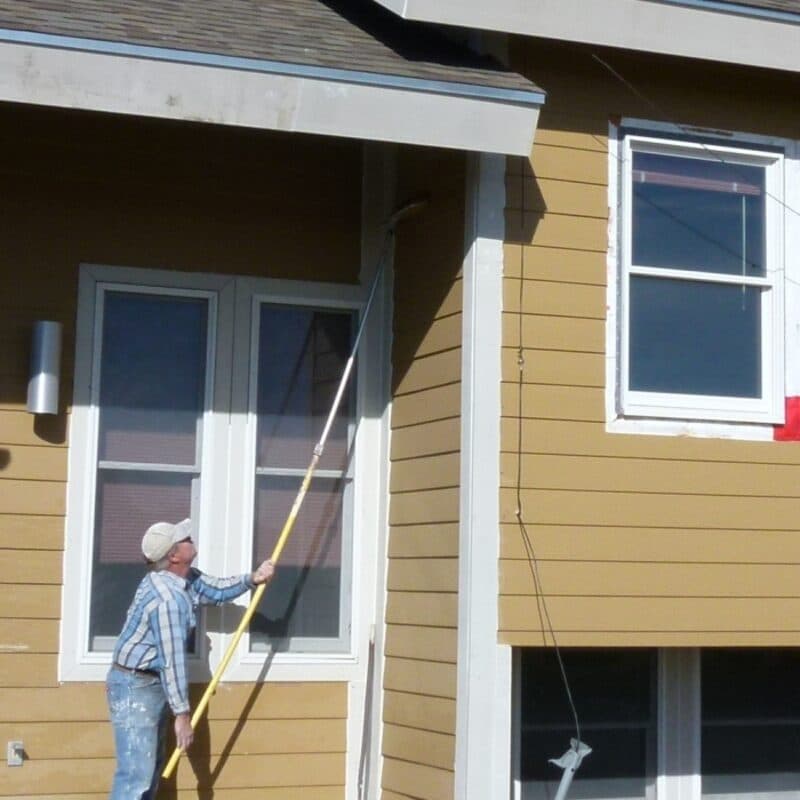
Here is how to price exterior house painting so the number holds up on the job: measure the walls and subtract the openings, turn the square feet into gallons with the coverage the paint maker publishes, price prep and ladder time as their own lines, check the year the house was built for the lead rule, and divide the total by the square feet.
How to measure a house for exterior painting
Walk the house with a measuring wheel, or trace the footprint on satellite imagery for the perimeter, read the wall height from grade to the eave at a corner, then take out the openings you will not paint and add the gables back in.
- Step 1: Perimeter: add the length of every wall.
- Step 2: Gross wall area: perimeter times the height from grade to the eave; a split level gets each section at its own height.
- Step 3: Openings: width times height for every door and window you will not paint; subtract the total.
- Step 4: Gables: each triangle is half its width times its rise; add them.
- Step 5: Trim, doors and shutters: count them; they get their own lines, not a share of the wall area.
Note the siding type too: deep lap boards and shingles take more paint than the flat number suggests, and that decides which end of the coverage range you use.
Prep is its own line: scrape, sand, prime, caulk
Prep is where a painting bid goes wrong, so price it apart from the coating. Mark the peeling, chalky and bare areas, the open caulk joints and the soft fascia, write down what you will do to each, then time it from past jobs: hours to wash and dry, hours to scrape and sand, the primer on bare wood, the tubes of caulk.
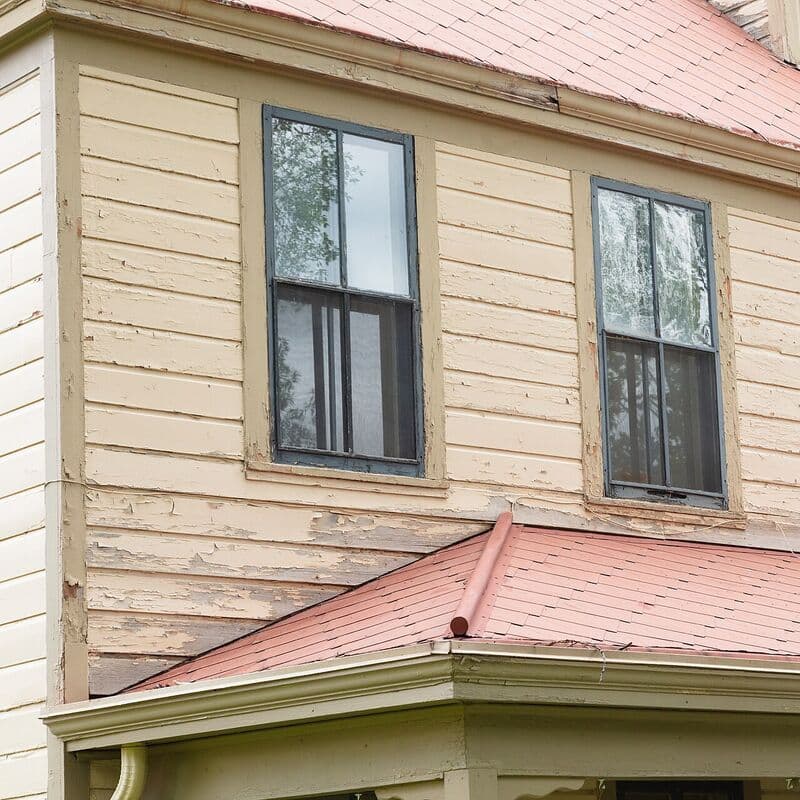
Primer covers more than finish paint. One water based primer's listing says a gallon covers about 450 sq ft and dries in an hour, so spot priming the bare patches rarely takes more than a gallon or two; a house that needs a full prime coat is a third coat and should be priced like one.
Stories, ladders and lifts: the time that is not painting
A second story adds setup time for every ladder move and often a lift rental. Under the US OSHA construction standard, 29 CFR 1926.1053, a portable ladder's side rails extend at least 3 feet above the upper landing and a non self supporting ladder stands with its foot about one quarter of the working length out from the wall. The Bureau of Labor Statistics lists falls from ladders as a common hazard for painters. Price an hour count for moving and footing ladders, or a day rate for a lift, as its own line.
Exterior paint coverage per gallon, and the gallons on the quote
Take the coverage from the maker's own page. Benjamin Moore's product page for Regal Select Exterior states 275 to 375 sq ft per gallon, 1 or 2 recommended coats, a 1 hour dry time and recoat in 4 hours. A retailer's listing for Valspar Professional exterior says approximately 400 sq ft per gallon. Sherwin-Williams says Duration takes one coat for repaints and two coats for new work.
The arithmetic: net wall area times coats, divided by the coverage figure, rounded up to whole gallons. Use the low end of the range for rough or porous siding and the high end for smooth, previously painted boards. A color change over a dark wall is a two coat job whatever the can says about repaints.
| Net wall area | At 275 sq ft per gallon | At 375 sq ft per gallon | At 400 sq ft per gallon |
|---|---|---|---|
| 1,500 sq ft | 10.9 gallons | 8.0 gallons | 7.5 gallons |
| 2,500 sq ft | 18.2 gallons | 13.3 gallons | 12.5 gallons |
Exterior painting labor cost from the BLS wage and your own pace
Labor is the biggest line, and the only published floor for it is the federal wage data. The Bureau of Labor Statistics' Occupational Outlook Handbook puts the median pay for painters at $23.75 an hour, or $49,400 a year, in May 2025, with the lowest 10 percent under $37,440 and the highest 10 percent above $78,810. That is the wage, not your rate: add payroll taxes, insurance, the truck and the unbilled time, and the loaded hourly figure is what goes into the quote.
Hours come from your own pace. Time three recent houses, split the hours into wash, prep, prime, coats and trim, and divide each by the square feet or the count it covered. Those rates times this house's numbers are the labor estimate.
Lead paint rules for painters: homes built before 1978
Check the year the house was built. The EPA's Renovation, Repair and Painting Program page says the federal government banned lead-based paint for homes in 1978 and that about three quarters of US homes built before then still contain some of it. Anyone paid to do work that disturbs paint in those homes must be certified in lead-safe work practices, which the page says includes all firms, even sole proprietorships.
The threshold is small. The EPA's page for contractors exempts only minor repair and maintenance that disturbs 20 square feet or less on the exterior of a home; scraping a wall of peeling siding is far past that. The definition in 40 CFR 745.83 adds that jobs in the same room within the same 30 days count as one job, and a removed painted component counts by its entire surface area.
- Certification: the firm is certified by the EPA or its state and a certified renovator leads the job; the EPA's program rules page says the requirements became fully effective April 22, 2010.
- Renewal: online training certifies a renovator for three years, hands-on training for five.
- Testing: a certified renovator may use an EPA recognized test kit to show a component is free of lead-based paint; housing built in 1978 or later is not covered.
A pre-1978 house with peeling paint gets a lead line that covers containment, test kits, cleanup and the hours the work practices add, and the quote says the work is done under the EPA rule by a certified firm.
Good to know: This is general information, not legal advice. Read the current EPA rule and your state's program before relying on it, and ask your state lead program or a lawyer when a job is close to the line.
Worked example: A two story house, 40 by 28, 18 feet to the eave
- Perimeter: 2 × (40 + 28) = 136 linear feet; gross wall area 136 × 18 = 2,448 sq ft.
- Openings you will not paint: 2 doors at 3 × 7 = 42 sq ft and 16 windows at 3 × 4 = 192 sq ft; net 2,448 minus 234 = 2,214 sq ft.
- Gables: two ends 28 wide with a 6 ft rise, ½ × 28 × 6 = 84 sq ft each; net wall area 2,214 + 168 = 2,382 sq ft.
- Gallons: two coats × 2,382 = 4,764 sq ft; at 300 sq ft per gallon (inside Benjamin Moore's 275 to 375 range, toward the low end for lap siding) that is 15.9, so 16 gallons at your price per gallon.
- Primer: bare patches after scraping total about 480 sq ft (your own count) ÷ 450 sq ft per gallon = 1.1, so 2 gallons.
- Labor: 2 painters × 3 days × 8 hours (your own pace from past jobs) = 48 hours; at the BLS median wage of $23.75 that is $1,140 in wages before burden, overhead and profit, so use your loaded rate × 48.
- Separate lines: prep hours, 16 windows and 2 doors at your count price, ladder time, a lead line if the house predates 1978.
Result: 16 gallons of paint and 2 of primer at your prices, 48 labor hours at your loaded rate, plus prep, trim, access and lead lines. Add overhead and margin, then divide by 2,382 sq ft for this house's price per square foot of wall.
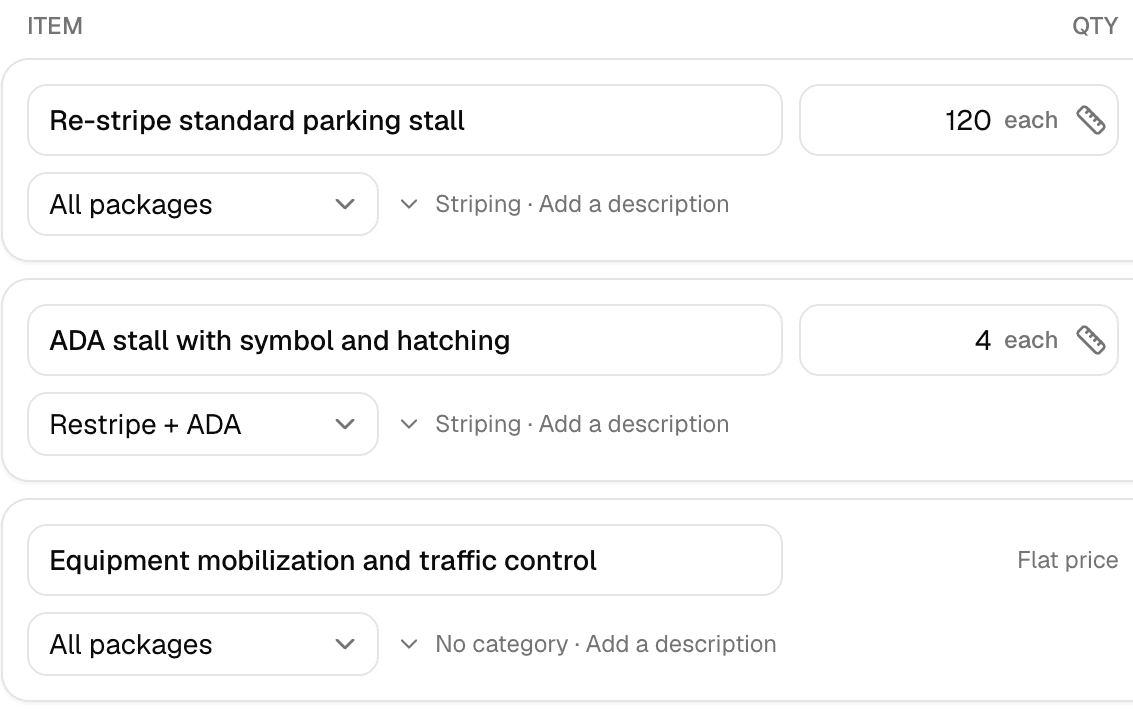
A quote with the walls per square foot, the windows and doors by the count and the prep by the hour.
Exterior painting cost per square foot: the answer on the quote
The per square foot rate is the output of the example, not the input. Divide each house's total by its net wall area and after ten houses you have a band, one story ranches at the bottom and three story houses with 40 windows at the top. Quote the next house from the band, then check it against the gallons and hours. Show the arithmetic on the quote: a customer who sees 2,382 sq ft and two coats understands the number, and the crew has the takeoff in hand.
Weather windows: 35 degrees, dew and the recoat time
The three products above publish the same floor: Benjamin Moore's page gives an application temperature range of 35 to 100°F, the Valspar listing says the paint can be applied in temperatures as low as 35°F, and Sherwin-Williams says Duration is formulated for low temperature application down to 35°F.
Sherwin-Williams' late-season painting article names the common mistake: painting when daytime temperatures rise above 50°F and nighttime temperatures drop below 35°F, because the paint can stop coalescing when the temperature falls, and dew that forms as soon as the sun sets seeps into uncured paint, causing staining and adhesion problems.
With a 4 hour recoat, the second coat goes on the same day only when the first is finished by early afternoon, so at the ends of the season price the days, not the coats, and put a weather clause on the quote.
Writing the quote so the customer approves it
In MakeHay, quote lines carry their own units, so the walls go on per square foot, the trim per linear foot, each door and window per item and the prep as a flat line (create and send a quote). A satellite measurement of the footprint gives the perimeter before the site visit. The customer approves and signs online, and a deposit on the quote covers the paint order before the crew arrives.
Keep the quote specific: net square feet, coats, the product by name, the window and door count, the prep you will and will not do, the weather clause and the lead line. Writing a service quote customers approve covers the wording; how much deposit to ask for covers the state caps.
FAQ
How many gallons of paint does an exterior house take?
Net wall area times coats, divided by the maker's coverage figure. Benjamin Moore's Regal Select Exterior page states 275 to 375 sq ft per gallon and 1 or 2 coats. Two coats on 2,000 sq ft of wall is 4,000 sq ft, which is 10.7 to 14.5 gallons at that range.
What does a painter make per hour?
The Bureau of Labor Statistics put the median pay for painters at $23.75 an hour in May 2025, with about 326,900 jobs that year. The quote carries a loaded rate above the wage, covering payroll taxes, insurance and unbilled time.
Does the EPA lead rule apply to exterior painting?
Yes, on homes and child-occupied facilities built before 1978 when paid work disturbs more than 20 square feet of painted surface on the exterior. The firm must be certified and a certified renovator on the job; an EPA recognized test kit can show a component is free of lead-based paint.
How cold is too cold to paint a house?
The exterior products cited here are rated down to 35°F, and Sherwin-Williams warns against days that rise above 50°F but drop below 35°F at night, because the paint can stop coalescing as the temperature falls and dew after sunset seeps into uncured paint.
Sources
- Benjamin Moore: Regal Select Exterior Paint, Soft Gloss, product page · Product details state coverage of 275 to 375 sq. ft. per gallon, a recommended 1 or 2 coats, an application temperature of 35 to 100 °F, a dry time of 1 hour and a recoat time of 4 hours. (accessed October 18, 2026)
- True Value: Valspar Professional 100% Acrylic Flat Exterior House Paint, 1 Gal., listing · Retailer listing: "Covers approximately 400 Sq. Ft. per gallon"; "can be applied in temperatures as low as 35 Deg. F."; the specifications list Dries To Touch 1 Hr. and Time Before Recoating 4 Hr.; no price shown online, "In-store price may vary". (accessed October 18, 2026)
- True Value: Zinsser Bulls Eye water-base interior/exterior stain blocking primer, 1 Gal., listing · Retailer listing: "1 gallon covers approximately 450 Sq. Ft." (the specification table also lists 450 sq. ft.); "Dries in 1 hour" in the overview, while the specification table lists dry to touch 35 Min.; no price shown online, "In-store price may vary". (accessed October 18, 2026)
- Sherwin-Williams: Duration Exterior Acrylic Latex, product page · States the product "requires just one coat for repaints and two coats for new work" and offers "Low temperature application down to 35° F"; no coverage figure found on the page. (accessed October 18, 2026)
- Sherwin-Williams: Late-Season Painting · "A common mistake is to paint when daytime temperatures rise above 50° F and nighttime temperatures drop below 35° F"; the paint can stop coalescing when the temperature drops; "dew will form on almost everything as soon as the sun sets, and seep into the uncured paint", causing staining and possible adhesion problems; Emerald, Duration, SuperPaint and A-100 are "formulated for low temperature application down to 35° F"; article from PPC Magazine, undated. (accessed October 18, 2026)
- US Bureau of Labor Statistics, Occupational Outlook Handbook: Painters, Construction and Maintenance · Median pay $23.75 per hour and $49,400 per year in May 2025; the lowest 10 percent earned less than $37,440 and the highest 10 percent more than $78,810; about 326,900 jobs in 2025; painting "requires a lot of bending, kneeling, reaching, and climbing"; falls from ladders are a common hazard; page last modified August 27, 2026. (accessed October 18, 2026)
- US EPA: Renovation, Repair and Painting Program · "In 1978, the federal government banned the sale of lead-based paint for use in homes, childcare facilities and preschools"; "Approximately three-quarters of the homes in the United States built before 1978 still contain some lead-based paint"; anyone paid to perform work that disturbs paint in housing and child-occupied facilities built before 1978 "must be certified in lead-safe work practices", which "includes all firms, even sole proprietorships"; page last updated June 17, 2026. (accessed October 18, 2026)
- US EPA: Renovation, Repair and Painting Program: Contractors · Minor repair and maintenance that disturbs "six square feet or less of paint per room inside" or "20 square feet or less on the exterior of a home or building" is exempt; the rule covers housing and child-occupied facilities "built before 1978" and not housing "built in 1978 or later"; a certified renovator can use "an EPA recognized test kit" to determine components are free of lead-based paint; page last updated March 31, 2026. (accessed October 18, 2026)
- US EPA: Lead Renovation, Repair and Painting Program Rules · Firms "must be EPA- or state-certified and must use certified renovators who follow specific work practices"; "These requirements became fully effective April 22, 2010"; from the February 10, 2016 update, "Renovators who take the online training will be certified for three years" and those who take the hands-on training are certified for five years. (accessed October 18, 2026)
- 40 CFR 745.83, Definitions (Cornell Legal Information Institute) · Minor repair and maintenance activities "disrupt 6 square feet or less of painted surface per room for interior activities or 20 square feet or less of painted surface for exterior activities"; "When removing painted components, or portions of painted components, the entire surface area removed is the amount of painted surface disturbed"; jobs "performed in the same room within the same 30 days must be considered the same job"; renovation "does not include minor repair and maintenance activities". (accessed October 18, 2026)
- OSHA: 29 CFR 1926.1053, Ladders · Paragraph (b)(1): portable ladder side rails "shall extend at least 3 feet (.9 m) above the upper landing surface"; (b)(5)(i): a non-self-supporting ladder is used at an angle where the horizontal distance from the top support to the foot is "approximately one-quarter of the working length of the ladder"; (b)(13): "The top or top step of a stepladder shall not be used as a step." (accessed October 18, 2026)