How to Price an Estate Cleanout: Walkthrough to Final Sweep
How to price an estate cleanout: the walkthrough, truckload versus day rates, donation sorting, refrigerant and paint rules, gate fees, labor, the deposit.
The MakeHay team · · 11 min read
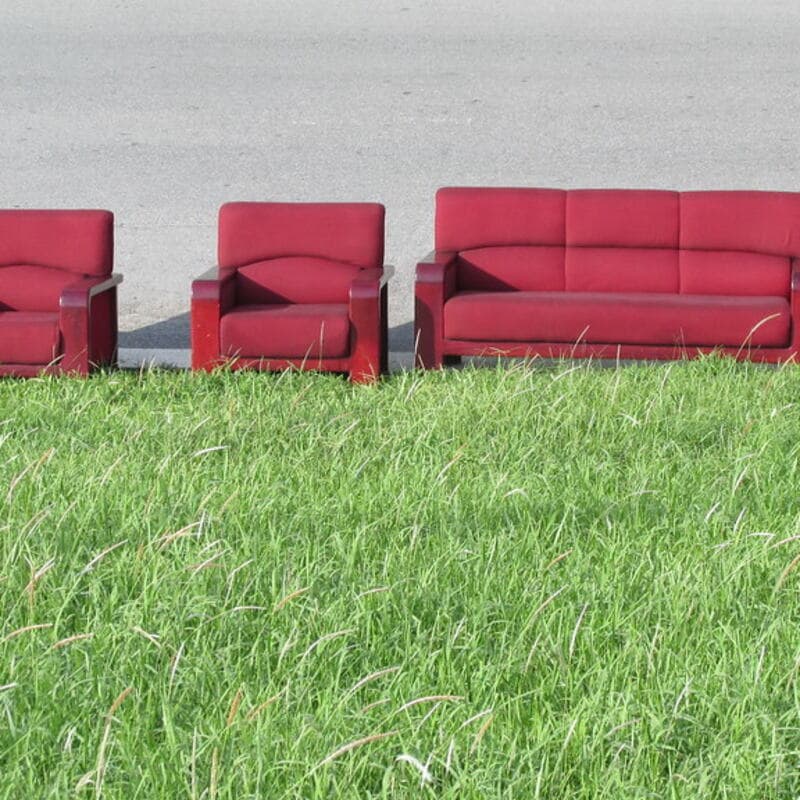
Here is how to price an estate cleanout so the number holds from the first walkthrough to the last sweep. Walk all of it, decide whether the job is truckloads or days, pull out what a charity will take and what the dump will not, then build the price from gate fees, labor, fuel and a deposit.
Start with the estate cleanout walkthrough
Never price an estate from the living room; the cost is in the attic nobody has opened in years and the basement shelf of paint cans. Walk every space with the executor and photograph each room from the doorway.
- Step 1: Count the big pieces room by room: sofas, beds, dressers, appliances, pianos, safes. Each is a two person carry and a share of a truck.
- Step 2: Open everything: closets, attic, crawl space, garage, shed. Loose boxes are volume you cannot see from the hall.
- Step 3: Tag what stays, what goes to an estate sale and what goes to a relative, and write that list into the quote.
- Step 4: Note the access (stairs, a long carry to the truck) and flag the trouble items: refrigerators, screens, paint, medicines, propane, tires. Ask about the deadline; a rush is a line on the quote.
Estate cleanout cost by the truckload or by the day
The walkthrough tells you which model fits. By the truckload suits a house the family has already sorted: you can count the loads and stand behind a price per load. By the day suits a house nobody has sorted, where the crew opens drawers and makes decisions as it goes; there the hours are what you are selling.
A truckload price starts with the truck's volume. Budget Dumpster's guide defines a cubic yard as a cube 3 feet on each side, 27 cubic feet, and puts a standard full-size pickup at about 2 to 3 cubic yards. Measure your own box, price the full load, then the half and the quarter; pricing junk removal by the load walks through the fractions.
A day price is a crew for a day plus the truck, with gate fees, per item charges and fuel billed on top at cost or with a stated markup. State the crew size, the hours a day covers and what a second day costs before the first one starts.
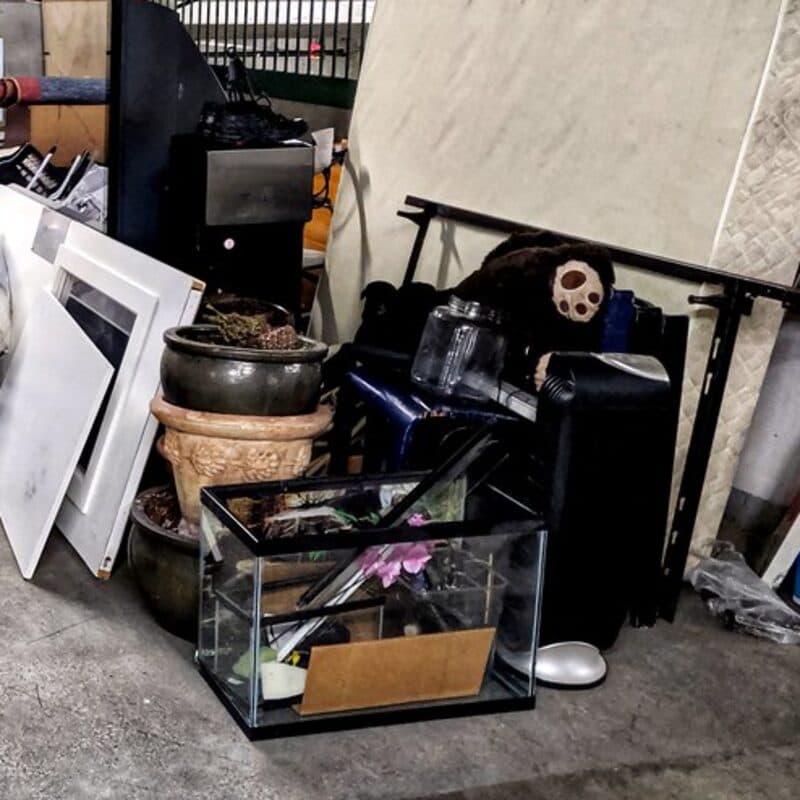
Sorting an estate for donation and resale
Every piece a charity takes is a piece you do not pay to dump. Habitat for Humanity's ReStore donation page says its stores accept "new and gently used appliances, furniture, building materials, household goods and more," that many ReStores offer free pickup of large items, and that each store is different, so call ahead.
Thrift stores are pickier than families expect. Goodwill of North Georgia's accepted items page asks for items that are "clean, gently used, and in good working condition whenever possible" and will not take mattresses, box springs, bed frames, large appliances, paint, chemicals, lumber, doors, tires, or anything water soaked or in need of repair. Read your local store's list.
The tax side is the family's. IRS Publication 526 for 2025 returns says a donor cannot deduct household items unless they are "in good used condition or better," so the donation run is for sound furniture and working electronics, and the charity's receipt goes in the executor's folder.
Resale is a separate business: an appraiser or an estate sale company works before you arrive, and your quote covers what is left. If the family would rather trade saleable items for a lower price, name the items and the credit on the quote, never on a handshake.
Items with disposal rules: refrigerators, TVs, paint, medicine
Refrigerators, freezers and window units
EPA's Section 608 safe disposal requirements cover "household refrigerators and freezers, and window unit air conditioners." The "final person in the disposal chain" must see that refrigerant is recovered before final disposal, and a unit that arrives empty needs "a signed statement from the person who dropped off the appliance" naming who recovered it; a sticker is not accepted. A refrigerator is a line with recovery, a statement and a fee under it, never loose volume.
Televisions, monitors and computers
Some states keep screens out of the trash. Oregon's E-Cycles ban makes it illegal to put computers, monitors and TVs in the garbage, and participating collectors take seven or fewer at a time for free. Where a station takes them, it charges per item: the Lindon, Utah, station below charges $10 per household electronic item.
Paint, cleaners, oil and pesticides
EPA's household hazardous waste page, updated June 1, 2026, names "paints, cleaners, oils, batteries, and pesticides" as products that can contain hazardous ingredients and points to the local agency's collections instead of the trash. In the states with a PaintCare program, drop-off sites take house paint, primers and stains in original labeled containers of 5 gallons or less with a secured lid, and refuse aerosols, solvents and open cans. Price the hazardous run as its own trip.
Medicines and papers
The FDA's disposal page says the best option for most medicines is a take back location or a prepaid mail-in envelope; otherwise, for medicines not on its flush list, mix them with dirt or cat litter, seal the mix in a bag, and scratch the personal information off the label. Hand the executor the medicines and the financial papers rather than hauling them.
Crew, hours, fuel and gate fees
Estate cleanout crew size and hours
Two people can empty a sorted apartment; a full house in a week needs three or four, because every big piece is a two person carry. The Bureau of Labor Statistics' Occupational Outlook Handbook puts median pay for hand laborers and material movers at $18.38 per hour in May 2025; your loaded cost sits above that, and the BLS number is the floor under the day rate.
Hours come from the walkthrough: big pieces times a carry time measured on your own jobs, a rate per room for loose contents, and the station trips. Fuel follows the trips: the Energy Information Administration's weekly update put diesel at $6.179 a gallon for the week of October 12, 2026, taxes included.
Gate fees from the station's own page
The North Pointe transfer station in Lindon, Utah, prices mixed waste by weight for participating cities: $13.00 for 500 pounds or less, $26.00 for 501 to 1,000 pounds, then $43.50 per ton, with a state tonnage tax of $0.22 per ton on weighed loads; the rates double for other cities and for an unsecured load. Lane County, Oregon, prices by volume on its fee page: a $25.00 minimum up to 1 cubic yard, then $7.00 per half cubic yard at rural sites or $123.10 per ton at Glenwood and Florence, "subject to change without notice."
| Item | Lindon, Utah (North Pointe) | Lane County, Oregon |
|---|---|---|
| Mattress or box spring | $10 for a first mattress from a listed city; $20 each otherwise | Free to recycle at Glenwood, up to 4 a day; garbage elsewhere |
| Appliance with refrigerant | $15 per unit for refrigerant removal | $25 each, refrigerant units included |
| Electronics | $10 per household item | No electronics fee listed |
Worked example: A three bedroom house, sorted by the family, two days with three people
- Walkthrough count: four loads in your box truck, one refrigerator, two TVs, two mattresses, a shelf of paint, one donation run.
- Gate fees at the Lindon participating city rate: 4 tons across four trips (your own scale tickets) × $43.50 = $174.00 (the $0.22 per ton tonnage tax adds $0.88, rounded away here).
- Refrigerant appliance $15.00 (plus your own recovery cost). Two TVs × $10.00 = $20.00. Two mattresses × $20.00 = $40.00.
- Labor: three people × 8 hours × 2 days = 48 labor hours × $18.38 = $882.24, plus 1 hour for the paint run = $18.38.
- Fuel: five trips of 20 miles at 10 miles per gallon (both your own) = 10 gallons of diesel × $6.179 = $61.79.
- Direct cost: $174.00 + $15.00 + $20.00 + $40.00 + $882.24 + $18.38 + $61.79 = $1,211.41.
- Price: direct cost ÷ (1 minus your overhead and profit share). At a 40 percent share, your own figure, $1,211.41 ÷ 0.60 = $2,019.02.
Result: About $1,211 of direct cost for two days and four loads, a quote near $2,019 at a 40 percent overhead and profit share, with the deposit and a third day as their own lines.
Photos on the request form, then a quote the family signs
Many estate calls come from an executor in another state. Ask for the photos you would take yourself: each room from the doorway, the appliances and the paint shelf, plus the address and the deadline. Price a range from the photos, make the firm number depend on a walkthrough or a stated load count, and write the assumptions on the quote.
In MakeHay, the request form goes on your website or out as a link; a request lands in Requests with the executor's details, photos and the job site address, and a request with an address can start a draft quote in one tap. The quote carries lines in your own units, per item for the refrigerator and flat for each load or day, with a deposit on the quote; the executor approves and signs online, and a long job can be billed in stages.
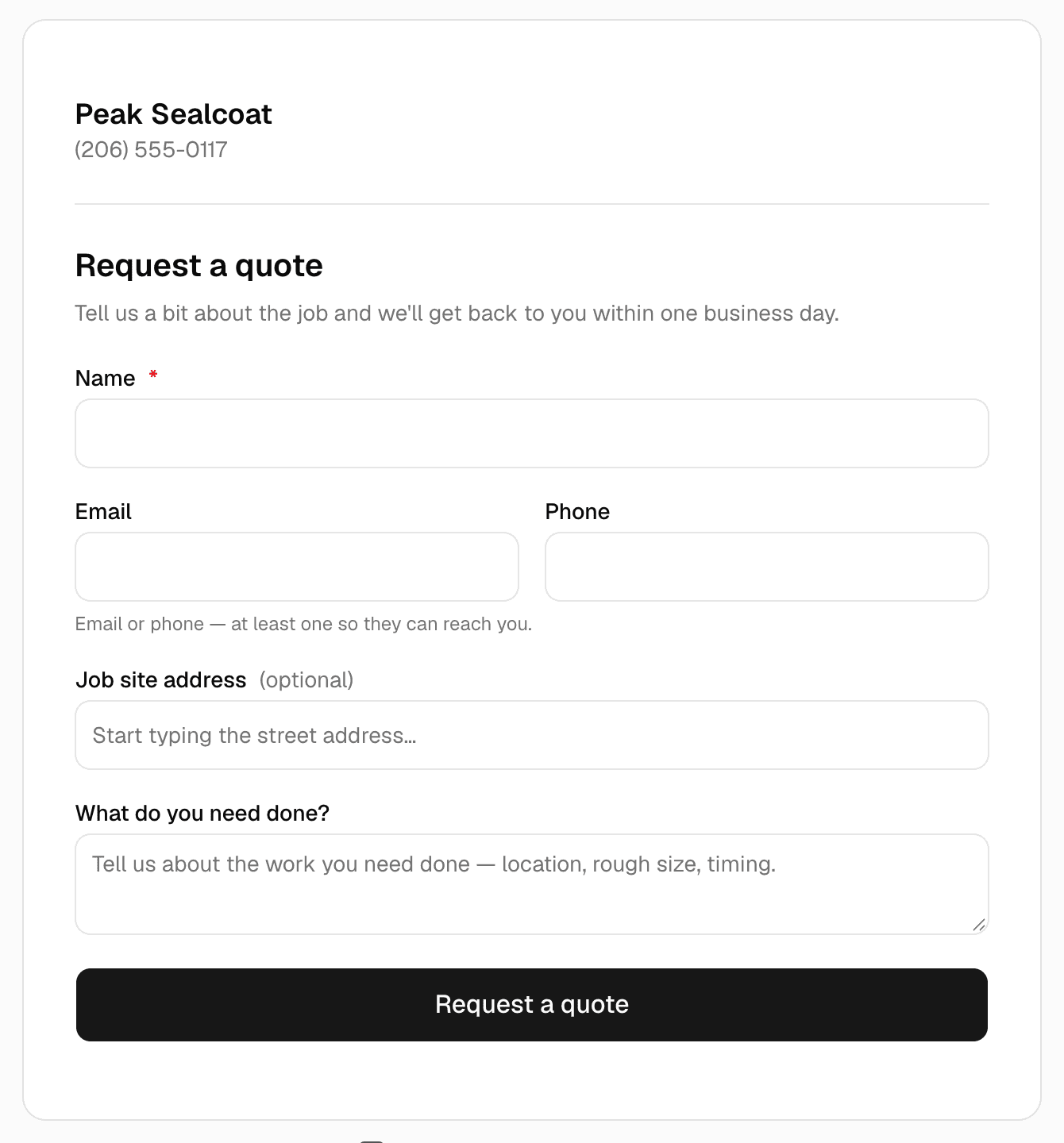
The request form asks for the job site address and a description of the work, the start of an estate quote before the walkthrough.
The deposit, the final sweep and the handoff
Two risks are special to an estate: the family can change its mind after you have booked a crew for days, and the house can be fuller than the walkthrough showed. The deposit answers the first: set it to cover the first day's crew and the first load's gate fee, and collect it when the quote is signed (how much deposit a contractor should ask for covers the state rules). A stated price for an extra day answers the second.
Define done before you start: every room, closet and shelf empty, the garage and shed cleared, the floors swept, and the keys handed back. Put that sentence on the quote with the exclusions next to it (no wall repair, no carpet removal, no cars). Finish with a photo of every room from the same doorway you shot at the start, sent with the final invoice.
Good to know: This is general information, not legal advice. Disposal rules, charity acceptance lists and gate fees change; read the current pages before you rely on them.
FAQ
What should an estate cleanout deposit cover?
Enough that a cancellation after you have booked the crew does not cost you the day: the first day's labor at your loaded rate plus the first load's gate fee. Collect it when the quote is signed and check your state's deposit limits in the deposit guide linked above.
How long does an estate cleanout take?
A sorted house is counted in truckloads and usually finishes in a day or two with three people; an unsorted house is sold by the day. Price the extra day before the first one begins.
Who pays the dump fees on an estate cleanout?
The family does, through the price. On a truckload quote the gate fee sits inside each load's price; on a day rate it is billed on top at cost or with a stated markup. Either way it comes from the station's own page: Lindon, Utah, charges $43.50 per ton past the first 1,000 pounds for participating cities.
Sources
- Budget Dumpster: How Much Is a Cubic Yard? · "A cubic yard is a unit of volume equivalent to a cube with a length, width and height of 1 yard (or 3 feet)"; "There are 27 cubic feet in 1 cubic yard"; "A standard full-size pickup truck can hold about 2 to 3 cubic yards, depending on material"; cubic yards = (square feet × depth in feet) ÷ 27. (accessed October 18, 2026)
- Habitat for Humanity: Donate goods to a Habitat ReStore · ReStores accept "new and gently used appliances, furniture, building materials, household goods and more"; "many Habitat ReStores offer free pickup of large items, including furniture pickup"; each ReStore is unique and many accept items outside those categories; donors should call ahead because donation hours can differ from store hours; the page lists no refused items; copyright 2026. (accessed October 18, 2026)
- Goodwill of North Georgia: items it does and does not accept · Items should be "clean, gently used, and in good working condition whenever possible"; "Items that are broken, heavily damaged or water soaked may not be accepted"; not accepted: "Mattresses," "Box springs," "Bedframes," "Large appliances (stoves, washer/dryer)," air conditioners, "Paint," "Chemicals," "Lumber," "Doors," "Wall cabinets," "Tires," "Cribs," "Car seats," items in need of repair and water soaked or stained items; accepted: many types of furniture that meet the store's guidelines, housewares, small appliances, lamps, bicycles, and electronics such as monitors, desktops, laptops and printers, recycled through Dell Reconnect in any condition. (accessed October 18, 2026)
- IRS: Publication 526 (2025), Charitable Contributions · "For use in preparing 2025 Returns"; "You can't take a deduction for clothing or household items you donate unless the clothing or household items are in good used condition or better"; household items include "Furniture and furnishings," "Electronics," "Appliances," "Linens" and similar items, and exclude food, "Paintings, antiques, and other objects of art," "Jewelry and gems" and "Collections"; an item not in good used condition can be deducted only when the deduction is more than $500 and a qualified appraisal and Form 8283, Section B, are included. (accessed October 18, 2026)
- US EPA: Stationary Refrigeration Safe Disposal Requirements (Section 608) · Equipment that typically enters the waste stream with its refrigerant charge intact includes "household refrigerators and freezers, and window unit air conditioners"; "The final person in the disposal chain" is "responsible for ensuring that refrigerant is recovered from equipment before its final disposal"; a final disposer who accepts an appliance without a charge keeps "a signed statement from the person who dropped off the appliance" that includes "the name and address of the person who recovered the refrigerant"; "EPA does not mandate or accept a sticker as a form of verification"; people recovering refrigerant from small appliances "are not required to be certified technicians" but their equipment "must meet the same performance standards as refrigerant recovery equipment used for servicing." (accessed October 18, 2026)
- Oregon DEQ: Oregon E-Cycles disposal ban · "It is illegal in Oregon to dispose of computers, monitors and TVs in the garbage" or at landfills, incinerators and transfer stations; the ban "went into effect January 2010"; "Anyone knowingly disposing of these items can be fined"; "Anyone can bring seven or fewer computers, monitors and TVs at a time" to participating Oregon E-Cycles collectors for free recycling. (accessed October 18, 2026)
- US EPA: Household Hazardous Waste (HHW) · Leftover household products that can catch fire, react or explode, or that are corrosive or toxic, are household hazardous waste; "Products, such as paints, cleaners, oils, batteries, and pesticides can contain hazardous ingredients"; improper disposal includes "pouring them down the drain, on the ground, into storm sewers" and "putting them out with the regular trash"; contact the local agency about "permanent or periodic HHW collections" and look for designated collection days where no year-round program exists; "Last updated on June 1, 2026." (accessed October 18, 2026)
- PaintCare: Products accepted · "PaintCare sites accept house paint as well as primers, stains, sealers, and clear coatings such as shellac and varnish"; sites "do not accept aerosol coatings, solvents" or non-architectural products such as paint thinners, auto and marine paints, art and craft paints, two component coatings, traffic paints and asphalt, tar and bitumen based products; products must be in "original containers of no larger than 5 gallons in size" with "the original manufacturer's printed label on the container" and "covered with a secured lid"; open, leaking, empty or unlabeled cans are not accepted; programs are listed for California, Colorado, Connecticut, the District of Columbia, Illinois, Maine, Maryland, Minnesota, New York, Oregon, Rhode Island, Vermont and Washington. (accessed October 18, 2026)
- US FDA: Disposal of Unused Medicines: What You Should Know · The best option for most medicines is "to immediately use a take-back option," by dropping them at a take back location or mailing them in a prepaid envelope; medicines on the FDA Flush List should be flushed when no take back option is available; other medicines go in household trash mixed with "an unappealing substance such as dirt, cat litter, or used coffee grounds," not crushed, sealed in a plastic bag, with personal information scratched off the prescription label; "Content current as of: 10/31/2024." (accessed October 18, 2026)
- North Pointe Solid Waste Special Service District, Lindon, Utah: Transfer station fees and charges · Mixed waste from participating cities: $13.00 for 500 lbs or less, $26.00 for 501 to 1,000 lbs, $43.50 per ton over 1,000 lbs; non-participating cities $26.00, $52.00 and $87.00 per ton for the same steps; "Double Charge of All Non-Covered and Unsecured Loads. $13.00 minimum / $50.00 maximum"; mattresses $10.00 for a first mattress for residents of listed cities, $20.00 each for others, $500.00 per ton for bulk loads of 25 or more; appliances with refrigerant $15.00 per unit for refrigerant removal; electronics $10.00 per household item; regular car or pickup tires $6.50 each, commercial truck tires $20.00; special handling $60.00 per ton with a $60.00 minimum in addition to the regular fee; "All weighed items have a state required tonnage tax added in addition to the fee," $0.22 per ton; participating cities listed as Orem, Vineyard, Pleasant Grove, Lindon, American Fork, Cedar Hills, Highland, Lehi and Saratoga Springs; no effective date shown. (accessed October 18, 2026)
- Lane County, Oregon: Waste management fees · Garbage fees "effective Aug. 10, 2026 to July 2027": up to 1 cubic yard $25.00 minimum at rural sites and at Glenwood and Florence; over 1 cubic yard $7.00 per each half cubic yard at rural sites, $123.10 per ton at Glenwood and Florence; appliances $25.00 each, "Appliances containing refrigerant will be charged the appliance fee"; mattresses and box springs free to recycle at Glenwood only, maximum four per customer per day, charged as garbage at other transfer stations; tires with rims of 20 inches or less $5.00, $6.00 with the wheel; "Fees are subject to change without notice." (accessed October 18, 2026)
- US Bureau of Labor Statistics, Occupational Outlook Handbook: Hand Laborers and Material Movers · 2025 median pay $38,220 per year, $18.38 per hour; hand laborers and material movers "manually move freight, stock, or other materials" and some "load and unload cargo from a truck"; page last modified August 27, 2026. (accessed October 18, 2026)
- US Energy Information Administration: Gasoline and Diesel Fuel Update · US average retail prices for the week of October 12, 2026: regular gasoline $4.331 per gallon, on-highway diesel $6.179 per gallon; the footnote says "prices include all taxes." (accessed October 18, 2026)