How to Price Fleet Washing per Vehicle: Trucks and Vans
How to price fleet washing per vehicle: a price per class, the labor, chemical, water and fuel under each unit, weekly route pricing, wash water rules.
The MakeHay team · · 11 min read

Here is how to price fleet washing when a customer runs a yard of trucks and vans and wants one number per unit. Put every vehicle in a class, time one of each, cost the labor, chemical, water and fuel under it, add your margin, and sell a route visit every week with one invoice a month. The prices below come from published pages; the minutes come from your stopwatch.
Fleet washing prices per vehicle: one price per class
A fleet manager compares washers on the price per unit, so the quote needs a class list, not a lump sum. A class is a group of vehicles that take about the same minutes, chemical and water; time one of each on the first visit.
| Class | What the wash covers | What moves a unit up |
|---|---|---|
| Sedan or small SUV | Exterior, wheels, jambs on request | Rooftop gear, a wrap washed by hand |
| Van or pickup | Exterior, wheels, ladder rack rinse | A high roof, a tool body with open bins |
| Box truck | Cab, box on three sides, rear door, wheels | A reefer unit, a lift gate, a tall box |
| Tractor | Cab, sleeper, tanks, stacks, wheels | Polished aluminum, chrome dried by hand |
| Trailer | Both sides, rear doors, landing gear, flaps | A reefer nose, a tanker, chassis detail |
Write the class on each quote line and list the units by number beneath it.
The cost under each unit: labor, chemical, water and fuel
Price from the cost of one unit in each class, not from a competitor's flyer.
Labor at the published wage
O*NET's wage page for cleaners of vehicles and equipment, crediting BLS 2025 data, shows a median of $17.23 an hour and $35,830 a year, the figure the BLS Occupational Outlook Handbook's hand laborers and material movers page lists for May 2025. Add the employer's payroll share from IRS Topic 751, 6.2 percent for Social Security and 1.45 percent for Medicare, and the loaded floor is $17.23 × 1.0765 = $18.55 an hour before insurance and overhead.
Two step truck wash chemicals from a supplier's page
A two-step wash lays down a low pH presoak, then a high pH one, and rinses; no brush. Kleen-Rite lists Kleen-Track 1A, a low pH presoak sold "as a first step in a two-step touchless wash," at $52.87 for a 5 gallon pail at 75:1 to 120:1, and Kleen-Track 1B, the high pH second step, at $48.17 for 5 gallons at 64:1 to 90:1. Both pages flag a $38.50 hazardous material fee that may be added to the order.
At the weak end of each range, 5 gallons of 1A at 75:1 makes 5 × 76 = 380 gallons of mix, $52.87 ÷ 380 = about $0.14 a gallon; 5 gallons of 1B at 64:1 makes 325 gallons, $48.17 ÷ 325 = about $0.15. At 3 gallons of each mix on a box truck (your own count), the chemical on the unit is under a dollar. Oxidized aluminum is its own step: Technichem's Mighty Brite brightener is $102.00 for 5 gallons at up to 20:1, and the page warns that it contains hydrofluoric acid: a separate line with the training and gear under it.
Water by the minute on the trigger
The water on a unit is trigger minutes times the machine's flow. Tool Nut lists a Mi-T-M 4000 PSI direct drive machine at 4.0 GPM for $2,909.99: six minutes on the trigger is 24 gallons, and the tank carries a route's worth. The machine's price spread over the hours you expect from it is the fifth line, wear.
Fuel for the drive
The drive is a cost of the visit, not of the unit, which is why a stop needs a minimum. The Energy Information Administration's weekly retail prices put regular gasoline at $4.331 a gallon and on-highway diesel at $6.179 for the week ending October 12, 2026; miles there and back, over your truck's miles per gallon, times the price, is the line.
Weekly fleet wash route pricing versus biweekly
A fleet is route work: the same yard, the same units, the same night. Three things follow.
- A stop minimum. The drive and the setup cost the same for 4 units as for 40, so a yard below the minimum pays the minimum.
- A per-unit price that drops with frequency. A unit washed weekly carries a week of film and takes fewer minutes than one washed every other week, so quote both and show the weekly price lower.
- A line for units that are not there. Trucks on the road at wash time are skipped, not billed, and not credited against the minimum.
Access decides the schedule. Most yards want the washing after the last truck is in and before the first one leaves: nights or weekends, a gate code and a light. Ask where the spigot and the drain are and who signs when the office is closed; with nobody to sign, photograph each unit after the wash.
Put the unit prices, the minimum and the schedule on one page and the quote reads as a contract: "Thursday nights after 8, 14 units as listed, price per class, minimum per visit, skipped units not billed, one invoice at month end."
Worked example: A 12 unit box truck fleet, washed weekly at the yard
- Minutes: 15 per box truck (your own timing) × 12 units = 180, plus 45 to set up, contain the wash water and pack up = 225 minutes, 3.75 hours for one person.
- Labor: 3.75 hours × $18.55 loaded = $69.56.
- Chemical: 3 gallons of 1A mix at $0.14 and 3 gallons of 1B mix at $0.15 per unit = $0.87 × 12 = $10.44.
- Water: 6 trigger minutes × 4.0 GPM = 24 gallons per unit, 288 for the visit, at your own cost per gallon.
- Fuel: 24 miles round trip ÷ 12 miles per gallon (your truck's figure) = 2 gallons × $4.331 = $8.66.
- Wear: $2,909.99 over 1,000 hours of life (your own estimate) = $2.91 an hour × 3.75 hours = $10.91.
- Direct cost: $69.56 + $10.44 + $8.66 + $10.91 = $99.57, before insurance, the truck and the tank, your overhead per hour.
- Price at a 50 percent margin: $99.57 ÷ 0.5 = $199.14 per visit, $16.60 per box truck; quote $17 per unit weekly, $204 a visit, with a $150 minimum.
Result: About $100 of direct cost under a weekly 12 truck visit, priced at $17 per box truck and $204 a visit at a 50 percent margin, $816 for a month of four visits; the minutes, the miles and the margin are yours to replace.
That is the floor, not the market. If the fleet pays more today, the margin is where the difference lives; if it pays less, check the minutes first.
Wash water and storm drains: what the city expects
Wash water is the cost a new operator leaves out and an inspector does not. Portland's vehicle and equipment washing page says the city "prohibits the discharge of wash water into the stormwater system," tells a business to "Ensure the mobile washer contains and collects all wash water," and warns that "If a mobile washer generates a prohibited discharge from your site, your facility may be held responsible." That last sentence is why a fleet manager asks about reclaim before price.
Austin's page for power washers and mobile car washes says the water "may not be discharged into the storm sewer if it contains pollutants or cleaning compounds and has not been treated before entering the environment," may go to the sanitary sewer only when "collected and transported to a private fixed-site facility" with pretreatment, and that "all industrial wastewater discharges must be authorized by permit." Two cities, one rule.
For the price that means berms, a drain cover, a vacuum or sump into a holding tank, the minutes to set them up at every stop, and a disposal fee where the water is hauled. Read the yard's own city page before the first quote, ask whether the wash area drains to the sanitary sewer, and put "wash water contained and disposed of per city rules" on the quote as a line the fleet can show its inspector.
The rules sell for you too. Under 49 CFR 393.9 the lamps and reflective devices a commercial vehicle must carry may not be obscured by dirt, and a truck that fails that at roadside is the fleet's cost. A regular wash keeps lights, reflectors and DOT numbers readable; say so on the proposal.
Good to know: This is general information, not legal advice. Stormwater and wastewater rules differ by city and change; read the current page for the yard's city and ask its stormwater office or a lawyer before you rely on it.
One monthly invoice per fleet, one line per vehicle
Bill a fleet the way its office pays: one invoice a month, a line per class with the count and the rate, unit numbers beneath.
In MakeHay the fleet is one customer with the yard as its job site, the quote carries a per item line for each class with the customer's approval and signature online, the weekly visit is recurring service on the calendar, and the invoice goes out by email with card and ACH payment online; a fleet that would rather not touch an invoice goes on autopay. Photos of each unit after a night wash reach the fleet through the client portal.
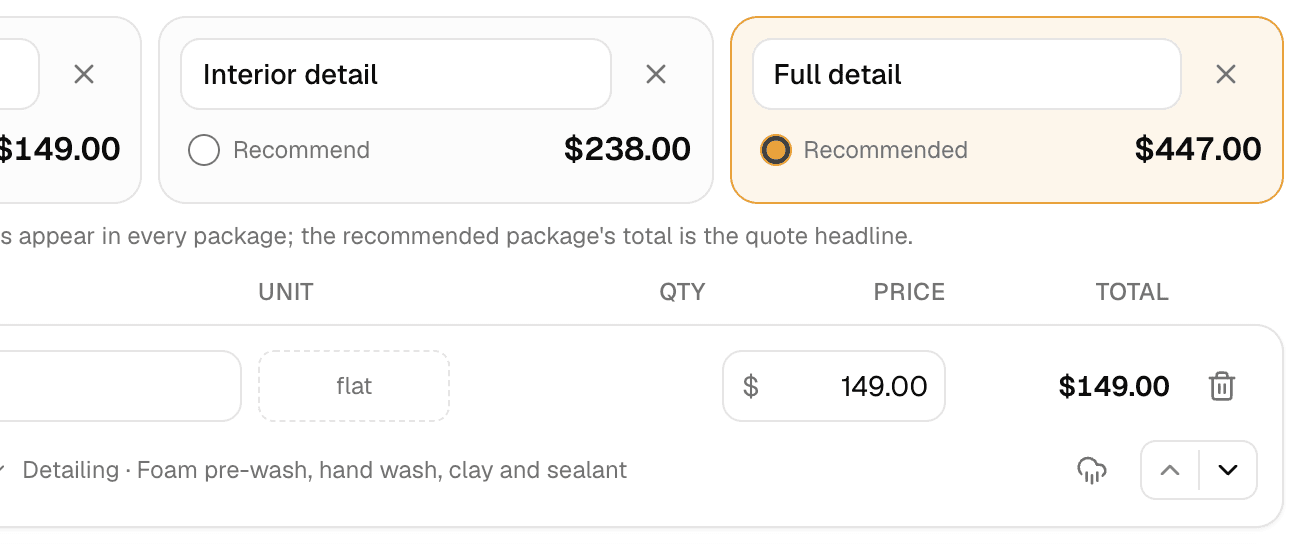
Packages on a detailing quote; a fleet quote uses a per item line for each vehicle class instead.
For the owner's own cars, mobile detailing maintenance plan pricing prices a visit the same way, and estimating a pressure washing job without a site visit covers the yard's building when the fleet asks.
FAQ
How much to charge to wash a semi truck?
Price it as two classes, tractor and trailer, each from minutes times loaded labor plus chemical, water, fuel and wear, then your margin. Labor starts at the BLS 2025 median for vehicle cleaners, $17.23 an hour, $18.55 with the employer's 7.65 percent payroll share; the two-step pair is under a dollar of chemical on a box truck, and polished aluminum adds a brightener line.
Should a fleet be washed weekly or every other week?
Quote both and let the fleet choose. A weekly unit carries less film and takes fewer minutes, so its price per unit is lower; the drive and the setup are the same either way, so the stop minimum does not change.
Can a mobile fleet washer let the water run to the storm drain?
Not in the cities cited here. Portland prohibits discharging wash water into its stormwater system and expects a mobile washer to contain and collect all of it under a Discharge Authorization; Austin bars wash water with cleaning compounds from the storm sewer and requires a permit. Read the page for the yard's own city and price the containment.
What is a two-step wash and why price it that way?
A low pH presoak, then a high pH one, then a rinse; the two lift road film without brushing, which is what makes a unit take minutes. The supplier lists the first step at $52.87 and the second at $48.17 per 5 gallon pail, diluted 75:1 and 64:1 at the weak end, so the chemical is small; the minutes and the containment are the larger costs.
Sources
- O*NET OnLine: Cleaners of Vehicles and Equipment, wages and employment · Median wages $17.23 hourly and $35,830 annual for 2025; the page credits "Bureau of Labor Statistics 2025 wage data". (accessed October 18, 2026)
- BLS Occupational Outlook Handbook: Hand Laborers and Material Movers · Median annual wages in May 2025 by occupation, including 35,830 for cleaners of vehicles and equipment; the group's median was $38,220 a year, $18.38 an hour, in May 2025. (accessed October 18, 2026)
- IRS Topic no. 751, Social Security and Medicare withholding rates · "The current tax rate for Social Security is 6.2% for the employer and 6.2% for the employee"; "The current rate for Medicare is 1.45% for the employer and 1.45% for the employee"; the 2026 Social Security wage base is $184,500. (accessed October 18, 2026)
- Kleen-Rite: Kleen-Track 1A Low pH Liquid Presoak, 5 Gallon · Listed at $52.87 (MSRP $68.25) for a 5 gallon container, dilution ratio 75 to 120 to 1; "This presoak is used as a first step in a two-step touchless wash"; contains ammonium bifloride; hazardous material with a $38.50 fee that may be added to the order; October 18, 2026. (accessed October 18, 2026)
- Kleen-Rite: Kleen-Track 1B High pH Liquid Presoak, 5 Gallon · Listed at $48.17 (MSRP $62.14) for a 5 gallon container, dilution ratio 64 to 90 to 1; "formulated for use as a second step in a two-step touchless wash process" and "best when preceded by an acidic presoak"; "This is Hazardous Material" and "A $38.50 fee may be added to your order"; October 18, 2026. (accessed October 18, 2026)
- Technichem: Mighty Brite 3 Acid Blend Aluminum Brightener · $102.00 for the 5 gallon size; "an aluminum brightener for truck bodies, trailers, tankers, and jet boats"; "a dilution rate up to 20 to 1 with water"; "Use with caution as this formula contains Hydrofluoric Acid"; ships as hazardous material by truck freight; October 18, 2026. (accessed October 18, 2026)
- Tool Nut: Mi-T-M CA Aluminum Series 4000 PSI gasoline direct drive cold water pressure washer · Retail listing at $2,909.99; 4000 PSI, 4.0 GPM, 389cc Honda OHV engine, 50 foot by 3/8 inch hose, nozzles at 0, 15 and 25 degrees; October 18, 2026. (accessed October 18, 2026)
- US Energy Information Administration: Gasoline and Diesel Fuel Update · US average retail prices for the week ending October 12, 2026: regular gasoline $4.331 per gallon, on-highway diesel $6.179 per gallon. (accessed October 18, 2026)
- City of Portland, Bureau of Environmental Services: Vehicle and equipment washing · The city "prohibits the discharge of wash water into the stormwater system"; businesses should "Use a dedicated wash pad connected to the sanitary sewer" or a closed-loop recirculation or recovery and reuse system; for mobile washing services, "Ensure the mobile washer contains and collects all wash water," "Ensure rinse water is collected for discharge to the sanitary sewer," "Ensure the mobile washer holds a Discharge Authorization with the City," and "If a mobile washer generates a prohibited discharge from your site, your facility may be held responsible." (accessed October 18, 2026)
- Austin Water: Wastewater Disposal for Power Washers and Mobile Car Washes · Power washing and mobile car wash wastewater "may not be discharged into the storm sewer if it contains pollutants or cleaning compounds and has not been treated before entering the environment"; it may go to the sanitary sewer under certain conditions when "collected and transported to a private fixed-site facility connected to the City's sanitary sewer collection system" with pretreatment such as a sand/oil interceptor or grit trap; "all industrial wastewater discharges must be authorized by permit". (accessed October 18, 2026)
- Legal Information Institute, Cornell: 49 CFR 393.9, Lamps operable, prohibition of obstructions of lamps and reflectors · Paragraph (b): required lamps and reflective devices or material must not be obscured by the tailboard, by any part of the load or its covering, by dirt, or by other added vehicle or work equipment, with an exception for conspicuity treatments on front end protection devices obscured by part of the load. (accessed October 18, 2026)