How to Price Landscape Installation: Plants, Mulch, Sod
How to price landscape installation: measure the beds and lawn, mulch by the cubic yard, sod by the pallet, plants by container size, labor and a deposit.
The MakeHay team · · 11 min read
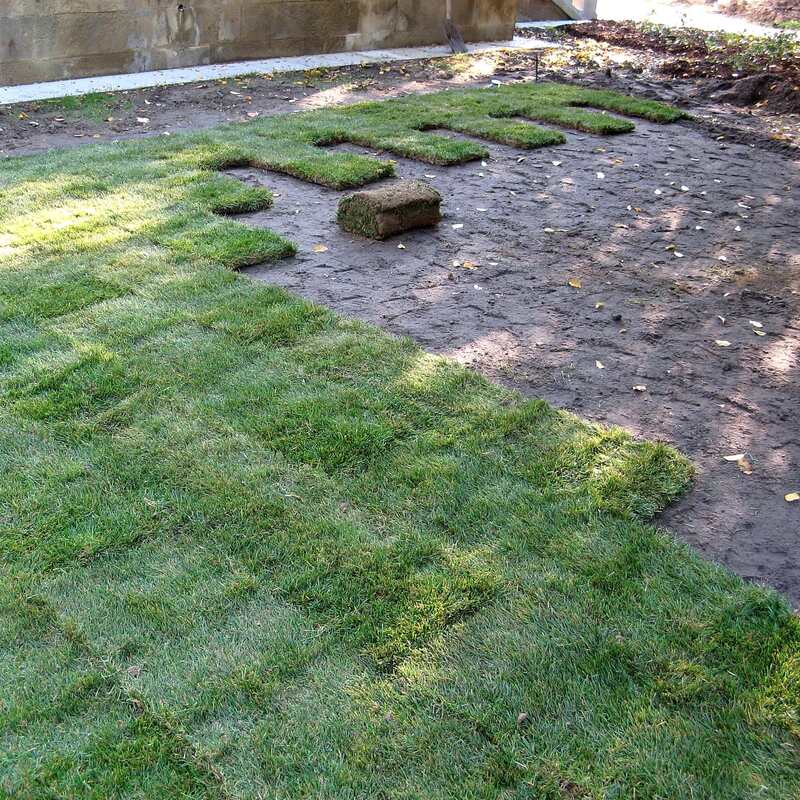
Here is how to price landscape installation so the quote holds when the truck is loaded: measure the beds and the lawn in square feet, turn mulch into cubic yards and the lawn into pallets, price each plant by its container class with your markup, and put labor, delivery and the deposit underneath as their own lines.
Measure the beds and the lawn in square feet first
Every line on the quote comes from two measurements: square feet of bed and square feet of lawn. Walk the beds with a tape. A rectangle is length times width; for a circular bed, Clemson Cooperative Extension's mulch factsheet says to square the radius and multiply by 3.14. An odd shape splits into rectangles and triangles.
The lawn is the larger area and the one a tape handles badly. Measure it from satellite imagery, section by section, and keep the beds out of the lawn number so the sod count does not include ground that is getting mulch.
- Step 1: Draw each bed and each lawn section as its own shape and write the square feet beside it.
- Step 2: Count the plants from the drawing by container class: so many #1, so many #3, so many #5.
- Step 3: Mark access: gate width, slope, and where the sod pallets and the mulch pile can be dropped.
How much mulch per cubic yard covers, and what to charge for it
Clemson's factsheet (HGIC 1604, revised June 20, 2016) gives the conversion: "There are 27 cubic feet in a cubic yard," and "One cubic yard will cover a 324-square-foot area with an inch of mulch." So the yards to order are square feet times depth in inches, divided by 324. Fine wood and bark mulches "should not be more than 2 to 3 inches deep," coarse pine bark nuggets "can be as deep as 4 inches," and the mulch stays 2 to 3 inches off woody stems and 6 to 12 inches off building walls.
| Depth | Square feet per cubic yard | Yards for 1,000 sq ft |
|---|---|---|
| 2 inches | 162 sq ft | 6.2, ordered as 7 |
| 3 inches | 108 sq ft | 9.3, ordered as 10 |
| 4 inches | 81 sq ft | 12.3, ordered as 13 |
The mulch line is yards times your supplier's price, plus delivery and spreading time. For a published reference, Garden Supply Company in Cary, North Carolina lists a scoop of bulk triple shredded hardwood, about one cubic yard, at $27.99, caps a truck at 12 cubic yards, and delivers only to the end of the driveway, so a big job is two deliveries and a wheelbarrow run. Round up to the whole yard.
Sod installation pricing per pallet, with the prep and the water
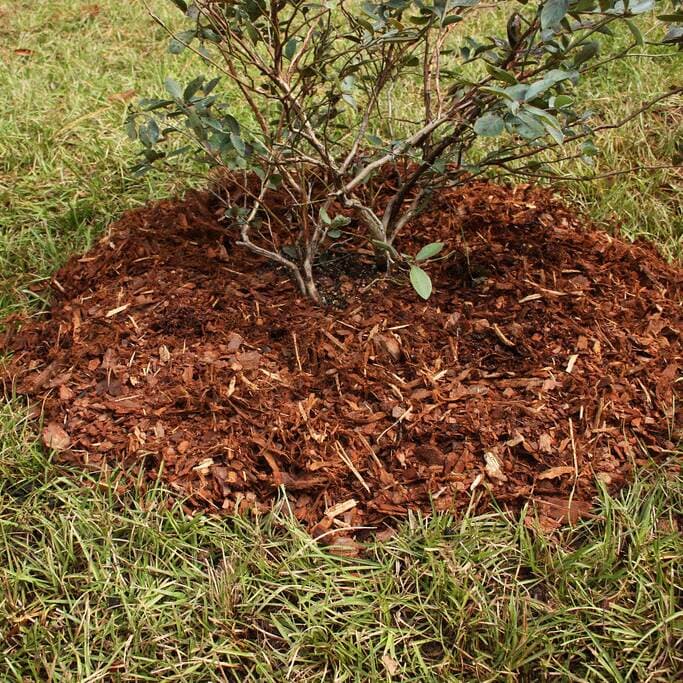
Sod sells by the pallet. The Grass Outlet, a sod seller in Austin, Texas, lists pallets that cover 450 sq ft: 419 Tifway Bermuda at $220, marked down from $240, and on its home page Raleigh St. Augustine at $205 and Palisades Zoysia at $315, as shown October 18, 2026. Pallets are the lawn's square feet divided by 450, rounded up; pieces cut around curves become waste. The seller loads pickup pallets by forklift, each weighing up to 3,000 lbs, so the seller's delivery to the address, which can arrive as soon as the next day, is usually the right line.
The prep comes from Penn State Extension's lawn establishment guide, updated September 19, 2025. Soil preparation for sod "is identical" to seed: till "at least 4 inches" deep, and for good turf "a minimum of 4 to 6 inches (firmed or settled depth) of a good-quality topsoil is needed." Lay on soil that is dry to slightly moist, never wet.
Laying is the fast part: stagger the strips like bricks, close gaps by moving the piece rather than stretching it, roll, then water. Sod "deteriorates rapidly (within 24 to 48 hours) in warm weather," so the pallets arrive the morning of the job. After that, "Continue to water daily (if needed) until the sod is well rooted," which "may take up to 4 weeks." The watering is the customer's job; write it into the quote.
Tip: Quote sod as three lines: the prep (grading, topsoil, tilling), the sod by the pallet, and the laying labor. The customer sees why a lawn that needs topsoil costs more.
Plants by container size, and the plant markup for landscapers
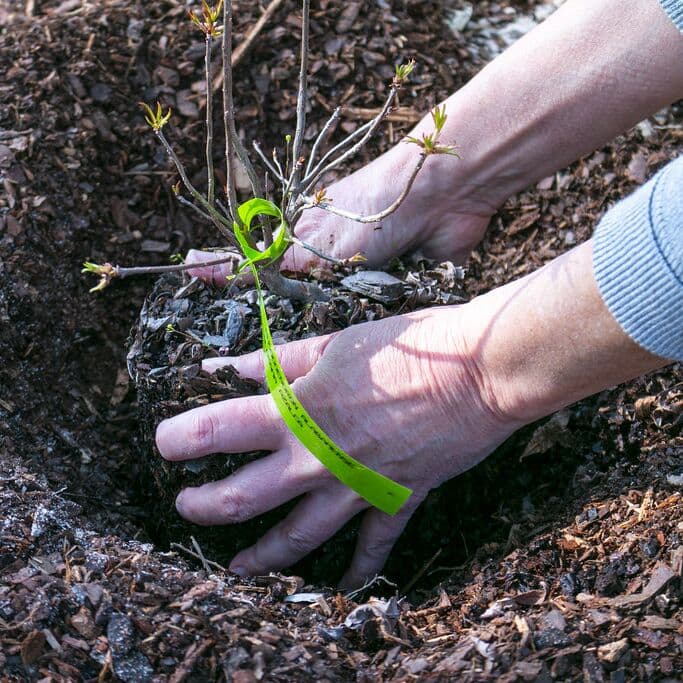
Nursery stock is priced by container class, and the class number is not a gallon. Nature Hills' guide to container sizes puts it plainly: "A #3 container does not hold three gallons of water." A #1, the trade gallon, "holds approximately 0.73 to 0.76 gallons of soil volume, about 183 cubic inches"; a #3 holds about 2.5 gallons and is roughly 10.5 inches across; a #5 holds about 3.6 gallons. The class tracks the age of the root system, which is what the customer is paying for.
The standard behind the classes is AmericanHort's American Standard for Nursery Stock, 2025 edition, written to "provide buyers and sellers of nursery stock with a common terminology." Spec every plant on the quote by name and class, so a substitution at the nursery is visible instead of silent.
The plant line is the nursery invoice times your markup, and the markup has work to cover: the nursery trip, the handling, the watering before the hole is dug, and the warranty call if one dies. Planting time rises with the class: a #1 is a trowel and a moment, a #5 is a hole wider than the root ball and a wheelbarrow of soil. Quote per plant by class, the marked-up plant plus the planting labor.
Soil, grading, delivery and labor as their own lines
Topsoil uses the same arithmetic as mulch, 324 sq ft per yard at an inch, and the numbers get large fast: Penn State's 4 to 6 inches of topsoil over a 1,000 sq ft lawn is 12.3 to 18.5 cubic yards. Price the yards, the loads and the spreading time; where a skid steer grades, price its hours or day rate as a line.
Delivery is each supplier's fee times the loads: the sod farm, the mulch yard, the topsoil, the nursery. The haul away is the old sod and the bed's debris, by the load with the dump fee on top. None of these belong inside the per square foot number, because they do not scale with the area.
Labor starts from a published wage and ends at your loaded rate. The Bureau of Labor Statistics' Occupational Outlook Handbook puts the median hourly wage for landscaping and groundskeeping workers at $18.82 in May 2025. The wage is not the cost: add payroll taxes, workers' compensation, the truck and the overhead to reach a loaded rate, then multiply by the crew hours.
Landscape installation cost per square foot: a worked job
Worked example: 1,200 sq ft of sod, 400 sq ft of beds at 3 inches, 12 shrubs in #3 containers
- Mulch: 400 sq ft × 3 inches ÷ 324 = 3.7 cubic yards, ordered as 4.
- Mulch cost: 4 cubic yards × $27.99 (Garden Supply Company's bulk hardwood) = $111.96, plus delivery.
- Sod: 1,200 sq ft ÷ 450 sq ft per pallet = 2.67 pallets, ordered as 3.
- Sod cost: 3 pallets × $220 (The Grass Outlet's 419 Tifway Bermuda) = $660, plus delivery.
- Plants: 12 shrubs × your #3 nursery cost × your markup; the nursery invoice is the only source for this line.
- Labor: a crew of two for 10 hours (your own timing) = 20 crew hours; at the BLS median wage of $18.82 that is $376.40 in bare wages, so multiply the hours by your loaded rate instead.
- Materials and bare wages so far: $111.96 + $660 + $376.40 = $1,148.36 over 1,600 sq ft, which is $0.72 per sq ft before plants, deliveries, labor burden and margin.
Result: About $0.72 per sq ft in materials and bare wages for the mulch and sod work, plus the plants at your markup, the delivery fees, the loaded labor and the margin the business needs, each on its own line.
In MakeHay the measurement comes first: trace the lawn and each bed on satellite imagery for square feet and send the figures into the quote (measure a property from satellite); the free public version is the satellite measurement tool. Quote lines carry your units, per sq ft, per cubic yard, per pallet or per item (create and send a quote), and the customer approves and signs from a link (get a quote approved and signed).
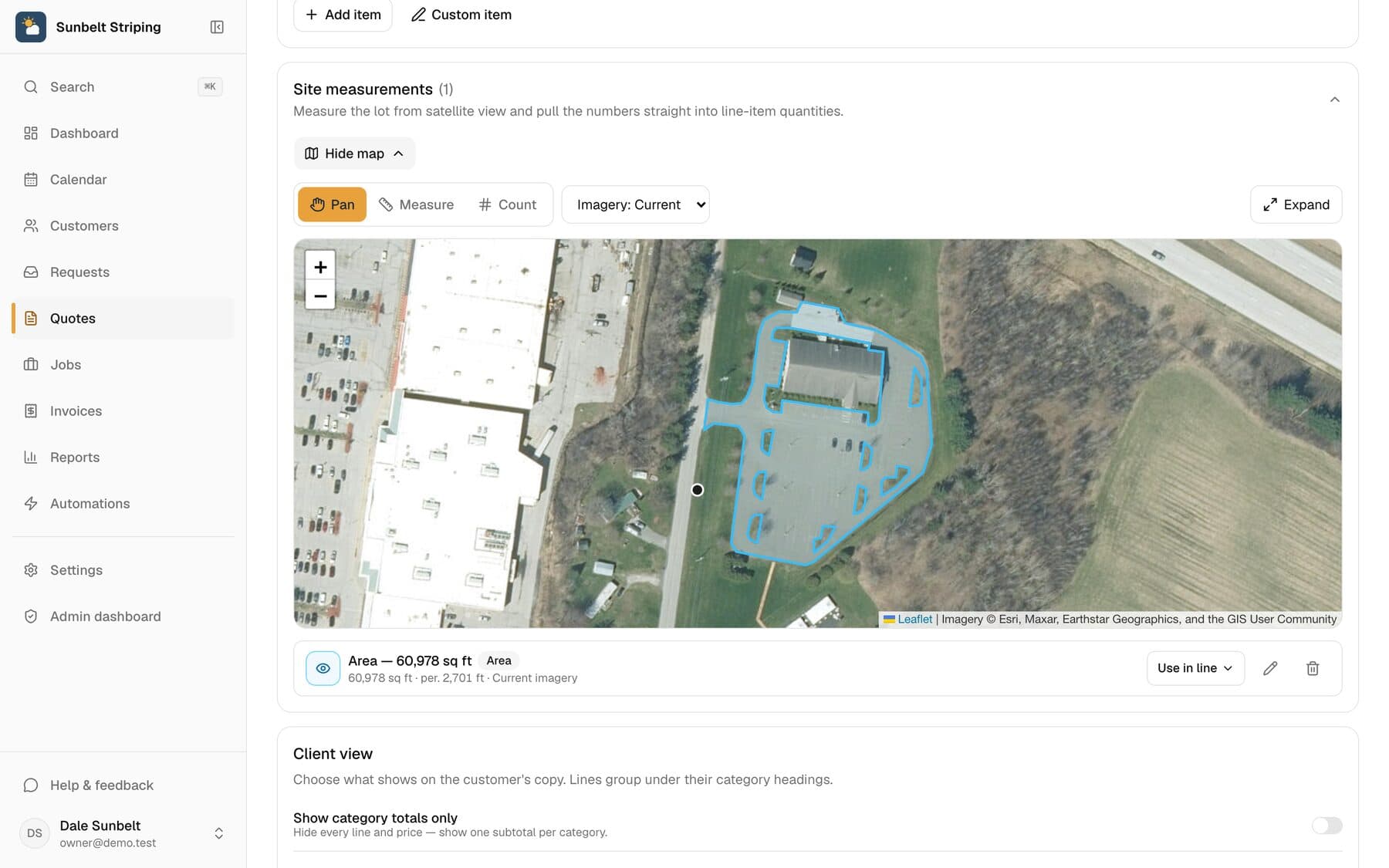
The lawn and the beds traced from the address; the square feet go straight into the quote lines.
Drawing, plant warranty and the landscaping deposit for plant orders
A sketch sells the job: the beds, the plant names and classes, the mulch depth, the sod area. For a small job it rides inside the quote; a full planting design is a line of its own, credited back if the customer books the installation.
Plants die from no water more than anything else, and Penn State calls lack of water the most common cause of sod failure. A warranty that holds up says what is covered (one replacement of a plant that dies within the stated season), what is not (drought, pets, mower damage), and what the customer does (water daily until rooted). Price the warranty into the plant markup.
Plants are a special order, so a deposit at signing that covers the nursery invoice is standard, and some states cap it. Maryland's home improvement law reads: "A person may not receive a deposit of more than one-third of the home improvement contract price." Check your own state; how much deposit a contractor should ask for walks through the statutes. The quote can ask for the deposit at approval, and a large job can be billed in stages: the plant order, the sod day, the final walk.
Good to know: This is general information, not legal advice. Deposit caps and home improvement rules differ by state and change; read the current text or ask your state licensing board or a lawyer before you rely on it.
FAQ
What does it cost per square foot to install landscaping?
No single number covers it, because the plants and the soil swing the total more than the area does. Build it: mulch by the cubic yard, sod by the 450 sq ft pallet, each plant at its class with your markup, then labor at your loaded rate and delivery per load. In the worked job above, mulch and sod materials with bare wages came to about $0.72 per sq ft before plants, delivery, burden and margin.
How many pallets of sod does 1,000 square feet take?
At 450 sq ft per pallet, 1,000 ÷ 450 is 2.2 pallets, so order 3 and expect leftover pieces. The Grass Outlet lists 450 sq ft pallets of 419 Tifway Bermuda at $220, Raleigh St. Augustine at $205 and Palisades Zoysia at $315.
Is a #3 plant the same as a 3 gallon plant?
No. The number is a trade class, not a liquid measure. Nature Hills' guide says a #3 container holds about 2.5 gallons of soil and a #1 trade gallon about 0.73 to 0.76 gallons. Quote plants by name and class so the nursery, the quote and the customer mean the same plant.
Sources
- Clemson Cooperative Extension Home and Garden Information Center: Mulch (HGIC 1604) · States that "There are 27 cubic feet in a cubic yard" and "One cubic yard will cover a 324-square-foot area with an inch of mulch"; to find cubic yards, multiply square footage by the depth in inches and divide by 324; for a circular bed, take the distance from the middle to the outside, multiply it by itself, then by 3.14; fine wood and bark mulches "should not be more than 2 to 3 inches deep"; coarse mulches such as pine bark nuggets "can be as deep as 4 inches"; keep mulch 2 to 3 inches from the stems of woody plants and 6 to 12 inches from building walls; factsheet revised June 20, 2016. (accessed October 18, 2026)
- Penn State Extension: Lawn Establishment · States that "Soil preparation methods for sodding are identical to those for establishing turf from seed"; "The depth of tilling for most turf establishments should be at least 4 inches"; "a minimum of 4 to 6 inches (firmed or settled depth) of a good-quality topsoil is needed"; collect soil samples three to four weeks before preparing the soil; "The soil should be dry to slightly moist when sodding" and "Never lay sod on wet soil"; lay sod in a staggered pattern like bricks, close gaps by moving the piece with a steel rake rather than stretching, roll before watering; "Sod should be used immediately upon delivery because it deteriorates rapidly (within 24 to 48 hours) in warm weather"; lack of water is the most common cause of sod failure; "Continue to water daily (if needed) until the sod is well rooted into the soil," which "may take up to 4 weeks"; page updated September 19, 2025. (accessed October 18, 2026)
- The Grass Outlet: 419 Tifway Bermuda Grass Sod · Lists a 450 sq ft pallet of 419 Tifway Bermuda at $220.00, marked down from $240.00; with the "Deliver As Soon As Possible" option, delivery "may be as soon as the next day"; pickup in Austin, Texas uses a forklift to load pallets, "with each pallet weighing up to 3000 lbs," and customers must confirm the vehicle can handle it; price as shown October 18, 2026. (accessed October 18, 2026)
- The Grass Outlet: home page, best-selling sod by the pallet · Lists three varieties by the 450 sq ft pallet under its best-sellers: Palisades Zoysia at $315.00, 419 Tifway Bermuda at $220.00 marked down from $240.00, and Raleigh St. Augustine at $205.00 marked down from $220.00; prices as shown October 18, 2026. (accessed October 18, 2026)
- Garden Supply Company (Cary, NC): Bulk Hardwood Mulch 1 cu yd · Lists one scoop, about one cubic yard, of triple shredded hardwood mulch at $27.99; bulk materials cannot be combined on one truck and require separate delivery; a maximum of 12 cubic yards per truck load; delivery to the end of the driveway on pavement only; store at 1421 Old Apex Road, Cary, NC; price as shown October 18, 2026. (accessed October 18, 2026)
- Nature Hills Nursery: What is the difference between container sizes? · States that "A #3 container does not hold three gallons of water"; "A trade gallon, the industry-standard #1 container, holds approximately 0.73 to 0.76 gallons of soil volume, about 183 cubic inches"; a #3 holds about 2.5 gallons and is "roughly 10.5 inches in diameter and 9 inches tall, though exact dimensions vary by manufacturer"; a #5 holds about 3.6 gallons; container size reflects the age of the plant and its root system, not the liquid volume of the pot. (accessed October 18, 2026)
- AmericanHort: American Standard for Nursery Stock · States that the standard exists to "provide buyers and sellers of nursery stock with a common terminology," covering how plants are measured and sized and "Determining whether a root ball or container is large enough for a particular size plant"; the 2014 edition (ANSI Z60.1) was approved in April 2014 and "The current standards were officially approved on April 12, 2025," offered for download as the 2025 edition. (accessed October 18, 2026)
- US Bureau of Labor Statistics, Occupational Outlook Handbook: Grounds Maintenance Workers · States that "The median hourly wage for grounds maintenance workers was $19.27 in May 2025" and, in the Pay section's May 2025 list, a median of 18.82 for landscaping and groundskeeping workers; "Grounds maintenance workers held about 1.3 million jobs in 2025." (accessed October 18, 2026)
- Maryland General Assembly: Business Regulation § 8‑617, Deposits · Subsection (b): "A person may not receive a deposit of more than one-third of the home improvement contract price" before or at the time the contract is executed. (accessed October 18, 2026)