How to Price One-Time Pest Control Jobs: Wasps, Mice, Ants
How to price one-time pest control jobs: a trip charge plus flat lines per nest, per opening and per room, product from the label, return visit built in.
The MakeHay team · · 11 min read
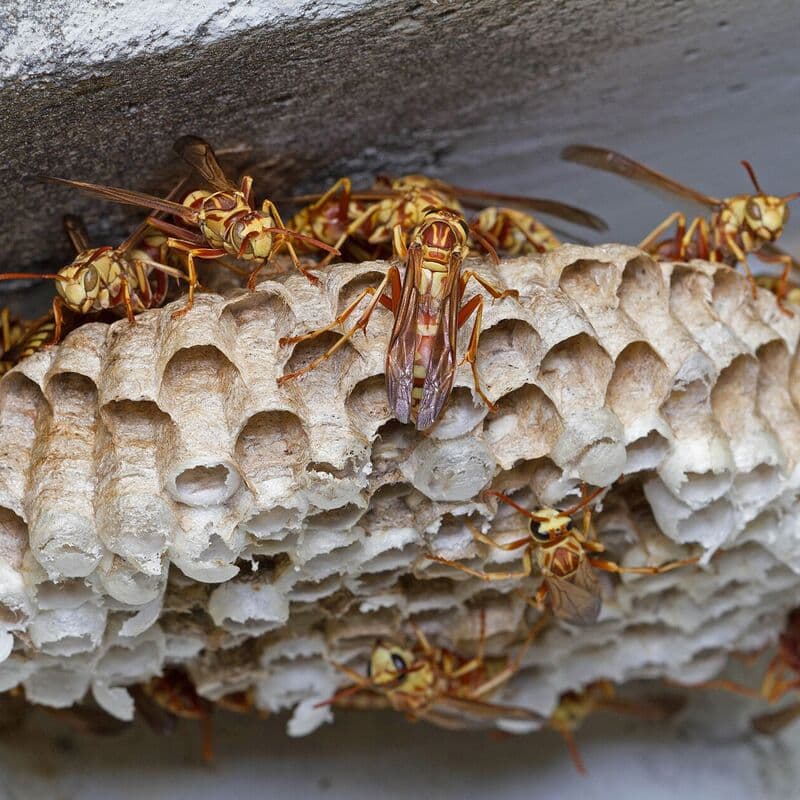
Here is how to price one-time pest control jobs so a single wasp nest, a mouse in the garage or a trail of ants pays for the truck that drove there. Charge a trip that covers the drive and the inspection, add a flat line per nest, per opening or per room, and put the return visit inside the price.
Start with the pest control trip charge, then add the job
A quarterly customer pays for the drive across a route. A one-time customer pays for it once, on a ticket that also carries the phone call, the inspection and the paperwork. So the first line on every one-time quote is the trip: a flat amount, the same whether the job is one nest or three, and the minimum anyone pays for a truck in the driveway. The job lines go under it.
Size the trip from labor. The Bureau of Labor Statistics' Occupational Outlook Handbook puts the median pay for pest control workers at $21.75 an hour, $45,250 a year, for May 2025, and counts inspecting buildings and estimating the cost as part of the work. That is a wage, not a cost: payroll taxes, workers' compensation, the truck and the license sit on top. Time the drive, the walk and the write-up on a dozen calls and multiply by your loaded hour.
Wasp nest removal cost: a trip, a can, a ladder and dusk
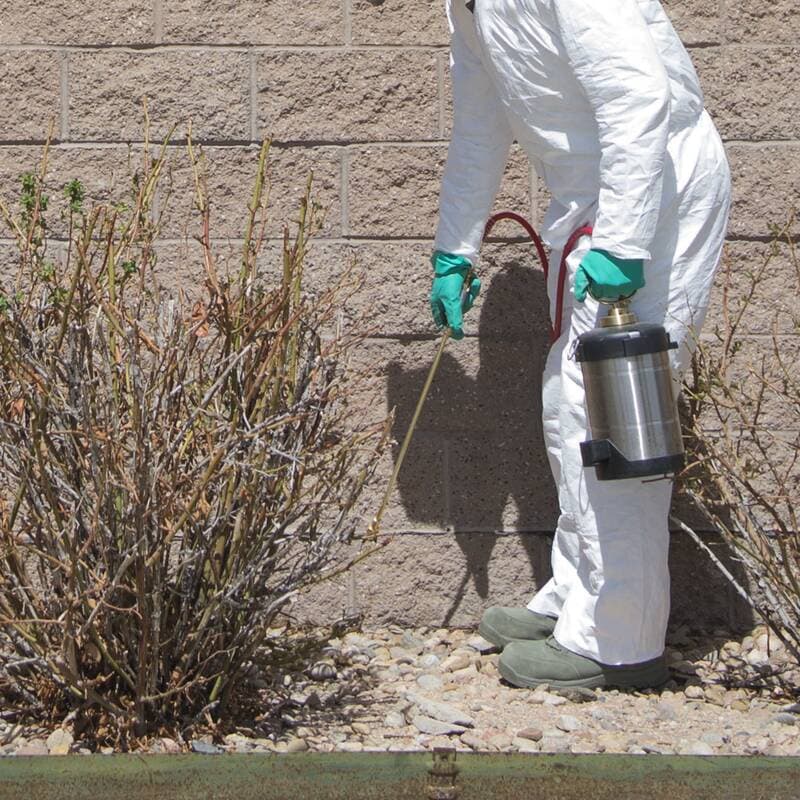
A wasp nest is the cleanest one-time job in the trade because the unit is obvious. The University of California's IPM page on yellowjackets and other social wasps says aerial nests hang from eaves or tree limbs, ground nests commonly use rodent burrows, and yellowjackets sometimes use wall and ceiling voids. Colonies normally live only one season, wasps are most likely to be in the nest at night, and protective clothing covering the entire body, with a veil and gloves, is prudent.
Product is a can. On the Solutions Stores page dated October 18, 2026, a 15 oz can of Stryker Wasp and Hornet Killer (prallethrin 0.1 percent) is $13.63; the page says it works from a safe spraying distance of up to 20 feet, that the best time to treat is in the evening or early morning when wasps and hornets are inactive and resting in their nests, and to treat the nest until completely wet. The price is the ladder and the suit, not the can.
- A per-nest line for a nest reached from the ground or a step ladder.
- A second-story line: an extension ladder, often two people, a veil on every rung.
- A wall-void line priced as an inspection plus treatment.
After-hours pest control: the evening visit is the right visit
Wasps are the one job where the best time to work is outside the office day, because the university page says wasps are most likely to be in the nest at night and the product page says to treat in the evening or early morning, when the colony is home. That is a scheduling fact, not an emergency fee: run a dusk route in summer and the per-nest price covers it. Charge an after-hours line only when a technician leaves dinner for a nest over someone's front door.
Mouse exclusion pricing: trapping visits plus openings sealed
A mouse call is two jobs sold together, and the quote should show both. The University of California's IPM Pest Note on the house mouse, updated July 2025, says mice enter through openings as small as 1/4 inch, that exclusion is the most successful and permanent form of control, that steel wool is a temporary plug that may rust, and that plastic, rubber, vinyl, expanding foam and wood are ineffective; seal cracks and utility openings with metal or concrete. Trapping works well as a first step, with enough traps, no more than about 10 feet apart where mice are active.
Materials are cheap; the count is what you sell. On the Solutions Stores pages dated October 2026, a Victor Professional wooden mouse snap trap is $0.58 each, placed 2 to 3 feet apart along rodent pathways, and a 4 inch by 10 foot roll of Xcluder stainless steel exclusion fabric is $35.31 before freight, cut to fit weep holes, cracked brickwork and the space around pipes and wires.
- Step 1: Walk the foundation, the garage door, the sill plate and every pipe and wire penetration and count each gap wider than a pencil; that count is the exclusion line, per opening.
- Step 2: Set the trap line on the first visit as a flat line that includes the traps.
- Step 3: Quote the trapping as two or three return visits a few days apart to clear, reset and remove the line.
- Step 4: Put exclusion first. Traps without sealing is the customer who calls again in a month.
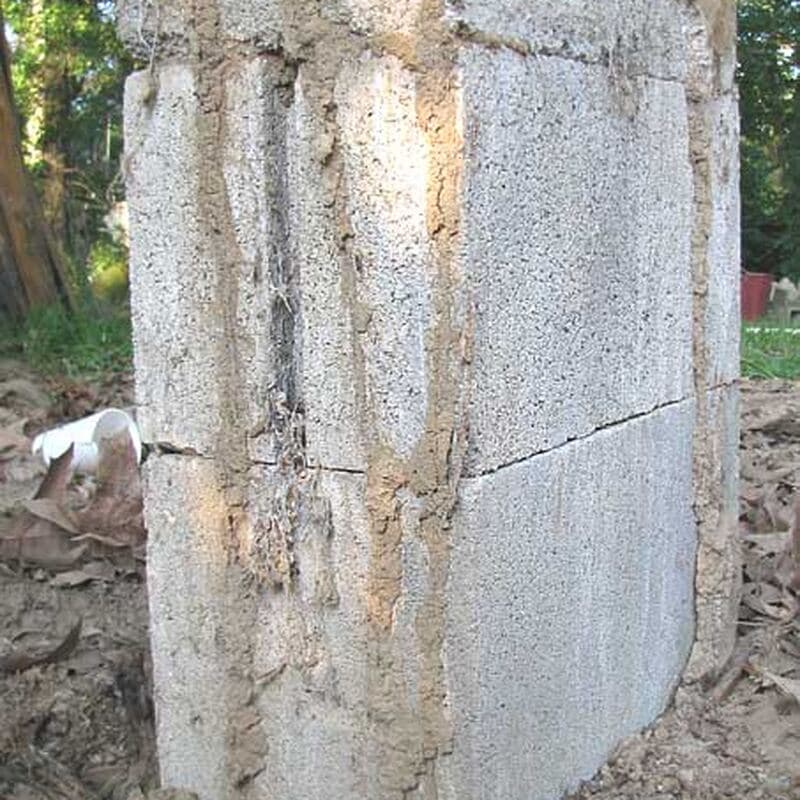
Termites and bed bugs look like one-time calls and are not: quote the inspection as the one-time job and the treatment after it.
Ant treatment price: bait inside, a band outside, a return
Ants are where a one-time price goes wrong most often, because the customer wants a spray and the spray is the part that does not work. The University of California's IPM Pest Note on ants says baits, properly used, are more effective and safer than sprays; that it can take 5 to 10 days to see fewer ants and several weeks or more for complete control; and that spraying around the foundation will not provide permanent control, because it kills only foragers and the ants build back up.
So the ant job is three lines. Bait inside: on the Solutions Stores page dated October 18, 2026, Advion Ant Gel Bait (indoxacarb 0.05 percent) is $25.46 for a pack of four 30 gram tubes, applied as 0.1 to 1.0 gram spots in kitchens, bathrooms, cabinets and under sinks. A band outside: the same distributor's Talstar P page (bifenthrin 7.9 percent) lists four sizes from 16 oz to 1 gallon in a $33.98 to $60.98 range, mixes 1 oz per gallon of water for heavy infestations, covers 1,000 sq ft per gallon of spray and allows a re-treat no more than once every 7 days. And the return, below.
Tip: EPA's do's and don'ts page tells homeowners to ask a hired company to find and correct the source before applying pesticides, to use baits and crack and crevice treatments when feasible, and to write down the name and EPA registration number of any chemical used.
Follow-up visits: price them in instead of giving them away
Every pest above needs a second trip: the ant bait takes 5 to 10 days to show, the trap line has to be pulled, and the dead wasp nest comes down after the colony is gone. A technician who drives back for free turns a profitable call into a break-even one. Write the return as its own line: one visit within two weeks to re-bait, reset or remove, anything new quoted separately. A second return is a new ticket.
Worked example: A one-time ant job on a 180 foot foundation with one return
- Trip, inspection and treatment: 2 hours (your own timing) at the BLS median of $21.75 = $43.50.
- Inside bait: one 30 gram tube from the four-pack, $25.46 ÷ 4 = $6.37.
- Perimeter band: 180 linear ft × a 6 ft band (your own label's width) = 1,080 sq ft, at 1 gallon of spray per 1,000 sq ft = 1.08 gallons.
- Product at the heavy rate: 1 fl oz per gallon × 1.08 gallons = 1.08 fl oz; take the top of the page's range, $60.98, for the 1 gallon jug of 128 fl oz, so $0.48 per fl oz, and 1.08 × $0.48 = $0.52.
- Return in 5 to 10 days, the bait's window: 30 minutes on site plus the drive, call it 1 hour at $21.75.
- Floor before overhead: $43.50 + $21.75 + $6.37 + $0.52 = $72.14 across two trips.
Result: About $7 of product and about $65 of median wage across two visits is the floor. Burden, the truck, the license, insurance, the office and margin go on top; the customer sees a trip line, a bait line, a perimeter line and a return line.
When to sell a quarterly plan instead of another call-out
The university page gives the rule: a foundation spray kills foragers, not the colony, and the ants build back up. The Talstar P page allows a re-treat no more than once every 7 days. A customer who calls twice in one season for the same pest is paying two trips for a problem a scheduled visit would have kept down, and the second call is the moment to say so.
Make the switch easy: the one-time price just paid counts toward the plan's initial service, and a covered pest between visits is a free return. Pricing pest control quarterly plans has the initial-visit math, the per-visit billing and the termite inspection.
Writing the one-time quote so it is approved from a phone
A one-time customer decides fast, usually from a phone, and the quote that wins reads like a receipt: the trip, each flat line with its count, the return and the product named. A photo of the nest before the visit says step ladder or extension ladder before the truck leaves.
In MakeHay, a request form on your website brings in the customer's details, the job site address and their photos, and a request with an address can start a draft quote in one tap. Quote lines are in your own units, so the trip is a flat line and nests and openings are per item; the customer opens the link and approves and signs online, and the approved quote becomes an invoice in one click, paid online by card or bank or recorded as a check at the door. MakeHay is free; online payments carry a processing fee.
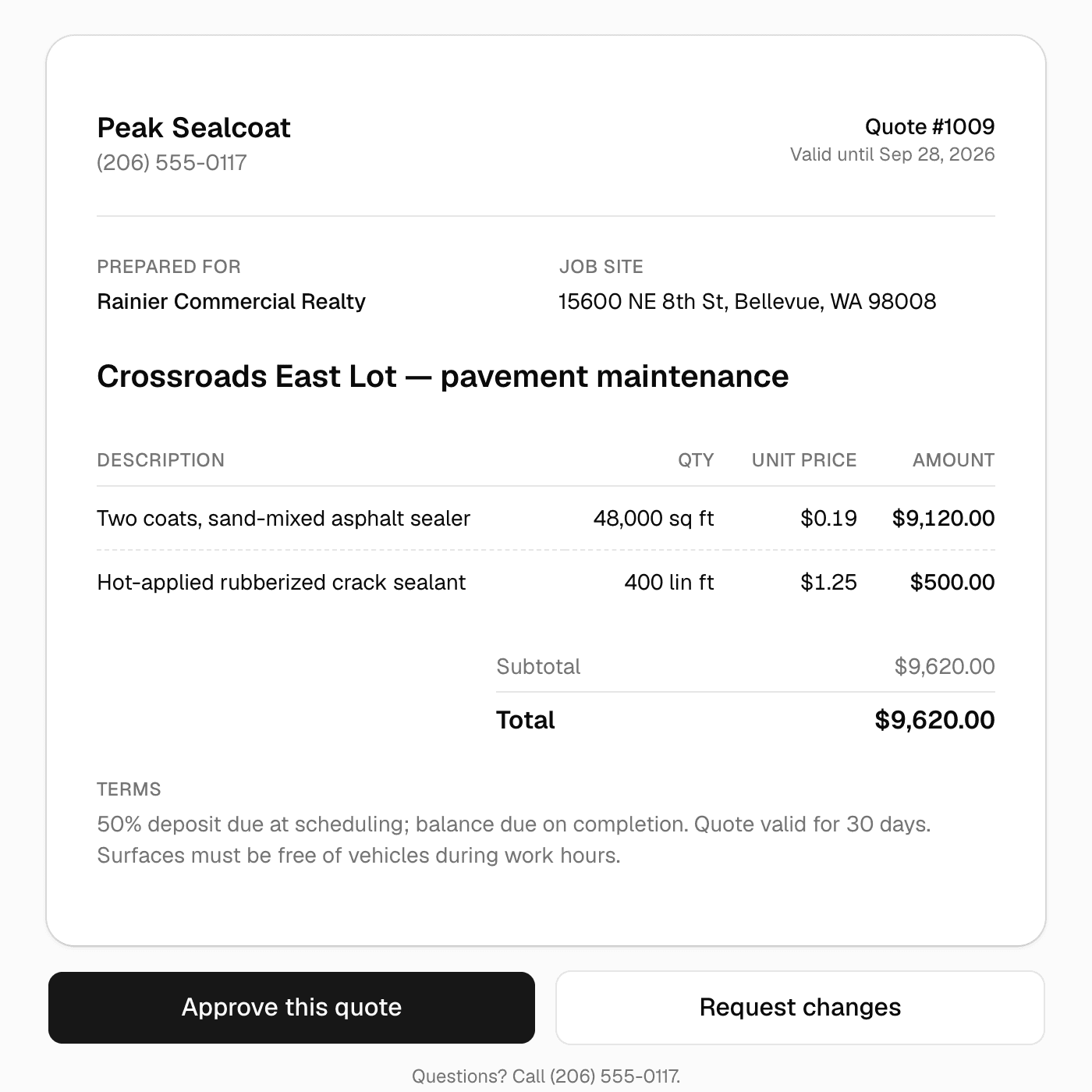
The customer's view of a quote: lines, total, terms and an approve button.
Keep the pest treated, the product and its EPA registration number, the count of nests or openings and the date of the return on the quote and the invoice. That record is what a state inspector asks for and what you open when the address calls next spring.
FAQ
What should a one-time pest control visit include?
The trip (drive, inspection and setup), the treatment priced per nest, per opening or per room, the product named with its EPA registration number, and one return visit within a stated window.
How much product does a wasp nest take?
Part of a can. On the Solutions Stores page dated October 18, 2026, a 15 oz can of Stryker Wasp and Hornet Killer is $13.63, sprays from up to 20 feet and is applied until the nest is completely wet. The job is the ladder, the suit and the dusk visit, not the can.
Why charge for mouse exclusion separately from trapping?
Because they are different work. UC IPM says trapping is a great first step and exclusion is the most successful and permanent form of control, that mice enter through openings as small as 1/4 inch, and that foam, wood and plastic plugs are ineffective. Exclusion is the line that stops the next call.
Should a one-time job include a follow-up visit?
Yes, and the price should say so. UC IPM says ant baits take 5 to 10 days to show fewer ants and several weeks or more for complete control. One return inside the flat rate is a complete job; a second is a new ticket or the start of a plan.
Sources
- Bureau of Labor Statistics, Occupational Outlook Handbook: Pest Control Workers · Median pay $45,250 per year, $21.75 per hour, May 2025 data; employment projected to grow 6 percent from 2025 to 2035; pest control workers inspect buildings for signs of pests, determine the treatment needed, estimate the cost of their services, use baits and traps and apply pesticides; state laws require pest control workers to be licensed, usually after training and an exam; evening and weekend work is common. (accessed October 18, 2026)
- University of California Statewide IPM Program: Yellowjackets and Other Social Wasps, Pest Notes · Updated 03/2012, UC ANR Publication 7450: aerial yellowjackets hang paper nests from building eaves or tree limbs, paper wasps hang open-celled nests under eaves, ground-nesting yellowjackets commonly use rodent burrows and sometimes wall and ceiling voids; "Normally, yellowjacket and paper wasp colonies live only one season"; wasps are most likely to be in the nest at night; "Aerosol formulations of insecticides labeled for use on wasp and hornet nests can be effective"; "It is prudent to wear protective clothing that covers the entire body, including a veil over your face and gloves." (accessed October 18, 2026)
- Solutions Pest and Lawn: Stryker Wasp and Hornet Killer · Retailer product page, price as of 10/18/26: $13.63 for the 15 oz can, freight not included; prallethrin 0.1 percent; used "from a safe spraying distance of up to 20 feet"; "The best time to treat is in the evening or early morning when wasps and hornets are inactive and resting in their nests"; "Treat the nest until it is completely wet"; labeled for outdoor use and in attics and crawl spaces only; insects knocked down quickly and dead within minutes of contact. (accessed October 18, 2026)
- University of California Statewide IPM Program: House Mouse, Pest Notes · Updated 07/2025, UC ANR Publication 7483: mice can enter through openings as small as 1/4 inch and squeeze under gaps 1/4 inch tall and through openings 3/8 inch wide; "Exclusion is the most successful and permanent form of house mouse control"; "Steel wool scouring pads make good temporary plugs but may rust over time"; "Plastic screening, rubber, vinyl, insulating (expanding) foam, wood, and other gnawable materials are ineffective"; seal foundation cracks and utility openings with metal or concrete; "For most situations, trapping works well and is a great first step in controlling house mice"; "Use enough traps to make the trapping period short and decisive"; "space traps no more than about 10 feet apart in areas where house mice are active"; rodenticide baits generally take several days; good housekeeping reduces shelter and food but seldom controls mice on its own. (accessed October 18, 2026)
- Solutions Pest and Lawn: Victor Professional Wooden Mouse Snap Trap M325 · Retailer product page, price as of 10/17/26: $0.58 each; 4 inches long by 1 3/4 inches wide; place un-set traps on common rodent pathways or wherever rodent activity has been seen, with the plastic plate facing the wall; multiple traps placed 2 to 3 feet apart (the page writes the range with a hyphen) and kept in the same spot daily; bait with a high-protein bait such as peanut butter or hazelnut spread, pre-baiting the un-set trap for one or two days; wear gloves when handling traps and bait. (accessed October 18, 2026)
- Solutions Pest and Lawn: Xcluder Rodent Exclusion Fabric · Retailer product page, price as of 10/18/26: $35.31 per roll, freight not included (a separate min and max line on the page reads 42.31); "This single roll is a filled stainless steel fabric that measures 4 inches by 10 feet"; for any void or space a rodent or insect could use to enter the structure, such as weep holes, cracked brickwork and extra space around plumbing and electrical wires, and for voids too big for caulk or sealant; cut with scissors, a razor knife or tin snips and tuck into the gap, pushing it in with a screwdriver; you do not have to fill the void, just enough to keep out the pests. (accessed October 18, 2026)
- University of California Statewide IPM Program: Ants, Pest Notes · Updated 10/2012, UC ANR Publication 7411: "When properly used, baits are more effective and safer than sprays" because foragers carry them back to the colony; "It can take 5 to 10 days to see fewer ants"; control with baits is not immediate and may take several weeks or more to be complete; spraying around the foundation will not provide permanent control because it kills only foraging ants without killing the colony and the queens, and ants quickly build back up and invade again; perimeter treatments pose more risk of environmental upset than baits in bait stations; caulk cracks and crevices around foundations and other sites that provide entry from outside. (accessed October 18, 2026)
- Solutions Pest and Lawn: Advion Ant Gel Bait · Retailer product page, price as of 10/18/26: the pack of four 30 gram tubes at $25.46, freight not included, with an "as low as" line reading $29.90; indoxacarb 0.05 percent; "Apply 0.1 to 1.0 gram spots of Advion Ant Gel or approximately 1/4 of an inch in diameter spots"; lines approximately an eighth of an inch wide and 2 inches long; placement in the kitchen, bathrooms, cabinets, under sinks and weep holes; a slow acting stomach poison, so the time to control varies with consumption; each tube comes with its own plunger and tip. (accessed October 18, 2026)
- Solutions Pest and Lawn: Talstar P Professional insecticide · Retailer product page, price as of 10/18/26: four sizes (16 oz, 32 oz, 3/4 gallon, 1 gallon), a stated price range of $33.98 to $60.98 with only the 16 oz priced on its own at $28.06, freight not included, so which size sits at the top of the range is not stated; bifenthrin 7.9 percent; "For preventive treatment or minor infestations, the rate is 0.33 fl. oz per gallon of water"; "Heavy infestations should be 1 oz. per gallon of water"; 1 fl oz in 1 gallon of water covers 1,000 sq ft; a 1 gallon container yields 128 to 256 gallons of finished solution and can cover 128,000 to 256,000 sq ft; a residual lasting up to 90 days for one listed pest; re-treating should occur no more than once every 7 days when there are signs of new activity; ants, carpenter ants, wasps and yellowjackets are on the target list; the page says to read the label for specific rates. (accessed October 18, 2026)
- US EPA: Do's and Don'ts of Pest Control · Page last updated May 5, 2026: "Always read and follow the pesticide label's instructions and safety warnings"; if hiring outside help, "ask them to find and correct the source of the problem before applying pesticides" and "Ask them to use baits and crack and crevice treatments when feasible"; "Write down the name and EPA registration number of any chemical used by someone you hire." (accessed October 18, 2026)