How to Price Pest Control Quarterly Plans and One-Time Jobs
How to price pest control: quarterly perimeter plans, a higher first visit, product cost from the label mix rate, licensing, termite, wasp and rodent work.
The MakeHay team · · 11 min read
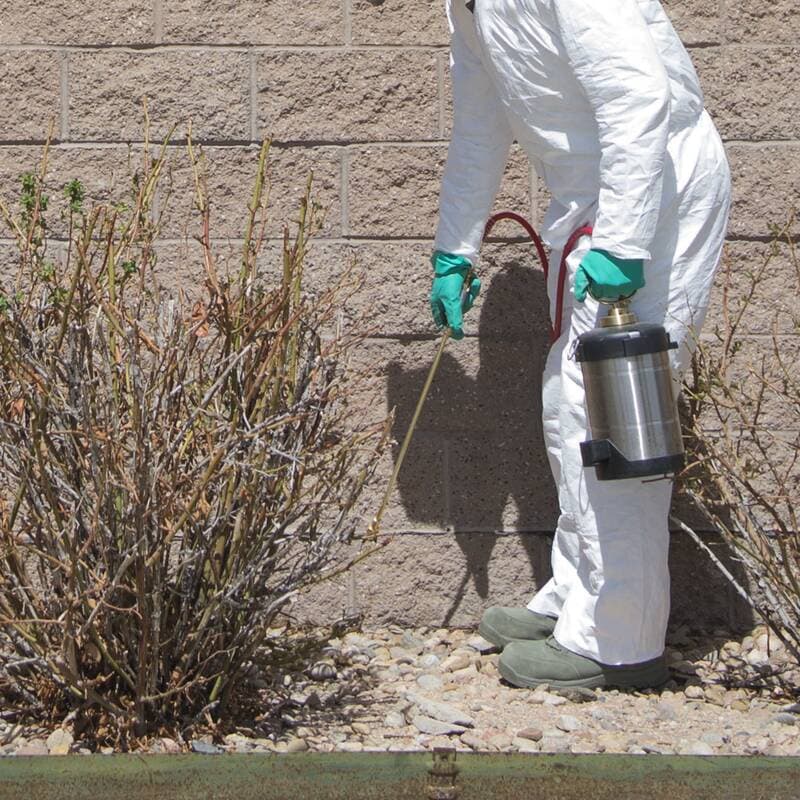
Here is how to price pest control so the quarterly plan carries the company and the one-time calls pay for the drive. Price the recurring visit from a technician's hour and a tank of mixed product, price the first visit higher because it is a different job, and keep termites, wasps and rodents on their own quotes.
Quarterly pest control pricing versus a one-time job
A quarterly plan sells a result over a year: a treated perimeter every three months and a return visit if something shows up inside. A one-time job sells a single visit for a single problem and carries the drive, the inspection and the setup on one ticket, so its visit price is higher.
The label sets the cadence. On the Solutions Stores page for Talstar P, a bifenthrin perimeter product, the barrier treatment gives residual control of up to 90 days, and the page says to re-treat no more than once every 7 days when new activity shows. Four treatments a year at the top of that residual is a quarterly plan; a shorter gap is a bimonthly or monthly plan, and the price moves with the visit count.
Put both on the quote: an initial service plus three recurring visits with re-service included, and beside it the one-time price, which shows why the plan is cheaper per visit. Writing a service quote customers approve covers the layout.
What drives the price: perimeter, pests covered and exclusions
Pest control cost per square foot, or per foot of foundation?
Customers ask for a price by the square footage of the house, but the work follows the perimeter: the spray band is the foundation wall and the strip of ground beside it, so a long ranch takes more product and walking than a two-story on a smaller slab. Price from the linear feet of foundation times the band width your label allows, then quote in the size bands customers understand.
Pests covered, and the ones that are not
The plan names the pests it covers (ants, spiders, roaches, earwigs, the general crawling list) and the ones it excludes. Termites, bed bugs, German roaches in a kitchen, wildlife and stinging insects are separate quotes because each is a different inspection, product or license category. EPA's termite page says firms offering termite services must be licensed by the state, a second reason to keep termites off the general plan.
Why the initial pest control service price is higher
The first visit is a different job: a walk of the whole property, an interior treatment of the kitchen, bath, garage and attic access points, nests knocked down under the eaves, and the heavy rate of product where activity is live. The Solutions Stores page gives 1 fl oz per gallon for heavy infestations against 0.33 fl oz per gallon for prevention, so the first tank carries three times the product of a maintenance tank, and the re-treat it allows after 7 days is a visit the initial price has to cover.
Time it on your own trucks. Price the first visit from the longer time plus the heavier product, and list what it includes so the customer sees why it costs more.
Product cost per application from the label's dilution rate
Product is cheaper than most owners expect. On the Solutions Stores page with prices dated October 18, 2026, Talstar P (bifenthrin 7.9 percent) comes in four sizes from 16 oz to 1 gallon, with a price range of $33.98 to $60.98 before freight; the page states coverage of 1,000 sq ft per gallon of water at 0.33 fl oz for prevention and 1 fl oz for heavy infestations, and says the 1 gallon container yields 128 to 256 gallons of finished spray. Use the rate the label gives for the pest and the pressure, never a heavier one.
Worked example: A quarterly visit on a 200 foot foundation
- Band area: 200 linear ft of foundation × a 6 ft band (3 ft up the wall and 3 ft out, your own label's width) = 1,200 sq ft of treated surface.
- Spray at 1 gallon per 1,000 sq ft: 1,200 ÷ 1,000 = 1.2 gallons of finished spray.
- Product at the heavy rate (initial visit): 1 fl oz per gallon × 1.2 gallons = 1.2 fl oz. Take the top of the retailer's price range, $60.98, as the 1 gallon jug; it holds 128 fl oz, so $60.98 ÷ 128 = $0.48 per fl oz, and 1.2 × $0.48 = $0.57.
- Product at the preventive rate (recurring visit): 0.33 fl oz × 1.2 gallons = 0.4 fl oz, about $0.19.
- Labor at the BLS median: $21.75 an hour × 45 minutes on site and 15 minutes of drive (your own timing) = $21.75 for the hour.
- Floor before overhead: $21.75 + $0.57 = $22.32 on the initial visit; about $21.94 on the recurring visit. Burden, truck, insurance, license fees, office and margin go on top.
Result: Product is under a dollar a visit at either rate and the wage is about $22 for the hour. Everything above about $23 on the recurring visit is burden, overhead and profit, so the quarterly price is a labor decision, not a product one.
Tip: EPA's pest control do's and don'ts page tells homeowners to write down the name and EPA registration number of any chemical a hired company uses. Put both on the service ticket before anyone asks.
Labor and the pest control license requirements behind it
Labor sets the price. The Bureau of Labor Statistics' Occupational Outlook Handbook puts the median pay for pest control workers at $21.75 an hour, $45,250 a year, for May 2025. That is the median wage, not your cost: add payroll taxes, workers' compensation, the truck and the training time before it goes into a visit price.
Licensing is overhead the price has to carry. The same BLS page says state laws require pest control workers to be licensed, usually after training and an exam. EPA's federal certification standards page says anyone who applies or supervises the use of restricted use pesticides must be certified, that commercial applicators must show core knowledge plus at least one category, and that recertification generally means continuing education every 3 to 5 years.
The state layer is more detailed. Texas, for example, licenses the business (current insurance and a renewal fee by the expiration date, or the license lapses), the certified applicator and the technician, registers an apprentice within 10 days of starting training, and requires continuing education every calendar year after the first. Put your state's yearly total, insurance included, into overhead.
Good to know: This is general information, not legal advice. Pesticide and licensing rules change and differ by state; read the current text and ask your state agency before you rely on it.
Termite inspection pricing: a separate visit and a separate quote
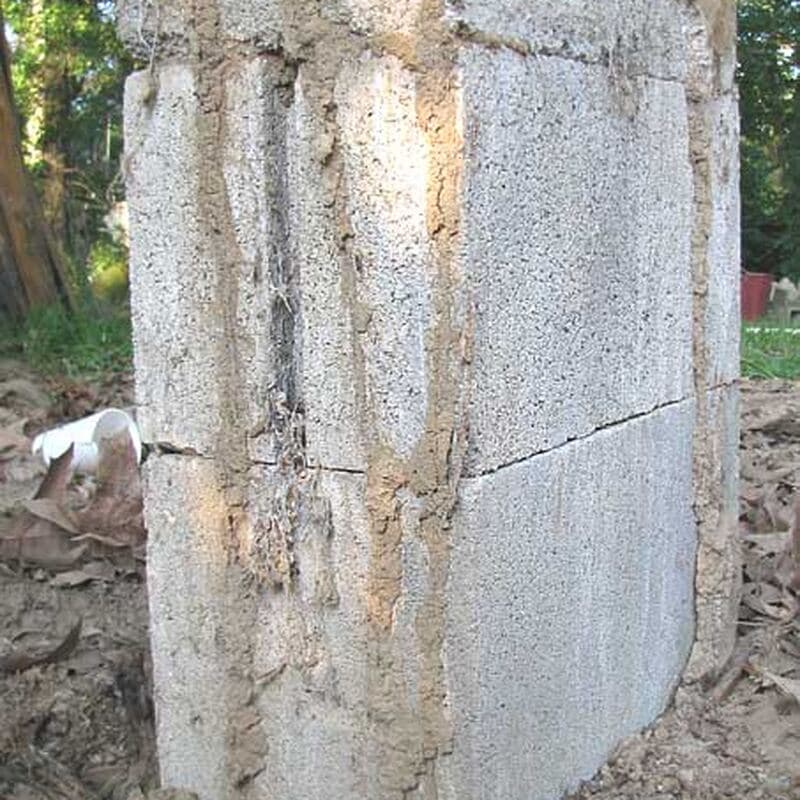
Termite work starts with an inspection, and the inspection is its own ticket. EPA's termite page says they rarely emerge from the soil, mud tubes or the wood they tunnel through, so people often do not know they have them until a swarm or construction exposes damage, and it suggests probing exposed wood for hollow spots with a screwdriver.
Price the inspection as a flat visit, then quote the treatment from what it finds. EPA lists liquid soil-applied termiticides, baits, treated building materials and borate wood treatments, says the soil-applied barrier is the most common, and says termiticide application can in most cases only be properly performed by a trained pest management professional. A barrier is priced from the linear feet of foundation to be trenched and drilled, a bait system from the station count plus the monitoring visits. Product and stations are bought before the visit, so a deposit is normal; how much deposit a contractor should ask for covers the state rules.
Wasp nest removal price and rodent calls as flat jobs
Stinging insects and rodents come in by phone as one-time calls, and both price best as flat jobs with a count. The Texas Apiary Inspection Service says paper wasp nests are typically under eaves, grow to an average diameter of 6 to 8 inches, can hold several dozen wasps, are left empty when the workers die off in winter and are never reused, while mated females overwinter elsewhere and start new nests in spring.
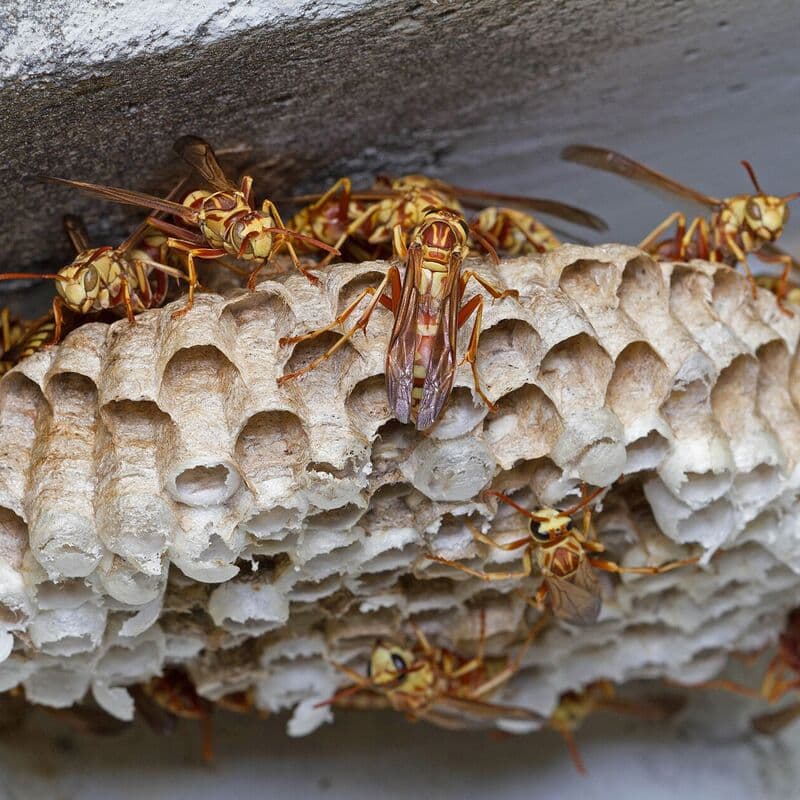
So the wasp price is a trip charge plus a per-nest amount, a ladder surcharge for a second story, and a note that the same spot may host a new nest next spring.
Rodent work is two prices: trapping visits and exclusion. The University of California's IPM page on house mice says mice enter through openings as small as 1/4 inch, that exclusion is the most successful permanent control, that steel wool is a temporary plug that may rust, and that expanding foam, wood and other gnawable materials are ineffective; trapping works well as a first step, close to walls and no more than about 10 feet apart. Price trapping by the visit and exclusion by the opening: count every gap larger than a quarter inch on the walk the quarterly technician already does, times a per-opening price for metal or concrete sealing.
Billing a quarterly plan after each visit
Bill the plan per visit, not per year up front. The customer pays for the visit that just happened, the invoice carries the date and the product, and a customer who cancels mid-year owes nothing beyond the visits done. Put all four visits on the calendar at signup.
In MakeHay the plan is a recurring service: the job repeats on the calendar, each visit is marked done, and an invoice goes out after each one. A customer who saves a card or bank account pays by autopay after each done visit; one-time jobs come from an approved quote that turns into an invoice in one click, and overdue tracking shows who has not paid for the last visit. MakeHay is free; online payments carry a processing fee.
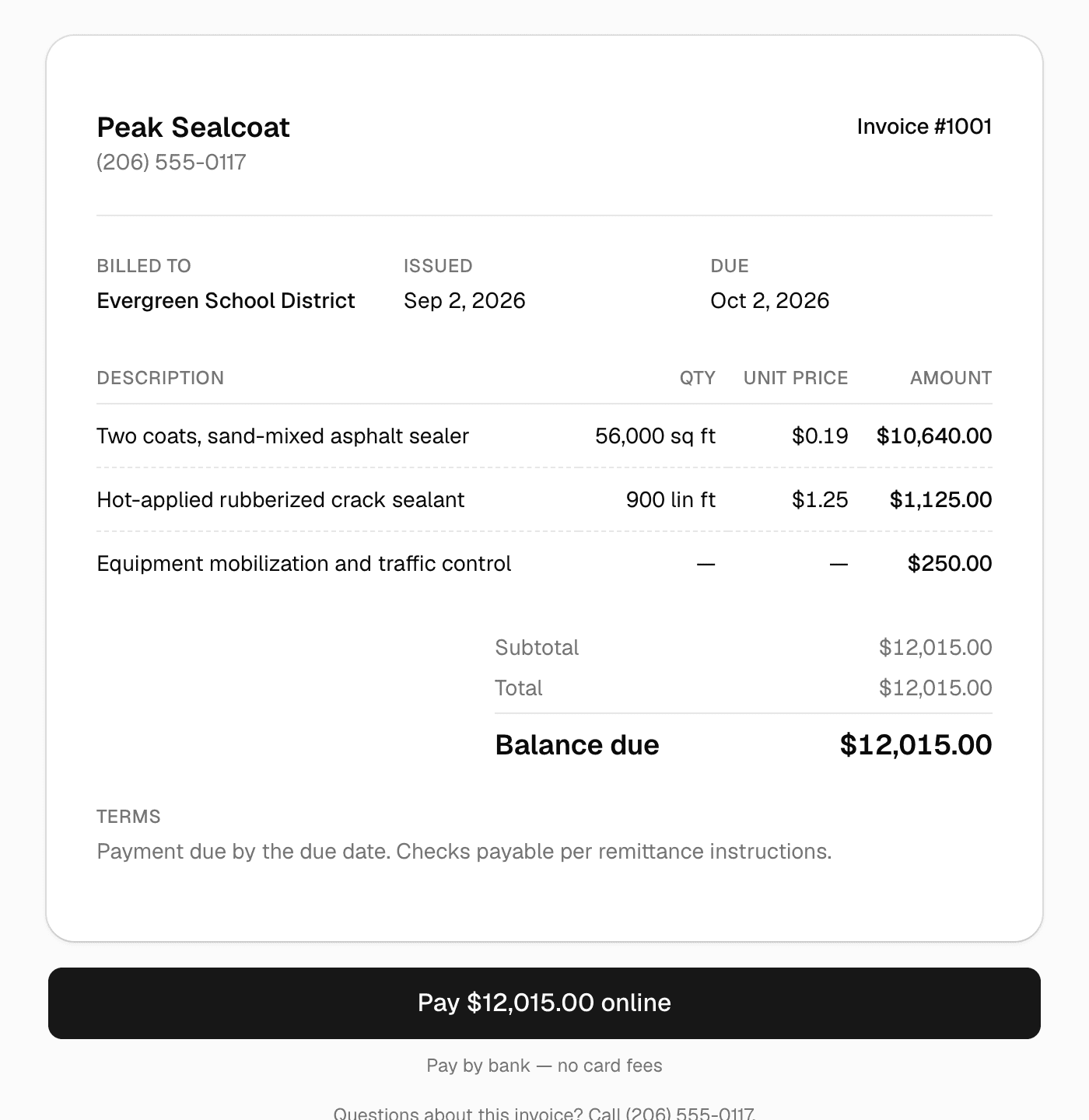
The invoice the customer opens after a visit, with the line items and a way to pay online.
Put the product name and registration number, the visit date and the next scheduled date on every invoice: that is what a state inspector asks for.
FAQ
Should a quarterly plan be billed per visit or per year?
Per visit, after the visit. The customer pays for work that is done, a cancellation owes nothing further, and the invoice is the service record. Price the first visit higher than the three that follow, since it includes the inspection, the interior work and the heavier product rate.
How much product does a perimeter treatment use?
Less than most owners think. On the Solutions Stores page for Talstar P, 1 fl oz per gallon covers 1,000 sq ft at the heavy rate and 0.33 fl oz per gallon at the preventive rate, and the 1 gallon jug, at the top of the page's price range at $60.98, yields 128 to 256 gallons of spray, so a 200 foot foundation uses under a dollar of product.
Do pest control technicians need a license?
Yes. The BLS Occupational Outlook Handbook says state laws require pest control workers to be licensed, usually after training and an exam, and EPA's certification standards page says anyone applying or supervising restricted use pesticides must be certified, with recertification generally every 3 to 5 years.
Is termite treatment part of a general pest plan?
No. It is an inspection first and a separate quote after, priced from the linear feet of foundation for a soil barrier or the station count for a bait system. EPA says firms offering termite services must be licensed by the state.
Sources
- Solutions Pest and Lawn: Talstar P Professional insecticide · Retailer product page, prices dated 10/18/26: four sizes (16 oz, 32 oz, 3/4 gallon, 1 gallon), a stated price range of $33.98 to $60.98 with no price tied to a size (the size selector shows the 16 oz at $28.06), freight not included; active ingredient bifenthrin 7.9 percent; mix 0.125 oz up to 1.0 oz per gallon of water depending on the severity of the infestation, 0.33 fl oz per gallon for preventive or minor infestations, 0.5 oz per gallon for general use, 1 oz per gallon for heavy infestations; 0.33 fl oz or 1 fl oz in a gallon of water covers 1,000 sq ft; the 1 gallon container yields 128 to 256 gallons of finished solution and can cover 128,000 to 256,000 sq ft, the 16 oz bottle yields 16 to 32 gallons; barrier treatment against nuisance pests for up to 90 days; re-treating no more than once every 7 days when new activity shows; not a restricted use product. (accessed October 18, 2026)
- Bureau of Labor Statistics, Occupational Outlook Handbook: Pest Control Workers · Median pay $45,250 per year, $21.75 per hour, May 2025 data; 108,700 jobs in 2025; projected growth 6 percent from 2025 to 2035; high school diploma or equivalent and moderate-term on-the-job training that can usually be completed in less than 3 months; state laws require pest control workers to be licensed, with requirements that vary by state and usually include training and an exam. (accessed October 18, 2026)
- US EPA: Federal Certification Standards for Pesticide Applicators · Federal law and regulations require any person who applies or supervises the use of restricted use pesticides to be certified; a private applicator applies pesticides to produce an agricultural commodity on land they or their employer own or rent, and anyone else is a commercial applicator; commercial applicators must demonstrate core knowledge of pesticide use and safety plus at least one category; states, territories and tribes certify through tests or other EPA-approved systems and may add or delete categories; applicators must be recertified periodically, which generally requires continuing education courses every 3 to 5 years (the page writes the range with a hyphen); page last updated February 26, 2026. (accessed October 18, 2026)
- Texas Department of Agriculture: Structural Pest Control Service licensing · The service licenses and regulates pest management professionals who apply pesticides in and around structures; a business license renews only when current insurance and the renewal fee are received by the expiration date; certified applicator licenses are applied for through the state portal; an apprentice must be registered within 10 days of starting training and pass the technician exam before the registration expires; adding a category takes 40 hours of on-the-job and 8 hours of classroom training; exams administered by a testing contractor from May 19, 2025; continuing education units required each calendar year except the first, by December 31; fee amounts are on a separate page. (accessed October 18, 2026)
- US EPA: Termites, how to identify and control them · Termites rarely emerge from soil, mud tubes or the food sources they tunnel through, so people often do not know they have them until a swarm or construction exposes damage; probe exposed wood for hollow spots with a flathead screwdriver; swarming termites have wings of roughly equal length and straight antennae, ants have longer front wings and bent antennae; in most cases termiticide application can only be properly performed by a trained pest management professional; treatments include liquid soil-applied termiticides, baits, termiticide-treated building materials and wood treatments such as borates, with the soil-applied barrier the most common; improper barrier treatment can contaminate the home and nearby wells; firms offering termite services must be licensed by the state. (accessed October 18, 2026)
- US EPA: Do's and Don'ts of Pest Control · Always read and follow the pesticide label's instructions and safety warnings; using too much of a pesticide can endanger a family's health; if you hire outside help, ask them to find and correct the source of the problem before applying pesticides and to use baits and crack-and-crevice treatments when feasible; write down the name and EPA registration number of any chemical used by someone you hire, and the operator should be able to provide information about it. (accessed October 18, 2026)
- Texas Apiary Inspection Service, Texas A&M AgriLife: Paper Wasps · Nests are typically found under eaves but can be in garages, sheds, barns, shrubbery or any protected area; a nest grows on average to a diameter of 6 to 8 inches and can contain several dozen wasps; in winter the remaining workers die off, the nest is left empty and will never be reused; mated females overwinter elsewhere and start new nests in spring. (accessed October 18, 2026)
- University of California Statewide IPM Program: House Mouse, Pest Notes · Updated 07/2025: mice can enter through openings as small as 1/4 inch, and squeeze under gaps 1/4 inch tall and through openings 3/8 inch wide; exclusion is the most successful permanent control, eliminating gaps larger than 1/4 inch; steel wool makes a good temporary plug but may rust; plastic screening, rubber, vinyl, insulating (expanding) foam, wood and other gnawable materials are ineffective; seal foundation cracks and utility openings with metal or concrete; trapping works well and is a first step, placed close to walls, spaced no more than about 10 feet apart where mice are active, with enough traps to make the trapping period short; good housekeeping reduces shelter and food but seldom controls mice on its own. (accessed October 18, 2026)