How to Price a Concrete Patio or Walkway per Square Foot
How to price a concrete patio or walkway per square foot: square feet to yards, base, mesh, forms, pump access, saw cuts, sealer and three finish tiers.
The MakeHay team · · 11 min read
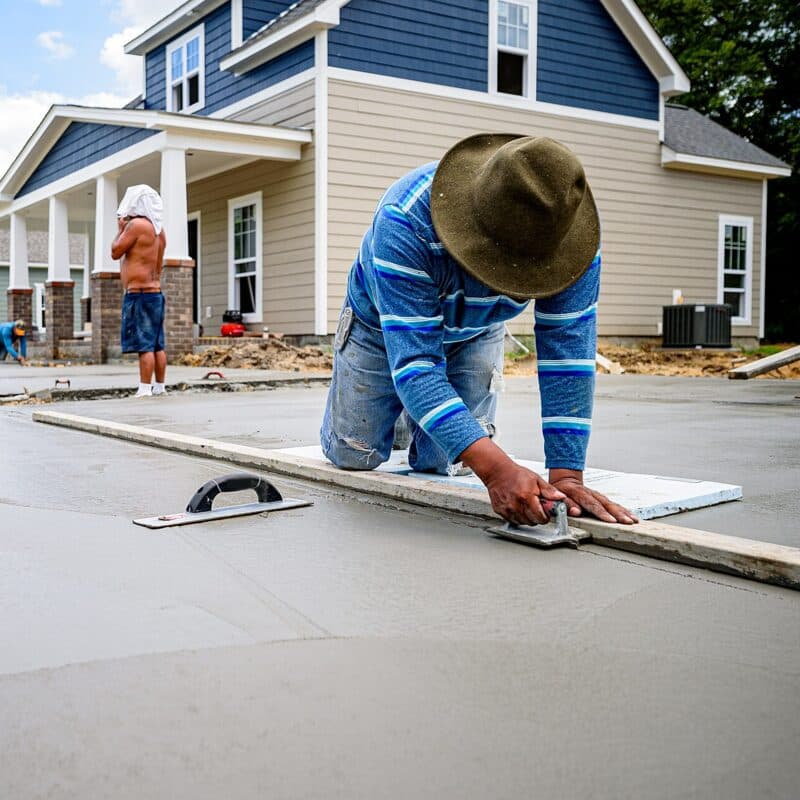
Here is how to price a concrete patio or walkway per square foot so the number still works on pour day. Measure each slab as its own shape, turn square feet into cubic yards, price the concrete delivered, then add base, forms, mesh, saw cuts, sealer, the pump when the truck cannot reach, and finisher time. The finish tier is the customer's choice.
Measure the patio and the walkway as separate shapes
A patio with a walk to the driveway is two jobs on one quote; the walk has more edge, form board and joints per square foot, so it earns its own rate.
- Step 1: Wheel the patio at its longest and widest points; a curved edge saves concrete but not form work.
- Step 2: Wheel the walk end to end and note its width; a walk that bends gets a line per leg.
- Step 3: Note the drop from the house to the yard; fill to reach a door is a base line, not a concrete line.
- Step 4: Photograph the gate and the side yard; the narrowest point decides truck, buggy or pump.
Concrete Network's calculator page says "4 inches is typical for patios, walkways, and driveways," so both shapes get the same thickness unless a vehicle will drive on one; that case is the concrete driveway post.
How many yards of concrete for a patio
The formula on the calculator page is length times width times thickness, all in feet, then "Divide by 27 to convert cubic feet to cubic yards." Four inches is 0.333 feet. The page also says "Never order the exact amount of needed concrete. Include a margin of safety," and its rule is to "add 1/4" to the thickness of your slab for your slab concrete budget," assuming an even, compacted grade.
| Slab | Square feet | Yards at 4 inches | Yards at 4.25 inches |
|---|---|---|---|
| 12 by 12 patio | 144 sq ft | 1.78 | 1.89 |
| Typical patio in the cost guide | 288 sq ft | 3.56 | 3.78 |
| 20 by 20 patio | 400 sq ft | 4.94 | 5.25 |
Price the yards at your plant's delivered rate. Fixr's homeowner survey, updated January 31, 2025, says concrete runs "from $150 to $210 per cubic yard delivered" by strength, with 4,000 psi at $180 to $190, and that "A short load concrete delivery costs $15 to $17 per cubic yard." A 4 yard patio is a short load at most plants, so the fee is its own line on the quote.
Base, forms and mesh: the lines under the slab
Concrete Network's subgrade page says "The entire subbase and base system should be at least 4 inches thick," and that "The key for the soil support system is uniform support rather than strong support." Price the gravel by the ton, the compactor by the day and the spoil by the load.
Forms are priced by the linear foot of edge, which is why the walk costs more per square foot than the patio: a narrow walk is nearly all edge. Straight runs take lumber and stakes; curves take hardboard or plastic bender board, which bends but takes longer to stake and brace, so the curve gets its own rate.
Steel comes from a supplier's page. Ernest Maier lists a welded wire mesh sheet, 5 by 10 feet in 6x6 W1.4/W1.4 at 10 gauge, at $14.95, "Used to reinforce and provide strength to concrete slabs and to control cracking." A sheet covers 50 sq ft, so divide the slab by 50 and add sheets for the laps. The driveway post covers when rebar earns its price instead.
Control joint spacing for a four inch slab
Concrete Network's control joints page spaces joints in feet at no more than two to three times the slab thickness in inches, so a 4 inch slab gets joints 8 to 12 feet apart, and says to "Cut joints 25% of the depth of the slab," which is 1 inch deep on that slab. The American Concrete Institute's answer on saw cutting says "cuts should typically be made within 4 to 12 hours after placing the slab" and "to one-fourth the depth of the slab." A sawn joint is a return trip; a tooled joint goes in during finishing. Draw the joints on the quote and count them, because every joint on a long walk is a cut.
Concrete patio cost per square foot
Concrete Network's patio cost guide, updated January 20, 2026, tiers the market by design; its typical patio is 288 sq ft at an average of $3,200, about $11 per sq ft.
| Tier | Per sq ft | What the guide says it includes |
|---|---|---|
| Plain | $5 to $8 | No decorative finishes or colors |
| Simple | $8 to $11 | One coloring method or decorative technique |
| Custom | $11 to $18 | Two or three colors or a contrasting border |
| Elaborate | $18 and up | Borders, sawcut designs, hand-applied coloring |
Stamped concrete vs broom finish as good, better and best
A broom finish is the plain tier: a broom dragged across the floated surface for grip, no color, stamps or release. Concrete Network calls stamped patios "the most expensive option" and exposed aggregate "more decorative yet still reasonably priced," a natural three-step quote. Its stamped concrete page, reviewed January 26, 2026, prices basic stamping at $10 to $14 per sq ft with "One stamp pattern" and "One color," mid-range at $14 to $20 and high-end at $20 and more; Fixr's homeowner survey, updated January 31, 2025, puts the most common range at $12 to $18. Stamping is slower, with color, release, mats and a second day for the wash and seal, so price that tier from your own stamped hours.
Concrete pump for a backyard patio
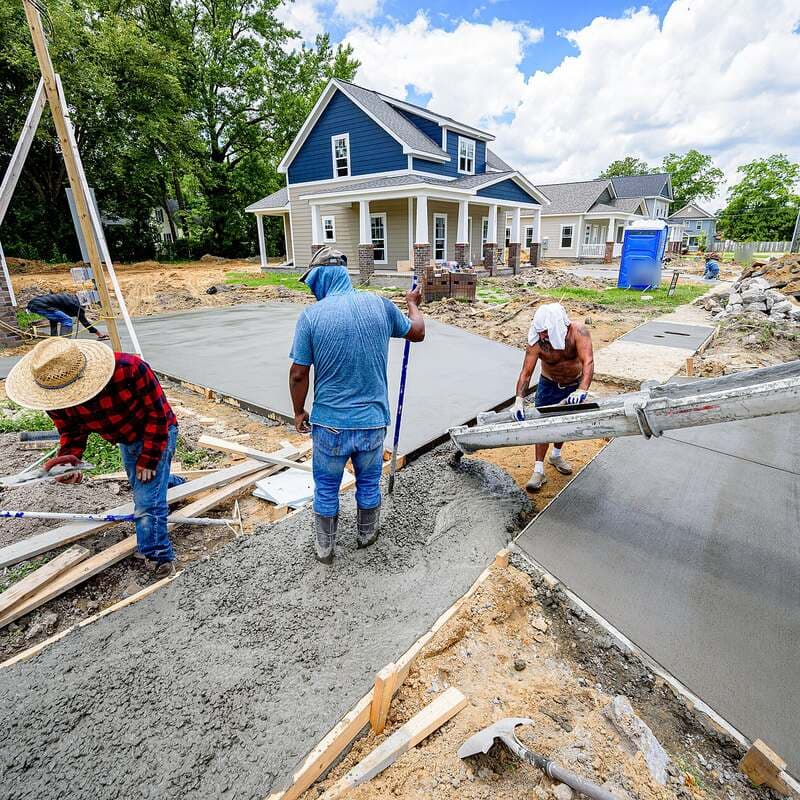
Concrete Network's pumping article says that when a stamped patio goes into a fenced backyard, you must find another way to move the concrete from the truck to the point of placement, and that pumping is sometimes "the only way of getting concrete into certain locations." It describes line pumps as versatile, portable units; for a patio behind a gate that is the usual answer, a trailer unit at the curb and a hose through the gate.
The pump is its own line with the pump company's quote on it, minimum hours and travel stated. The alternative is the wheelbarrow or a power buggy, which is labor: count the trips and the people it takes to keep the truck moving. Name the choice on the quote, "Truck access from the street" or "Line pump through the side gate," so a pour that needs a pump after all is a change, not a loss.
Sealing, finisher time and a worked job
Sealer is a gallon count. Quikrete's page for its Acrylic Concrete Cure & Seal, Satin Finish, says "As a curing compound, apply at 200 sq ft per gallon (4.9 M2/L) to comply with ASTM C 309," applied right after finishing. A decorative seal is different: Concrete Network's patio sealer page says new patios should cure completely, typically at least 28 days, before a sealer goes on in two thin coats, with a service life of three to five years. That seal is a return trip, so price it as one; the reseal is a repeat customer.
Labor starts from the wage. O*NET's page for cement masons and concrete finishers lists a median of $27.41 hourly from Bureau of Labor Statistics 2025 wage data. Your loaded rate adds payroll taxes, insurance and the truck; the hours come from your last three pours.
Worked example: A 12 by 16 patio with a 3 by 30 foot walk, broom finish
- Square feet: 12 × 16 = 192 sq ft of patio, plus 3 × 30 = 90 sq ft of walk, which is 282 sq ft.
- Yards with the quarter inch margin: 282 sq ft × (4.25 ÷ 12) = 99.9 cubic feet; 99.9 ÷ 27 = 3.70 cubic yards, ordered as 4 yards.
- Concrete: 4 yards × $180 to $190 = $720 to $760 at 4,000 psi, plus a short load fee of 4 × $15 to $17 = $60 to $68.
- Mesh: 282 ÷ 50 sq ft per sheet = 5.64 sheets; order 7 for the laps, 7 × $14.95 = $104.65.
- Cure and seal: 282 ÷ 200 sq ft per gallon = 1.41 gallons, two 1 gallon bottles at your price.
- Finisher wages at the median: 3 finishers × 8 hours × $27.41 = $657.84, before payroll burden and markup.
- Known lines: $720 + $60 + $104.65 + $657.84 = $1,542 at the low end and $1,590 at the high end, before base, forms, joints, sealer, overhead and profit.
- Market check at the plain tier: 282 sq ft × $5 = $1,410; 282 × $8 = $2,256.
Result: Concrete, mesh, the short load fee and median finisher wages alone come to about $1,542 to $1,590 for 282 sq ft, against $1,410 to $2,256 at the plain tier, so this broom patio and walk price at the top of the plain band or as the simple tier.
Writing the quote so the customer picks a tier
In MakeHay, a quote carries line items in your units, per sq ft for the slab, per linear ft for the curve, per item for the saw cuts and flat for the pump; the screenshot below shows the quote builder's lines, each with its quantity, unit and package. The broom, exposed and stamped tiers go out as good, better and best packages on one quote, the customer picks one and approves and signs online, a deposit on the quote covers the concrete order, and a patio and walk poured on different days can be billed in stages.
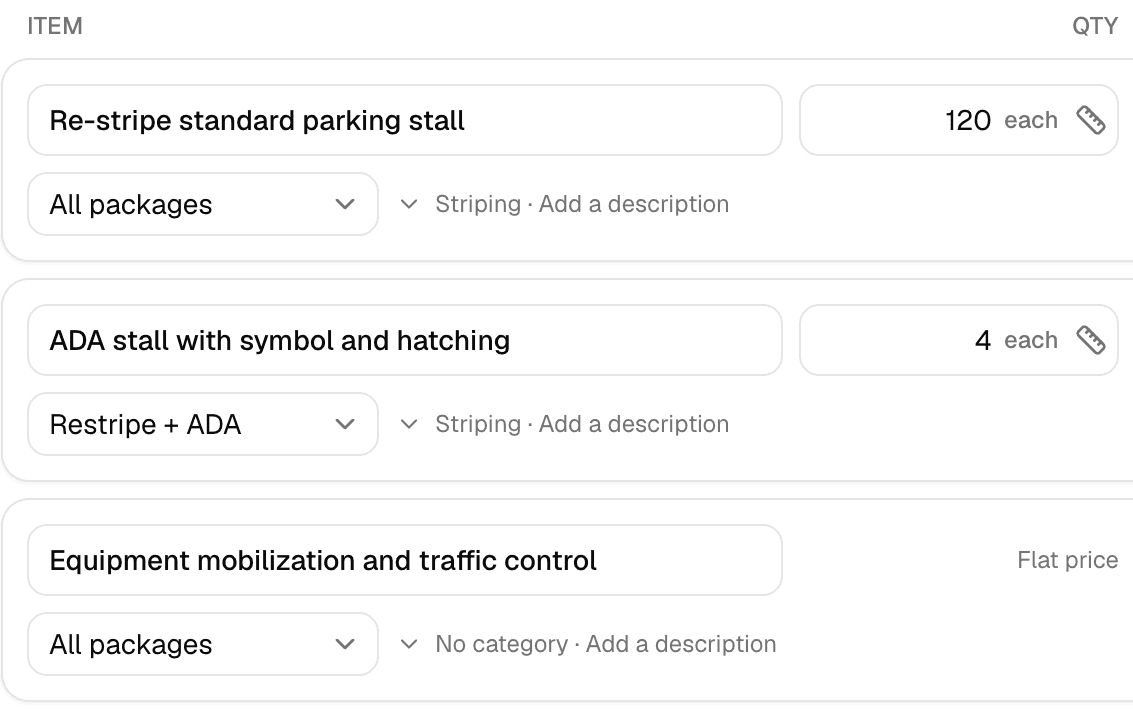
A per item line for every package, a per item line in one package only and a flat price line on the same quote.
How to bill a job in stages covers the deposit, the pour and the seal as three invoices; how much deposit to ask for covers the deposit itself.
FAQ
How wide should a concrete walkway be?
For a walk the public uses to reach a business, the Access Board's guide to the ADA Standards says "The continuous clear width must be at least 36 inches," the running slope "cannot exceed 1:20 (5%)," cross slopes are "1:48 maximum," and the surface must be "firm, stable, and slip resistant." A residential walk has no such rule.
How much does a concrete patio cost?
Concrete Network's patio cost guide, updated January 20, 2026, puts a 288 sq ft patio at an average of $3,200, about $11 per sq ft, and its size chart runs from $900 to $3,000 for a 12 by 12 patio to $3,200 to $7,200 for a 20 by 20. Those are market bands; the concrete, steel, base, pump and finisher hours decide where in the band a job can sit.
When should a new patio be sealed?
A cure and seal goes on right after finishing; Quikrete's page says its Acrylic Concrete Cure & Seal "can be applied immediately after the finishing application." A decorative sealer waits: Concrete Network's patio sealer page says new patios should cure completely, typically at least 28 days, before it goes on in two thin coats, with a service life of three to five years.
Sources
- Concrete Network: Concrete Calculator · The formula is length times width times thickness for cubic feet, then "Divide by 27 to convert cubic feet to cubic yards"; "4 inches is typical for patios, walkways, and driveways"; "Never order the exact amount of needed concrete. Include a margin of safety"; "add 1/4" to the thickness of your slab for your slab concrete budget" assuming an evenly graded, well compacted grade; the 4 inch shortcut "Take the total square footage of the job and divide it by 81 to get the number of cubic yards you need"; updated September 24, 2026. (accessed October 18, 2026)
- Fixr: How Much Does Concrete Delivery Cost? · Homeowner survey (consumer cost guide): concrete "ranging from $150 to $210 per cubic yard delivered" by strength; the table lists 4,000 PSI at $180 to $190 per cubic yard delivered; "A short load concrete delivery costs $15 to $17 per cubic yard"; the minimum order depends on the supplier; updated January 31, 2025. (accessed October 18, 2026)
- Ernest Maier: Welded Wire Mesh Sheet · "Welded Wire Mesh Sheet," "5'x10' Sheet," "6x6 W1.4/W1.4," "10 Ga Wire," listed at $14.95; "Used to reinforce and provide strength to concrete slabs and to control cracking"; supplier listing on October 18, 2026. (accessed October 18, 2026)
- Concrete Network: Subgrades and Subbases for Concrete Slabs · Subgrade is the native or improved soil, usually compacted, and subbase is a layer of gravel on top of it; "The entire subbase and base system should be at least 4 inches thick"; "The key for the soil support system is uniform support rather than strong support"; a slab that settles more in one part than another bends; last updated July 31, 2018. (accessed October 18, 2026)
- Concrete Network: Control Joints in Concrete Slabs · Joints are spaced in feet at no more than two to three times the slab thickness in inches, so a 4 inch slab gets joints 8 to 12 feet apart; "Cut joints 25% of the depth of the slab," so a 4 inch slab gets joints 1 inch deep; in hot weather the concrete might crack if joints are not cut within 6 to 12 hours after finishing; updated July 1, 2021. (accessed October 18, 2026)
- American Concrete Institute: When should saw cuts be made on a concrete slab? · ACI technical question: "cuts should typically be made within 4 to 12 hours after placing the slab"; "In hot weather, saw cuts may need to be placed within 1 hour"; "Conventional saw cuts should generally be made to one-fourth the depth of the slab." (accessed October 18, 2026)
- Concrete Network: Concrete Patio Cost · Plain design $5 to $8 per square foot with "No decorative finishes or colors"; simple design $8 to $11, "May include one coloring method or decorative technique"; custom design $11 to $18, "May include two or three colors or a contrasting border"; elaborate design "$18+ per square foot" with borders, sawcut designs and hand-applied coloring; a typical 288 sq ft patio "costs an average of $3,200," about $11 per sq ft; size chart 12x12 $900 to $3,000, 10x20 $1,200 to $3,600, 20x20 $3,200 to $7,200; stamped patios are "the most expensive option" and exposed aggregate is "more decorative yet still reasonably priced"; "Updated January 20, 2026 by Sarah Hutchinson." (accessed October 18, 2026)
- Concrete Network: How Much Does Stamped Concrete Cost? · Basic $10 to $14 per square foot with "One stamp pattern" and "One color"; mid-range $14 to $20 per square foot with borders, contrasting patterns and multiple colors; high-end "$20+ per square foot" with multiple patterns and colors, specialty scored designs and hand-coloring; reviewed January 26, 2026 by Sarah Hutchinson. (accessed October 18, 2026)
- Fixr: How much does it cost to lay a stamped concrete patio? · Homeowner survey (consumer cost guide): "The most common average range of costs for designs is between $12 and $18 per square foot"; basic designs $8 to $12 per square foot; complex designs $18 to $30 per square foot; "Stamped concrete patio costs range from $2,400 to $5,600, with a national average of $3,073"; updated January 31, 2025. (accessed October 18, 2026)
- Concrete Network: Concrete Pumping · When a stamped patio goes into a fenced backyard, or a floor into an enclosed building, another way must be found to move the concrete from the truck to the point of placement; pumping is sometimes "the only way of getting concrete into certain locations"; line pumps are versatile, portable units; boom trucks are self-contained units of a truck, a frame and the pump. (accessed October 18, 2026)
- Quikrete: Concrete Sealers, Acrylic Concrete Cure & Seal, Satin Finish (No. 8730) · "As a curing compound, apply at 200 sq ft per gallon (4.9 M2/L) to comply with ASTM C 309"; "When used as a sealer, coverage will depend on porosity of surface"; sold in 1 gallon bottles and 5 gallon pails; "The sealer can be applied immediately after the finishing application." (accessed October 18, 2026)
- Concrete Network: Concrete Patio Sealer · "New concrete patios should be allowed to cure completely before sealer application (typically at least 28 days)"; apply two thin coats and follow the manufacturer's coverage rates; a sealer's service life is three to five years depending on traffic and exposure; a solvent- or water-based acrylic is the primary type on decorative patios; updated March 17, 2021. (accessed October 18, 2026)
- O*NET OnLine: Cement Masons and Concrete Finishers · Wages: "$27.41 hourly" and "$57,020 annual" median, from Bureau of Labor Statistics 2025 wage data. (accessed October 18, 2026)
- U.S. Access Board: Guide to the ADA Standards, Chapter 4, Accessible Routes · Walking surfaces on accessible routes: "The continuous clear width must be at least 36 inches"; "The running slope of walking surfaces cannot exceed 1:20 (5%)"; "Cross slopes must be 1:48 maximum"; "All surfaces of accessible routes must be firm, stable, and slip resistant." (accessed October 18, 2026)