How to Price Asphalt Driveway Paving per Square Foot
How to price asphalt driveway paving per square foot: area, overlay or full depth, tons from the formula, the plant's price, base, removal, crew, roller.
The MakeHay team · · 11 min read
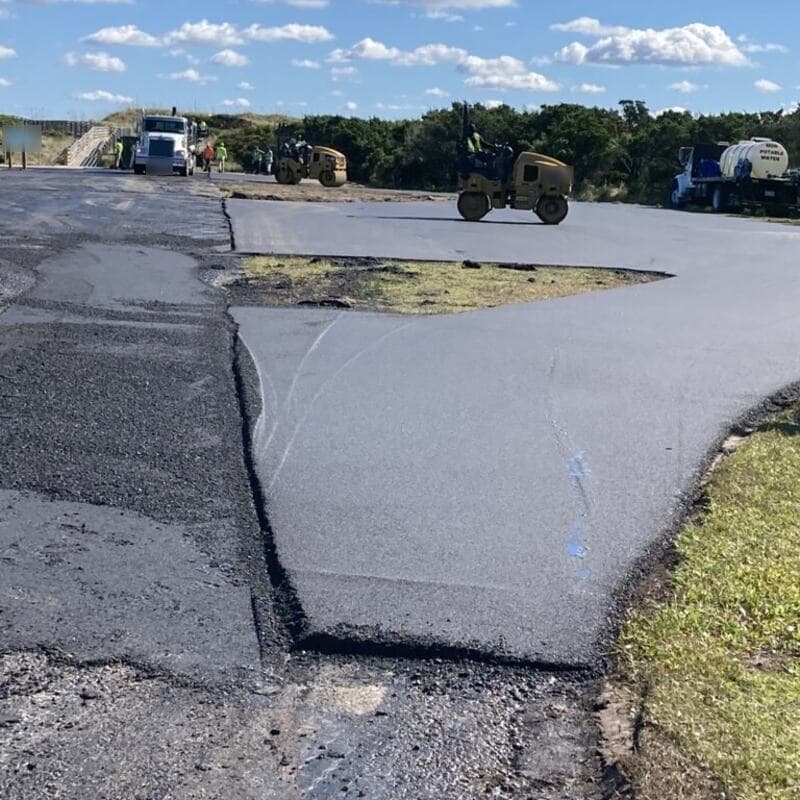
Here is how to price asphalt driveway paving per square foot without guessing at a market number. Measure the area, settle overlay or full depth with the customer, turn area and thickness into tons at the plant's dated quote, then add base, removal, the crew day, the paver and roller, trucking and your margin. The total divided by the square feet is the price for that driveway, not for driveways in general.
How to price asphalt driveway paving: the six numbers
Every driveway price is six numbers added up: square feet, compacted thickness, tons of mix at the plant's price, base and removal, the crew and machine day, and trucking. The per square foot figure is the result, which is why a straight drive and a smaller one with a turnaround and a hand-raked edge land at different prices.
- Step 1: Measure: length times width for the straight run, plus the apron, the turnaround and the garage pad as their own rectangles.
- Step 2: Agree overlay or full depth, and write the compacted thickness on the quote.
- Step 3: Run the tonnage formula, add waste, round up, and price the tons at the plant's dated quote.
- Step 4: Add base, removal and the dump fee, the crew day, the paver and roller, and trucking; divide by the square feet.
Asphalt overlay vs new driveway: settle the thickness first
The Illinois Asphalt Pavement Association's driveway page draws the line. For an existing driveway in fair shape, a surface course 1.5 to 2 inches thick will usually suffice. For a new driveway, "A 4-inch thickness may be adequate, but 5 or even 6 inches of full-depth asphalt will assure you of a stronger, stable driveway," and some contractors instead "use 6 to 8 inches of compacted aggregate, or gravel, as a base under 3 inches of asphalt pavement."
| Job | Asphalt | Under it |
|---|---|---|
| Overlay on a sound driveway | 1.5 to 2 inches | The existing pavement |
| Full-depth asphalt, minimum | 4 inches, as 2.5 inches then the rest | Firm, dry subgrade |
| Full-depth asphalt, stronger | 5 or 6 inches | Firm, dry subgrade |
| Asphalt over aggregate | 3 inches | 6 to 8 inches of compacted aggregate |
The page gives the trade: "1 inch of asphalt pavement is equivalent to 3 inches of aggregate base." Two inches of asphalt taken out of a full-depth drive comes back as six inches of stone, graded and compacted. Price both sections and let the customer pick.
Write the compacted thickness, not the loose one. The association says a contract should spell out who is responsible "for compacting the subgrade and base, for measuring compacted pavement thicknesses." A customer who reads 3 inches and cores 2.25 inches is a dispute.
Asphalt tonnage for a driveway: area times thickness
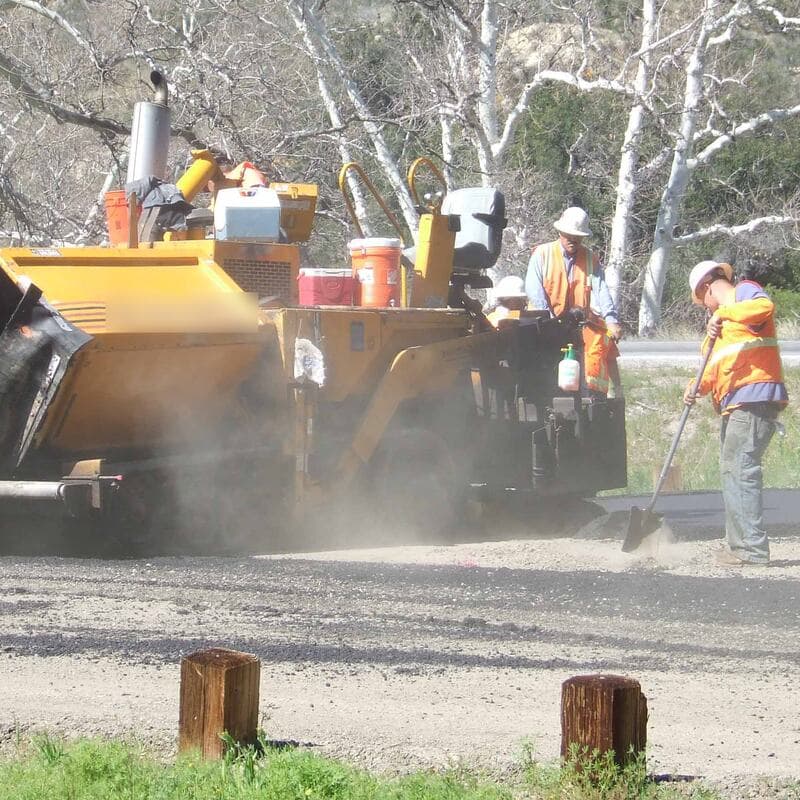
Mix is sold by the ton, so the quantity on the quote is tons. The formula and its constants are in how to calculate asphalt tonnage: tons equals square feet divided by 9, times compacted inches, times 110 lb per square yard per inch, divided by 2,000. Add a waste allowance you can defend, larger where the crew hand-rakes an apron or a drain, then round up to whole tons because the plant bills the scale ticket. A full-depth drive goes down in two lifts, which is two passes of the paver and two rounds with the roller for the same tons.
| Compacted thickness | Tons per 100 sq ft | Tons for 600 sq ft |
|---|---|---|
| 1.5 inches (overlay) | 0.92 | 5.5 |
| 2 inches (overlay) | 1.22 | 7.3 |
| 3 inches (over aggregate) | 1.83 | 11.0 |
| 4 inches (full depth) | 2.44 | 14.7 |
What the mix costs: the plant quote and the state index
There is no national price for hot mix. The number on your quote is the plant's price per ton for the mix the job needs, picked up or delivered, for the week you will pave. Get it in writing with a date, and ask whether a partial load pays for a full trip, because on a small driveway the last ton can cost more than the first.
What a state index shows is how fast the binder inside that price moves. Georgia DOT's asphalt cement price index sat between $571 and $585 a ton through all of 2025, then went from $559 in March 2026 to $653 in April, $721 in June and $704 in October. A driveway quoted in March and paved in May lost money on the mix.
Tip: Give the price a life on the proposal: "Mix priced from the plant's quote of (date); good for 30 days." An expired proposal gets re-priced, not argued over.
Base gravel, removing the old driveway and the dump fee
Base is priced from the quarry ticket. Depth times area gives the volume: 6 inches of aggregate under 600 sq ft is 300 cubic feet, about 11 cubic yards before compaction, at the quarry's price per yard or ton. Add the grading and compaction hours, and the association's rule for the subgrade: paving waits until the soil under the stone is "firm and dry."
Removal is its own line: machine time to break and load the old surface, the trip and the gate fee. Larimer County, Colorado's 2026 landfill fee schedule charges rubble, a category that names concrete and asphalt, at $40 per cubic yard plus a Colorado surcharge of $1.16 per cubic yard on commercial loads. A 600 sq ft driveway at 2 inches is 100 cubic feet in place, under 4 cubic yards before it bulks in the truck. Your own landfill or recycler sets the number; some take clean asphalt for less, so ask first.
Paver and roller rental cost, and the crew day
If you own the paver and the roller, the day rate is what the payment, insurance, fuel and maintenance cost per working day. If you rent, use the counter's number. On the DOZR rental marketplace's Rochester, New York page, a 34 inch double drum roller listed at $366 a day and $1,077 a week, a 54 inch at $494.40 a day and a 64 inch at $1,195.20 a day in October 2026. Rates vary by city and yard; the page is a reference, not your price.
Labor is hours times wage times burden. O*NET's tables of 2025 BLS wage data give national medians of $25.64 an hour for paving, surfacing and tamping equipment operators, $28.78 for operating engineers and other construction equipment operators, and $22.66 for construction laborers. The spread runs $18.38 to $44.34 an hour for paving operators, so your own payroll beats the median; add payroll taxes, workers' compensation and insurance before the hours go on the quote.
Asphalt paving temperature, wind and the season
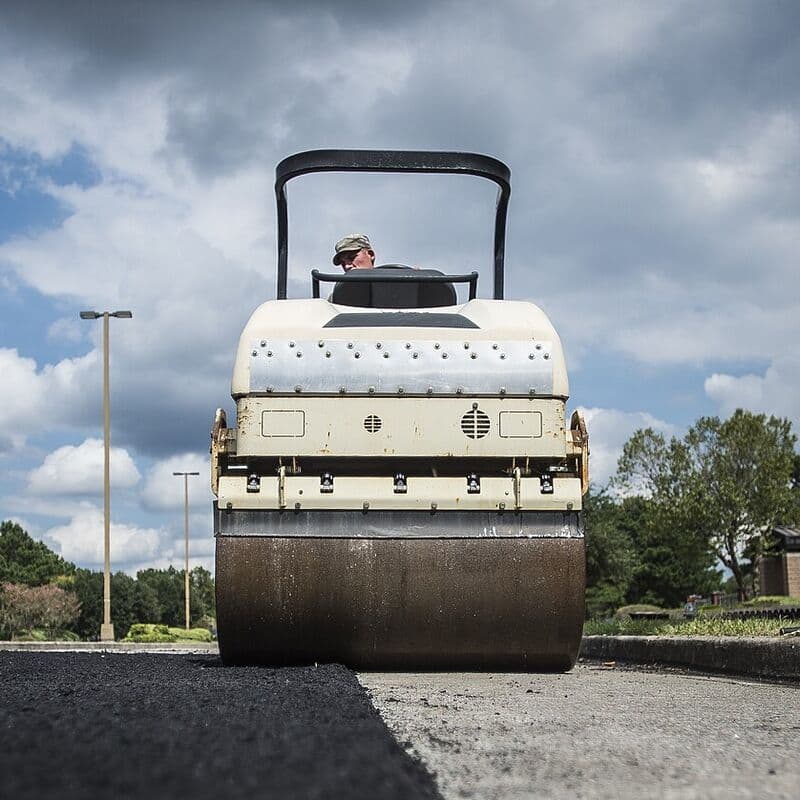
The association's page says the main concern about when to pave is temperature, by lift: for a 1.5 inch lift "the air and surface temperatures should be above 70°F," and for a 2 inch lift "above 40°F." The reason is working time: its table runs from a 300°F delivery temperature to a 175°F final one and allows "at the very least 20 minutes" to place and compact a lift, with wind under 10 mph; each additional 10 mph takes "about 5 to 10 minutes" off. A thin overlay is a summer job; a cold, windy day is a day to move.
Worked example: A 600 sq ft driveway, 3 inches of asphalt over new aggregate, old surface removed
- Area: 50 ft × 12 ft = 600 sq ft.
- Tons: 600 ÷ 9 = 66.67 sq yd × 3 inches × 110 ÷ 2,000 = 11.0 tons; with 5 percent waste, 11.55, ordered as 12 tons.
- Mix: 12 tons × the plant's dated price per ton. Every $10 per ton on that quote is 12 × $10 ÷ 600 = $0.20 per sq ft.
- Base: 600 sq ft × 0.5 ft = 300 cubic feet, about 11 cubic yards at the quarry's price, plus the hours to grade and compact.
- Removal: 600 sq ft × 2 inches of old asphalt = 100 cubic feet, quoted as 4 cubic yards × Larimer County's $41.16 = $164.64, plus machine time and the trip.
- Crew: $28.78 + $25.64 + 2 × $22.66 = $99.74 an hour in median wages; 8 hours = $797.92 before burden.
- Roller: $366 for the day at the Rochester marketplace rate; the paver at your own day rate.
- Known so far: $797.92 + $366 + $164.64 = $1,328.56, or $2.21 per sq ft.
Result: $2.21 per sq ft from labor, the roller and the dump fee alone, with 12 tons of mix, 11 cubic yards of base, the paver, trucking, burden and margin still to add; the sum divided by 600 is this driveway's price per square foot.
Asphalt driveway cost per square foot: putting it on the quote
Show the sections, not just the total: an overlay and a full-depth rebuild, each at its thickness with a per square foot line and the removal and base lines underneath. The association tells homeowners to "obtain at least two bids" and to ask for "written proof" of liability insurance, so the quote that states compacted thickness and attaches the certificate reads as the professional's.
In MakeHay, a quote carries line items in your units, per square foot for the paving and per item or flat for the rest, and good/better/best packages put the overlay and the rebuild side by side on one document. The square feet can come from a satellite trace of the driveway, and the mix money from a deposit on the quote before the plant is paid; how much deposit to ask for covers the state rules.
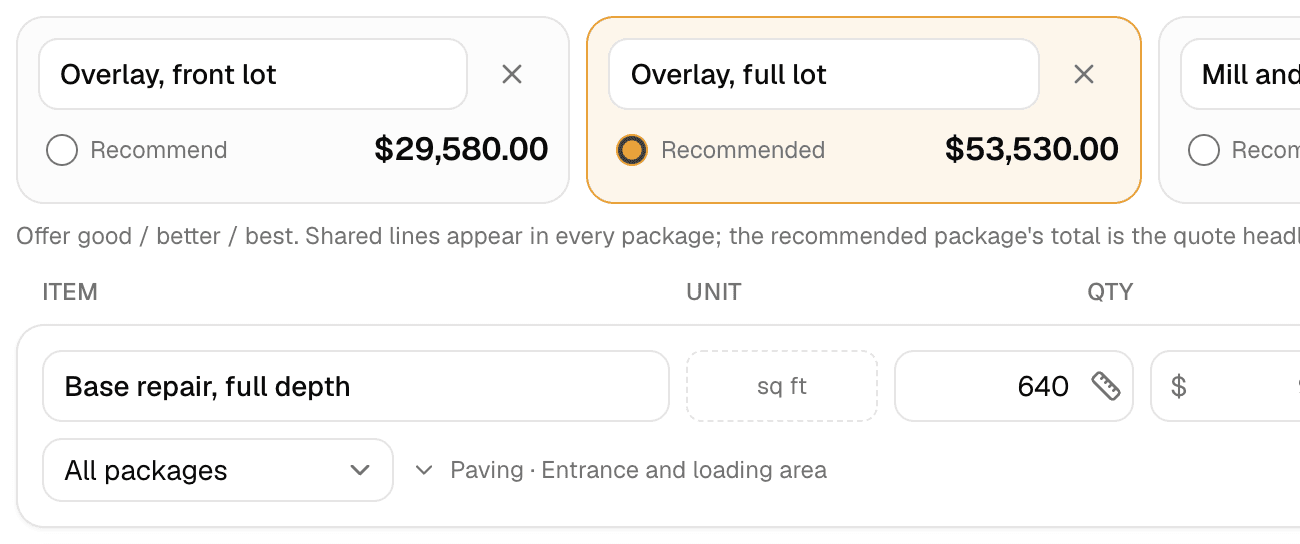
Packages on one quote let the customer choose the section with the numbers in front of them.
Small driveways are where the arithmetic bites: the plant's minimum load, the paver's move, the roller's day and the dump trip cost about the same on 400 sq ft as on 1,200. Set a minimum charge that covers the fixed day, or book two small driveways on one street for the same morning. A patching price list handles jobs too small for the paver, and sealcoating is the return visit in a year or two.
FAQ
How thick should an asphalt driveway be?
The Illinois Asphalt Pavement Association puts an overlay on a sound driveway at 1.5 to 2 inches, a new full-depth driveway at 4 inches at least and stronger at 5 or 6, or 3 inches of asphalt over 6 to 8 inches of compacted aggregate. Quote compacted thickness.
Is there an asphalt driveway minimum job size worth taking?
There is no published floor; the floor is your fixed day. The plant's minimum load, the machine move, the crew's travel and the dump trip add up to what the smallest driveway pays before any square footage is priced. Jobs under it get a minimum charge, a shared morning with a neighbor's driveway, or a patching price.
Why did the plant's price change between the quote and the job?
The binder moved. Georgia DOT's asphalt cement index went from $559 a ton in March 2026 to $653 in April and $721 in June after a flat 2025. Date the plant's quote on the proposal and give the price a life, so a late customer gets a re-price rather than an argument.
What temperature is too cold to pave a driveway?
The Illinois association's guide wants air and surface temperatures above 70°F for a 1.5 inch lift and above 40°F for a 2 inch lift, because the crew needs at least 20 minutes to place and compact a lift before it cools. Wind over 10 mph takes 5 to 10 minutes off that for every extra 10 mph.
Sources
- Illinois Asphalt Pavement Association: Driveways · States that "A 4-inch thickness may be adequate, but 5 or even 6 inches of full-depth asphalt will assure you of a stronger, stable driveway"; that some contractors "use 6 to 8 inches of compacted aggregate, or gravel, as a base under 3 inches of asphalt pavement"; that "1 inch of asphalt pavement is equivalent to 3 inches of aggregate base"; that for driveways a surface course of one and a half to 2 inches "will suffice"; that a 4 inch mat is placed as two and a half inches, compacted, "and then pave the remainder and compact again"; that a one and a half inch lift needs air and surface temperatures "above 70°F" and a 2 inch lift "above 40°F", allowing "at the very least 20 minutes" to place and compact a lift, based on 300°F delivery and 175°F final temperatures and wind under 10 mph, less "about 5 to 10 minutes for every additional 10 mph of wind speed"; that the subgrade must be "firm and dry"; that a contract should cover "the responsibility for grading work and accuracy" and "for compacting the subgrade and base, for measuring compacted pavement thicknesses"; "Ask for written proof" of liability insurance; "obtain at least two bids". Page copyright 2026. (accessed October 18, 2026)
- Georgia Department of Transportation: Asphalt Cement and Fuel Price Index · Asphalt cement price index in dollars per ton: 2025 from $575 in January to $585 in August and $571 in December; 2026 January $566, February $561, March $559, April $653, May $687, June $721, July $719, August $719, September $714, October $704; the page says payments on eligible projects use the Georgia Base Asphalt Price. (accessed October 18, 2026)
- O*NET OnLine: Paving, Surfacing, and Tamping Equipment Operators (47‑2071), wages · 2025 wage data from the Bureau of Labor Statistics: national hourly median $25.64, annual median $53,340; 10 percent of workers earn $18.38 or less per hour and 10 percent earn $44.34 or more. (accessed October 18, 2026)
- O*NET OnLine: Operating Engineers and Other Construction Equipment Operators (47‑2073), wages · 2025 wage data from the Bureau of Labor Statistics: national hourly median $28.78, annual median $59,850; 10 percent earn $20.28 or less per hour and 10 percent earn $48.60 or more. (accessed October 18, 2026)
- O*NET OnLine: Construction Laborers (47‑2061), wages · 2025 wage data from the Bureau of Labor Statistics: national hourly median $22.66, annual median $47,120; 10 percent earn $16.87 or less per hour and 10 percent earn $37.54 or more. (accessed October 18, 2026)
- DOZR: Asphalt Compaction Double Drum rentals in Rochester, NY · Rental marketplace listing, priced for a two-day rental window in October (the page's default search dates), "Price based on availability": 34 inch drum, supplier network, $366 daily, $1,077 weekly, $2,736 for four weeks (Hamm HD8, BOMAG BW 900, BOMAG BW 90 AD-5, Cat CB1.7 named as possible models); 54 inch drum $494.40 daily from the supplier network; 64 inch drum $1,195.20 daily from the supplier network. Copyright 2026. (accessed October 18, 2026)
- Larimer County, Colorado: 2026 Landfill Fee Schedule · Rubble, "concrete, dirt, sod, asphalt, tree trunks, sludge, non-friable asbestos, and other materials" over 1,000 lbs per cubic yard: "$40 per cubic yard + CO surcharge"; 2026 Colorado surcharge "$1.16 per CY commercial"; the pricing applies to both landfills and the transfer station. (accessed October 18, 2026)