How to Price Residential Snow Plowing per Driveway
How to price residential snow plowing per driveway: per push or per season, driveway size and shape, walks and salt as add-ons, and a worked example.
The MakeHay team · · 11 min read
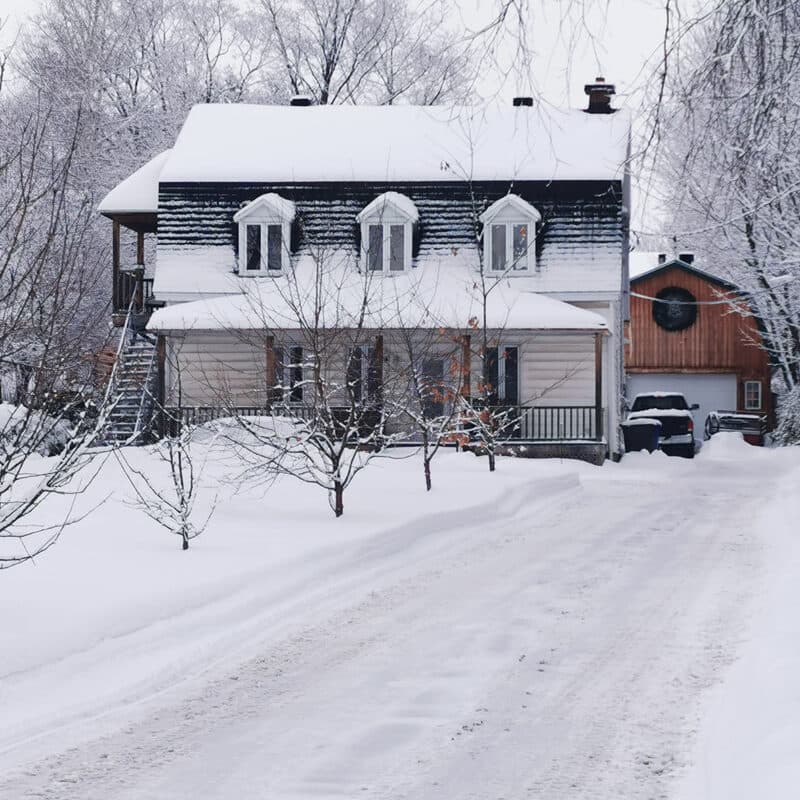
A driveway is a small job that repeats all winter, so the price has to be right to the dollar and the route tight to the minute. Here is how to price residential snow plowing per driveway: time one push, build the hourly cost, fill the street, add walks and salt as their own lines, and turn the per-push number into a seasonal price with a cap.
Driveway snow plowing prices: what the homeowner survey shows
Start with the band customers have already read. Fixr's snow removal survey, updated January 31, 2025, prices snow removal from a driveway at $40 to $75 per visit, a seasonal contract at $250 to $450, sidewalks at $40 to $80 per visit and salting at $20 to $40 per visit. Its size rows are the useful part for a quote.
| Driveway | Survey price per visit |
|---|---|
| 640 sq ft or less | $40 to $65 |
| 641 to 800 sq ft | $50 to $80 |
| 800 to 1,000 sq ft | $65 to $100 |
| 1,000 sq ft or more | $80 to $200 |
Two cautions: the survey is national, and it reports what homeowners paid, not what the job cost. The steps below build your number; the band says whether the quote will look normal.
Per push vs seasonal snow plowing for driveways
Per push, the homeowner pays for each visit and carries the weather risk. Seasonal, you carry the risk for a flat price, usually billed monthly, and a push cap keeps a bad winter from eating the margin. Offer both and let the customer choose.
The per-push price is the foundation of both, since a seasonal price is a push count times a per-push price plus a reserve. How to price a seasonal snow plowing contract covers the reserve and the cap; snow removal contract clauses covers the words around them.
Step 1: Measure the driveway and name its shape
Pace the driveway or trace it on satellite imagery: length, width, and whether it is straight, L-shaped or circular. Square feet puts it in a survey row; shape decides the minutes. Fisher Engineering's driveway guide says to make passes "as straight as possible" on a circular drive and to "stake out the driveway before the first snowfall."
- Straight, two cars wide, garage at the end: the fastest shape; a back-drag at the door and a push to the street.
- Long and narrow: Fisher says to back drag "about two car lengths," then back into the cleared area and push the rest out.
- Curved, or nowhere to pile: more passes and stakes; Fisher says to "Always think two or three storms ahead," because piles grow.
Step 2: How long does it take to plow a driveway?
Not long with the blade down; the time is in everything around it. BOSS Snowplow's productivity guide puts an angled 98 inch blade at about 85 inches of effective width, call it 7 ft, so a 20 ft driveway is three passes; snow of 2 inches or less plows at 8 to 14 mph; each turn adds 15 to 30 seconds; and it adds a 20 to 25 percent buffer for transitions. Its plowing tips say "Do not exceed 14 mph when plowing."
At 10 mph a truck covers 880 feet a minute, so a 60 ft driveway is seconds of blade time per pass. The minutes are the back-drag, the turns, the push to the street and the pile. BOSS says to "backdrag only two or three truck lengths before turning around." Time three driveways of each shape, street to street, and use those minutes.
Step 3: Cost per stop: labor, fuel and the truck
Labor: the US Bureau of Labor Statistics' Occupational Outlook Handbook puts the median wage for grounds maintenance workers at $19.27 an hour in May 2025; add payroll taxes and workers' compensation. Fuel: the US Energy Information Administration's weekly update put regular gasoline at $4.331 a gallon and on-highway diesel at $6.179 for the week of October 12, 2026; multiply by the gallons your truck burns in a plowing hour. The truck and plow: insurance, payments, blade wear and repairs for the winter, divided by expected plowing hours.
Hourly cost = labor + fuel per hour + truck per hour. Cost per stop = (minutes on the driveway + minutes to the next driveway) ÷ 60 × hourly cost.
Step 4: Snow plowing route density decides the margin
A driveway that takes 13 minutes with a 5 minute drive from the last one costs 18 minutes; with a 15 minute drive it costs 28, more than half again as much at the same price. So sell by the street: a flyer on the ten houses around a customer, a lower price for the neighbor who signs before the first storm. Price the lone driveway twenty minutes out at its real cost or decline it.
Step 5: Walkways and steps as add-ons, and the salt line
The walk is a separate line because it is a separate machine, and because the city makes it the homeowner's problem. Ypsilanti, Michigan, requires property owners to clear adjacent sidewalks within 24 hours of the first accumulation, full width to bare pavement, with abatement crews billing the owner. Minneapolis Ordinance 445.20 gives homes 24 hours after it stops snowing, and its crews "will remove the snow and ice and bill you." Quote the walk against that deadline.
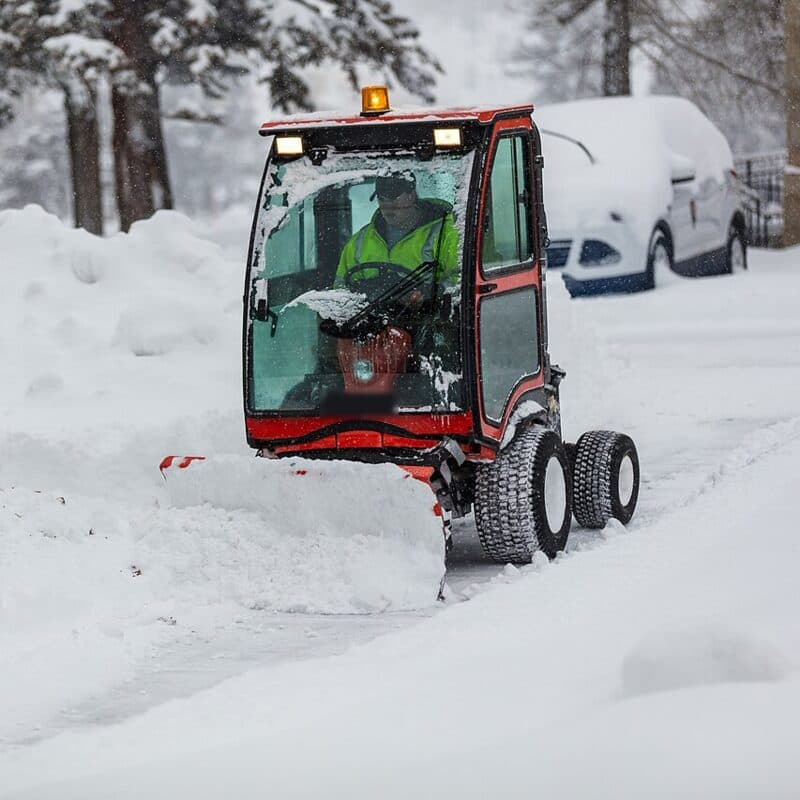
A single-stage blower is the usual walk tool: Toro's Power Clear 721 E lists a 21 in clearing width, a 12.5 in intake height and $799.00. A 4 ft walk is two to three passes; steps are a shovel. Price them as their own line, so the customer who shovels can leave it off.
Salt for walks costs almost nothing in product. The Minnesota Pollution Control Agency's sidewalk factsheet gives dry salt rates for snow of 0.75 to 3 lb per 1,000 sq ft by pavement temperature and trend, calls its table a starting point, and says rock salt "does not work on cold days, less than 15oF." Blain's Farm & Fleet lists a 50 lb bag of Morton Safe-T-Salt at $8.99, about 18 cents a pound. Charge for the stop and the minute, and change the product below 15°F; the parking lot salt post covers rates.
Step 6: Trigger depth and who measures it
The trigger is the depth that starts a push, and it decides how many pushes a season holds. The Snow and Ice Management Association defines a trigger depth as "a specific measurement of snow accumulation" that must be reached before service begins, and argues against triggers for salting. Meyer's residential guide says to plow at more than an inch, since waiting lets ice build; the trigger depth post counts the visits a 1 inch trigger adds. Say who measures and how: the National Weather Service's measuring guide says to pick a spot of average depth, avoid drifts, average around 5 readings, and read new snow to the nearest tenth of an inch.
Step 7: The seasonal price with a cap on pushes
Count pushes from the 1991 to 2020 climate normals for the nearest station. For Chicago O'Hare the NCEI station file gives 11.4 days a year with 1 inch or more of snowfall and 3.9 days with 3 inches or more. At a 1 inch trigger, count a push per 1 inch day and a second trip per 3 inch day: 11.4 + 3.9 = 15.3, so 15 pushes. Set the cap a few pushes above the count and price every push over it at the per-push rate.
Worked example: A 60 by 20 ft two-car driveway with a 40 ft walk, per push and per season
- Hourly cost = $19.27 labor (BLS median) + 1.5 gallons × $4.331 regular gasoline (your own burn rate at the EIA price) = $6.50 + $40 truck and plow (your own figure) = $65.77 per hour.
- Passes: 20 ft ÷ 7 ft effective width = 3. Blade time: 1,200 sq ft ÷ (7 ft × 10 mph × 88 ft per minute per mph) = 0.2 minute, which rounds away.
- Minutes on the driveway (your own timing): 3 back-drag + 3 for turns (6 turns × 30 seconds, BOSS's high end) + 4 to push out and pile = 10, × 1.25 buffer = 12.5, call it 13.
- Drive to the next stop on a dense route: 5 minutes. Cost per push = (13 + 5) ÷ 60 × $65.77 = $19.73.
- Price at a 40 percent margin: $19.73 ÷ 0.6 = $32.88; quote $45, inside the survey's $40 to $75 band.
- Walk and steps with the blower, 6 minutes (your own timing): 6 ÷ 60 × $65.77 = $6.58; quote $15. Salt on 160 sq ft at the 2.75 lb per 1,000 sq ft row (20 to 25°F and falling, snow) = 0.44 lb, about 8 cents; quote $10.
- Season on O'Hare normals: 15 pushes × $45 = $675, capped at 20 pushes, each push past 20 at $45.
Result: $45 per push, $15 for the walk and steps, $10 per salt application, or $675 for the season with a 20 push cap, on a cost of $19.73 per push and 18 minutes per stop.
Good to know: The same driveway on a 15 minute drive costs $30.69 per push. The survey's $250 to $450 seasonal band is national; a Chicago winter at its own per-visit price lands above it, so the push count for your town sets the seasonal number.
Putting the per-driveway price on the quote
Write the driveway as a flat line per push, the walk and the salt as their own lines, and the season as its own package, so the customer picks a model instead of arguing a number. In MakeHay, quote lines carry your own units, per item or flat, and good, better, best packages put per push, seasonal, and seasonal with walks side by side for the customer to approve and sign online. A seasonal customer becomes recurring service on the calendar, where weather warnings from rules you set flag the cold days, with autopay for repeat customers.
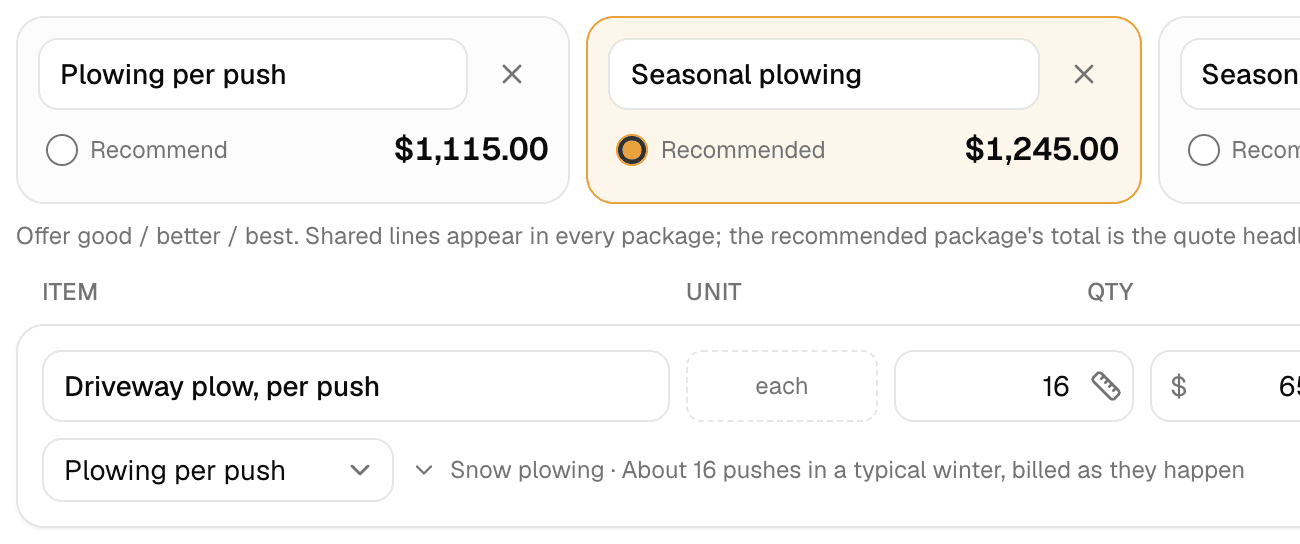
Per push and seasonal packages side by side on one quote.
Log every push the night it happens; the plow log template gives the columns. Before the first storm, knock on the doors between your stops.
FAQ
How much should you charge to plow a driveway?
Build it from cost: minutes on the driveway plus minutes to the next stop, times your hourly cost for labor, fuel and the truck, divided by one minus your margin. Then check it against Fixr's homeowner survey, updated January 31, 2025: $40 to $75 per visit, and by size up to $80 to $200 for 1,000 sq ft or more.
Is per push or seasonal better for residential customers?
Offer both as packages. Per push pays for each visit; seasonal is a flat price built from the push count for your town (11.4 days a year with 1 inch or more of snowfall at Chicago O'Hare on the 1991 to 2020 normals, plus a second trip on the 3.9 days with 3 inches or more), with a push cap.
Should walkways and salt be included in the driveway price?
Price them as separate lines. The walk is its own machine and minutes, and cities like Ypsilanti (24 hours of the first accumulation) and Minneapolis (24 hours after it stops snowing for homes) make clearing it the owner's duty. Salt is pennies of product at the Minnesota rates of 0.75 to 3 lb per 1,000 sq ft; charge for the stop.
Sources
- Fixr: How much does it cost to hire a snow removal service? · Homeowner survey, updated January 31, 2025: snow removal by location, driveway, $40 to $75 per visit (the by-method row for plowing reads $50 to $125); by driveway size, about $40 to $65 for 640 sq. ft. or less, $50 to $80 for 641 to 800 sq. ft., $65 to $100 for 800 to 1,000 sq. ft., and $80 to $200 for 1,000 sq. ft. or more; sidewalk removal "$40 to $80 per visit"; salting "$20 to $40 per visit"; a seasonal contract "$250 to $450"; "The annual cost of snow removal in the U.S. is between $300 and $600." (accessed October 18, 2026)
- Grounds Maintenance Workers, Occupational Outlook Handbook (US Bureau of Labor Statistics) · "The median hourly wage for grounds maintenance workers was $19.27 in May 2025." "Some jobs are seasonal." Grounds maintenance workers "sometimes provide other services during the winter months, such as snow removal." (accessed October 18, 2026)
- Gasoline and Diesel Fuel Update (US Energy Information Administration) · US average retail prices for the week of October 12, 2026: regular gasoline $4.331 per gallon, on-highway diesel $6.179 per gallon; prices include all taxes. (accessed October 18, 2026)
- How to Calculate Snowplow Productivity Per Hour in 7 Steps (BOSS Snowplow) · A 98 inch straight blade has an effective width of "around 85 inches" at a 30 degree angle, about 7 feet; for light snow of 2 inches or less the guide puts plowing speed at 8 to 14 mph; 4 to 6 inches typically slows a truck to 5 to 10 mph; turns add 15 to 30 seconds each; a 20 to 25 percent buffer for transitions; an efficiency factor between 60 and 80 percent until the crew's real rate is known. (accessed October 18, 2026)
- Plowing Tips (BOSS Snowplow) · "Do not exceed 40 mph when transporting a plow. Do not exceed 14 mph when plowing." "You should backdrag only two or three truck lengths before turning around." "Your plow will be more effective when pushing snow than when backdragging over long distances." (accessed October 18, 2026)
- How to Efficiently Plow a Driveway (Fisher Engineering) · On a long straight driveway, "back drag snow about two car lengths away," then back into the cleared area and push to the end; on a short or narrow driveway, backdragging the whole drive may be "easier and more efficient"; on a circular driveway make passes "as straight as possible," start from the inside edge and finish with a cleanup pass; "Always think two or three storms ahead"; walk the property and "stake out the driveway before the first snowfall." (accessed October 18, 2026)
- Let's Be Clear: Plowing Residential Driveways and Streets (Meyer Products) · "Stake the driveway to avoid damaging lawn or landscape, especially if driveways are long and curvy." "For short and straight driveways, back dragging the snow works well." Pick a pile spot with "enough room for multiple snow events without a significant thaw"; plow whenever there is more than an inch of snow, since waiting lets ice build; on wider drives make several passes and "work from the center outward." (accessed October 18, 2026)
- Triggered: Why accumulation thresholds should be removed from snow management contracts (SIMA Snow and Ice Resource Center) · "A trigger depth is typically defined as a specific measurement of snow accumulation" that must be reached before services begin; "The intention is to standardize delivery of service and (most often) control costs"; gives salt application only after one inch has accumulated as the example clause; calls trigger depths outdated and counterproductive for salting. (accessed October 18, 2026)
- How to Measure Snow (National Weather Service, Boulder) · Find "a location where the snow appears to be of average depth"; "Avoid areas of drifted snow"; take "around 5 readings and average your measurements, especially if drifting occurred"; a snow board should be painted white and cleared and moved after each observation; new snowfall is measured "to the nearest tenth of an inch." (accessed October 18, 2026)
- 1991 to 2020 US Climate Normals, annual and seasonal, station USW00094846 Chicago O'Hare International Airport (NOAA NCEI) · Station file for CHICAGO OHARE INTL AP, IL US: ANN-SNOW-AVGNDS-GE010TI (days per year with snowfall of 1.0 inch or more) 11.4; ANN-SNOW-AVGNDS-GE030TI (3.0 inches or more) 3.9; ANN-SNOW-AVGNDS-GE050TI (5.0 inches or more) 1.4; ANN-SNOW-NORMAL (annual snowfall) 38.4 inches. (accessed October 18, 2026)
- Winter Parking Lot and Sidewalk Maintenance Factsheet (Minnesota Pollution Control Agency stormwater manual) · De-icing table in lbs per 1,000 sq ft, dry salt (NaCl) column, snow rows: 0.75 above 30°F rising, 1.5 at 30°F falling, 2.75 at 20 to 25°F falling, 3.0 at 15 to 20°F falling (snow or freezing rain), not recommended at 0 to 15°F; "Consider the following table to be a starting point only." "Sodium chloride (NaCl; road salt) does not work on cold days, less than 15oF." (accessed October 18, 2026)
- Morton 50 lb Safe-T-Salt Rock Salt (Blain's Farm & Fleet) · A 50 lb bag of Morton Safe-T-Salt rock salt (halite) listed at $8.99 on October 18, 2026; "50 lb Capacity: Provides ample coverage for residential driveways and walkways." No minimum working temperature is stated. (accessed October 18, 2026)
- 21 in. (53 cm) Power Clear 721 E Gas Snow Blower (Toro) · Single-stage gas snow blower: clearing width "21 in. / 53 cm"; intake height "12.5 in / 31 cm"; 212 cc engine; weight "84 lbs / 38.1 kg"; throw distance "Up to 35 ft / 10.7 m"; listed at "$799.00 USD" with a note to contact a local dealer. (accessed October 18, 2026)
- Sidewalk Snow Removal (City of Ypsilanti, Michigan) · The city "requires that property owners clear adjacent sidewalks within 24 hours of the first accumulation"; "Shovel the full width of the sidewalk on all sides of your property, down to the bare pavement"; after a complaint or inspection, Ordinance Enforcement will inspect and "give the property owner a citation"; "Abatement crews will remove the snow and ice from the sidewalk" and "Property owners will be billed for this service." (accessed October 18, 2026)
- Sidewalk Snow Clearing Rules (City of Minneapolis) · Minneapolis Ordinance 445.20. Single-family homes and duplexes: "You must clear sidewalks within 24 hours after it stops snowing." All other properties: "You must clear sidewalks within 4 daytime hours (8 a.m. to 5 p.m.) after it stops snowing." "Shovel the entire width of the city sidewalk on your entire property down to bare pavement." If still uncleared at the follow-up inspection, "Crews will remove the snow and ice and bill you." (accessed October 18, 2026)